Satavahana Dynasty: History, Rulers, Administration, Art and Culture
Citizenship in India: Articles 5 to 11, Citizenship Act 1955 and Key Facts

Get in Touch with RASonly!

Indian citizenship is governed by Articles 5 to 11 of the Constitution and the Citizenship Act, 1955. Learn about citizenship provisions, acquisition and loss, single citizenship, OCI status, NRI and OCI differences, and key provisions of the Citizenship Amendment Act, 2019.

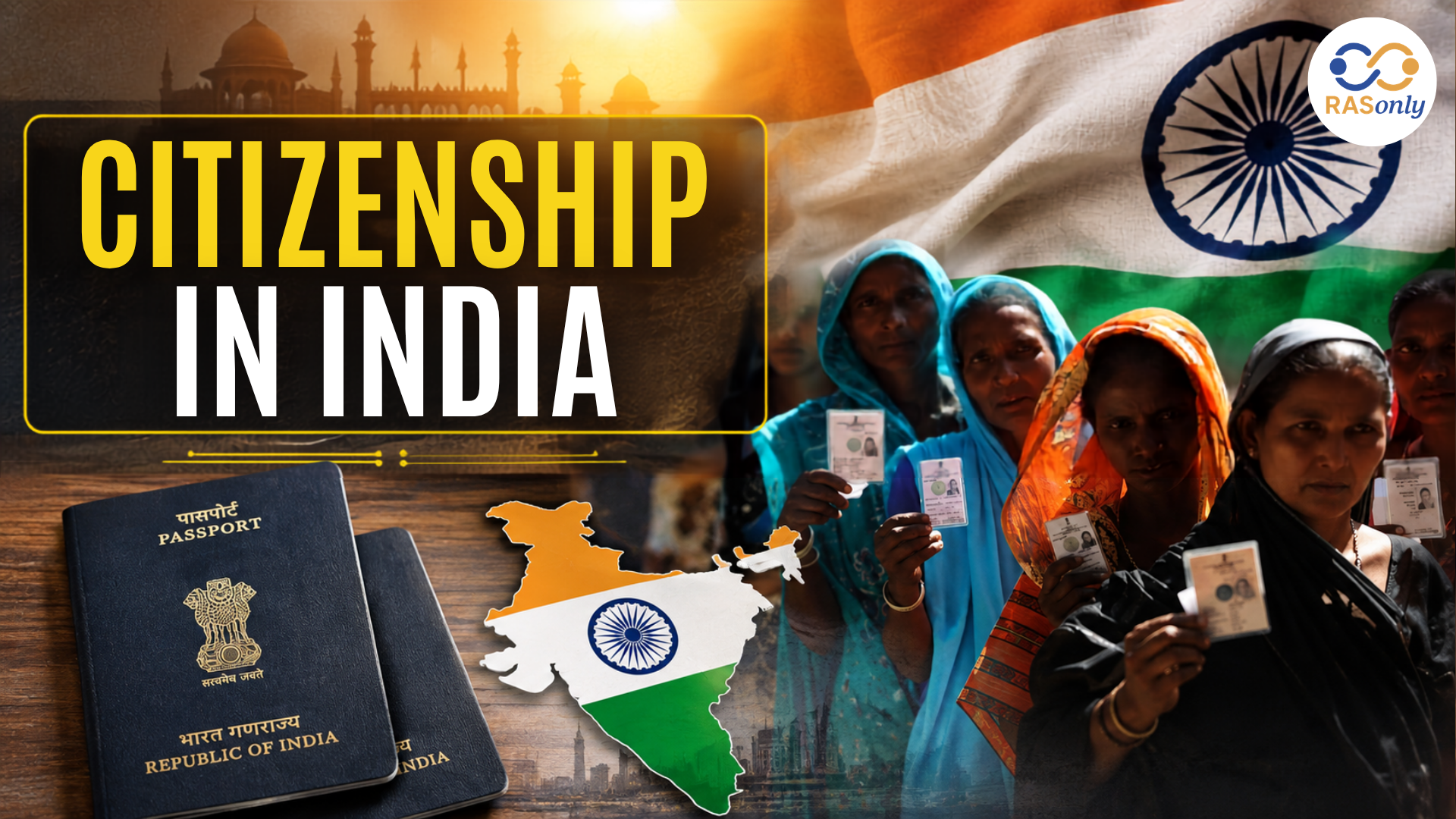
Citizenship means the legal membership of a person in a country. It determines who is acknowledged as a citizen and thereby entitled to privileges that only citizens can have. In India, citizenship is largely governed by Part II of the Constitution, which has Articles 5 to 11. These were the provisions made to determine who would be an Indian citizen when the Constitution came into force on 26 January, 1950. The Constitution didn't even attempt to write a comprehensive citizenship statute for all future events. Rather, Article 11 authorised Parliament to legislate on citizenship. Later, Parliament exercised this power to pass the Citizenship Act, 1955. Further, India follows the principle of single citizenship. An individual is an Indian national and not a citizen of a specific state under the Constitution.
What is Citizenship in India?
Indian citizenship is the relationship between an individual and a state. There are a few Rights that Indian Citizens have over Foreigners. However, some key rights within Articles 15, 16 and 19 are subject to the availability of citizenship status. Citizens are also bestowed with political rights like the right to vote, contingent on the prerequisites outlined by law. The Constitution does not define the term citizenship separately. Rather, Articles 5 to 11 outline the constitutional framework of citizenship.
Key Features of Indian Citizenship
The most important feature of Indian citizenship is single citizenship. Instead, a resident of states like Rajasthan, Maharashtra or even Kerala is just an Indian, as they are Indian citizens. There is no separate constitutional citizen of Rajasthan, Maharashtra or Kerala.
Important Features
- India follows single citizenship.
- Part II of the Constitution is devoted to the Citizenship provisions.
- Articles 5 to 11 are related to citizenship.
- Article 11 gives power to Parliament to make citizenship law.
- The Citizenship Act of 1955 is the principal legislation governing citizenship.
- Some Fundamental Rights are available only to citizens.
- OCI is not Indian citizenship.
Articles 5 to 11: Citizenship Provisions in the Constitution
The seven Articles under Part II deal with different citizenship questions. The easiest way to understand them is to look at the specific situation addressed by each provision.
| Article | What it deals with |
|---|---|
| Article 5 | Citizenship at the commencement of the Constitution |
| Article 6 | Certain persons who migrated from Pakistan to India |
| Article 7 | Certain persons who migrated from India to Pakistan |
| Article 8 | Persons of Indian origin living outside India |
| Article 9 | Voluntary acquisition of foreign citizenship |
| Article 10 | Continuance of citizenship |
| Article 11 | Parliament's power to regulate citizenship |
Citizenship Act, 1955
Indian citizenship falls under the Citizenship Act, 1955. Although Articles 5 to 11 of the Constitution provide the constitutional framework for citizenship, the Act contains further specific provisions on acquiring and losing citizenship. The Act has been amended multiple times, with significant amendments in 1986, 1992, 2003, 2005,2015, and 2019. These amendments subsequently modified various elements of India's citizenship framework.
Modes of Acquiring Indian Citizenship
| Mode of Citizenship | Section | Key Point |
|---|---|---|
| By Birth | Section 3 | Citizenship depends on the date of birth and, in relevant cases, the citizenship/status of the parents. |
| By Descent | Section 4 | A person born outside India may acquire citizenship through an Indian parent, subject to prescribed conditions. |
| By Registration | Section 5 | Certain eligible categories, including specified persons of Indian origin, spouses, minor children and OCI cardholders, may acquire citizenship by registration. |
| By Naturalisation | Section 6 | A foreigner can acquire citizenship by fulfilling prescribed conditions relating to residence, good character and language. |
| By Incorporation of Territory | Section 7 | When a territory becomes part of India, the Central Government specifies which persons connected with that territory will become Indian citizens. |
Loss of Indian Citizenship
Indian citizenship can also come to an end. The Citizenship Act provides for three broad means of loss of Indian citizenship, namely: (i) by renunciation, (ii) by termination and (iii) by deprivation.
Renunciation of Citizenship
Renunciation means a voluntary and deliberate renouncing of Indian citizenship. As per the provisions of the Citizenship Act and Rules, an Indian citizen who is not a minor may renounce citizenship by making a declaration of renunciation. This law also includes provisions focusing on the impact of renunciation on minor children.
Termination of Citizenship
Usually, this happens when an Indian citizen renounces citizenship of another country, as per the provisions outlined under the Citizenship Act. Termination, on the other hand, is related to the acquisition of foreign citizenship voluntarily and is thus different from renunciation.
Deprivation of Citizenship
Deprivation is the forced nullification of citizenship through a decree by the central government in accordance with the law. Under certain circumstances, for example, citizenship by fraud or concealment of fact and other clauses provided under the Act, it may apply to citizenship acquired (by registration or naturalisation).
Overseas Citizenship of India (OCI)
Overseas Citizenship of India (OCI) is a special category of Indian citizenship for people with or maintaining family contact on the outside. OCI does not confer Indian citizenship and is not dual citizenship, even though 'Citizenship' is in its name. An OCI cardholder is not a citizen of another country. OCI mainly offers some immigration and other privileges to qualifying people of Indian origin.
What OCI Cardholders Cannot Do?
OCI cardholders do not have political rights in India. They cannot:
- Vote in elections
- Contest elections
- Have any political rights, except nominally for constitutional offices such as President or Vice-President
- Exercise political rights which under the Constitution of India are reserved for citizens
NRI and OCI: Important Difference
NRI (Non-resident Indian) and an OCI cardholder are not the same. An NRI is an Indian citizen residing outside India. The person continues to be an Indian citizen as well. An OCI cardholder, however, is a foreign citizen who has been granted OCI status under Indian law.
| Basis | NRI | OCI |
|---|---|---|
| Indian citizen | Yes | No |
| Foreign citizen | No | Yes |
| Indian passport | Yes | No |
| Voting rights | Subject to law | No |
| Political rights | Available subject to law | No |
Citizenship Amendment Act, 2019
Citizenship (Amendment) Act, 2019 (CAA): Amends the Citizenship Act, 1955 It provided for a special provision for certain categories of six communities- Hindu, Sikh, Buddhist, Jain, Parsi and Christian- who entered India on or before 31st December 2014 from Afghanistan, Bangladesh and Pakistan. The amended provision is given effect with the Citizenship (Amendment) Rules, 2024
Also Read
| President of India | Parliament of India |
| Election Commission of India | Indian Polity Topic-wise Questions |
| Indian Polity Notes for RAS | National Human Rights Commission |
FAQs on Citizenship in the Indian Constitution
Part II of the Indian Constitution, covering Articles 5 to 11, deals with citizenship.
Article 5 deals with citizenship at the commencement of the Constitution on 26 January 1950.
Article 11 gives Parliament the power to make laws relating to the acquisition, termination and other matters concerning citizenship.
India follows the principle of single citizenship. There is no separate constitutional citizenship for individual states.
The Citizenship Act, 1955 is the principal law that regulates Indian citizenship, including its acquisition and loss.
BEST SELLER
🏆 PRELIMS
RAS Pass
Prelims focused Hindi & English
₹399
✓
Prelims Topic-Wise Tests
✓
Subject-Wise Tests
✓
Full-Length Prelims Tests
✓
Daily Current Affairs Tests
✓
Prelims PYQs Tests
✓
Detailed Solutions & Analysis
✓
All Rajasthan Ranking
✓
Unlimited Reattempts
✓
Mains Tests
✓
Hindi & English Tests
✓
All Rajasthan Ranking
Trusted by 5,000+ Students
Post Category
- RAS Salary
- Result
- RAS Admit Card
- RAS Job
- RAS Cutoff
- Preparation Tips
- RAS Answer Key
- RAS Exam Analysis
- RAS Syllabus
- RAS Previous Year Papers
- RPSC RAS Exam Pattern
- RAS Interview
- RAS Exam Date
- RAS Vacancy
- RAS Test Series
- RAS Best Books
- RAS Preparation Resources
- RAS Coaching Centre
- History
- Polity
- Geography
- Economics
- Science
- Art and Culture
- RPSC RAS Application Form
- RPSC RAS Notification
- RAS Eligibility Criteria
- UPSC Exam
- RPSC RAS Mains
Visit Our RASonly Offline Center
Our Expert Faculty

Bhunesh Sir
Current Affairs · 13+ Yrs

Aamir Khan Sir
RAS-2017 · IIM Ahm.

Akash Sir
Polity · 8+ Yrs
Free Resources
Official Mobile App

RASOnly App
by OTSAdda · Free
Full Video Lectures
Mock Tests & PYQs
Daily Current Affairs
AI Mock Interview
Free Download · No subscription needed to install
RAS 2024 Toppers — RASonly
Rank 2
Virendra Charan
Rank 9
Bhoopinder Singh
Rank 26
Aanchal Nagpal
Rank 33
Lokendra Singh
Rank 45
Amar Rathore
Rank 46
Manasvini Verma

Join RASonly WhatsApp Community
Get daily current affairs, exam alerts, free study material and tips from expert faculty — right on WhatsApp.
Join for Free →RASonly Interview Guidance Program

Mr. Ashok Jain
Ex-Chief Secretary Govt of Rajasthan
- IAS officer of the 1981 batch, Rajasthan cadre.
- Passionate about mentoring the next generation of RAS officers with real-world insights.
- Got retired in Dec 2017 from the post of Chief Secretary of the state of Rajasthan.

Mr. Guru Charan Rai
Ex-ASP / SP in Jaisalmer
- Guru Charan Rai, IPS (Retd), retired as Inspector General of Police (Security), Rajasthan, Jaipur in 2017.
- Served as ASP and SP in Jaisalmer, Nagaur, Sri Ganganagar, Sawai Madhopur, Dausa, Sikar, and Karauli.
- He also held key positions as DIGP and IGP in the Law and Order division.

Mr. Rakesh Verma
Ex-IAS Officer, B.Tech, MBA, and M.A. (Economics)
- IAS officer of the 1981 batch and retired in Chief Secretary Rank.
- Civil servant of high repute and vast experience.
- Has been teaching UPSC CSE subjects for the last six years.
Related Post


Daily Current Affairs for RAS Exam Preparation 2026

Financial Approval Granted for the Development of Religious Sites
October 05, 2026
IIT Madras Signs MoU for Joint Educational Programmes
October 05, 2026
Niharika Rathore Wins MIS Global India Title
October 03, 2026