Chola Dynasty: Capital, Founder, Kings, Time Period and History
RAS Exam Pattern 2026: New Changes in Prelims & Mains with Updated Syllabus

Get in Touch with RASonly!

The Rajasthan Public Service Commission has introduced major reforms in the RAS Exam 2026 for both Prelims and Mains. Key changes include the removal of Sports and Yoga, the inclusion of the Rajasthan Examination Act, 2022, the elimination of 2-mark questions, a clearly defined unit-wise syllabus, and a revised Hindi-English paper with an essay section. These updates aim to enhance analytical ability, administrative understanding, and answer-writing skills of aspirants.

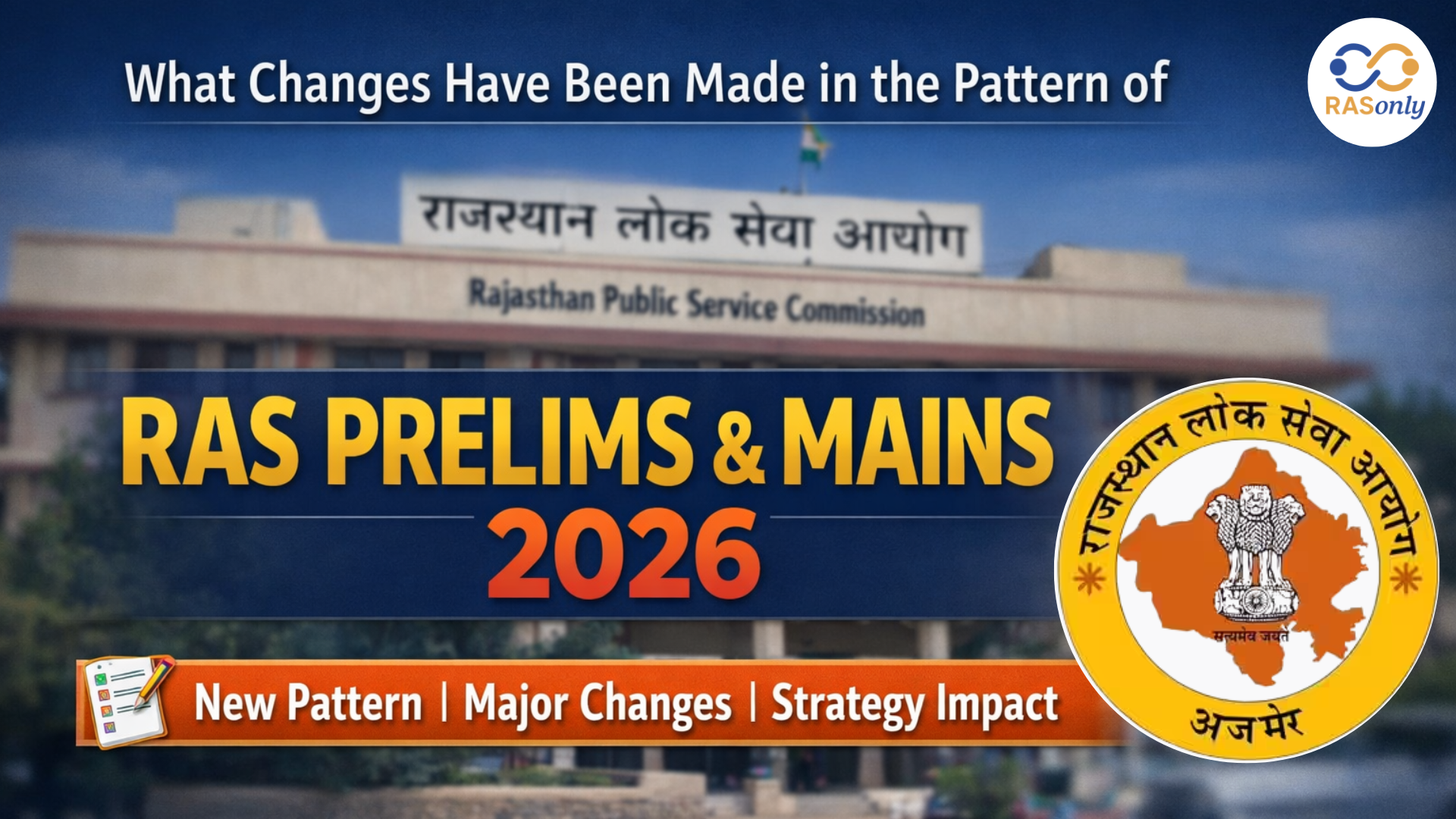
RPSC officially revised the RAS exam pattern in January 2026, the first major overhaul since 2013. Around 25% of the syllabus has changed across Prelims and Mains, and the reforms are designed to make evaluation more structured, transparent, and aligned with real administrative work. The general structure of the RAS examination is the same, but the new pattern of the RAS exam presents significant improvements in syllabus outline, the way of questions, and the assessment process.
These changes are essential to the aspirants who are planning to take exams in the Rajasthan Administrative Services and other related posts. A good understanding of the RAS Prelims New Syllabus, the RAS Mains New Syllabus, and the modified marking scheme will assist the candidates in changing their preparation plan accordingly.
RAS Syllabus 2026 PDF Download
| Exam Stage | Syllabus Details | PDF Download |
|---|---|---|
| Prelims | RAS Prelims syllabus 2026 – General Studies with Rajasthan, India & current affairs | Download PDF |
| Mains | RAS Mains syllabus 2026 – GS Paper I, II, III & General Hindi–English | Download PDF |
Overview of the RAS Examination Structure (2026)
The RAS Exam 2026 remains a three-stage selection process:
- Preliminary Examination (Screening/Qualifying Test)
- Main Examination (Descriptive Written Test)
- Interview / Personality Test
Although the three-stage structure remains unchanged, major changes have been made to the content and pattern of both Prelims and Mains in the new syllabus and pattern of the RAS exam.
Key Changes in RAS Exam Pattern 2026: Prelims & Mains
| Aspect | Earlier Pattern | RAS Exam 2026 (New Pattern) |
|---|---|---|
| Sports & Yoga (Prelims) | Included (20 marks, 5% of total) | Removed |
| New Addition (Prelims) | - | Rajasthan Examination Act, 2022 |
| Mains Question Types | 2, 5 & 10 mark questions | Only 5 & 10 mark questions |
| Unit-wise Syllabus | Limited clarity | Clearly defined units (Unit I, II, III) |
| Law & Management | Limited weightage | Increased emphasis |
| Hindi-English Paper | Combined format | Divided into Part A (Hindi), Part B (English) & Essay |
| Essay Section | Less defined | 40 marks, 6 themes, 600-word essay |
| Word Limits | Not explicit | Short answers: 50 words · Long answers: 150 words |
| Optional Subjects | None | None (unchanged) |
| Total Mains Papers | 4 | 4 (unchanged) |
| Total Mains Marks | 800 | 800 (unchanged) |
1. Sports and Yoga Module Removed
The 20-mark Sports and Yoga section, which made up about 5% of total Prelims marks, has been completely removed from the syllabus. This section was a separate section of the Prelims syllabus. From the 2026 exam onward, this section no longer exists.
2. The act of inclusion of Rajasthan Examination Act, 2022
The provisions of the Rajasthan Examination Act, 2022, have been provided in lieu of the Sports and Yoga. The transition shows the interest of RPSC to ensure that candidates are enlightened on the issues of examination integrity, legal provisions, and administrative responsibility, which are more applicable in the position of the public service.
3. Further Stress on Rajasthan-Themed Issues.
Although the change is above, the fundamental point of RAS Prelims has not changed. The syllabus still insists upon:
- Rajasthan history, culture, and heritage.
- Economy and geography of Rajasthan.
- Government and politics in India.
- Present state, national, and international issues.
The new syllabus of RAS prelims still stands as an objective test, and still a screening test, and scores do not count in the final merit list.
Key Changes in RAS Mains Exam Pattern 2026
The RAS mains new pattern has been more structured and evaluation-oriented, with the most significant changes being presented at the level of Mains level in 2026.
1. Coherent Unit-Wise Syllabus.
Previously, the unit-wise clarity was not high, whereas the syllabus existed. With the new syllabus RAS mains new syllabus 2026, the divisions between Unit I, Unit II, and Unit III have become very distinct, with the themes being clearly specified.
- This change helps aspirants:
- Know the limits of the subject matter.
- Be more organized when preparing.
- Do not introduce unnecessary overlap and redundancy.
2. Removal of 2-Mark Questions
The significant restructuring of the RAS exam's new pattern is that Questions of 2 marks have been removed. in the Mains examination.
In previous Mains papers, there were:
- 2-mark questions
- 5-mark questions
- 10-mark questions
From 2026 onwards:
- 2-mark questions have been eliminated
- The 5-mark and 10-mark questions are increased.
This transformation is a clear indication that there is a transition towards analytical, descriptive, and application-focused evaluation as opposed to recalling facts.
3. More Emphasis on Legal and Managerial Issues.
The General Studies papers have also had certain parts expanded, in particular:
- Law-related topics
- Management and administration theory.
This is an improvement that makes the syllabus more in line with the real-life duties of the civil servant and serves to strengthen the administrative orientation of the RAS mains new syllabus.
4. Hindi and English Paper Structural Changes.
General Hindi and General English papers have been dramatically revised in terms of structure.
At this point, the paper is split into three parts:
- Part A: Hindi (90 Marks)
- Part B: English (70 Marks)
- Part C: Essay (40 Marks)
Both languages have the Essay part (Part C). The applicants are assigned six themes, and they have to compose an essay of approximately 600 words. The essay can be in Hindi or English, but it is up to the applicants to choose the language to be used.
This change highlights:
- More significance of articulation, coherence, and expression.
- Testing of the ability of the candidates to make well-structured arguments on modern subjects.
5. Awkward Word Count and Response Format.
The other significant addition, according to the RAS mains new pattern is the direct mention of the word boundaries:
Short-answer questions: approximately 50 words.
Long/descriptive answers: approximately 150 words.
- Now the candidates are expected to:
- Compose specific and detailed responses.
- Follow structured formats
- Avoid unnecessary length
What Has Not Changed in 2026?
Irrespective of these changes, some of the basic elements of the RAS examination have not changed:
- Number of Mains papers: 4
- Marks per paper: 200
- Total Mains marks: 800
- Interview marks: 100
- No elective subjects in Mains.
- Prelims is still a qualifying one.
This will guarantee continuity in addition to enhancing clarity and quality of evaluation
Impact of the RAS Exam New Pattern on Preparation Strategy
The RAS exam's new syllabus and new pattern require a change in the approach to preparation:
- Increase in the focus on writing answers.
- Pay attention to administration and morals.
- Firm control of Rajasthan-based issues.
- Essential information about the latest events and government changes.
Applicants who only memorize will not succeed and the ones who practice organized writing and clarity in concepts will do well.
Importance of Staying Updated
Aspirants must: Since the RAS Exam 2026 is a pointer of official changes, it means that it requires aspirants to:
- Most of the time, go by formal syllabus PDFs.
- Monitor the developments with respect to the RAS prelims new syllabus and the RAS mains new syllabus.
- Concur with the new pattern of the RAS exam, but not the old one.
Conclusion
The reforms that will be implemented in the RAS Prelims and Mains 2026 do not change the basis of the exam but rather improve its clarity and transparency, and more administrative orientation. The abolishment of Sports and Yoga, the introduction of the Rajasthan Examination Act, the abolition of 2-mark questions, the unit-wise syllabus, and the reformatting of the Hindi-English paper altogether reform the manner in which aspirants are supposed to prepare. Candidates who are swift to acclimate to the RAS new pattern and the RAS exam new syllabus would have an apparent competitive advantage.
FAQs
The biggest change is the removal of the Sports and Yoga section. In its place, the Rajasthan Examination Act, 2022 has been added, focusing on examination integrity and legal awareness.
Yes, the RAS Prelims exam remains a screening test. Marks obtained in prelims will not be counted in the final merit list.
Yes, from RAS Exam 2026 onwards, 2-mark questions have been completely removed. The Mains exam will now include only 5-mark and 10-mark descriptive questions.
The Hindi and English paper is now divided into three parts: Hindi, English, and an essay section of 40 marks. Candidates must write one essay from six given themes in either language.
The RAS Exam 2026 is conducted by the Rajasthan Public Service Commission for Rajasthan Administrative Services and allied posts.
BEST SELLER
🏆 PRELIMS
RAS Pass
Prelims focused Hindi & English
₹399
✓
Prelims Topic-Wise Tests
✓
Subject-Wise Tests
✓
Full-Length Prelims Tests
✓
Daily Current Affairs Tests
✓
Prelims PYQs Tests
✓
Detailed Solutions & Analysis
✓
All Rajasthan Ranking
✓
Unlimited Reattempts
✓
Mains Tests
✓
Hindi & English Tests
✓
All Rajasthan Ranking
Trusted by 5,000+ Students
Post Category
- RAS Salary
- Result
- RAS Admit Card
- RAS Job
- RAS Cutoff
- Preparation Tips
- RAS Answer Key
- RAS Exam Analysis
- RAS Syllabus
- RAS Previous Year Papers
- RPSC RAS Exam Pattern
- RAS Interview
- RAS Exam Date
- RAS Vacancy
- RAS Test Series
- RAS Best Books
- RAS Preparation Resources
- RAS Coaching Centre
- History
- Polity
- Geography
- Economics
- Science
- Art and Culture
- RPSC RAS Application Form
- RPSC RAS Notification
- RAS Eligibility Criteria
- UPSC Exam
- RPSC RAS Mains
Visit Our RASonly Offline Center
Our Expert Faculty

Bhunesh Sir
Current Affairs · 13+ Yrs

Aamir Khan Sir
RAS-2017 · IIM Ahm.

Akash Sir
Polity · 8+ Yrs
Free Resources
Official Mobile App

RASOnly App
by OTSAdda · Free
Full Video Lectures
Mock Tests & PYQs
Daily Current Affairs
AI Mock Interview
Free Download · No subscription needed to install
RAS 2024 Toppers — RASonly
Rank 2
Virendra Charan
Rank 9
Bhoopinder Singh
Rank 26
Aanchal Nagpal
Rank 33
Lokendra Singh
Rank 45
Amar Rathore
Rank 46
Manasvini Verma

Join RASonly WhatsApp Community
Get daily current affairs, exam alerts, free study material and tips from expert faculty — right on WhatsApp.
Join for Free →RASonly Interview Guidance Program

Mr. Ashok Jain
Ex-Chief Secretary Govt of Rajasthan
- IAS officer of the 1981 batch, Rajasthan cadre.
- Passionate about mentoring the next generation of RAS officers with real-world insights.
- Got retired in Dec 2017 from the post of Chief Secretary of the state of Rajasthan.

Mr. Guru Charan Rai
Ex-ASP / SP in Jaisalmer
- Guru Charan Rai, IPS (Retd), retired as Inspector General of Police (Security), Rajasthan, Jaipur in 2017.
- Served as ASP and SP in Jaisalmer, Nagaur, Sri Ganganagar, Sawai Madhopur, Dausa, Sikar, and Karauli.
- He also held key positions as DIGP and IGP in the Law and Order division.

Mr. Rakesh Verma
Ex-IAS Officer, B.Tech, MBA, and M.A. (Economics)
- IAS officer of the 1981 batch and retired in Chief Secretary Rank.
- Civil servant of high repute and vast experience.
- Has been teaching UPSC CSE subjects for the last six years.
Related Post
Daily Current Affairs for RAS Exam Preparation 2026

Continuous Biomass Torrefaction Reactor
October 17, 2026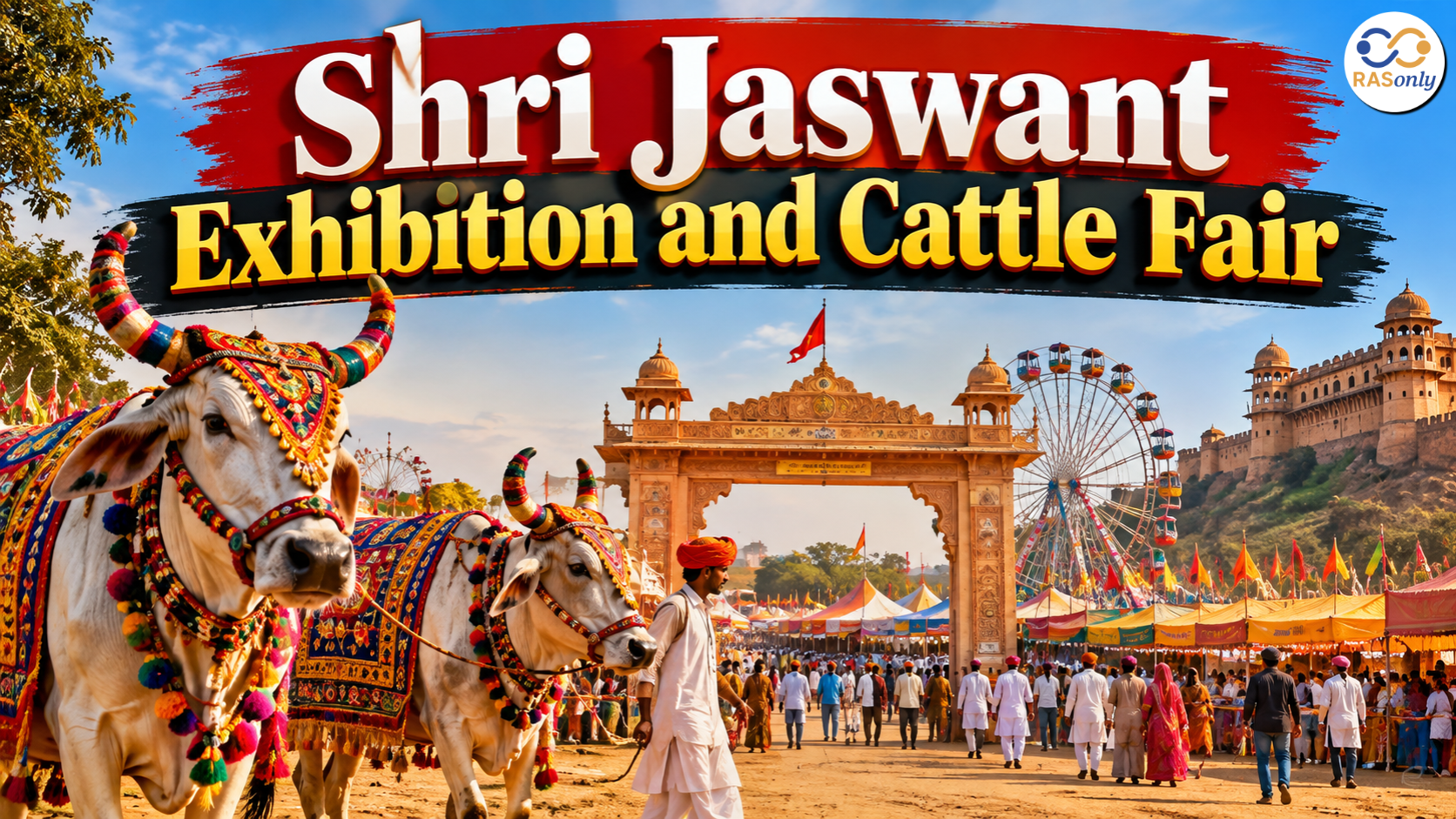
Shri Jaswant Exhibition and Cattle Fair
October 17, 2026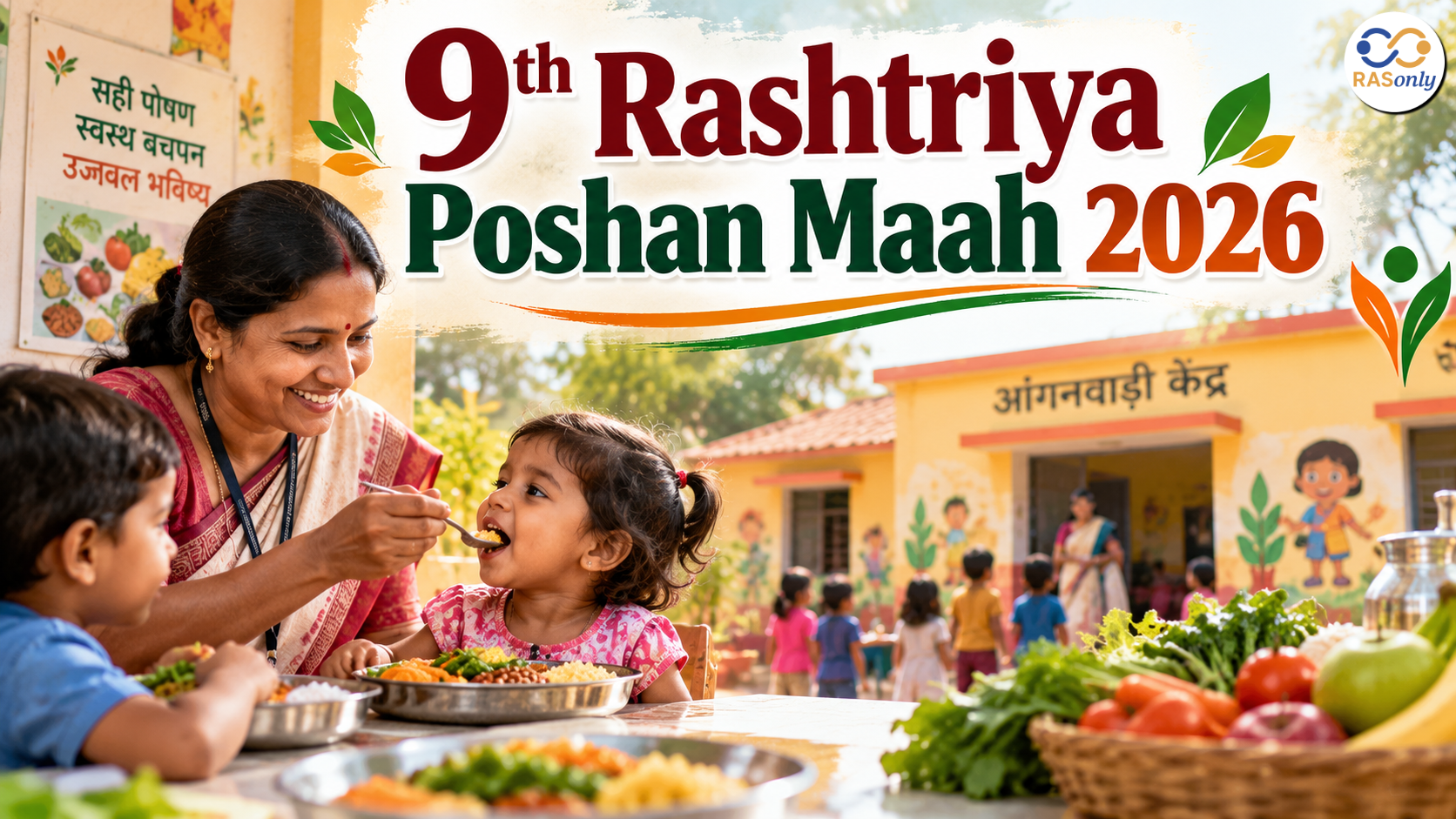
9th Rashtriya Poshan Maah 2026
October 16, 2026