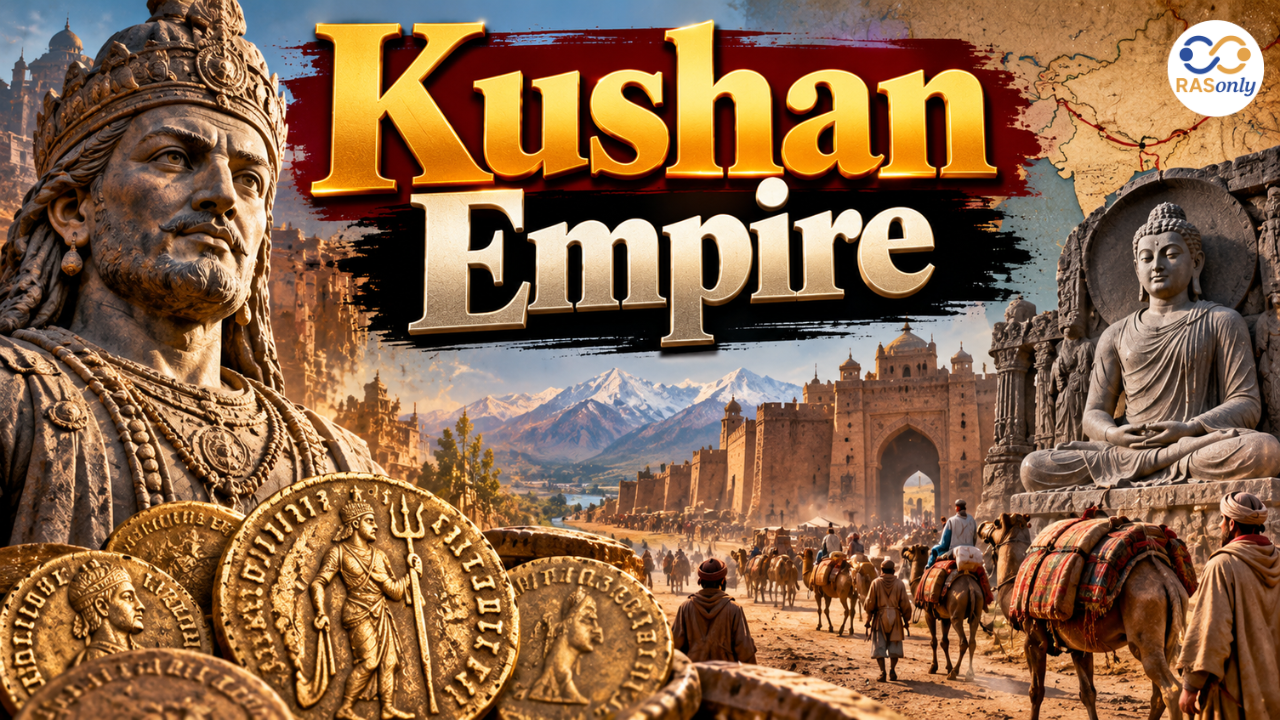
Kushan Empire: History, Rulers, Administration, Economy, Art, Decline
RAS Mains Paper 1 Strategy & Answer Writing Framework: A Complete Preparation Guide

Get in Touch with RASonly!

A complete guide to RAS Mains Paper 1 covering syllabus mapping, Rajasthan-specific preparation, current affairs integration, answer writing, time management, study resources, common mistakes, and test series strategy for effective and structured exam preparation.

RAS Mains Paper 1 strategy is the most crucial one that distinguishes between a well-prepared candidate and one who is merely reading the syllabus at random. RPSC changed the exam pattern, which made it clear that you won't get away with mere rote learning; you will need a proper ‘RAS' answer-writing structure that is based on ‘Syllabus mapping', ‘Rajasthan-related questions', and ‘Disciplined daily practice'. This blog outlines the RPSC RAS Mains syllabus for Paper 1, provides you with a stage-by-stage preparation strategy, and demonstrates how you can craft high-scoring answers in an exam that is descriptive, time- and word-limited.
If you're taking the RAS Mains test for the first time, or you've taken it before and need to review, the idea of this guide is the same: to provide you with a repeatable, practical system and not general advice. Each of the following sections is aimed at helping you transform the knowledge of the syllabus into answers you can give in the exam that the examiner can mark quickly and give marks generously.
Understanding the RAS Mains Paper 1 Exam Pattern
Even before preparing anything else, it is important to know the pattern of RAS Mains exam so that you can understand the length of answers, the time allotted, and what is important to revise. There are no optional subjects to choose from, and every candidate will study the same syllabus for the Mains examination with four compulsory descriptive papers.
| Component | Details |
|---|---|
| Number of Mains Papers | 4 (GS Paper I, II, III, and General Hindi & English) |
| Marks per Paper | 200 marks each |
| Total Mains Marks | 800 marks |
| Duration per Paper | 3 hours |
| Question Type | Descriptive/analytical — brief, medium, and long answers |
| Negative Marking | Not applicable in Mains (only in Prelims) |
| Standard of GS Papers | Graduate level |
RAS Mains Paper 1 Syllabus: Topic-Wise Breakdown
RAS Mains GS Paper 1 syllabus is to test the candidate's knowledge of History, Art, Culture and Heritage with high emphasis on the content of Rajasthan and other history topics with themes of India and the world. The paper also briefly addresses issues of both a social nature and geographical aspects that are related to governance and administration. Many of the topics are now broken into easily identifiable units, so that plotting your notes to these units is much easier to do and therefore much easier to revise.
- Rajasthan History, Art & Culture – prehistoric sites, political and cultural achievements of Rajasthan's rulers, forts, monuments, folk traditions, and the 1857 revolt and later mass movements
- Indian Heritage and Culture – fine arts, architecture, and literature from the Indus Civilisation through the British era, along with religious and reform movements
- World History – Renaissance, Enlightenment, Industrial Revolution, colonialism, and the impact of the World Wars
- Indian Society – social change, urbanisation, modernisation, and challenges such as poverty, unemployment, and issues concerning weaker sections, with special reference to Rajasthan
- Geography-based themes – locational and physical context, links between history and administration and context of government today
Building an Effective RAS Mains Paper 1 Preparation Strategy
A good Mains Paper 1 preparation strategy is not the volume of books read, but the type of book read, the sequence of the books read, and the revision of the books read regularly. The following four-step strategy will enable you to study the syllabus thoroughly and still have ample time to practice answer writing - a key aspect that is usually neglected during preparation.
Step 1: Syllabus Mapping and NCERT Foundation
First, break the official syllabus into small, manageable chunks, acquire the basics of the topic by reading books at the NCERT level and then read the advanced books for reference. This will avoid the usual issue of diving into a lot of reference books or resources without a conceptual foundation, resulting in eventual confusion.
Step 2: Rajasthan-Specific Study Material
As the aspects of Rajasthan history, culture and heritage have been given due weight in this paper, a separate study track should be devoted to this state and not its extension of Indian history. This section should be strong with the use of regional sources, RPSC's own syllabus document and standard references of Rajasthan GK.
Step 3: Current Affairs Integration
All though the paper 1 is largely historical and cultural, you must tie in the topics to the present-day situations to include heritage conservation, cultural festivals or archaeological findings, etc., to make the answers relevant and current. This practice also boosts your performance in the interview later.
Step 4: Daily Answer Writing Practice
RAS Answer Writing practice is an essential part of reading and revising, as the final exam tests the ability to present knowledge within a given word limit and time frame. Try to get at least 2-3 answers per day and eventually get to doing full-length mock tests as the exam date gets closer.
RAS Answer Writing Framework: How to Structure a Perfect Answer
A reliable answer-writing framework ensures consistency across all your answers, regardless of the topic, and helps examiners quickly identify the key points you make. This is the best structure to follow: intro, body, conclusion, which is suitable for a descriptive, analytical paper.
Introduction Techniques
Start each answer with a brief, concise opening (2-3 lines) that clarifies the topic or provides context, rather than with a long, vague, time-consuming introduction to the question. It is better to begin with a fact, brief definition or one-line background statement, rather than a generic opening paragraph.
Body: Structured Points, Examples, and Visual Elements
The structure should be broken down into clearly labelled points and/or short paragraphs that cover one idea and, if possible, include relevant examples from Rajasthan or India. For geography and history-related questions, it may be helpful to use diagrams, flow charts or simple maps to present and to show that the question has been thought through well.
- Use headings or underlined keywords within the answer for descriptive questions.
- Support arguments with specific examples — places, events, dates, or personalities.
- Limit each point to 2-3 lines to keep the examiner able to read.
- Only use a diagram or a timeline when it helps to make the point, not as decoration.
Conclusion: Ending with a Forward-Looking Statement
End each answer with a concise, well-structured conclusion which either restates the main argument or links the argument to its current relevance or administrative importance. Avoid repeating the introduction word-for-word; instead, add a fresh insight or a forward-looking line.
Time Management and Word Limit Strategy for RAS Mains Paper 1
Time management is as crucial as the subject during the exam, as every paper consists of several questions of different weightages and is not to be completed in 3 hours. This ensures that you don't spend too much time on an easy question and run out of time on a more difficult one, since marks are allocated based on how easy the question was rather than how well you can answer it.
| Question Type | Suggested Time Allocation | Approach |
|---|---|---|
| Short/Brief Answers | 3–5 minutes each | Direct, factual, no lengthy introduction |
| Medium-Length Answers | 8–10 minutes each | Introduction + 3–4 body points + conclusion |
| Long/Descriptive Answers | 12–15 minutes each | Full structured framework with examples |
| Final Revision Buffer | 10–15 minutes | Check unanswered questions and word limits |
Common Mistakes Aspirants Make in RAS Mains Paper 1
Knowing about common mistakes beforehand can save months of futile preparation and prepare you to put together your RAS Mains Paper 1 strategy in advance of the actual exam. Most of these mistakes are related to time management, over-reliance on rote content, or neglecting Rajasthan-specific material.
- Wasting a lot of time on lengthy introductions rather than content
- Ignoring Rajasthan-specific history and culture in favour of only national-level topics
- Answer writing left until the last month instead of being practised throughout preparation
- Overloading answers with information without proper structure or headings
- Failure to update static items regularly, which may result in factual inaccuracies in exams
- Skipping diagram or map-based presentation even when the question demands it
Best Study Resources for RAS Mains Paper 1
One of the important aspects of any efficient RAS Mains GS Paper 1 preparation plan is to choose focused resources which are in line with the syllabus instead of gathering too many books. Focus on making ideas clear and repeating ideas rather than repeating a lot of information.
- NCERT textbooks (History and Geography) for foundational understanding
- The official RPSC syllabus document was used as the main source of topics covered.
- The typical reference books on History, Art, and culture of normal Rajasthan.
- Newspaper and monthly compilation of current affairs for updated linkage.
- Previous years' question papers to understand question framing and trends
Final Revision and Test Series Strategy
The final period of the examination preparation will focus on revising and recalling previously learned material in a structured way and by taking full-length mock examinations. Participating in test series with the new exam pattern will enable you to practice the test pattern and fine-tune your answer writing, understand your weaknesses, and gain an insight into the actual exam environment. Continue to write full-length answers, and make 3-4 revisions of short notes in the final month leading up to the exam.
Conclusion
A well-planned strategy for RAS Mains Paper 1 involves correctly understanding the syllabus, studying the topics with a focused approach, and practising answer writing regularly in a systematic manner. Successful candidates do not try to prepare for all in one sitting, but instead prepare in stages, by conceptualising the topic, preparing it in detail for Rajasthan, and then revising it and practising it in mock tests. Using the structured RAS answer writing technique provided in this guide (which consists of a concise introduction, an organised body with examples provided, and a conclusion), you will be able to express your knowledge in a manner that is complete and understandable to the examiner. Be consistent, work through the units of the syllabus regularly and cramming won't get you through Paper 1.
FAQs
RAS Mains Paper 1 comprises of the questions regarding Rajasthan History, Art and Culture, Indian Heritage and Culture, World History, Indian Society, and Geography-related topics.
Follow the four-step approach: Syllabus Mapping and NCERT Foundation, Rajasthan-specific Study, Integration of Current Affairs and Daily Answer Writing Practice.
The article recommends practising at least 2–3 answers per day, gradually moving toward full-length mock tests.
Follow a clear introduction, body, and conclusion structure. Have a brief introduction, use points and examples to organise the main body, and have a conclusion that is relevant.
Practice answers regularly, use headings and keywords, provide relevant examples from Rajasthan and/or India, and use diagrams, flowcharts, or maps as appropriate.
BEST SELLER
🏆 PRELIMS
RAS Pass
Prelims focused Hindi & English
₹399
✓
Prelims Topic-Wise Tests
✓
Subject-Wise Tests
✓
Full-Length Prelims Tests
✓
Daily Current Affairs Tests
✓
Prelims PYQs Tests
✓
Detailed Solutions & Analysis
✓
All Rajasthan Ranking
✓
Unlimited Reattempts
✓
Mains Tests
✓
Hindi & English Tests
✓
All Rajasthan Ranking
Trusted by 5,000+ Students
Post Category
- RAS Salary
- Result
- RAS Admit Card
- RAS Job
- RAS Cutoff
- Preparation Tips
- RAS Answer Key
- RAS Exam Analysis
- RAS Syllabus
- RAS Previous Year Papers
- RPSC RAS Exam Pattern
- RAS Interview
- RAS Exam Date
- RAS Vacancy
- RAS Test Series
- RAS Best Books
- RAS Preparation Resources
- RAS Coaching Centre
- History
- Polity
- Geography
- Economics
- Science
- Art and Culture
- RPSC RAS Application Form
- RPSC RAS Notification
- RAS Eligibility Criteria
- UPSC Exam
- RPSC RAS Mains
Visit Our RASonly Offline Center
Our Expert Faculty

Bhunesh Sir
Current Affairs · 13+ Yrs

Aamir Khan Sir
RAS-2017 · IIM Ahm.

Akash Sir
Polity · 8+ Yrs
Free Resources
Official Mobile App

RASOnly App
by OTSAdda · Free
Full Video Lectures
Mock Tests & PYQs
Daily Current Affairs
AI Mock Interview
Free Download · No subscription needed to install
RAS 2024 Toppers — RASonly
Rank 2
Virendra Charan
Rank 9
Bhoopinder Singh
Rank 26
Aanchal Nagpal
Rank 33
Lokendra Singh
Rank 45
Amar Rathore
Rank 46
Manasvini Verma

Join RASonly WhatsApp Community
Get daily current affairs, exam alerts, free study material and tips from expert faculty — right on WhatsApp.
Join for Free →RASonly Interview Guidance Program

Mr. Ashok Jain
Ex-Chief Secretary Govt of Rajasthan
- IAS officer of the 1981 batch, Rajasthan cadre.
- Passionate about mentoring the next generation of RAS officers with real-world insights.
- Got retired in Dec 2017 from the post of Chief Secretary of the state of Rajasthan.

Mr. Guru Charan Rai
Ex-ASP / SP in Jaisalmer
- Guru Charan Rai, IPS (Retd), retired as Inspector General of Police (Security), Rajasthan, Jaipur in 2017.
- Served as ASP and SP in Jaisalmer, Nagaur, Sri Ganganagar, Sawai Madhopur, Dausa, Sikar, and Karauli.
- He also held key positions as DIGP and IGP in the Law and Order division.

Mr. Rakesh Verma
Ex-IAS Officer, B.Tech, MBA, and M.A. (Economics)
- IAS officer of the 1981 batch and retired in Chief Secretary Rank.
- Civil servant of high repute and vast experience.
- Has been teaching UPSC CSE subjects for the last six years.
Daily Current Affairs for RAS Exam Preparation 2026

India Wins Bronze Medal in Men’s Double Sculls
September 25, 2026
India-France Maritime Exercise VARUNA 2026
September 25, 2026
Mirabai Chanu wins a silver medal in Asian Games
September 24, 2026