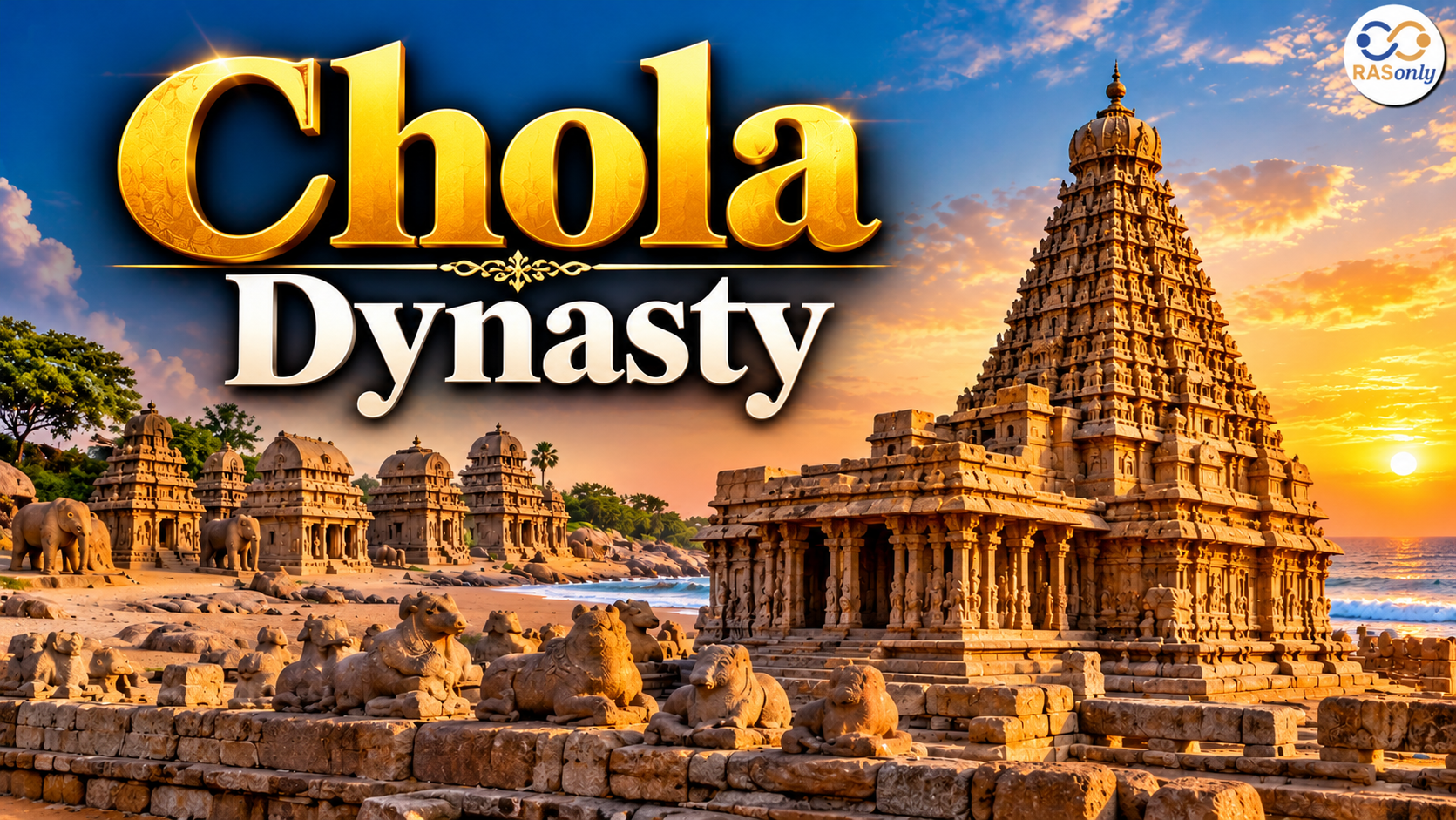
Chola Dynasty: Capital, Founder, Kings, Time Period and History
Science & Technology Topic-wise Questions for RAS 2026 (Prelims & Mains) | MCQs & Complete Preparation

Get in Touch with RASonly!

Practice Science & Technology topic-wise questions for RAS 2026 with important MCQs and concept-based coverage. This helps you build clarity, improve accuracy, and understand key science topics easily. Stay consistent with revision and practice to score better in the RAS exam.

Science & Technology is an important and high-scoring topic in the RAS 2026 Prelims exam, which includes direct and factual questions. Science & Technology is both static and dynamic because it includes both basic science concepts and the latest in technology. Physics, biology, space technology, biotechnology, and IT are commonly tested topics. Regular practice with Science & Technology topic-wise questions and RAS Science MCQs enhances your understanding, conceptual clarity, speed, and accuracy.
This topic will be simplified to comprehend and revise through a well-organized preparation plan. You will start identifying key areas and trends in questions when you practice RAS Science MCQs and PYQs. This not only contributes to scoring higher in Prelims, but also to writing answers in Mains where science is correlated with development and innovation.
Why Science & Technology are Important for RAS 2026
Science & Technology is a scoring subject as the majority of the questions are easy to answer and do not involve technical knowledge. When you have your fundamentals clear, then you can answer questions without taking long.
It also has a significant role in contemporary relations, since most of the questions are associated with modern scientific achievements, space missions, and technological progress.
Key Reasons to Focus on Science
- Direct and concept-based questions
- High relevance in Prelims
- Strong connection with current affairs
- Easy to revise with a basic understanding
Important Areas Frequently Asked
- Basic Physics, Chemistry, Biology
- Space technology and ISRO missions
- Biotechnology
- Information Technology & AI
- Recent scientific developments
Science & Technology Syllabus for RAS 2026 (Detailed Breakdown)
Knowing the Science & Technology syllabus of RAS 2026 will assist you to be on point with essential issues and not to be distracted by irrelevant information. The exam is primarily a test of basic science knowledge and your knowledge of how science can be applied in the real world and what is happening in the field. An organized treatment of these subjects will facilitate preparation and enhance your performance in RAS Science MCQs.
| Topic | Key Areas |
|---|---|
| Physics | Motion, energy, light |
| Chemistry | Matter, chemical reactions |
| Biology | Human body, plants, health |
| Space Technology | ISRO, satellites |
| Biotechnology | DNA, genetics |
| IT & AI | Computers, AI basics |
| Current Science | Recent developments |
Basic Concepts
Strong basics are essential for scoring well in Science & Technology for RAS 2026. Many questions are directly based on fundamental concepts, so clear understanding is more important than memorization. Once your basics are strong, solving Science MCQs for RAS becomes much easier and faster.
| Concept | Explanation |
|---|---|
| Force | Push or pull |
| Energy | Ability to do work |
| Atom | Smallest unit of matter |
| Cell | Basic unit of life |
| DNA | Genetic material |
Detailed Topic-wise Questions
Organizing the syllabus of Science and Technology in a topic-based manner to prepare RAS 2026 would enable you to cover the syllabus in a clear and systematic manner. Rather than combining them all, it is better to address each topic individually to better understand and revise it much more quickly. The majority of RAS Science MCQs are posed based on these core areas, and hence being clear in these areas can directly translate to better scores.
Topic-wise Coverage (Core Areas)
| Topic | Key Focus Areas | Exam Approach |
|---|---|---|
| Physics | Motion, laws of motion, work-energy-power, light, heat | Questions are simple, based on daily-life applications |
| Chemistry | States of matter, chemical reactions, acids & bases, everyday chemistry | Mostly direct and definition-based questions |
| Biology | Human body systems, plant biology, diseases, nutrition | High-weightage area, many direct questions |
| Space Technology | ISRO missions, satellites, basic space concepts | Often linked with current affairs |
| Biotechnology | DNA, genetics, genetic engineering, medical applications | Concept-based and easy to score |
| IT & AI | Computer basics, artificial intelligence, digital tech | Basic understanding is enough |
| Current Science | Space missions, AI updates, scientific discoveries (2025–26) | Current affairs based questions |
Most Important Topics for RAS 2026
If you have limited time, the smartest way to prepare is to focus on high-weightage topics that are asked repeatedly in the RAS exam. In Science & Technology for RAS 2026, certain areas consistently appear in questions, so having strong clarity in these can help you attempt more questions with better accuracy.
Focus on These High-Weightage Topics
1. Biology (High Priority Topic)
- Human body systems
- Diseases and health
- Nutrition and vitamins
2. Physics Basics
- Energy, work, and power
- Light and its properties
- Daily-life applications
3. Space Technology
- ISRO missions
- Satellites and their uses
- Basic space concepts
4. Biotechnology
- DNA and genetics
- Genetic engineering
- Medical applications
5. Current Science
- Recent space missions
- AI and technology updates
- Scientific discoveries
Science & Technology MCQs for RAS 2026 ( Exam-Level)
Science and Technology MCQs for RAS 2026 will help you develop clarity and become faster. The majority of questions are straightforward, yet they challenge your knowledge of fundamental concepts and their use. The better you practice, the more you are sure that you will pass the exam.
Rajasthan Science & Technology Quiz
Q1. Which of the following is the unit of power?
Q2. The basic unit of life is:
Q3. Which of the following vitamins is produced in the human body by sunlight?
Q4. ISRO is responsible for:
Q5. Which of the following is a non-renewable source of energy?
Q6. Photosynthesis takes place in:
Q7. Which gas is essential for respiration?
Q8. Artificial Intelligence refers to:
Q9. The speed of light is highest in:
Q10. DNA is mainly responsible for:
Q11. Which organ purifies blood in the human body?
Q12. Which of the following is an example of chemical change?
Q13. Satellites are used for:
Q14. Which of the following is a greenhouse gas?
Q15. The human heart has how many chambers?
Q16. Which device is used to measure temperature?
Q17. Biotechnology is mainly related to:
Q18. Which of the following is a renewable resource?
Q19. Computer works on which system?
Q20. Which of the following helps in digestion?
Common Mistakes to Avoid
Science & Technology could be perceived to be easy; however, most students fail due to minor errors during preparation. The problem is not, mostly, the absence of study but rather the absence of clarity and coherence. The following are some of the pitfalls that you should avoid to increase your accuracy and confidence with RAS Science MCQs.
Avoid These Mistakes:
- Memorising concepts without actually understanding them
- Ignoring current science and recent developments
- Skipping regular MCQ Practice
- Not solving PYQs to understand exam patterns
How to Prepare Science for RAS 2026
Preparing Science & Technology for RAS 2026 becomes much easier when you follow a simple and consistent approach. This subject does not require deep technical knowledge—clear basics, regular revision, and practice are enough to score well.
Follow This Approach:
- Build strong clarity of basic concepts first
- Study from NCERT-level content for fundamentals
- Practice MCQs regularly to improve speed and accuracy
- Stay updated with current science and recent developments
Conclusion
The most scoring section of RAS 2026 would be Science & Technology if it is prepared with a strong and practical focus. With simple concepts, key topics, and practice of MCQs, you can develop a good level of clarity and enhance your accuracy in the exam. Because most of the questions are practical and straight to the point, a good grasp of fundamentals can assist you in attempting them promptly and with a lot of confidence.
With an understanding of concepts and awareness of current science, together with regular revision, this is a subject that can be simple enough to make up one of your best subjects in Prelims and Mains.
Science & Technology Topic-wise Questions - FAQ
Yes, it is an important and scoring section, especially in Prelims, where many questions are direct and concept-based.
Focus on basic concepts (NCERT level), practice MCQs regularly, and stay updated with current science.
Most questions are easy to moderate and can be solved quickly if your fundamentals are clear.
Practicing around 20–25 MCQs daily is enough to improve speed and accuracy.
Biology, Physics basics, Space Technology, Biotechnology, and Current Science are the most important areas.
BEST SELLER
🏆 PRELIMS
RAS Pass
Prelims focused Hindi & English
₹399
✓
Prelims Topic-Wise Tests
✓
Subject-Wise Tests
✓
Full-Length Prelims Tests
✓
Daily Current Affairs Tests
✓
Prelims PYQs Tests
✓
Detailed Solutions & Analysis
✓
All Rajasthan Ranking
✓
Unlimited Reattempts
✓
Mains Tests
✓
Hindi & English Tests
✓
All Rajasthan Ranking
Trusted by 5,000+ Students
Post Category
- RAS Salary
- Result
- RAS Admit Card
- RAS Job
- RAS Cutoff
- Preparation Tips
- RAS Answer Key
- RAS Exam Analysis
- RAS Syllabus
- RAS Previous Year Papers
- RPSC RAS Exam Pattern
- RAS Interview
- RAS Exam Date
- RAS Vacancy
- RAS Test Series
- RAS Best Books
- RAS Preparation Resources
- RAS Coaching Centre
- History
- Polity
- Geography
- Economics
- Science
- Art and Culture
- RPSC RAS Application Form
- RPSC RAS Notification
- RAS Eligibility Criteria
- UPSC Exam
- RPSC RAS Mains
Visit Our RASonly Offline Center
Our Expert Faculty

Bhunesh Sir
Current Affairs · 13+ Yrs

Aamir Khan Sir
RAS-2017 · IIM Ahm.

Akash Sir
Polity · 8+ Yrs
Free Resources
Official Mobile App

RASOnly App
by OTSAdda · Free
Full Video Lectures
Mock Tests & PYQs
Daily Current Affairs
AI Mock Interview
Free Download · No subscription needed to install
RAS 2024 Toppers — RASonly
Rank 2
Virendra Charan
Rank 9
Bhoopinder Singh
Rank 26
Aanchal Nagpal
Rank 33
Lokendra Singh
Rank 45
Amar Rathore
Rank 46
Manasvini Verma

Join RASonly WhatsApp Community
Get daily current affairs, exam alerts, free study material and tips from expert faculty — right on WhatsApp.
Join for Free →RASonly Interview Guidance Program

Mr. Ashok Jain
Ex-Chief Secretary Govt of Rajasthan
- IAS officer of the 1981 batch, Rajasthan cadre.
- Passionate about mentoring the next generation of RAS officers with real-world insights.
- Got retired in Dec 2017 from the post of Chief Secretary of the state of Rajasthan.

Mr. Guru Charan Rai
Ex-ASP / SP in Jaisalmer
- Guru Charan Rai, IPS (Retd), retired as Inspector General of Police (Security), Rajasthan, Jaipur in 2017.
- Served as ASP and SP in Jaisalmer, Nagaur, Sri Ganganagar, Sawai Madhopur, Dausa, Sikar, and Karauli.
- He also held key positions as DIGP and IGP in the Law and Order division.

Mr. Rakesh Verma
Ex-IAS Officer, B.Tech, MBA, and M.A. (Economics)
- IAS officer of the 1981 batch and retired in Chief Secretary Rank.
- Civil servant of high repute and vast experience.
- Has been teaching UPSC CSE subjects for the last six years.
Related Post

Daily Current Affairs for RAS Exam Preparation 2026

Ustad Bismillah Khan Yuva Puraskar
October 24, 2026
Marwar Festival 2026
October 24, 2026
Kundan Art Display in Hong Kong
October 23, 2026