Kushan Empire: History, Rulers, Administration, Economy, Art, Decline
TSP vs Non-TSP Areas in Rajasthan, RAS Guide 2026

Get in Touch with RASonly!

Explore TSP and Non-TSP areas in Rajasthan, including their differences, covered districts, PESA Act, Scheduled Areas, reservation, Gram Sabha powers, governance, and tribal development. This guide covers important facts and concepts for RAS Prelims, Mains, and Interview preparation.

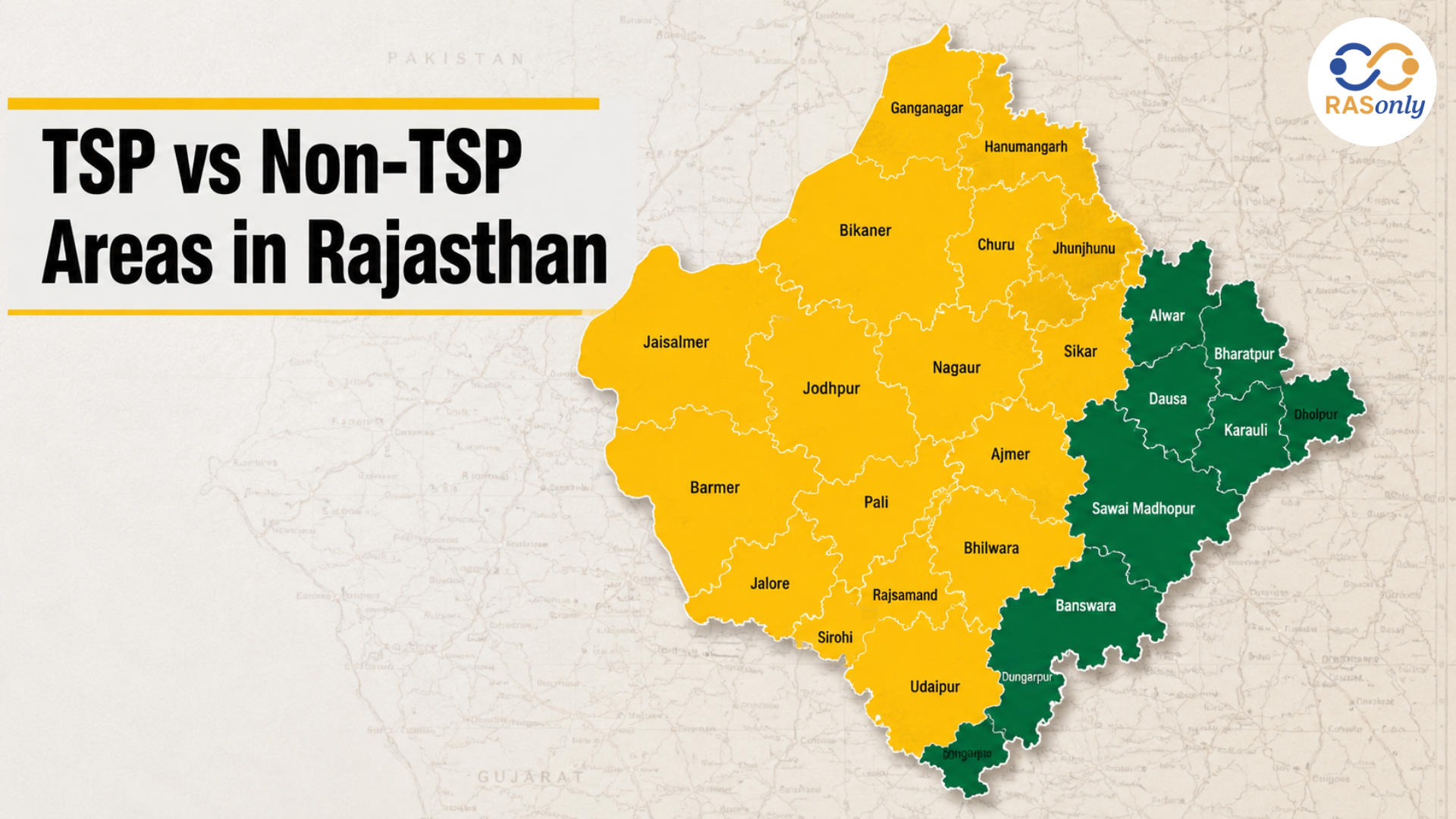
Tribal population is one of the largest in the country in Rajasthan, where the proportion of ST population is about 13-14% of the state's population as per Census data. To ensure development reaches these communities in a targeted way, the state is administratively split into two categories — Tribal Sub-Plan (TSP) Areas and Non-TSP Areas.
This division isn't just a geographical label. It influences the working of panchayati raj institutions, the application of the reservation system, the formulation of the welfare budget, and the working of local administration, and can be asked in either Prelims or Mains in RAS, REET, SI, and Patwari exams; in addition, it is also a part of interviews.
What Is TSP?
It is a special planning and budgeting mechanism introduced during the Fifth Five-Year Plan (1974–79) at the national level to channel a dedicated, protected share of government funds specifically toward tribal development rather than leave these regions to compete with the rest of the state for the same pool of money. In Rajasthan, this is a system for blocks or tehsils where 50 percent or more of the population is tribal, and on the ground through a dedicated administrative structure, not through the usual line departments.
- Introduced: Fifth Five-Year Plan (1974–79)
- Administered by: Tribal Area Development Department (TAD)
- Implementing agency: Integrated Tribal Development Agency (ITDA)
- Covers: Education, healthcare, roads, drinking water, employment schemes
- Eligibility: Blocks/tehsils with ≥50% tribal population
Key Objectives
The fundamental intent of this planning process isn't just about funding; it's about closing structural disparities between tribal and non-tribal areas, and recognizing and safeguarding the rights of tribal communities to their identity and usage rights. The framework is a dedicated allocation of resources that is not treated as a ‘tribal afterthought' in the main budget. It backs it up with legal protections against exploitation.
- Bridging the socio-economic gap between tribal and non-tribal populations
- Ensuring fund flow proportional to ST population share
- Building focused infrastructure — schools, hostels, health centres, roads
- Protecting tribal land and forest rights from exploitation
- Strengthening local self-governance through the PESA Act, 1996
What Is Non-TSP?
The remaining districts and blocks of Rajasthan which have not got a substantial tribal population are under the development plan and therefore are addressed solely through the normal, state-wide development plan and are not under a specific plan of development for the tribal population. The elections under Panchayati Raj, reservation policy, and implementation of schemes by the government are done as per general rules of the game in the rest of Rajasthan and not as provided in the Constitution, Gram Sabha, or the PESA.
TSP vs Scheduled Area
One of the most frequent confusions of the test takers is that they are not the same and are only supposed to be used in a specific way. Strictly speaking, the strict constitutional definition, "Scheduled Area," can only be found once it is formally notified, and the "tribal-development" category is an administrative and financial planning category designed to take care of a similar population, but with slightly more elastic boundaries.
| Term | Basis | Notified By |
|---|---|---|
| Scheduled Area | Article 244, Fifth Schedule of the Constitution | President (Gazette notification) |
| Tribal Sub-Plan Area | Administrative/planning category for budget allocation | State-level planning framework |
Rajasthan's current Scheduled Area was notified on 19 May 2018. The two categories broadly overlap on the map, but in some blocks there is a slight overlap with the notified Scheduled Area boundary, as there is a high concentration of tribal population in the areas that have not been formally brought under the Fifth Schedule.
Districts Covered
The Scheduled/TSP belt of Rajasthan is restricted to the southern and south-east of the state, and includes nearly 5,700 villages across eight districts, with some villages being entirely in this category and some villages only partially, depending on the proportion of tribal population in the blocks and tehsils.
| Category | Districts |
|---|---|
| Fully Tribal | Banswara, Dungarpur, Pratapgarh |
| Partly Tribal | Udaipur, Rajsamand, Chittorgarh, Sirohi, Pali |
Major tribal communities: Bhil, Meena, Garasia, Damor, Sahariya — with Bhil being by far the largest and most widely distributed tribal group across this entire belt.
TSP vs Non-TSP Table
The distinction between the two categories is in terms of governance, law, budgeting, and autonomy, and is best understood when examined together rather than individually, because of the reinforcement value each one of these has on the other.
| Basis | Tribal-Focused Area | Non-TSP Area |
|---|---|---|
| Governing Department | TAD / ITDA | Panchayati Raj Department |
| Constitutional Basis | Fifth Schedule (Article 244) | Normal Part IX provisions |
| Special Law | PESA Act, 1996 applies | PESA Act does not apply |
| Budget | Separate, earmarked | General state budget |
| Gram Sabha Powers | Enhanced (land, forest produce, money-lending) | Standard |
| Reservation | Proportional to ST population, up to 100% in some panchayats | General SC/ST/OBC/Women quota |
| Land Transfer | Strict restrictions | Standard revenue laws |
Gram Sabha & Reservation
The Gram Sabha in a tribal dominated area has a certain amount of power, which is not available to a regular Non-TSP panchayat; the Constitution of India provides it with protection under the Fifth Schedule and the PESA Act, 1996, thereby giving the tribal community a first voice on decisions affecting their land, resources, and their customary way of life before any outside force gets a say.
Gram Sabha powers include:
- Approving development plans and schemes before implementation
- Ownership rights over minor forest produce
- Controlling money-lending activities
- Consultation before land acquisition
- Managing local disputes as per customary practice
The effect is also proportionately strong on reservation — there is a higher reservation proportion of seats (including the post of Sarpanch) for STs in comparison to the rest of the state, and in some gram panchayats where the ST population is overwhelmingly more, the reservation can practically cover 100% of the seats, compared to the general state-wide reservation formula of distributing seats based on population per category of SC, ST, OBC, and women. Effectively touches 100%, a sharp contrast to the general state-wide formula that simply distributes seats among SC, ST, OBC, and women categories by population share.
Why It Matters for RAS
This is a topic that may be different in the Prelims and Mains levels — one thing aspirants need to realize is that this is not a one-time memorization exercise, i.e., they cannot simply regurgitate a Mains-level concept and expect it to pass the exam without any supporting facts, nor can they just recall a set of facts and expect the examiner to remember the concept.
| Exam Stage | Focus Areas |
|---|---|
| Prelims | District counts, notification years, full forms (TSP, PESA) |
| Mains (Paper 2) | Tribal welfare, PESA implementation, Forest Rights Act 2006, migration patterns |
| Interview | District-specific questions for candidates from/near the listed districts |
Quick Revision Points
- Introduced in the 5th Five-Year Plan (1974–79)
- 8 districts — 3 fully + 5 partly tribal — notified via Gazette on 19 May 2018
- Fully tribal: Banswara, Dungarpur, Pratapgarh
- Partly tribal: Udaipur, Rajsamand, Chittorgarh, Sirohi, Pali
- PESA Act, 1996 applies only here, not in Non-TSP areas
- Major tribes: Bhil, Meena, Garasia, Damor, Sahariya
Conclusion
It is a question of understanding the classification able to see the balance struck between broad, statewide development and focused, protected welfare of tribal communities; the tribal-development classification being the one with constitutionally guaranteed empowerment like the Fifth Schedule, the PESA Act, and dedicated budgets for the development and, crucially, a greater degree of local autonomy. The topic itself is a great package of polity, governance, and social justice, and a firm grip on the district list, PESA, and reservation pattern will keep you well-prepared no matter how the question is eventually framed for RAS aspirants.
FAQs
TSP stands for Tribal Sub-Plan. It is a unique planning and budgeting approach that has specific emphasis on socio-economic development of tribal communities by allocating targeted funds and welfare programmes.
The Tribal Sub-Plan was introduced during the Fifth Five-Year Plan (1974–79) to ensure focused development and dedicated financial resources for tribal communities.
The fully tribal districts are Banswara, Dungarpur, and Pratapgarh. These districts form an important part of Rajasthan's tribal belt.
The partly tribal areas consist of Udaipur, Rajsamand, Chittorgarh, Sirohi, and Pali; the specified areas are considered tribal areas.
The TSP is primarily a planning and development process, and Scheduled Areas have a constitutional status in Article 244 and the Fifth Schedule. Both may overlap but are not exactly the same.
BEST SELLER
🏆 PRELIMS
RAS Pass
Prelims focused Hindi & English
₹399
✓
Prelims Topic-Wise Tests
✓
Subject-Wise Tests
✓
Full-Length Prelims Tests
✓
Daily Current Affairs Tests
✓
Prelims PYQs Tests
✓
Detailed Solutions & Analysis
✓
All Rajasthan Ranking
✓
Unlimited Reattempts
✓
Mains Tests
✓
Hindi & English Tests
✓
All Rajasthan Ranking
Trusted by 5,000+ Students
Post Category
- RAS Salary
- Result
- RAS Admit Card
- RAS Job
- RAS Cutoff
- Preparation Tips
- RAS Answer Key
- RAS Exam Analysis
- RAS Syllabus
- RAS Previous Year Papers
- RPSC RAS Exam Pattern
- RAS Interview
- RAS Exam Date
- RAS Vacancy
- RAS Test Series
- RAS Best Books
- RAS Preparation Resources
- RAS Coaching Centre
- History
- Polity
- Geography
- Economics
- Science
- Art and Culture
- RPSC RAS Application Form
- RPSC RAS Notification
- RAS Eligibility Criteria
- UPSC Exam
- RPSC RAS Mains
Visit Our RASonly Offline Center
Our Expert Faculty

Bhunesh Sir
Current Affairs · 13+ Yrs

Aamir Khan Sir
RAS-2017 · IIM Ahm.

Akash Sir
Polity · 8+ Yrs
Free Resources
Official Mobile App

RASOnly App
by OTSAdda · Free
Full Video Lectures
Mock Tests & PYQs
Daily Current Affairs
AI Mock Interview
Free Download · No subscription needed to install
RAS 2024 Toppers — RASonly
Rank 2
Virendra Charan
Rank 9
Bhoopinder Singh
Rank 26
Aanchal Nagpal
Rank 33
Lokendra Singh
Rank 45
Amar Rathore
Rank 46
Manasvini Verma

Join RASonly WhatsApp Community
Get daily current affairs, exam alerts, free study material and tips from expert faculty — right on WhatsApp.
Join for Free →RASonly Interview Guidance Program

Mr. Ashok Jain
Ex-Chief Secretary Govt of Rajasthan
- IAS officer of the 1981 batch, Rajasthan cadre.
- Passionate about mentoring the next generation of RAS officers with real-world insights.
- Got retired in Dec 2017 from the post of Chief Secretary of the state of Rajasthan.

Mr. Guru Charan Rai
Ex-ASP / SP in Jaisalmer
- Guru Charan Rai, IPS (Retd), retired as Inspector General of Police (Security), Rajasthan, Jaipur in 2017.
- Served as ASP and SP in Jaisalmer, Nagaur, Sri Ganganagar, Sawai Madhopur, Dausa, Sikar, and Karauli.
- He also held key positions as DIGP and IGP in the Law and Order division.

Mr. Rakesh Verma
Ex-IAS Officer, B.Tech, MBA, and M.A. (Economics)
- IAS officer of the 1981 batch and retired in Chief Secretary Rank.
- Civil servant of high repute and vast experience.
- Has been teaching UPSC CSE subjects for the last six years.


Daily Current Affairs for RAS Exam Preparation 2026
Chandra Shekhar Sain Receives Lalit Kala Akademi National Award
October 01, 2026
Jodhpur to Get India’s Third Dedicated Tropical Medicine Institute
October 01, 2026
Establishment of the Aesthetic Office
September 30, 2026