Kushan Empire: History, Rulers, Administration, Economy, Art, Decline
Types of Sand Dunes in Rajasthan: Complete Guide to Thar Desert Dunes

Get in Touch with RASonly!

Rajasthan's Thar Desert has several types of sand dunes, each shaped differently by wind, sand supply, and terrain. Near Jaisalmer and Barmer, you'll mostly find crescent-shaped barchans, while broad U-shaped parabolic dunes dominate western Rajasthan. Some stretches even have long ridge-like linear dunes. This complete guide breaks down every major dune type found here, where exactly to spot them, and how they form, shift, and change shape over the years.

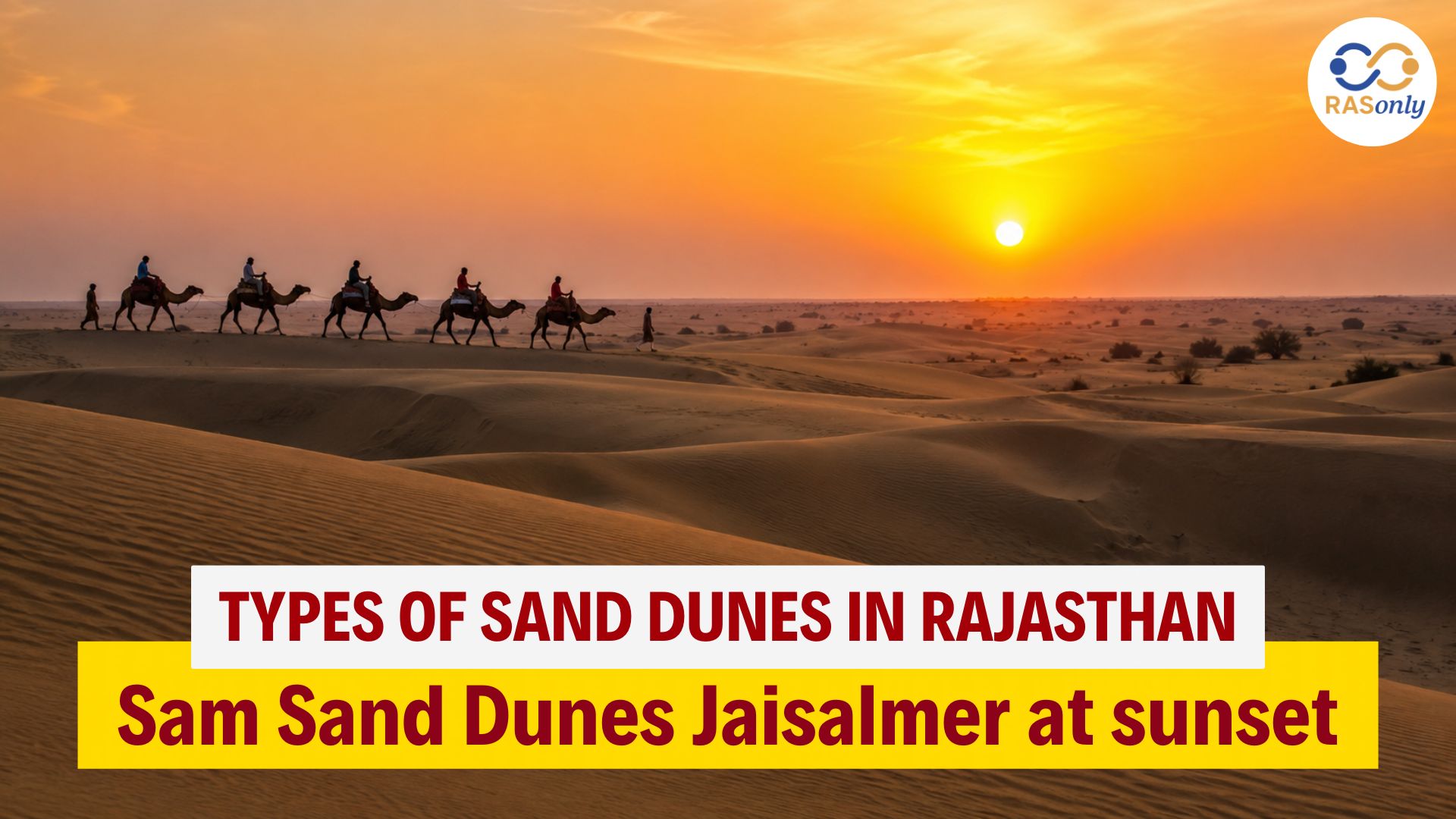
The Golden Desert of Rajasthan: Rajasthan is home to one of the world's most gorgeous desert landscapes - the Thar Desert. Stretching over 200,000 square kilometers, this vast arid region covers more than 58% of the state and is dominated by Stunning dunes of many shapes and sizes. For travelers, geographers, and students alike, understanding the types of dunes in Rajasthan opens a window into the Interesting science of wind, sand, and time.
The Thar Desert - the 18th largest desert in the world - supports a surprisingly dense population and a rich ecosystem. Its dunes are not just tourist attractions; they are dynamic geological features that shift, grow, and transform in response to wind, rainfall, and human activity. From crescent-shaped barchans to sprawling parabolic dunes covering entire districts, Rajasthan's dune landscape is remarkably diverse.
This guide covers every major type of dune found in Rajasthan, where to find them, how they are formed, and what makes each one unique - complete with a comparison table and FAQ section.
What Are Sand Dunes? Formation and Basics
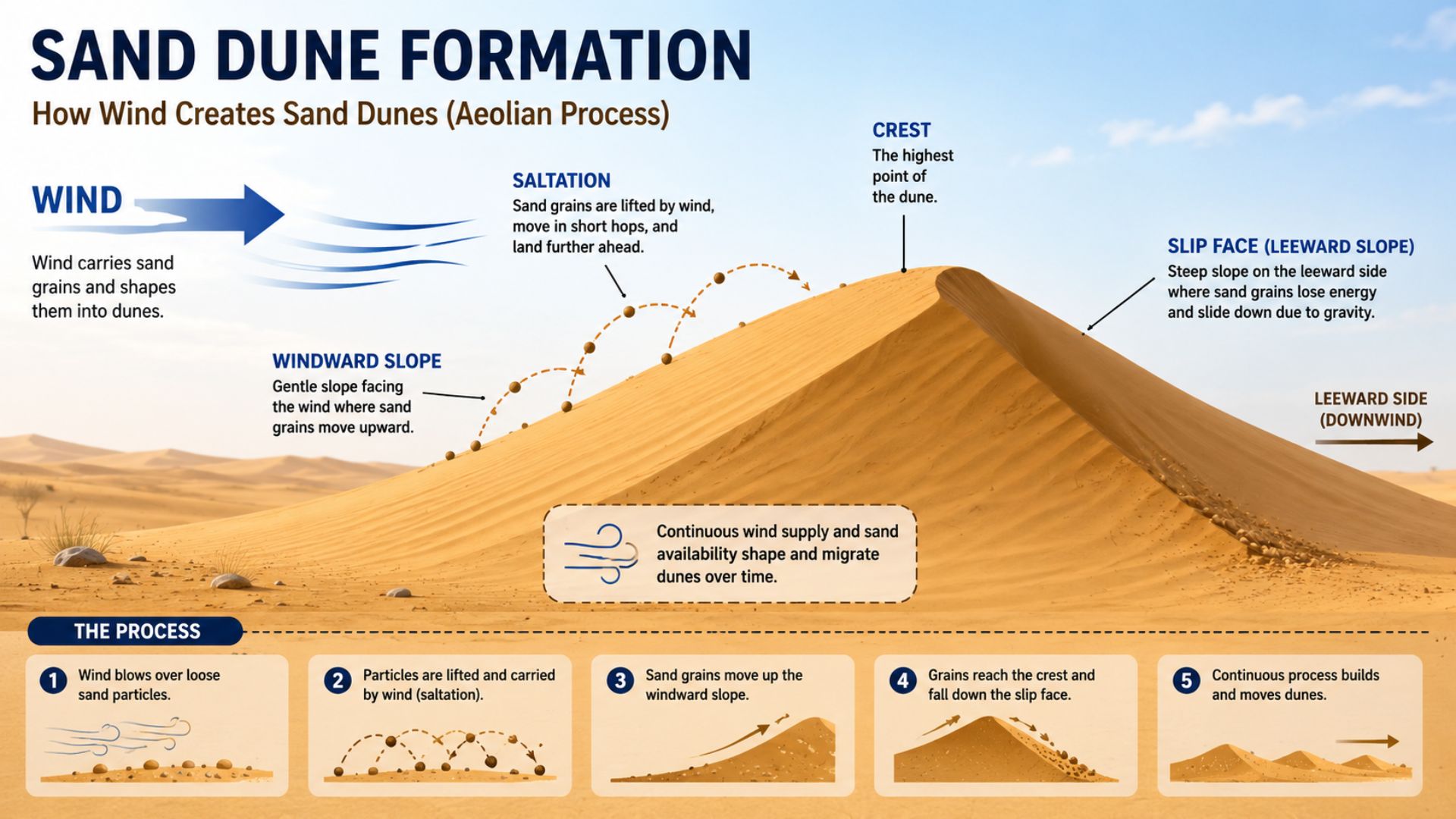
A sand dune is simply a hill or ridge of sand that wind has piled up, and you'll find them not just in deserts but on beaches and other sandy stretches too. The process behind this is called aeolian action: wind lifts loose sand particles off the ground and drops them somewhere else. Do this enough times over enough years, and you get the curved, layered shapes we recognise as dunes.
In the Thar Desert, it's the south-western winds that do most of this work. The sand here is fine, usually somewhere between 0.06 and 2.0 mm across, and it doesn't fly through the air so much as bounce along the surface in short hops, a movement geologists call saltation. Grain by grain, this is how Rajasthan's dunes have built up over time. Today they stand anywhere from 15 to 60 meters tall, and some stretch as far as 12 kilometres, while the smaller ones may run just 4 metres in length.
Key Factors That Determine Dune Type
- Wind direction and speed
- Sand supply and availability
- Presence or absence of vegetation
- Topography and obstacles in the landscape
- Moisture and groundwater levels
Types of Sand Dunes in Rajasthan - Overview
Scientific studies using satellite imagery and field surveys have identified five basic dune types in the Thar Desert: crescentic (barchan), linear, star, dome, and parabolic. Along with these, obstacle dunes, transverse dunes, and sand sheets are also found across different districts.
The Thar Desert dune system is classified into two age groups: Old System Dunes (formed 15,000–18,000 years ago during a prolonged arid climate phase) and New System Dunes (actively forming today due to current arid conditions). This distinction matters because old dunes are larger, more stabilized, and vegetated, while new dunes are smaller, active, and mobile.
Comparison Table: All Sand Dune Types in Rajasthan
| Dune Type | Shape | Wind Pattern | Where Found | Height |
|---|---|---|---|---|
| Parabolic | U-shaped/curved arms | Moderate, with vegetation | All western districts | 10–25 m |
| Barchan | Crescent (horns downwind) | Strong unidirectional | Jaisalmer, Barmer | 5–30 m |
| Linear/Longitudinal | Long straight ridges | Parallel to wind | Southern & western Rajasthan | 15–40 m |
| Transverse | Ridges perpendicular to wind | Strong, abundant sand | Eastern & southern Rajasthan | 10–30 m |
| Star Dunes | Multi-armed star shape | Variable/multidirectional | Rare – central zones | 20–40 m |
| Dome Dunes | Rounded, no-slip face | Variable | Rare, scattered | 10–20 m |
| Obstacle Dunes | Irregular, around obstacle | Variable | Barmer, Jaisalmer, Jodhpur | 10–40 m |
1. Parabolic Dunes - The Most Dominant Type
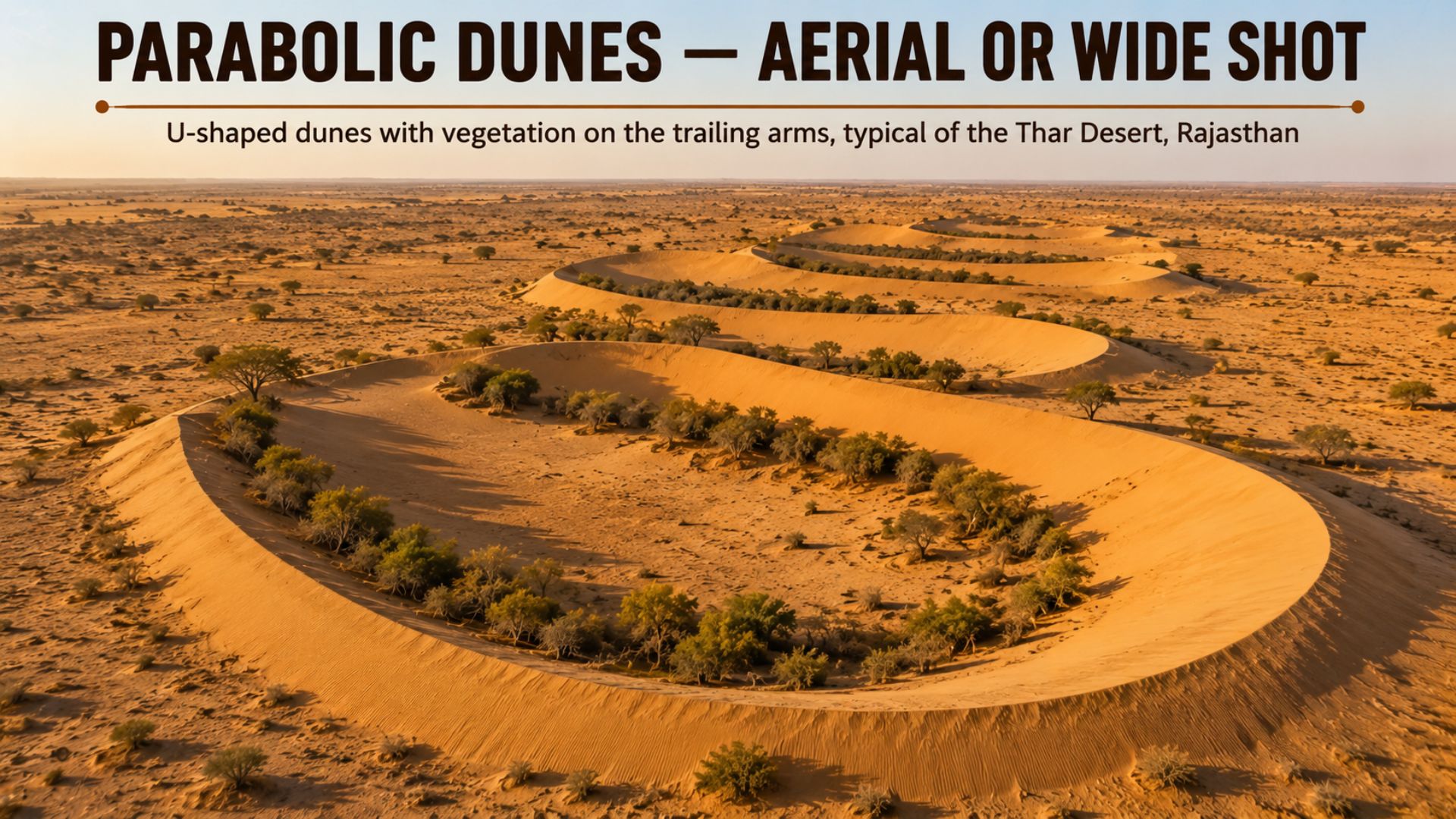
Parabolic dunes are the most common type of dune in this region, covering approximately 50% of the geographical area of western Rajasthan. They are U-shaped or parabolic in form; their convex tip points in the direction of the wind, while their long arms curve back against the wind (upwind).
These dunes form in areas with moderate wind speeds and dense vegetation. As the tip advances to create their characteristic curved shape, the long arms remain stabilized by the grip of plant roots. In the Thar Desert, parabolic dunes are found in the Jodhpur, Barmer, Jaisalmer, Bikaner, Nagaur, and Jalore districts.
Key Characteristics
- Height: 10 to 25 meters (well-stabilized); old-system dunes up to 40 m
- Sand is calcareous and compact - more stable than active dunes
- Migration rate: 0.5 to 9 meters per year
- Often vegetated with shrubs like Acacia and grasses
- Dominant in: Jodhpur, Barmer, Jaisalmer, Bikaner, Nagaur, Jalore, Shri Ganganagar, Churu, Jhunjhunu
2. Barchan Dunes - The Classic Crescent Shape
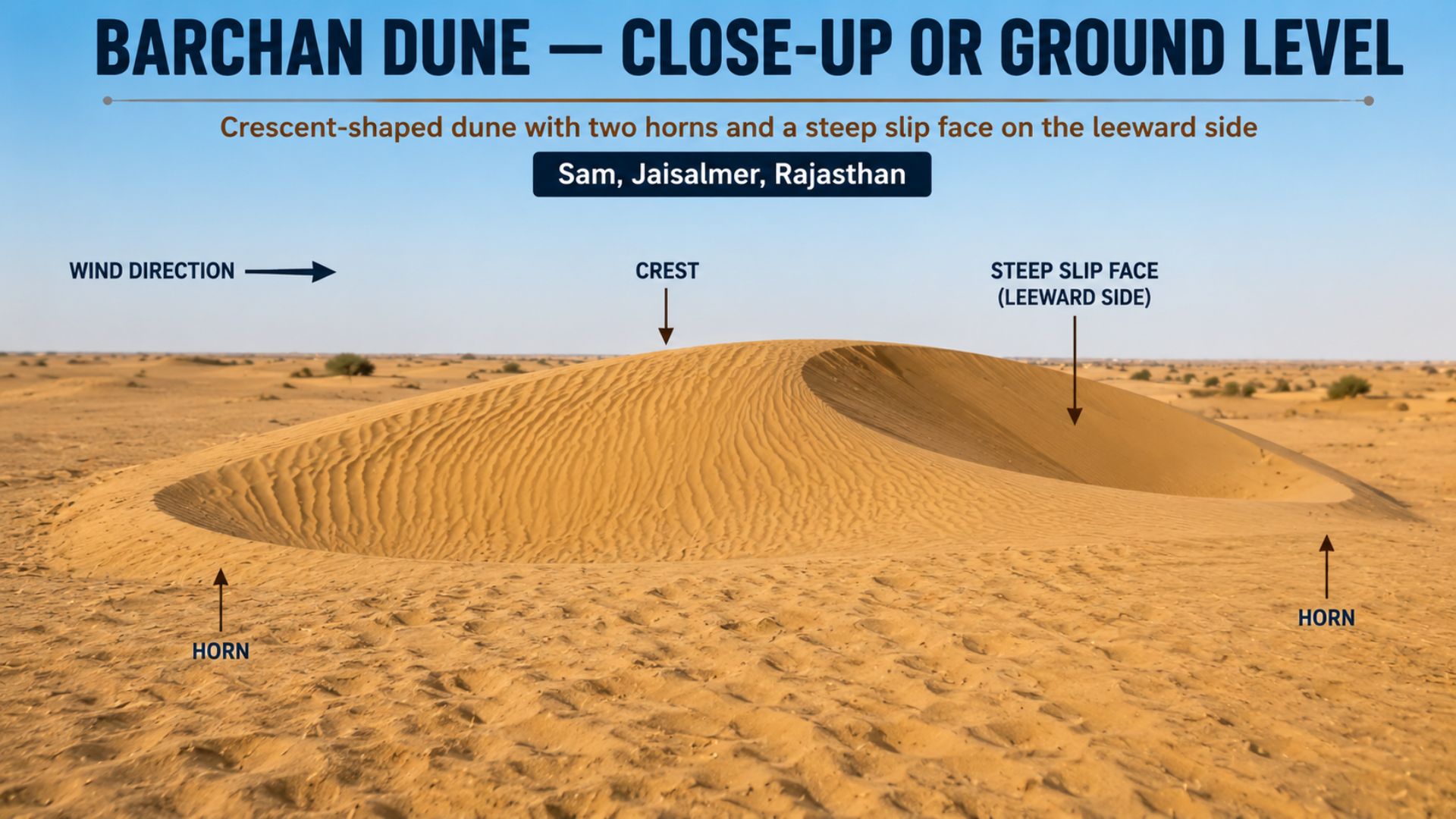
The crescent or horseshoe-shaped dunes are perhaps most familiar to the world, known as barchan dunes, with the two horns extending downwind. In the State of Rajasthan, barchan dunes are mostly present in Jaisalmer and Barmer districts with emphasis on Sam Sand Dune area in the State.
These dunes are developed in places where the winds are strong and wind direction is unidirectional, while the sand supply is limited. They move with great speed - Barchan dunes in western Rajasthan migrate at the average rate of 31.7 m/yr and pose a major problem for infrastructure and agricultural activities.
Key Characteristics
- Shape: Crescent with a steep concave (leeward) face and gentle convex (windward) slope
- Height: 5 to 30 meters; can reach over 20 meters
- Migration: Up to 31.7 m/year - the fastest moving dune type in Rajasthan
- New system dunes: 2–8 meters average height
- Found at Sam (Jaisalmer), Kanoi, Barmer; also Bikaner, Nagaur
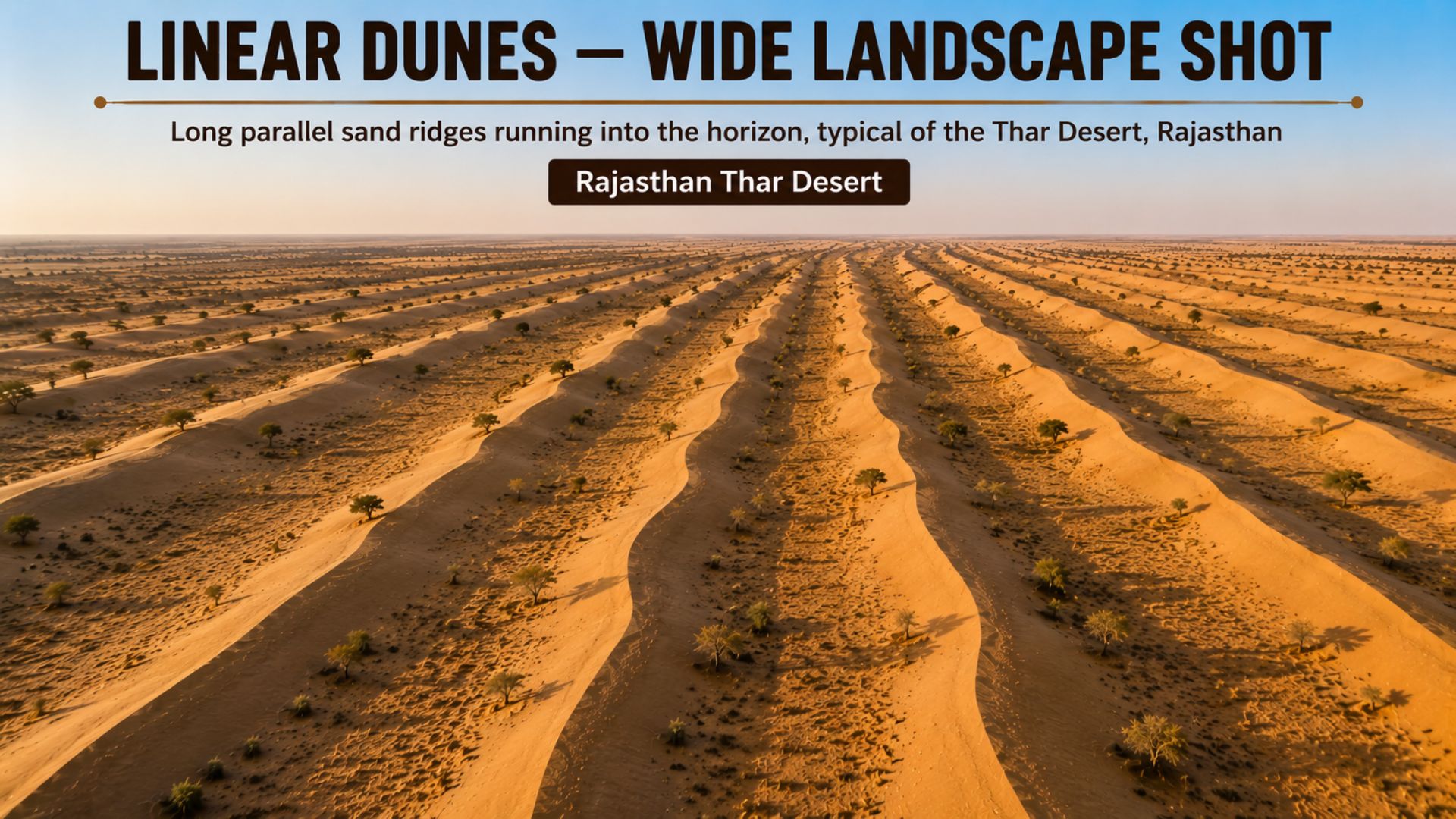
3. Linear (Longitudinal) Dunes - Long Sandy Ridges
Linear dunes - also called longitudinal or seif dunes - are long, straight or gently sinuous ridges of sand that run parallel to the dominant wind direction. In Rajasthan, they are predominantly found in the southern and western parts of the state.
These dunes are among the old system dunes of Rajasthan, formed during earlier prolonged arid climatic phases. They are well-stabilized, vegetated, and of high relief - typically 20 to 40 meters tall. Active linear dune fields are visible at places like Kanoi in the south-western Thar Desert.
Key Characteristics
- Orientation: Parallel to prevailing wind direction
- Height: 20–40 m (old system); elongated form
- Mostly stabilized and vegetated
- Found in: Southern and western Rajasthan, Kanoi area
- Can extend several kilometers in length
4. Transverse Dunes - Perpendicular to the Wind
Transverse dunes are sand ridges that form perpendicular to the dominant wind direction — the opposite orientation of linear dunes. They typically develop where there is an abundant supply of sand and consistent wind. In Rajasthan, transverse dunes are found in the eastern and southern parts of the Thar Desert.
Along with parabolic dunes, transverse dunes belong to the old system of Rajasthan dunes. They are massive, high-relief formations that were shaped by stronger southerly to south-easterly winds during ancient climatic phases.
Key Characteristics
- Orientation: Perpendicular to wind direction
- Require abundant sand supply
- Part of the old dune system - generally stabilized
- Height: 10–30 meters
- Found in: Eastern and southern Rajasthan
5. Star Dunes - Multi-Armed and Rare
Star dunes are the most complex and visually striking dune formations. As the name suggests, they develop into a multi-armed, star-like shape when viewed from above. Star dunes form in areas where winds blow from multiple directions at different times, causing sand to pile up from several angles into a central peak.
In Rajasthan, star dunes are relatively rare. They belong to the old system dune category and are found in limited zones in the central desert regions. Their complex shape makes them among the tallest dunes - they can reach 20 to 40 meters in height.
Key Characteristics
- Shape: Star or multi-armed radiating ridges
- Wind: Multi-directional - wind blows from several directions
- Height: 20–40 meters
- Relatively rare in Rajasthan - found in isolated zones
- Generally stabilized, old-system dunes
6. Dome Dunes - Rounded and Gentle
Dome dunes are rounded, mound-like dunes without a defined slipface. They are the simplest of all dune types in form - a gentle, symmetrical hill of sand. Dome dunes form under variable wind conditions where no single direction dominates strongly enough to create asymmetry.
In Rajasthan, dome dunes are relatively uncommon and are scattered across the desert in limited areas. They are typically 10 to 20 meters in height and belong mostly to the transitional zones between more active dune fields.
Key Characteristics
- Shape: Rounded mound, no visible slip face
- Height: 10–20 meters
- Variable wind conditions
- Relatively rare and scattered in Rajasthan
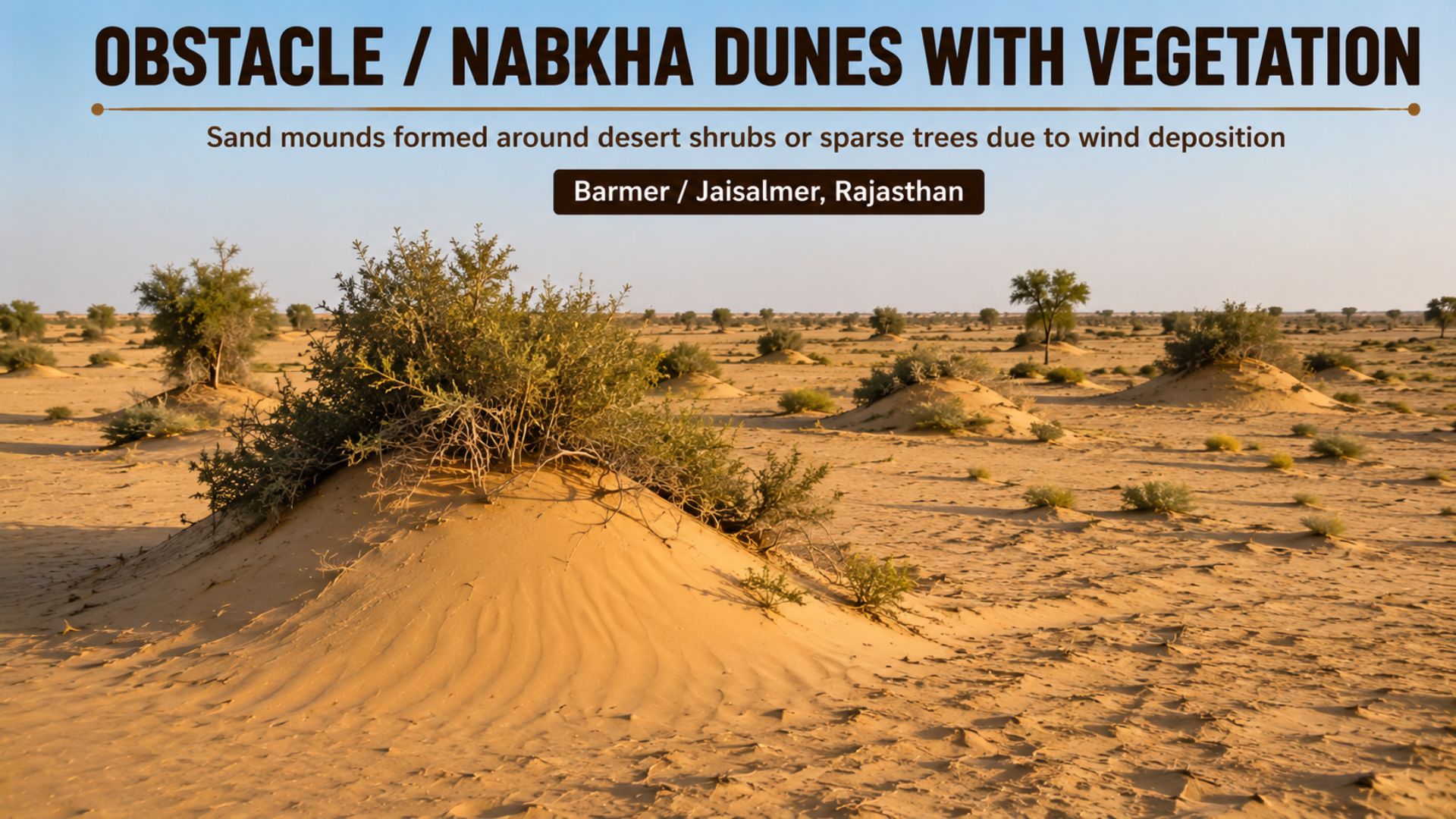
7. Obstacle Dunes (Coppice / Nabkha Dunes)
Obstacle dunes form when wind-blown sand is trapped by a physical obstruction — typically vegetation like shrubs and small trees. In Rajasthan, these obstructions are often plants such as Calligonum polygonoides and Leptadenia pyrotechnica. Small obstacle dunes are known as nabkha (or nebkha) and larger ones are called "rebdon."
Obstacle dunes are well-cemented and static. Their sand grains are compact and highly calcareous. They are found across Barmer, Jaisalmer, Nagaur, Jalore, and Jodhpur districts. As old-system dunes, they are 10 to 40 meters tall and well-stabilized.
Key Characteristics
- Formation: Around vegetation or physical obstacles
- Also called: Coppice dunes, nabkha (small), rebdon (large)
- Sand: Compact, calcareous, mean grain diameter ~0.14 mm
- Height: 10–40 m; well-cemented and stable
- Found in: Barmer, Jaisalmer, Nagaur, Jalore, Jodhpur
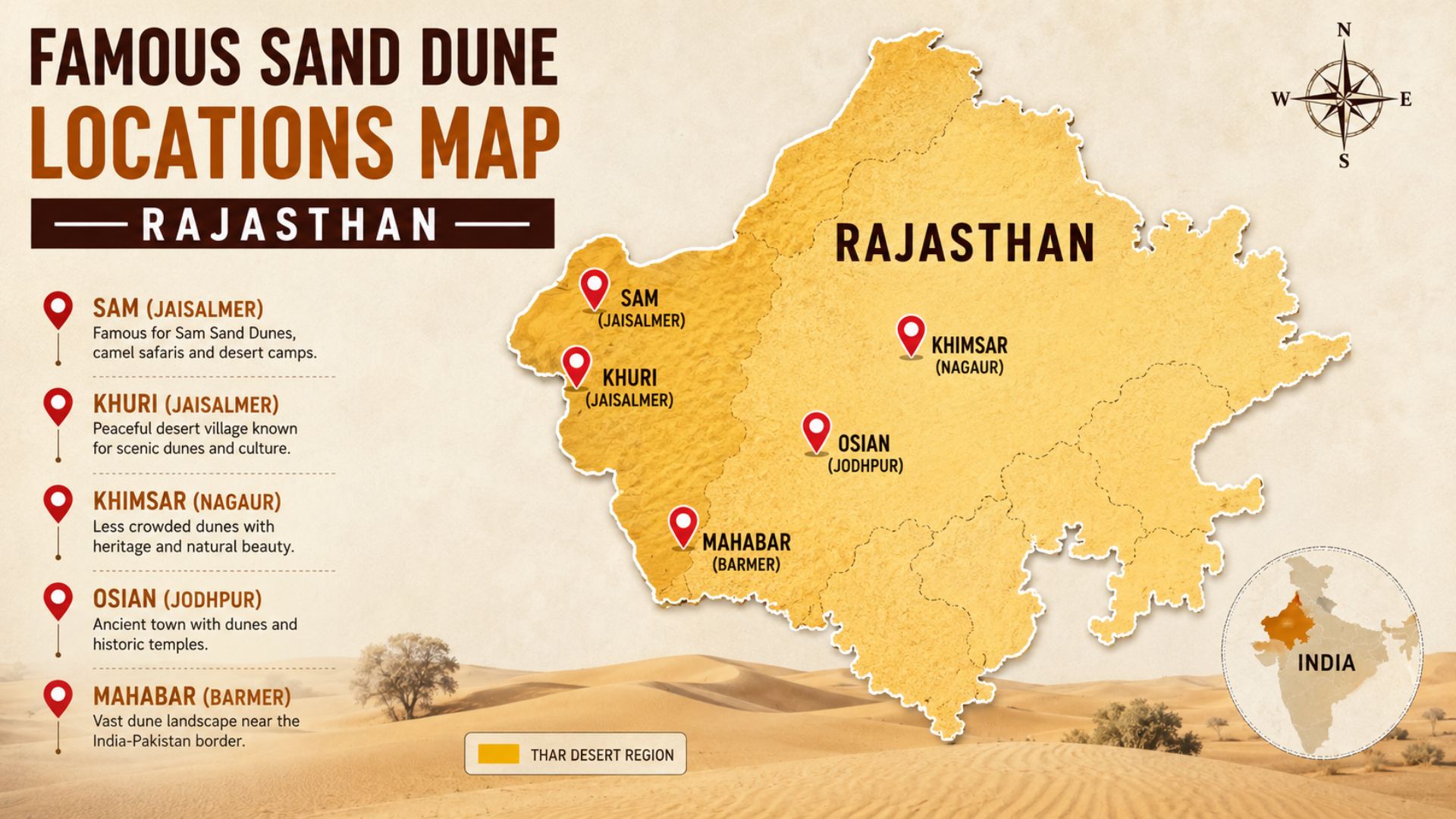
Famous Sand Dune Locations in Rajasthan
While the dune types above describe the geological formations, Rajasthan also has several famous tourist and trekking destinations built around these dunes:
1. Sam Sand Dunes, Jaisalmer
Located 42 km from Jaisalmer, Sam is the most visited sand dune destination in Rajasthan. Dominated by barchan and longitudinal dunes up to 30–60 meters tall, Sam offers camel safaris, jeep rides, and desert camping under the stars. The annual Desert Festival is held near Sam every January–February.
2. Khuri Sand Dunes, Jaisalmer
About 40 km southwest of Jaisalmer, Khuri is a quieter, less-crowded alternative. It features parabolic and barchan dunes and is especially popular for sunrise camel rides and authentic Rajasthani folk music experiences around campfires.
3. Khimsar Desert Dunes, Nagaur
Khimsar offers a mix of parabolic dunes and a rare combination of desert and a small lake nearby. It is accessible by camel, jeep, or horseback and is popular for those seeking solitude in the desert.
4. Osian Desert, Jodhpur
Located 65 km from Jodhpur, Osian combines ancient Pratihara-era temples with dramatic sand dunes. Parabolic and transverse dune formations dominate this area.
5. Mahabar Sand Dunes, Barmer
Just 5 km from Barmer, Mahabar is a less-explored but stunning desert landscape. It hosts an annual Mahotsav festival in March with camel races and cultural performances.
Old System vs New System Sand Dunes
Rajasthan's dune system is scientifically divided into two generations based on their age and activity level:
Old System Dunes - Formed 15,000 to 18,000 years ago during intense arid phases. These include linear, parabolic, transverse, star, network, and obstacle dunes. They are 20–40 m tall, stabilized, vegetated, and cemented. Their sand is calcareous and compact.
New System Dunes - Actively forming today due to current arid conditions. These include crescentic barchans, barchanoids, nebkhas, sand streaks, and zibars. They are 2–8 m tall, mobile, non-calcareous, and lack definite orientation. They represent the ongoing evolution of the Thar Desert.
Sand Dune Migration and Conservation Challenges
Sand dune migration is a serious environmental and infrastructure challenge in Rajasthan. Active barchan dunes near Jaisalmer migrate at an average of 5.15 meters per year, while those in Barmer shift as much as 7.11 meters annually. This movement threatens highways, railways, solar parks, agricultural land, and settlements.
Conservation and stabilization measures include planting deep-rooted tree species like Khejri (Prosopis cineraria), Acacia tortilis, and local shrubs. Surface treatments like stone mulching and shelter belts have also been used - especially to protect solar parks (Bhadla Solar Park in Jodhpur is the world's largest).
- Parabolic dune migration: 0.5–9 m/year
- Barchan dune migration: up to 31.7 m/year
- Districts most affected: Jaisalmer, Barmer, Bikaner, Jodhpur
- Stabilization: Khejri tree plantation, stone mulching, shelter belts
Conclusion
The sand dunes of Rajasthan are far more than golden hills for tourists to photograph - they are complex, living geological features shaped by thousands of years of wind, sand, and climate change. From the sweeping parabolic dunes that dominate over half of western Rajasthan to the fast-moving barchans of Sam and Kanoi, each dune type tells a different story.
Whether you are a traveller planning a desert safari, a student preparing for geography exams, or a researcher studying aeolian landforms, Rajasthan's dune landscape offers endless fascination. Understanding the types of sand dunes in Rajasthan is the first step to truly appreciating the Thar Desert's Stunning natural beauty.
FAQs
Parabolic dunes - they cover nearly 50% of western Rajasthan's area.
Barchan and linear dunes are dominant around Sam, Khuri, and Kanoi areas near Jaisalmer.
Dunes range from 15 to 60 meters in height, extending up to 12 km in length.
By aeolian (wind-driven) action - wind picks up and deposits sand particles, shaping them into dunes over time.
The Thar Desert (also called the Great Indian Desert) covers western Rajasthan.

BEST SELLER
🏆 PRELIMS
RAS Pass
Prelims focused Hindi & English
₹399
✓
Prelims Topic-Wise Tests
✓
Subject-Wise Tests
✓
Full-Length Prelims Tests
✓
Daily Current Affairs Tests
✓
Prelims PYQs Tests
✓
Detailed Solutions & Analysis
✓
All Rajasthan Ranking
✓
Unlimited Reattempts
✓
Mains Tests
✓
Hindi & English Tests
✓
All Rajasthan Ranking
Trusted by 5,000+ Students
Post Category
- RAS Salary
- Result
- RAS Admit Card
- RAS Job
- RAS Cutoff
- Preparation Tips
- RAS Answer Key
- RAS Exam Analysis
- RAS Syllabus
- RAS Previous Year Papers
- RPSC RAS Exam Pattern
- RAS Interview
- RAS Exam Date
- RAS Vacancy
- RAS Test Series
- RAS Best Books
- RAS Preparation Resources
- RAS Coaching Centre
- History
- Polity
- Geography
- Economics
- Science
- Art and Culture
- RPSC RAS Application Form
- RPSC RAS Notification
- RAS Eligibility Criteria
- UPSC Exam
- RPSC RAS Mains
Visit Our RASonly Offline Center
Our Expert Faculty

Bhunesh Sir
Current Affairs · 13+ Yrs

Aamir Khan Sir
RAS-2017 · IIM Ahm.

Akash Sir
Polity · 8+ Yrs
Free Resources
Official Mobile App

RASOnly App
by OTSAdda · Free
Full Video Lectures
Mock Tests & PYQs
Daily Current Affairs
AI Mock Interview
Free Download · No subscription needed to install
RAS 2024 Toppers — RASonly
Rank 2
Virendra Charan
Rank 9
Bhoopinder Singh
Rank 26
Aanchal Nagpal
Rank 33
Lokendra Singh
Rank 45
Amar Rathore
Rank 46
Manasvini Verma

Join RASonly WhatsApp Community
Get daily current affairs, exam alerts, free study material and tips from expert faculty — right on WhatsApp.
Join for Free →RASonly Interview Guidance Program

Mr. Ashok Jain
Ex-Chief Secretary Govt of Rajasthan
- IAS officer of the 1981 batch, Rajasthan cadre.
- Passionate about mentoring the next generation of RAS officers with real-world insights.
- Got retired in Dec 2017 from the post of Chief Secretary of the state of Rajasthan.

Mr. Guru Charan Rai
Ex-ASP / SP in Jaisalmer
- Guru Charan Rai, IPS (Retd), retired as Inspector General of Police (Security), Rajasthan, Jaipur in 2017.
- Served as ASP and SP in Jaisalmer, Nagaur, Sri Ganganagar, Sawai Madhopur, Dausa, Sikar, and Karauli.
- He also held key positions as DIGP and IGP in the Law and Order division.

Mr. Rakesh Verma
Ex-IAS Officer, B.Tech, MBA, and M.A. (Economics)
- IAS officer of the 1981 batch and retired in Chief Secretary Rank.
- Civil servant of high repute and vast experience.
- Has been teaching UPSC CSE subjects for the last six years.



Daily Current Affairs for RAS Exam Preparation 2026

Rajasthan State Election Commission Wins Gold SKOCH Award
September 28, 2026
Tarang Shakti 2026
September 28, 2026
India Wins Gold in 10m Air Pistol
September 26, 2026