Vedic Age in India: History, Society, Economy, Religion & Culture
Vedic Age in India: History, Society, Economy, Religion & Culture

Get in Touch with RASonly!

The Vedic Age (c. 1500–600 BCE) shaped early Indian civilisation through the Rigveda and other Vedic texts. Spanning the Early Vedic and Later Vedic periods, it witnessed the transition from tribal, pastoral society to territorial kingdoms, agricultural growth, evolving social structures, and profound religious and philosophical developments, including the emergence of Upanishadic thought.

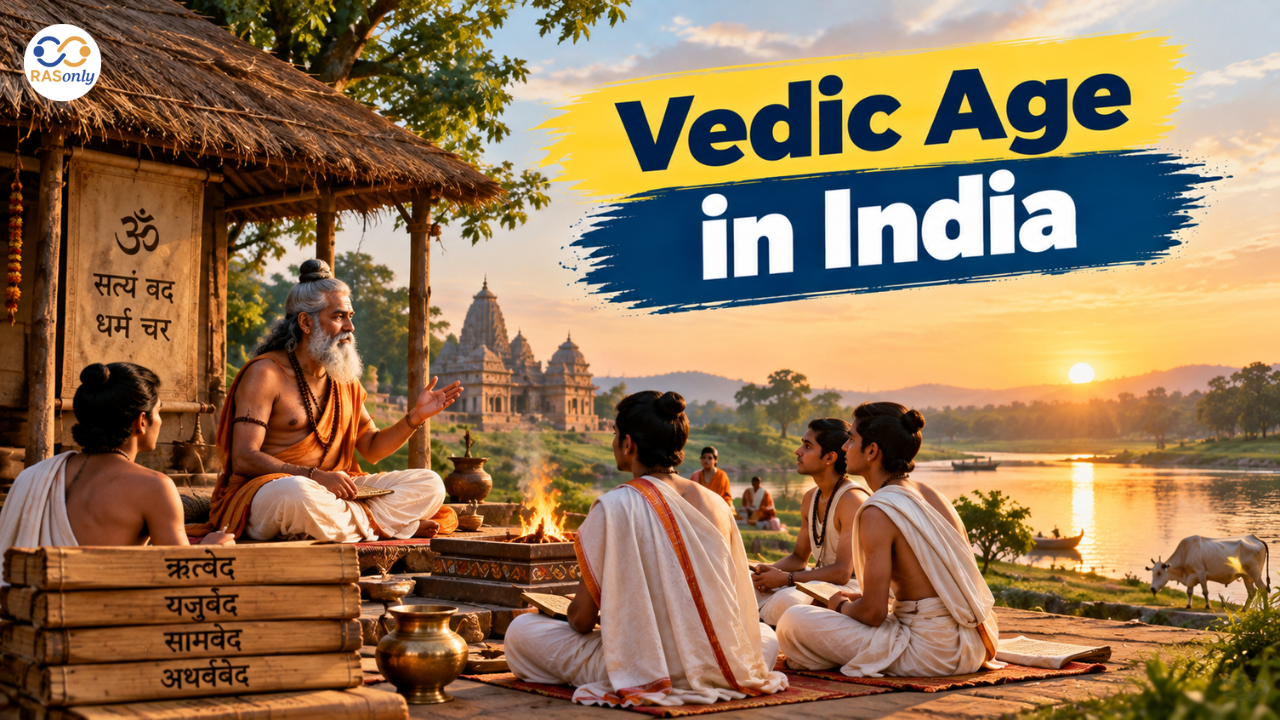
Vedic Age in India is considered to be an important period in the history of India, largely marked by the development of Vedic literature, social institutions, political system, economic system, religion and philosophy. In early history, from approximately 1500 BCE to 600 BCE.
The Vedic period is considered to be broadly classified as the Early Vedic Period (Rig Vedic Period) and the Later Vedic Period. The Early Vedic period saw pastoralism, tribal organisation and culture as seen in the Rigveda. During the Later Vedic period, farm areas grew larger, territorial kingdoms became stable, and social stratification.
What is the Vedic Age?
The uniqueness of the period allows it to be identified as the Vedic Age, referring to the era of the composition, conservation and dissemination of Vedic literature and the society portrayed in the literature.
The word Veda is derived from the Sanskrit root ‘vid’, meaning ‘to know’ or ‘knowledge
The four Vedas are:
- Rigveda
- Samaveda
- Yajurveda
- Atharvaveda
The Vedic tradition was primarily preserved orally. Along with the four Vedas, Brahmanas, Aranyakas and Upanishads form important parts of Vedic literature.
Timeline of the Vedic Age
| Period | Approximate Date | Main Characteristics |
|---|---|---|
| Early Vedic Period | c. 1500–1000 BCE | Pastoral economy, tribal organisation, Rigvedic culture |
| Later Vedic Period | c. 1000–600 BCE | Agricultural expansion, territorial kingdoms, social differentiation |
Early Vedic Period
Early Vedic Period (c. 1500-1000 BCE) comes from the Rigveda.
The society was predominantly kinship-based and tribal, with pastoralism and cattle-rearing activities; agriculture was also practised.
Geographical Area
- The Early Vedic geographical setting was mainly associated with the northwestern Indian subcontinent.
- The Early Vedic geographical setting was mainly associated with the northwestern Indian subcontinent. The Rigveda refers to the region of the Sapta Sindhu, or ‘land of seven rivers’, including the Indus and several rivers of the northwestern region
Political Organisation in Early Vedic Society
Early Vedic political organisation was largely based on tribal and kinship relationships.
The important units included:
- Kula: family
- Grama: village or settlement.
- Vis: The larger clans, communities
- Jana: tribe or broader political community
The political chief of the tribe was entitled 'Rajan'
He was supported by influential men, including the Purohita (followers of the Priest), thus connected with the priestly duties, and the Senani (Followers of the military), and related to military leadership.
Sabha and Samiti
From the Vedic literature, two important assemblies were mentioned:
Sabha
A meeting dedicated to certain topics of discussion and political and social significance.
Samiti
Samiti is generally understood as a broader assembly mentioned in the Rigveda, although its exact composition and functions remain debated among historians.
Early Vedic Society
The family was a key element of social organisation.
Early Vedic society was largely a patriarchal society, and kinship was a significant aspect.
Society included:
- Priests
- Warriors
- Farmers
- Herders
- Craftspeople
- Tribal chiefs
Women in Early Vedic Society
- There are traces of women involved with intellectual and religious traditions in the Vedic literature of the times.
- Many of the Rigvedic hymns are attributed to various names like Lopamudra, Ghosha, Apala and Vishvavara.
- But women's place should not be characterised as totally homogeneous. Throughout the various periods of Vedic life, they altered their social roles and status.
Early Vedic Economy
The economy of the early Vedic period was predominantly pastoral.
Cattle Rearing
A cow was one of the sources of wealth and was also important economically and socially.
Agriculture
Pastoralism was also known, but played a more prominent role in the Early Vedic phase.
Crafts
Important occupations included:
- Carpentry
- Chariot making
- Pottery
- Metalworking
- Weaving
- Leather work
Trade and Exchange
- Some exchange and some trade occurred, barter being of particular importance. Routes of river travel were also available for travel and communication.
- In some of the ancient texts (the Vedic texts), the word nishka is mentioned, but should not be assumed to denote the normal modern coin.
Religion in the Early Vedic Period
Early Vedic religion had a strong relation with Natural and Cosmic powers.
Important deities included:
- Indra: associated with strength, warfare and storms
- Agni: Fire and sacrificial ritual
- Varuna: associated with cosmic and moral order
- Surya: the Sun
- Soma: an important ritual and god.
- Ushas: goddess associated with dawn
Later Vedic Period
- Later Vedic Period: 1000-600 BCE.
- There were also changes in the political organisation, economy, society and religion during this phase.
- The geographical focus of the action slowly shifted towards the region of the Ganges River and Yamuna River. Kuru and Panchala emerged as significant political units, along with statelets like Kosala, Kashi and Videha.
Political Changes in the Later Vedic Period
- Gradually, the political system shifted from tribally organised to territorial kingdoms.
- Territorial political units known as Janapadas became increasingly important as political organisation moved beyond earlier tribal structure
- The power of kings grew, and kingship became more closely related to land, farming and political control.
Some of the key royal rituals were:
- Rajasuya: royal consecration ritual
- Ashvamedha: horse sacrifice
- Vajapeya: an important royal ritual associated with prestige and power
The relative importance of assemblies such as the Sabha and Samiti appears to have declined as royal authority became stronger.
Social Changes in the Later Vedic Period
The major developments were the growing importance of the Varna system.
The following four general types:
- Brahmana
- Kshatriya
- Vaishya
- Shudra
Later Vedic Economy
The later-Vedic economy started to shift towards a more agriculture-oriented one.
Important developments included:
- Increasing urban populations and the growth of agriculture.
- Increased production of paddy and wheat.
- Growth of permanent settlements
- Increased craft specialisation
- Greater use of metal tools
- Developing exchange and trade
- Enhancing exchanges and trade.
Religion in the Later Vedic Period
- Religious practices became more elaborate.
- The role of the specialist priests became more significant.
- Some deities grew more important
- The Rigvedic gods became more prominent during the Later Vedic period, with Prajapati, Vishnu and Rudra being prominent gods of the religion.
- But as the ritual emphasis increased, so did new philosophical questioning, including the Upanishadic questioning.
Vedic Philosophy and Upanishads
Over time, the Vedic intellectual tradition started to spread beyond ritual.
The Upanishads emphasised the following questions, which are particularly important:
- What is the self?
- What is ultimate reality?
- What kind of relationship is there between the individual and the universe?
- What causes rebirth?
- How can liberation be achieved?
Early Vedic vs Later Vedic Period
| Feature | Early Vedic Period | Later Vedic Period |
|---|---|---|
| Approx. period | 1500–1000 BCE | 1000–600 BCE |
| Main source | Rigveda | Later Vedic texts |
| Geography | Northwestern region | Expansion towards Ganga-Yamuna plains |
| Economy | Pastoralism prominent | Agriculture increasingly important |
| Political system | Tribal organisation | Territorial kingdoms |
| King/chief | Rajan | Stronger territorial ruler |
| Society | Comparatively less stratified | Greater social differentiation |
| Varna | Less pronounced | More firmly established |
| Agriculture | Present | Major economic activity |
| Iron | Not a defining feature | Increasingly important |
| Religion | Nature deities and sacrifice | More elaborate ritualism |
| Philosophy | Early Vedic ideas | Stronger Upanishadic thought |
Vedic Age and Rajasthan
The Vedic Age in Rajasthan, the Iron Age and the Painted Grey Ware (PGW) culture.
Key sites of Rajasthan that have PGW and Iron Age evidence include:
- Noh: Bharatpur
- Jodhpur: Jaipur region
- Viratnagar: Jaipur
- Sanari: Jhunjhunu
Important Facts About the Vedic Age
- The Vedic period is usually classified into two: Early Vedic and Later Vedic.
- The oldest of the four Vedas is the Rigveda.
- The Four Vedas are the Rigveda, Samaveda, Yajurveda and Atharvaveda.
- The assemblies mentioned are Sabha and Samiti.
- Rajan played an important role in politics during the Early Vedic period.
- An important facet of Early Vedic life was cattle.
- Political units of the Later Vedic period included Kuru and Panchala.
- Kosala, Kashi and Videha became prominent in the eastern region.
- Practices included Rajasuya, Ashvamedha and Vajapeya.
- During the Later Vedic period, the importance of iron increased.
- Indra and Agni were two important Rigvedic gods.
- Later Vedic traditions saw Prajapati, Vishnu and Rudra being more prominent.
- The Upanishads are significant.
- Rajasthan has some important sites related to the PGW/Iron Age, such as Noh, Jodhpur, Viratnagar and Sanari.
FAQs
The Vedic Age is the historical period associated with Vedic literature and the social, political, economic, religious and intellectual traditions reflected in these sources.
The two broad phases are the Early Vedic Period (c. 1500–1000 BCE) and the Later Vedic Period (c. 1000–600 BCE).
The Rigveda is the oldest of the four Vedas.
Pastoralism, especially cattle rearing, was highly important, although agriculture and crafts were also practised.
Agriculture expanded, territorial kingdoms became more important, social differentiation increased, and religious rituals became more elaborate.

BEST SELLER
🏆 PRELIMS
RAS Pass
Prelims focused Hindi & English
₹399
✓
Prelims Topic-Wise Tests
✓
Subject-Wise Tests
✓
Full-Length Prelims Tests
✓
Daily Current Affairs Tests
✓
Prelims PYQs Tests
✓
Detailed Solutions & Analysis
✓
All Rajasthan Ranking
✓
Unlimited Reattempts
✓
Mains Tests
✓
Hindi & English Tests
✓
All Rajasthan Ranking
Trusted by 5,000+ Students
Post Category
- RAS Salary
- Result
- RAS Admit Card
- RAS Job
- RAS Cutoff
- Preparation Tips
- RAS Answer Key
- RAS Exam Analysis
- RAS Syllabus
- RAS Previous Year Papers
- RPSC RAS Exam Pattern
- RAS Interview
- RAS Exam Date
- RAS Vacancy
- RAS Test Series
- RAS Best Books
- RAS Preparation Resources
- RAS Coaching Centre
- History
- Polity
- Geography
- Economics
- Science
- Art and Culture
- RPSC RAS Application Form
- RPSC RAS Notification
- RAS Eligibility Criteria
- UPSC Exam
- RPSC RAS Mains
Visit Our RASonly Offline Center
Our Expert Faculty

Bhunesh Sir
Current Affairs · 13+ Yrs

Aamir Khan Sir
RAS-2017 · IIM Ahm.

Akash Sir
Polity · 8+ Yrs
Free Resources
Official Mobile App

RASOnly App
by OTSAdda · Free
Full Video Lectures
Mock Tests & PYQs
Daily Current Affairs
AI Mock Interview
Free Download · No subscription needed to install
RAS 2024 Toppers — RASonly
Rank 2
Virendra Charan
Rank 9
Bhoopinder Singh
Rank 26
Aanchal Nagpal
Rank 33
Lokendra Singh
Rank 45
Amar Rathore
Rank 46
Manasvini Verma

Join RASonly WhatsApp Community
Get daily current affairs, exam alerts, free study material and tips from expert faculty — right on WhatsApp.
Join for Free →RASonly Interview Guidance Program

Mr. Ashok Jain
Ex-Chief Secretary Govt of Rajasthan
- IAS officer of the 1981 batch, Rajasthan cadre.
- Passionate about mentoring the next generation of RAS officers with real-world insights.
- Got retired in Dec 2017 from the post of Chief Secretary of the state of Rajasthan.

Mr. Guru Charan Rai
Ex-ASP / SP in Jaisalmer
- Guru Charan Rai, IPS (Retd), retired as Inspector General of Police (Security), Rajasthan, Jaipur in 2017.
- Served as ASP and SP in Jaisalmer, Nagaur, Sri Ganganagar, Sawai Madhopur, Dausa, Sikar, and Karauli.
- He also held key positions as DIGP and IGP in the Law and Order division.

Mr. Rakesh Verma
Ex-IAS Officer, B.Tech, MBA, and M.A. (Economics)
- IAS officer of the 1981 batch and retired in Chief Secretary Rank.
- Civil servant of high repute and vast experience.
- Has been teaching UPSC CSE subjects for the last six years.

Daily Current Affairs for RAS Exam Preparation 2026

India-US Yudh Abhyas 2026
September 17, 2026
Western Region Official Language Conference 2026
September 17, 2026
Rajasthan Ranks First in Mission Karmayogi
September 16, 2026