Kushan Empire: History, Rulers, Administration, Economy, Art, Decline
Biosphere Reserves of India Strategy for RAS 2026

Get in Touch with RASonly!

Learn the complete Biosphere Reserves of India Strategy for RAS 2026 including UNESCO Biosphere Reserves, biodiversity conservation, zonal structure, species-location linkage, maps, MCQs, and revision techniques. This detailed guide helps aspirants strengthen Environment and Ecology preparation for RAS Prelims 2026.

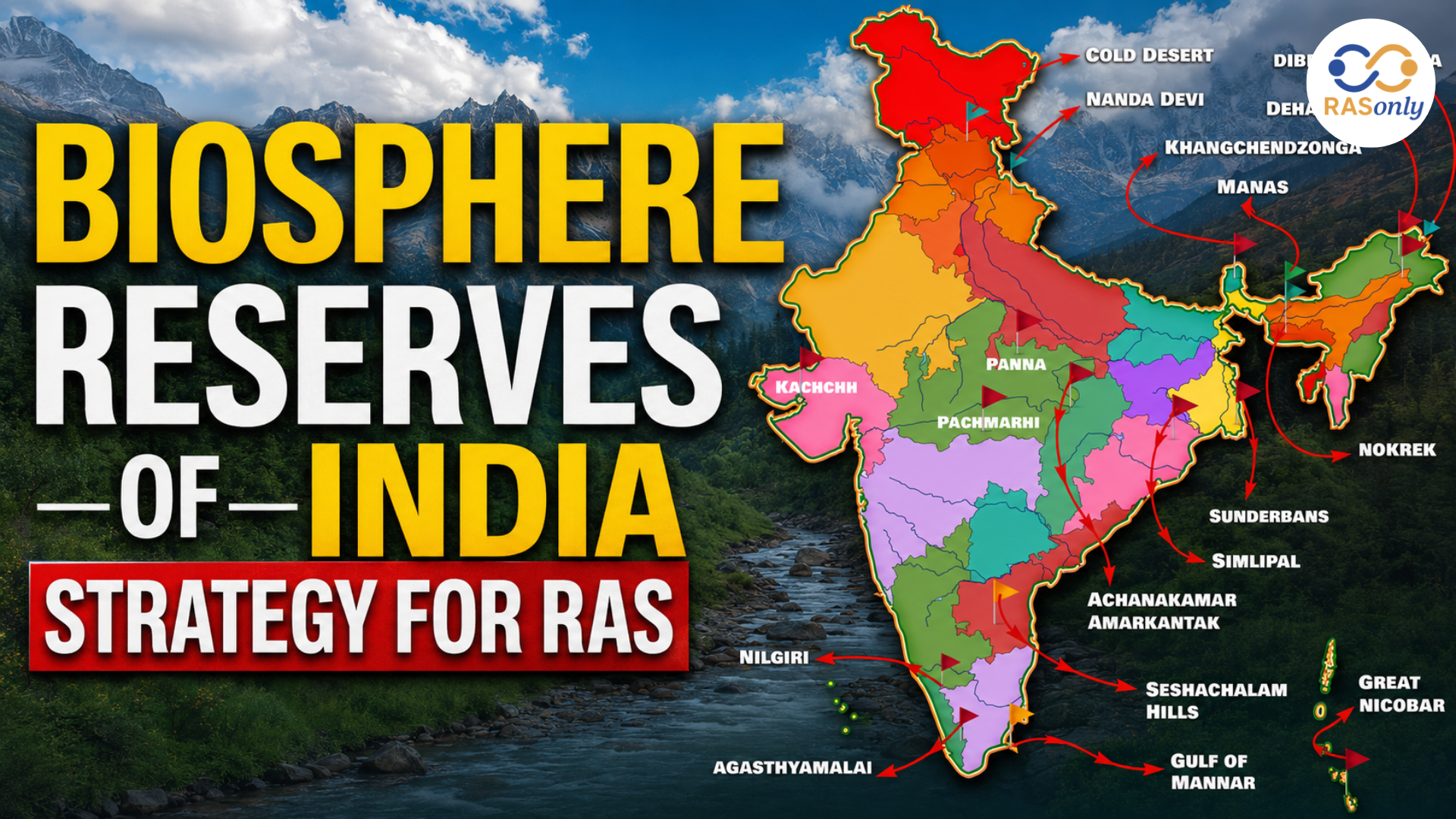
The Environment and Ecology section of RAS Prelims 2026 is often seen to have questions related to Biosphere Reserves, with regular queries from the concept of biodiversity conservation, protected areas, UNESCO recognition, wildlife conservation, ecological balance, endangered species, and sustainable development. In recent years, RAS has given a good weightage to Environment, Ecology, Biodiversity, and conservation-based current affairs, which has become a significant topic to score for serious aspirants. Currently, there are 13 Biosphere Reserves in India that are part of UNESCO's World Network of Biosphere Reserves, with the Cold Desert Biosphere Reserve being added to the list in 2025.
Multiple locations, multiple states, UNESCO-recognized Biosphere Reserves, core-buffer-transition zones, and species linkage are confusing to many aspirants. But this is one of the easiest and high-scoring parts of Environment and Geography preparation for RAS 2026, with practice of maps, state-wise revision, comparison of species, conservation project, and repeated practice of MCQs.
Why Biosphere Reserves are Important for RAS 2026
Biosphere Reserves are directly related to biodiversity conservation, ecological balance, wildlife protection, climate sustainability, and the protection mechanism of UNESCO, thus making it one of the most important parts of Environment and Ecology.
RAS often asks questions directly, conceptually, and through statements related to Biosphere Reserve, National Parks, wildlife species, conservation projects, and ecological zones.
Benefits of Strong Biosphere Reserve Preparation
- Improves the Environment & Ecology preparation
- Helps in Wildlife & Biodiversity topics
- Useful for current affairs linkage
- Strengthens map-based Geography understanding
- Helpful in both Prelims and Mains
- Scoring with proper revision and MCQ practice
What is a Biosphere Reserve?
Biosphere Reserves are extensive areas of nature conservation set up for the purposes of conserving biodiversity, protecting natural ecosystems, science, and sustainable development, with the participation of local communities. These reserves are internationally recognized under the UNESCO's Man and the Biosphere (MAB) Programme, and they are of significant importance in Environment and Ecology preparation for RAS Prelims 2026.
Questions related to Biosphere Reserve Objectives, Conservation Mechanism, Biosphere Reserve Linkage with UNESCO, Zonal Structure, and Concepts of Biosphere Reserve Protection are very common in competitive examinations like RAS. Candidates are required to concentrate on concepts more than simply memorizing definitions.
Main Objectives of Biosphere Reserves
- Biodiversity conservation
- Ecological and environmental protection
- Sustainable development
- Scientific research and monitoring
- Protection of endangered species
- Maintaining human-environment balance
Structure of Biosphere Reserves
Biosphere Reserves are divided into different zones to balance biodiversity conservation with sustainable human activities. It is very important to understand the zonal structure as many conceptual and statement-based questions are asked in RAS Geography and Environment sections.
Biosphere Reserve Zones Table
| Zone | Main Function |
|---|---|
| Core Zone | Strict biodiversity protection |
| Buffer Zone | Research, education & limited activities |
| Transition Zone | Sustainable human settlements & development |
The Core Zone continues to be highly protected for wildlife and biodiversity conservation, and there is a gradual reintroduction of controlled human activities in the Buffer Zones and Transition Zones, in order to balance the ecology and sustainable use of resources.
Biosphere Reserves of India for RAS 2026
There are 18 notified Biosphere Reserves in India, which represent various kinds of ecosystems including the Himalayas, Desert, Coastal, Forest, Wetland, Mangroves and Islands. Of these, 13 Biosphere Reserves are designated under UNESCO's "World Network of Biosphere Reserves.
Complete List of Biosphere Reserves in India
| Biosphere Reserve | State |
|---|---|
| Nilgiri | Tamil Nadu, Kerala, Karnataka |
| Nanda Devi | Uttarakhand |
| Nokrek | Meghalaya |
| Great Nicobar | Andaman & Nicobar Islands |
| Gulf of Mannar | Tamil Nadu |
| Sundarbans | West Bengal |
| Simlipal | Odisha |
| Pachmarhi | Madhya Pradesh |
| Achanakmar-Amarkantak | Chhattisgarh & Madhya Pradesh |
| Agasthyamalai | Kerala & Tamil Nadu |
| Khangchendzonga | Sikkim |
| Panna | Madhya Pradesh |
| Cold Desert | Himachal Pradesh |
| Dibru-Saikhowa | Assam |
| Dihang-Dibang | Arunachal Pradesh |
| Manas | Assam |
| Dehang Debang | Arunachal Pradesh |
| Kachchh | Gujarat |
UNESCO Biosphere Reserves Strategy for RAS 2026
Biosphere Reservations are very important for RAS since some questions are invariably related to current affairs, conservation of biodiversity, and international organisations.
Important UNESCO Biosphere Reserves of India
- Nilgiri
- Sundarbans
- Gulf of Mannar
- Nanda Devi
- Nokrek
- Pachmarhi
- Simlipal
- Achanakmar-Amarkantak
- Great Nicobar
- Agasthyamalai
- Khangchendzonga
- Panna
- Cold Desert
The Cold Desert Biosphere Reserve in Himachal Pradesh was added to the list of UNESCO World Network of Biosphere Reserves, bringing the total number of Biosphere Reserves in India to 13.
Cold Desert Biosphere Reserve Strategy
Cold Desert Biosphere Reserve is among the most crucial current affairs on the environment for RAS 2026 as it was added to the UNESCO Biosphere Reserve in 2025, making it the 13th Biosphere Reserve of India.
Important Features
- Located in Himachal Pradesh
- Includes Spiti Valley region
- High-altitude cold desert ecosystem
- Important species: Snow Leopard, Blue Sheep
- Includes Pin Valley National Park
Smart Strategy
- Revise Cold Desert current affairs carefully
- Learn location through maps
- Focus on UNESCO linkage
- Practice statement-based MCQs
Nilgiri Biosphere Reserve Strategy
Nilgiri Biosphere Reserve is India’s first Biosphere Reserve and one of the most important topics in environmental protection.
Important Features
- Established in 1986
- Spread across Tamil Nadu, Kerala & Karnataka
- UNESCO-recognized Biosphere Reserve
- Part of Western Ghats biodiversity hotspot
Important Species
- Nilgiri Tahr
- Lion-tailed Macaque
- Tiger
- Elephant
Smart Strategy
- Learn Western Ghats linkage carefully
- Revise species-location concepts
- Practice map-based MCQs
Sundarbans Biosphere Reserve Strategy
Sundarbans is one of the most important mangrove ecosystems in the world and is highly important for RAS Environment preparation.
Important Features
- Located in West Bengal
- Largest mangrove forest
- UNESCO-recognized
- Habitat of Royal Bengal Tiger
Smart Strategy
- Link mangroves with coastal ecology
- Focus on the delta ecosystem
- Revise the climate-change linkage
Gulf of Mannar Biosphere Reserve Strategy
Gulf of Mannar is important because it represents India’s marine biodiversity ecosystem.
Important Features
- Located in Tamil Nadu
- Marine Biosphere Reserve
- Rich coral reef ecosystem
- High biodiversity region
Smart Strategy
- Focus on marine ecology
- Revise coral reef concepts
- Practice map-based MCQs
Rajasthan & Biosphere Reserve Linkage Strategy
Even though there is no UNESCO Biosphere Reserve at present in Rajasthan, the Environment and Biodiversity questions on desert ecology, wildlife conservation and Protected areas are very significant in the preparation of RAS.
Important Rajasthan Environment Areas
- Desert National Park
- Ranthambore Tiger Reserve
- Sariska Tiger Reserve
- Thar Desert ecosystem
Smart Strategy
- Link desert ecology with biodiversity
- Revise Rajasthan protected areas
- Practice Rajasthan environment MCQs
Biosphere Reserves vs National Parks vs Wildlife Sanctuaries
Comparative questions are frequently asked in RAS Prelims.
Comparison Table
| Feature | Biosphere Reserve | National Park | Wildlife Sanctuary |
|---|---|---|---|
| Main Aim | Conservation + Development | Wildlife protection | Wildlife conservation |
| Human Activity | Allowed in the transition zone | Highly restricted | Limited allowed |
| Area Size | Large ecosystem area | Smaller protected area | Comparatively flexible |
| UNESCO Linkage | Yes | No | No |
Map Practice Strategy for Biosphere Reserves
Map practice is one of the most important parts of Biosphere Reserve preparation because many RAS questions are directly map-based.
Important Areas to Practice
- State-wise Biosphere Reserves
- UNESCO Biosphere Reserves
- Himalayan Biosphere Reserves
- Coastal & marine reserves
- Desert & island ecosystems
Smart Map Practice Tips
- Practice blank India maps regularly
- Mark Biosphere Reserves repeatedly
- Link species with locations visually
- Revise UNESCO reserves weekly
Best Note-Making Strategy for Biosphere Reserves
Biosphere Reserves contain multiple locations, species, ecosystems, and conservation concepts, so short and organized notes become extremely important for revision.
Smart Notes Strategy
- Prepare state-wise Biosphere Reserve notes
- Make species-location tables
- Use maps and diagrams
- Write one-line factual notes
- Revise notes weekly
Best Notes Format
| Notes Type | Purpose |
|---|---|
| Maps | Better visual memory |
| Comparison Tables | Avoid confusion |
| Species Notes | Quick revision |
| One-Line Facts | Final revision |
Biosphere Reserves MCQ Practice Strategy
MCQ practice is extremely important because Environment questions are factual, conceptual, and statement-oriented.
Best MCQ Practice Method
- Solve topic-wise MCQs daily
- Practice PYQs regularly
- Analyze wrong answers carefully
- Revise weak areas repeatedly
- Practice map-based questions
Important Focus Areas
- UNESCO Biosphere Reserves
- Biosphere Reserve locations
- Core-buffer-transition zones
- Species-habitat linkage
- Current affairs
Most Important Biosphere Reserve Topics for RAS 2026
There are certain topics in the Biosphere Reserve which are repeatedly asked in RAS Prelims as it is directly related to the conservation of biodiversity, UNESCO recognition, endangered species, ecological balance, and Environment current affairs. More emphasis is required on high-weightage Biosphere Reserves, zonal structure, species-location linkage, map based revision for getting more accuracy in the Environment and Ecology sections.
High-Weightage Topics
- UNESCO Biosphere Reserves
- Nilgiri Biosphere Reserve
- Cold Desert Biosphere Reserve
- Sundarbans
- Gulf of Mannar
- Biosphere Reserve zones
- Species-location linkage
Topic Priority Table
| Topic | Importance Level |
|---|---|
| UNESCO Biosphere Reserves | Very High |
| Cold Desert Biosphere Reserve | Very High |
| Nilgiri Biosphere Reserve | High |
| Sundarbans | High |
| Biosphere Reserve Zones | High |
Revision Strategy for Biosphere Reserves
Revision is extremely important because reserve locations, species, and UNESCO linkage are easy to confuse during the exam.
Smart Revision Tips
- Revise maps weekly
- Practice comparison tables
- Use one-line factual notes
- Focus on current affairs updates
- Revise species-habitat linkage visually
Best Revision Cycle
| Revision Stage | Focus Area |
|---|---|
| First Revision | Concepts & reserves |
| Second Revision | Maps & species |
| Final Revision | MCQs & quick notes |
How Toppers Prepare Biosphere Reserves for RAS
Most toppers follow the following strategy to prepare Biosphere Reserves: Maps, Species comparison, Conceptual clarity, Linking with current affairs, Repeated MCQ practice and not rote memorization.
Toppers’ Strategy
- Practice maps consistently
- Revise UNESCO reserves repeatedly
- Focus on conceptual understanding
- Solve PYQs regularly
- Prepare short revision notes
What Makes Toppers Different?
- Better map practice
- Strong species retention
- Consistent revision habits
- Smart MCQ analysis
- Better current affairs linkage
Conclusion
Biosphere Reserves are of immense significance for RAS Prelims 2026 as it is directly connected to the topics of Biodiversity Conservation, UNESCO recognition, ecological balance, wildlife protection, and sustainable development concepts. The questions from Biosphere Reservoir are generally factual, conceptual, map-based, and current affairs oriented and hence are an easily scoring section for aspirants if prepared systematically.
The smart preparation strategy for RAS 2026 should be based on the following: UNESCO Biosphere Reserves, Zonal Structure, Species Location Linkage, MCQ Practice, MCQ Revision, and Map Practice. Students who have recently updated maps, protected ecosystems, concepts related to biodiversity, and recent changes in the environment tend to perform much better in the Environment and Geography sections.
FAQ
A Biosphere Reserve is a protected ecological region created for biodiversity conservation, ecological protection, scientific research, and sustainable development along with local community participation.
India currently has 18 Biosphere Reserves, out of which 13 are included in UNESCO’s World Network of Biosphere Reserves.
Cold Desert Biosphere Reserve, Nilgiri Biosphere Reserve, Sundarbans, Gulf of Mannar, and UNESCO-recognized Biosphere Reserves are highly important for RAS 2026.
UNESCO Biosphere Reserves are important because many Environment and current-affairs-based questions are directly linked with international conservation recognition and biodiversity protection.
Focus on map practice, UNESCO linkage, species-location comparison, zonal structure, current affairs integration, and repeated MCQ practice for effective preparation.

BEST SELLER
🏆 PRELIMS
RAS Pass
Prelims focused Hindi & English
₹399
✓
Prelims Topic-Wise Tests
✓
Subject-Wise Tests
✓
Full-Length Prelims Tests
✓
Daily Current Affairs Tests
✓
Prelims PYQs Tests
✓
Detailed Solutions & Analysis
✓
All Rajasthan Ranking
✓
Unlimited Reattempts
✓
Mains Tests
✓
Hindi & English Tests
✓
All Rajasthan Ranking
Trusted by 5,000+ Students

Post Category
- RAS Salary
- Result
- RAS Admit Card
- RAS Job
- RAS Cutoff
- Preparation Tips
- RAS Answer Key
- RAS Exam Analysis
- RAS Syllabus
- RAS Previous Year Papers
- RPSC RAS Exam Pattern
- RAS Interview
- RAS Exam Date
- RAS Vacancy
- RAS Test Series
- RAS Best Books
- RAS Preparation Resources
- RAS Coaching Centre
- History
- Polity
- Geography
- Economics
- Science
- Art and Culture
- RPSC RAS Application Form
- RPSC RAS Notification
- RAS Eligibility Criteria
- UPSC Exam
- RPSC RAS Mains
Visit Our RASonly Offline Center
Our Expert Faculty

Bhunesh Sir
Current Affairs · 13+ Yrs

Aamir Khan Sir
RAS-2017 · IIM Ahm.

Akash Sir
Polity · 8+ Yrs
Free Resources
Official Mobile App

RASOnly App
by OTSAdda · Free
Full Video Lectures
Mock Tests & PYQs
Daily Current Affairs
AI Mock Interview
Free Download · No subscription needed to install
RAS 2024 Toppers — RASonly
Rank 2
Virendra Charan
Rank 9
Bhoopinder Singh
Rank 26
Aanchal Nagpal
Rank 33
Lokendra Singh
Rank 45
Amar Rathore
Rank 46
Manasvini Verma

Join RASonly WhatsApp Community
Get daily current affairs, exam alerts, free study material and tips from expert faculty — right on WhatsApp.
Join for Free →RASonly Interview Guidance Program

Mr. Ashok Jain
Ex-Chief Secretary Govt of Rajasthan
- IAS officer of the 1981 batch, Rajasthan cadre.
- Passionate about mentoring the next generation of RAS officers with real-world insights.
- Got retired in Dec 2017 from the post of Chief Secretary of the state of Rajasthan.

Mr. Guru Charan Rai
Ex-ASP / SP in Jaisalmer
- Guru Charan Rai, IPS (Retd), retired as Inspector General of Police (Security), Rajasthan, Jaipur in 2017.
- Served as ASP and SP in Jaisalmer, Nagaur, Sri Ganganagar, Sawai Madhopur, Dausa, Sikar, and Karauli.
- He also held key positions as DIGP and IGP in the Law and Order division.

Mr. Rakesh Verma
Ex-IAS Officer, B.Tech, MBA, and M.A. (Economics)
- IAS officer of the 1981 batch and retired in Chief Secretary Rank.
- Civil servant of high repute and vast experience.
- Has been teaching UPSC CSE subjects for the last six years.


Daily Current Affairs for RAS Exam Preparation 2026
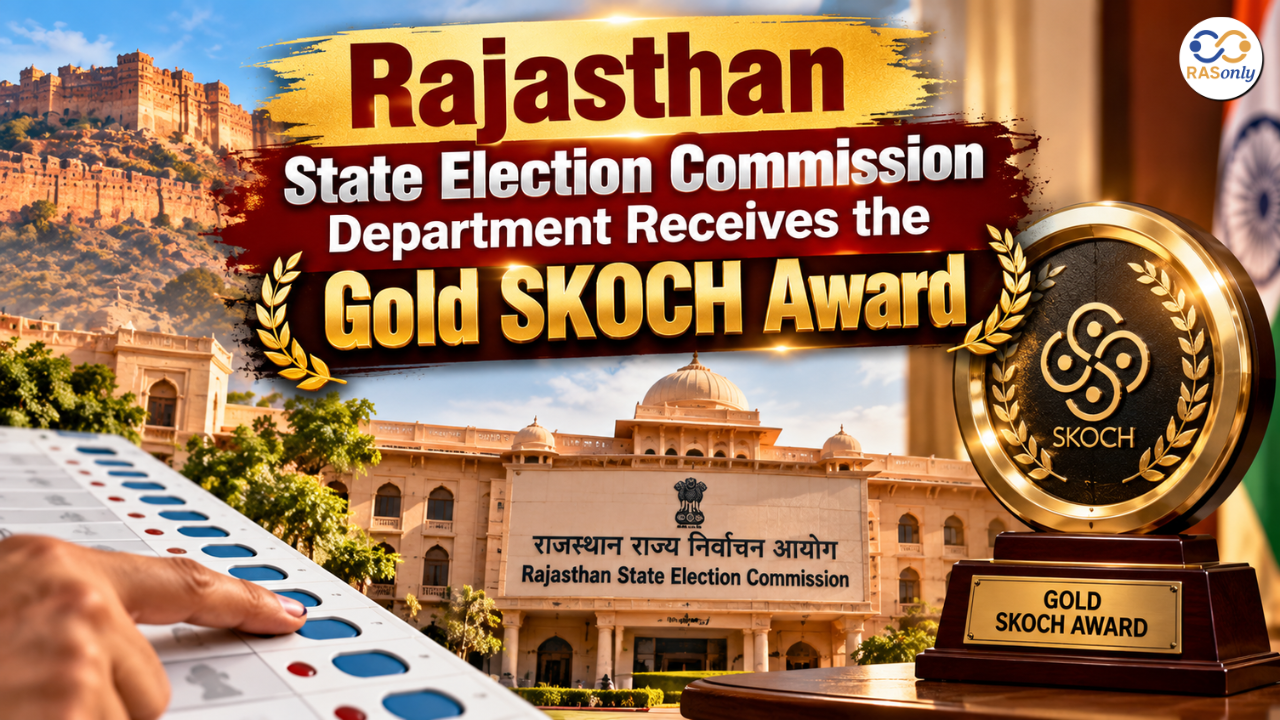
Rajasthan State Election Commission Wins Gold SKOCH Award
September 28, 2026
Tarang Shakti 2026
September 28, 2026
India Wins Gold in 10m Air Pistol
September 26, 2026