Kushan Empire: History, Rulers, Administration, Economy, Art, Decline
National Parks & Wildlife Sanctuaries Strategy for RAS 2026 Complete Guide

Get in Touch with RASonly!

Learn the complete National Parks & Wildlife Sanctuaries Strategy for RAS 2026 including Rajasthan wildlife, tiger reserves, endangered species, biodiversity conservation, Ramsar sites, maps, MCQs, and revision techniques. This detailed guide helps aspirants strengthen Environment and Geography preparation for RAS Prelims 2026.

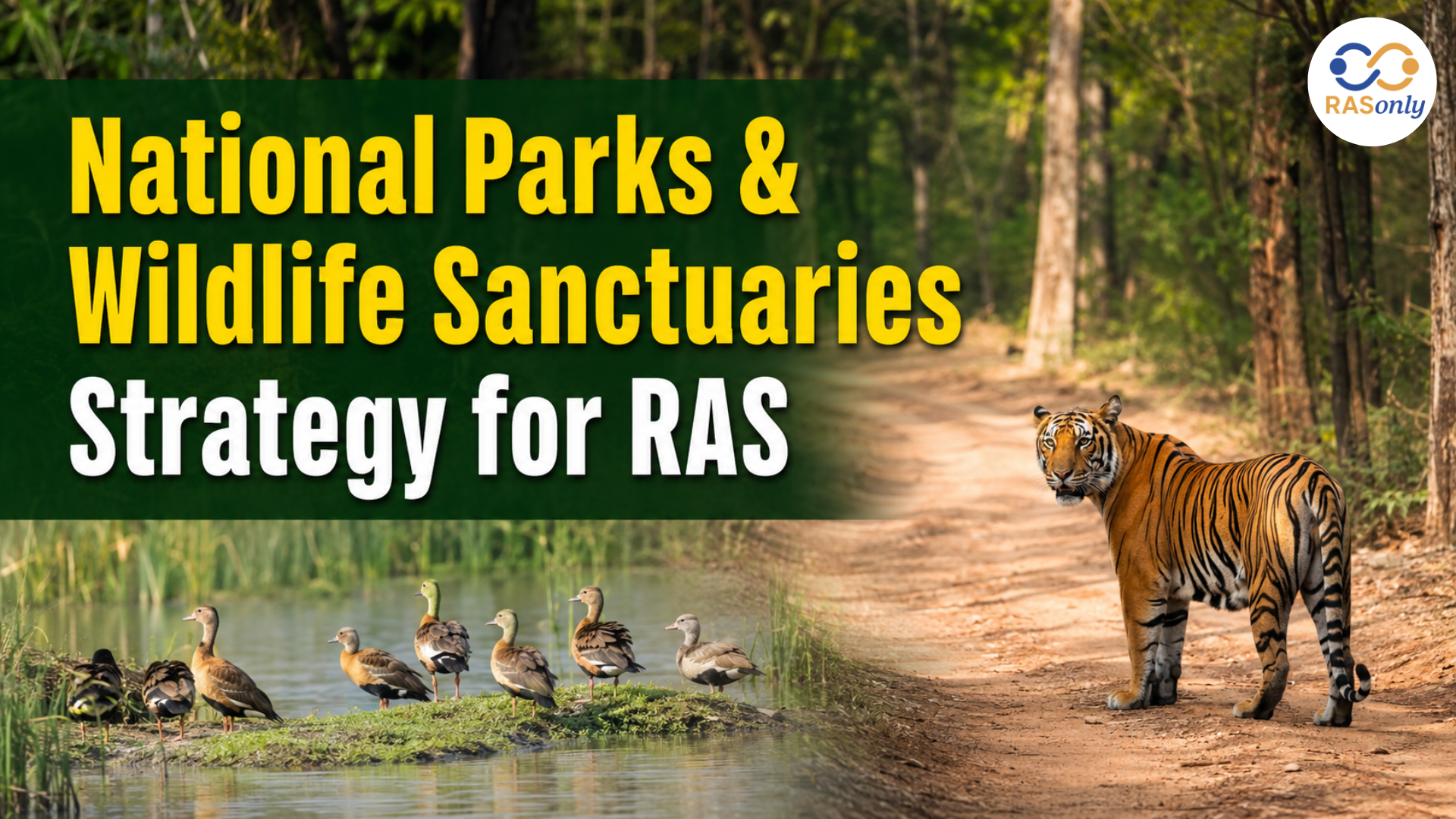
National Parks and Wildlife Sanctuaries are a significant part of the Environment and Rajasthan Geography section that is regularly examined for the RAS Prelims 2026 Exam. The weightage of Environment, Ecology, and Rajasthan wildlife topics has been steadily rising in the RAS exams in the past few years, and this is one of the crucial topics to score well in both RAS Prelims and Mains.
The preparation for Wildlife is confusing to many aspirants due to the presence of different National Parks, Wildlife Sanctuaries, Tiger Reserves, Species, and conservation projects in various States across India. But with the proper preparation strategy, such as Map Practice, Species-Location Linkage, Wildlife of Rajasthan, Conservation projects, Current affairs interconnection, and repeated MCQ revision, this section becomes one of the easiest and scoring sections of RAS Geography and Environment Preparation 2026.
Why National Parks & Wildlife Sanctuaries are Important for RAS 2026
In the environment and Rajasthan Geography section, questions are regularly asked on National Parks and Wildlife Sanctuaries, Tiger Reserves, Biodiversity Hot Spots, Endangered Species, Conservation Projects, Biosphere Reserves, and Ecological Conservation Mechanisms, making it one of the most significant sections of the Exam.
RAS frequently asks direct as well as statement-based questions about wildlife conservation, national parks, sanctuary locations, famous species, and Rajasthan biodiversity.
Benefits of Strong Wildlife Preparation
- Improves Environment & Ecology preparation
- Helps in Rajasthan Geography topics
- Useful for current affairs linkage
- Strengthens biodiversity concepts
- Helpful in both Prelims and Mains
- Scoring with map practice and revision
RAS National Parks & Wildlife Sanctuaries Syllabus 2026
National Parks and Wildlife Sanctuaries are mainly covered under Environment, Biodiversity, Ecology, Forests, Natural Vegetation, and Rajasthan Geography in the RAS syllabus. Questions are generally asked about protected areas, wildlife conservation, species distribution, and environmental organizations.
Important Wildlife Topics for RAS 2026
- National Parks of India
- Wildlife Sanctuaries
- Tiger Reserves
- Biosphere Reserves
- Ramsar Sites
- Endangered Species
- Project Tiger
- Project Elephant
- Rajasthan Wildlife
- Biodiversity Hotspots
- National Parks of Rajasthan
- Wildlife Conservation Laws
- Wildlife Protection Act 1972
- Environmental Conservation
Topic-Wise Importance Table
The effective preparation of National Parks and Wildlife Sanctuaries is significantly enhanced when one can study the topics in a systematic manner rather than memorizing facts randomly. The RAS questions are mostly map-oriented, species-oriented, and conservation-oriented, so there is an increasing need for more on maps, flagship species, concepts of biodiversity, and revision through MCQs and comparison tables.
| Topic | Preparation Focus |
|---|---|
| National Parks | Location, famous species & map practice |
| Wildlife Sanctuaries | State-wise wildlife mapping |
| Tiger Reserves | Tiger conservation & Project Tiger |
| Rajasthan Wildlife | Important parks, sanctuaries & species |
| Endangered Species | IUCN status & habitat regions |
| Biodiversity | Conservation concepts & environmental ecology |
Wildlife preparation becomes much easier and more scoring when studied through maps, species-location linkage, conservation projects, visual revision methods, and repeated MCQ practice.
Best National Parks & Wildlife Sanctuaries Preparation Strategy for RAS 2026
The preparation of wildlife topics cannot be random memorization, as protected areas, species, reserves, and environmental concepts are interrelated. A systematic preparation approach can truly help the aspirants to gain a lot of retention and understanding.
Smart Preparation Approach
- Start with biodiversity basics first
- Learn National Parks state-wise
- Focus on Rajasthan wildlife carefully
- Link species with protected areas
- Revise tiger reserves repeatedly
- Practice map-based MCQs regularly
- Prepare short revision notes weekly
Smart Wildlife Preparation Flow
| Step | Focus Area |
|---|---|
| Step 1 | Biodiversity basics |
| Step 2 | National Parks & Sanctuaries |
| Step 3 | Tiger reserves & species |
| Step 4 | Rajasthan wildlife |
| Step 5 | MCQs & revision |
National Parks Strategy for RAS 2026
National Parks are ecological zones that are extremely protected for wildlife conservation and the protection of biodiversity. Often asked questions include Park locations, Flagship species, States, and Conservation importance.
Important National Park Topics
- State-wise National Parks
- Famous species
- Tiger reserves
- Biosphere linkage
- UNESCO sites
- Ecological importance
Important National Parks Table
| National Park | State | Famous Species |
|---|---|---|
| Ranthambore | Rajasthan | Tiger |
| Kaziranga | Assam | One-horned Rhinoceros |
| Gir | Gujarat | Asiatic Lion |
| Jim Corbett | Uttarakhand | Tiger |
| Keoladeo | Rajasthan | Migratory Birds |
Smart Strategy
- Learn parks through India maps
- Link species with locations
- Revise tiger reserves repeatedly
- Practice state-wise MCQs regularly
India currently has more than 100 National Parks and hundreds of Wildlife Sanctuaries under biodiversity conservation mechanisms.
Wildlife Sanctuaries Strategy for RAS 2026
Protected areas are established primarily for the conservation of wildlife, with some human activities allowed under control. The questions that are frequently asked are Sanctuary locations, Species, Rajasthan sanctuaries, and Conservation importance.
Important Wildlife Sanctuary Topics
- Rajasthan Wildlife Sanctuaries
- Bird sanctuaries
- Tiger habitat regions
- Desert wildlife
- Wetland sanctuaries
Important Rajasthan Wildlife Sanctuaries
| Sanctuary | District | Important Species |
|---|---|---|
| Mount Abu Wildlife Sanctuary | Sirohi | Leopard |
| Nahargarh Wildlife Sanctuary | Jaipur | Leopard |
| Shergarh Wildlife Sanctuary | Baran | Sloth Bear |
| Ramsagar Wildlife Sanctuary | Dholpur | Wetland Wildlife |
| Jamwa Ramgarh Sanctuary | Jaipur | Dry deciduous fauna |
Smart Strategy
- Focus on Rajasthan sanctuaries carefully
- Learn district-wise wildlife mapping
- Revise species-location linkage
- Practice environment-based MCQs
Rajasthan National Parks & Wildlife Strategy
Rajasthan Wildlife is very important as RAS often asks questions related to Rajasthan National Parks, Tiger reserves, Desert Wildlife, Bird Sanctuaries and Biodiversity conservation.
Important Rajasthan Wildlife Areas
- Ranthambore National Park
- Keoladeo National Park
- Sariska Tiger Reserve
- Desert National Park
- Mount Abu Wildlife Sanctuary
- Nahargarh Wildlife Sanctuary
Important Rajasthan Wildlife Features
| Protected Area | Importance |
|---|---|
| Ranthambore | Tiger Reserve |
| Keoladeo | Bird Sanctuary |
| Desert National Park | Desert ecosystem |
| Sariska | Tiger conservation |
Smart Strategy
- Prepare Rajasthan wildlife separately
- Revise district-location mapping
- Focus on tiger reserves repeatedly
- Link Rajasthan current affairs with wildlife
Tiger Reserves Strategy for RAS 2026
Tiger reserves are among the highest-weightage wildlife topics in competitive exams because conservation-based questions are frequently asked.
Important Tiger Reserve Topics
- Project Tiger
- Core & buffer zones
- Rajasthan tiger reserves
- Tiger conservation
- NTCA
Important Tiger Reserves
| Tiger Reserve | State |
|---|---|
| Ranthambore | Rajasthan |
| Sariska | Rajasthan |
| Bandipur | Karnataka |
| Kanha | Madhya Pradesh |
Smart Strategy
- Revise tiger reserves state-wise
- Focus on Rajasthan tiger reserves
- Practice map-based MCQs
- Learn conservation projects carefully
Endangered Species Strategy for RAS 2026
Questions are regularly asked from endangered species, IUCN categories, flagship species, and biodiversity conservation.
Important Species to Prepare
- Tiger
- Asiatic Lion
- Great Indian Bustard
- Snow Leopard
- One-horned Rhinoceros
- Blackbuck
Smart Preparation Tips
- Learn species with habitats
- Focus on Rajasthan wildlife species
- Revise IUCN categories repeatedly
- Practice species-location MCQs
Wildlife Conservation Projects Strategy
Wildlife conservation projects are important because environment-related questions are increasingly linked with conservation initiatives.
Important Conservation Projects
- Project Tiger
- Project Elephant
- Crocodile Conservation Project
- Rhino Conservation
- Project Snow Leopard
Smart Strategy
- Learn project objectives carefully
- Link projects with species
- Revise conservation organizations
- Practice statement-based MCQs
Wildlife Protection Act & Environmental Laws Strategy
Environmental laws and biodiversity conservation mechanisms are increasingly important in RAS Prelims.
Important Topics
- Wildlife Protection Act 1972
- Biodiversity Act
- National Green Tribunal
- Forest Conservation
- Environmental Protection Mechanisms
Smart Strategy
- Focus on basic provisions only
- Revise wildlife protection categories
- Link laws with conservation
- Practice constitutional-environment MCQs
Map Practice Strategy for Wildlife Preparation
Map practice is one of the most important parts of wildlife preparation because many RAS questions are directly map-oriented.
Important Areas to Practice
- National Parks locations
- Wildlife Sanctuaries
- Tiger Reserves
- Rajasthan wildlife regions
- Biosphere reserves
Smart Map Practice Tips
- Practice blank India maps regularly
- Mark protected areas repeatedly
- Revise species-location linkage visually
- Practice Rajasthan wildlife mapping weekly
Best Note-Making Strategy for National Parks & Wildlife
Wildlife topics contain multiple parks, species, conservation projects, and locations, so proper short notes become extremely important for revision.
Smart Notes Strategy
- Prepare state-wise park notes
- Use species comparison tables
- Make wildlife maps
- Write one-line factual notes
- Revise notes weekly
Best Notes Format
| Notes Type | Purpose |
|---|---|
| Wildlife Maps | Better visual memory |
| Species Tables | Quick comparison |
| One-Line Facts | Final revision |
| Conservation Notes | Fast revision |
National Parks & Wildlife MCQ Practice Strategy
MCQ practice is essential because wildlife questions are mostly factual, conceptual, and map-based.
Best MCQ Practice Method
- Solve topic-wise MCQs daily
- Practice PYQs regularly
- Analyze wrong answers carefully
- Revise weak wildlife areas repeatedly
- Practice map-based questions
Important Focus Areas
- National Parks locations
- Tiger reserves
- Endangered species
- Rajasthan wildlife
- Conservation projects
Most Important Wildlife Topics for RAS 2026
Some wildlife topics are repeatedly asked in RAS Prelims because they form the foundation of Environment and Rajasthan Geography preparation.
High-Weightage Topics
- Rajasthan National Parks
- Wildlife Sanctuaries
- Tiger Reserves
- Project Tiger
- Endangered Species
- Ramsar Sites
- Biodiversity Conservation
Topic Priority Table
| Topic | Importance Level |
|---|---|
| Rajasthan Wildlife | Very High |
| National Parks | Very High |
| Tiger Reserves | High |
| Endangered Species | High |
| Conservation Projects | High |
Revision Strategy for National Parks & Wildlife
Revision is extremely important because park locations, species, reserves, and wildlife concepts are easy to confuse during the exam.
Smart Revision Tips
- Revise wildlife maps weekly
- Practice species charts regularly
- Use comparison tables
- Focus on repeated PYQ concepts
- Revise Rajasthan wildlife visually
Best Revision Cycle
| Revision Stage | Focus Area |
|---|---|
| First Revision | Wildlife concepts |
| Second Revision | Maps & species |
| Final Revision | MCQs & quick notes |
How Toppers Prepare National Parks & Wildlife for RAS
Most toppers prepare wildlife topics through maps, species comparison, conceptual clarity, current affairs linkage, and repeated MCQ practice instead of rote memorization.
Toppers’ Strategy
- Practice wildlife maps consistently
- Revise species repeatedly
- Focus on conceptual understanding
- Solve PYQs regularly
- Prepare short revision notes
What Makes Toppers Different?
- Better map practice
- Strong species retention
- Consistent revision habits
- Smart MCQ analysis
- Better current affairs linkage
Important Links
Conclusion
National Parks and Wildlife Sanctuaries are among the most important environmental and Rajasthan Geography topics for RAS Prelims 2026 because questions are regularly asked from protected areas, tiger reserves, biodiversity conservation, endangered species, Ramsar sites, and wildlife-related current affairs. This section becomes highly scoring when aspirants prepare it through maps, species-location linkage, conservation projects, and repeated MCQ practice instead of random memorization.
For Ras 2026, a smart approach to the wildlife topic should be based on wildlife in Rajasthan, National Parks, Wildlife Sanctuaries, Tiger Reserves, Endangered Species, Laws on conservation, and Biodiversity concepts. Generally, candidates who have been revising maps, protected areas, important plants and animals, and current affairs related to the environment do well in Geography and Environment.
FAQ
National Parks and Wildlife Sanctuaries are important because many Environment and Rajasthan Geography questions are directly asked from protected areas, tiger reserves, endangered species, and biodiversity conservation.
Rajasthan wildlife, National Parks, Wildlife Sanctuaries, Tiger Reserves, Ramsar Sites, Project Tiger, endangered species, and biodiversity conservation are the most important topics.
Focus on map practice, species-location linkage, Rajasthan wildlife, conservation projects, current affairs integration, MCQ practice, and repeated revision.
Yes, Rajasthan wildlife is extremely important because RAS frequently asks questions from Ranthambore, Sariska, Keoladeo, Desert National Park, and Rajasthan biodiversity.
The best revision method includes wildlife maps, species comparison tables, short notes, current affairs linkage, and repeated MCQ practice.
BEST SELLER
🏆 PRELIMS
RAS Pass
Prelims focused Hindi & English
₹399
✓
Prelims Topic-Wise Tests
✓
Subject-Wise Tests
✓
Full-Length Prelims Tests
✓
Daily Current Affairs Tests
✓
Prelims PYQs Tests
✓
Detailed Solutions & Analysis
✓
All Rajasthan Ranking
✓
Unlimited Reattempts
✓
Mains Tests
✓
Hindi & English Tests
✓
All Rajasthan Ranking
Trusted by 5,000+ Students

Post Category
- RAS Salary
- Result
- RAS Admit Card
- RAS Job
- RAS Cutoff
- Preparation Tips
- RAS Answer Key
- RAS Exam Analysis
- RAS Syllabus
- RAS Previous Year Papers
- RPSC RAS Exam Pattern
- RAS Interview
- RAS Exam Date
- RAS Vacancy
- RAS Test Series
- RAS Best Books
- RAS Preparation Resources
- RAS Coaching Centre
- History
- Polity
- Geography
- Economics
- Science
- Art and Culture
- RPSC RAS Application Form
- RPSC RAS Notification
- RAS Eligibility Criteria
- UPSC Exam
- RPSC RAS Mains
Visit Our RASonly Offline Center
Our Expert Faculty

Bhunesh Sir
Current Affairs · 13+ Yrs

Aamir Khan Sir
RAS-2017 · IIM Ahm.

Akash Sir
Polity · 8+ Yrs
Free Resources
Official Mobile App

RASOnly App
by OTSAdda · Free
Full Video Lectures
Mock Tests & PYQs
Daily Current Affairs
AI Mock Interview
Free Download · No subscription needed to install
RAS 2024 Toppers — RASonly
Rank 2
Virendra Charan
Rank 9
Bhoopinder Singh
Rank 26
Aanchal Nagpal
Rank 33
Lokendra Singh
Rank 45
Amar Rathore
Rank 46
Manasvini Verma

Join RASonly WhatsApp Community
Get daily current affairs, exam alerts, free study material and tips from expert faculty — right on WhatsApp.
Join for Free →RASonly Interview Guidance Program

Mr. Ashok Jain
Ex-Chief Secretary Govt of Rajasthan
- IAS officer of the 1981 batch, Rajasthan cadre.
- Passionate about mentoring the next generation of RAS officers with real-world insights.
- Got retired in Dec 2017 from the post of Chief Secretary of the state of Rajasthan.

Mr. Guru Charan Rai
Ex-ASP / SP in Jaisalmer
- Guru Charan Rai, IPS (Retd), retired as Inspector General of Police (Security), Rajasthan, Jaipur in 2017.
- Served as ASP and SP in Jaisalmer, Nagaur, Sri Ganganagar, Sawai Madhopur, Dausa, Sikar, and Karauli.
- He also held key positions as DIGP and IGP in the Law and Order division.

Mr. Rakesh Verma
Ex-IAS Officer, B.Tech, MBA, and M.A. (Economics)
- IAS officer of the 1981 batch and retired in Chief Secretary Rank.
- Civil servant of high repute and vast experience.
- Has been teaching UPSC CSE subjects for the last six years.



Daily Current Affairs for RAS Exam Preparation 2026

India Wins Gold in 10m Air Pistol
September 26, 2026
India’s Rank in Travel And Tourism Development Index 2026
September 26, 2026
India Wins Bronze Medal in Men’s Double Sculls
September 25, 2026