Central Information Commission (CIC), Power, RAS Notes
Central Information Commission (CIC), Power, RAS Notes

Get in Touch with RASonly!

The Central Information Commission (CIC), established under the RTI Act 2005, is India's apex statutory body ensuring transparency and accountability. Comprising a Chief Information Commissioner and up to 10 Information Commissioners, it hears second appeals, orders information disclosure, imposes penalties on erring CPIOs, and monitors RTI implementation across Central Public Authorities.

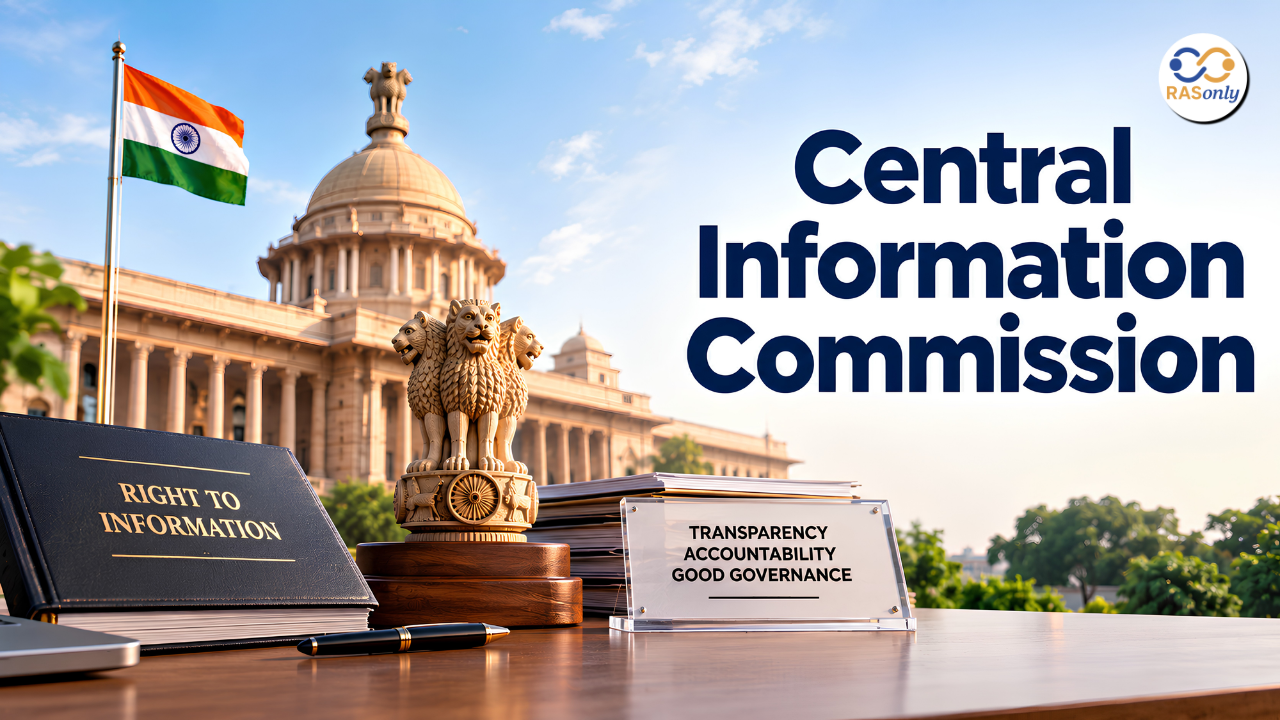
At the Central Government level, the apex statutory body for promoting transparency and enforcing the Right to Information (RTI) is the Central Information Commission (CIC). It came under the Right to Information Act, 2005, notified on 12 October 2005. The CIC hears second appeals and complaints from Central Public Authorities (CPIOs) and First Appellate Authorities (FAAs). It has significant functions, including access to information, requiring public authorities to make disclosures, investigating complaints and issuing penalties to responsible officials. The CIC has significant powers and functions that render it a key institution for transparency, accountability and good governance in India.
Central Information Commission
The Central Information Commission (CIC) is a statutory body set up under the Right to Information Act, 2005, with the aim of removing all official opacity and dishonesty in the activities of Central Public Authorities. It addresses access to information grievances and second appeals in the RTI process. The CIC direct disclosure of information, direct public authorities ought to improve their systems of information disclosure and that Central Public Information Officers (CPIOs) ought to be penalised in certain circumstances.
Composition
As per the RTI Act 2005, the CIC is made up of:
- Chief Information Commissioner (CIC)
- Such number of Information Commissioners (ICs), not exceeding 10, as may be deemed necessary.
The President of India appoints the Chief Information Commissioner and the Information Commissioners on the recommendations of a committee headed by the Prime Minister of India, which includes:
- Prime Minister: Chairperson
- Leader of Opposition in the Lok Sabha: Member
- The Member of the Union Cabinet appointed by the Prime Minister.
Qualifications
Persons of eminence in public life with broad knowledge and experience of the following types: the Chief Information Commissioner and Information Commissioners are:
- Law
- Science and technology
- Social service
- Management
- Journalism
- Mass media
- Administration and governance
They may not be members of Parliament or State Legislature and not be connected in any way to a political party, an office of profit, or follow any business or profession.
Tenure
- As per the amended RTI Act, 2019, the statutory tenure for an RTI is fixed at five years and has been removed. Instead, the term of office and service conditions are now determined by the Central Government in accordance with its rules.
- As per the provisions of the RTI, 2019, the term of office for the Chief Information Commissioner and Information Commissioners is of three years' duration.
Removal
The President can remove the Chief Information Commissioner or an Information Commissioner.
In the case of proved misbehaviour or incapacity, the President refers the matter to the Supreme Court, and removal can take place after the Supreme Court, following an inquiry, reports that the charge is established.
The President may also dismiss an Information Commissioner under certain conditions including:
- Being adjudged an insolvent.
- Criminal convictions for misconduct of a moral character.
- Working for pay in outside work.
- Being unfit, physically or mentally.
- Obtaining holdings, property or other interests that could be disadvantageous to official duties.
Powers and Functions
The Central Information Commission has the powers primarily as provided in the RTI Act, 2005.
- Accept and investigate complaints about access to information.
- Listen to second appeals against decisions of Central Public Information Officers and First Appellate Authorities.
- Educate a public authority on providing access to information in a legal manner, if allowed by law.
- Call for the creation of a CPIO from a public body or information in a specific format.
- Call for the improvement of record-keeping and the disclosure of information.
- Review the actions of a CPIO that denied or delayed information that should not have been denied or delayed.
- To punish a CPIO for violation of the RTI Act as provided for in it.
Powers of Civil Court
The CIC, on the initiation of an inquiry, has powers analogous to those of a civil court as per the provisions of the Code of Civil Procedure, 1908.
- Send for people; arrange to bring people.
- Conduct testimony under oath.
- Inspect and require discovery of documents.
- Get Affidavits of Evidence.
- Requisition public records.
- Sue, summon witnesses or documents for inspection
Penalty Power
The ability of the CIC to impose a fine on the concerned CPIO is one of the most potent powers of the CIC.
- refuses to receive an RTI application,
- Does not provide information on time, or
- wrongly refuses or rejects a request,
- deliberately provides false, incomplete or misleading information,
- destroys information requested under the Act,
Annual Report
CIC prepares an annual report on implementation of the RTI act to the Central Government. The report includes information regarding RTI applications, appeals, complaints and other aspects of implementation. The Central Government makes the report available to both Houses of Parliament.
Powers of Central Information Commission
The Central Information Commission (CIC) has significant powers under the Right to Information Act, 2005 for citizens to exercise their right to access information. Its powers primarily: relate to complaints; relate to second appeals; relate to inquiry; relate to disclosure of information; relate to penalties; and relate to monitoring the implementation of the RTI.
- Power to receive complaints: If a person has not been able to apply for an RTI, or they have been denied information, or they have not received the information within six months, or there are issues in getting information, then it may be submitted to the CIC, which will investigate the matter.
- Power to Hear Second Appeals: The CIC is a second appellate authority in matters relating to RTI in the case of a Central Public Authority. Those who are not satisfied with the order of the First Appellate Authority can go to the CIC.
- Power to Order Disclosure by CIC: The CIC has power to ask for disclosure by the Central Public Authority if it is legally permissible under the RTI Act.
- Power to make Inquiry: Power of the CIC to inquire into the complaint/appeal while deciding a case. Whilst undergoing such enquiry, it has powers equivalent to those of a civil court.
- Power to Summon Persons: The Commission can summon and enforce the attendance of persons and examine them on oath.
- Power to Call for Documents: The CIC may compel discovery and production of documents, evidence on an affidavit and requests for public records to be submitted.
- Power to Inspect Records: The Commission may review records that pertain to an RTI matter. This kind of documentation shall not be denied for the sole reason they are not accessible to the applicant.
- Right to give directions for corrective measures: The CIC can make directions with respect to methods and requirements, like the appointment of a Central Public Information Officer (CPIO), disclosure of certain information, strengthening records, etc.
- Power to impose Penalty: The CIC can sentence the CPIO against the violations of the RTI Act. This fine amounts to ₹250 per day (Maximum ₹25,000).
- Power to Recommend Disciplinary Action: If a CPIO commits a continuous or serious breach with respect to any provision of the RTI Act, the CIC can make a recommendation for disciplinary action in accordance with the appropriate service rules.
- Power to Monitor RTI Implementation: The CIC monitors the implementation of the RTI framework by Central Public Authorities and information on applications, appeals and complaints under RTI.
- Annual Report: The Annual Report of the CIC is a report which is prepared by the CIC and submitted to the Central Government once a year regarding implementation of the RTI Act. This report is then laid before both Houses of Parliament.
- Important Fact: The CIC does not have a constitutional status. It is a governmental organisation functioning as per the provisions of the Right to Information Act, 2005.
Also Read
| Citizens’ Charter in India | Public Policy |
| Legislature and Judiciary in India | Union Executive |
| Parliament of India | Ethical Governance in Rajasthan |
Central Information Commission - FAQs
The Central Information Commission (CIC) deals with complaints and second appeals under the Right to Information Act, 2005. It works to ensure access to information from Central Public Authorities and promotes transparency and accountability.
The President of India appoints the Chief Information Commissioner and Information Commissioners on the recommendation of a committee consisting of the Prime Minister, the Leader of the Opposition in the Lok Sabha and a Union Cabinet Minister nominated by the Prime Minister.
Under the RTI Rules, 2019, the Chief Information Commissioner and Information Commissioners hold office for three years from the date of entering office. The earlier fixed five-year tenure under the RTI Act was changed following the RTI (Amendment) Act, 2019.
The Chief Information Commissioner and Information Commissioners must be persons of eminence in public life with wide knowledge and experience in fields such as law, science and technology, social service, management, journalism, mass media, administration and governance.
No. The CIC is a statutory body established under the Right to Information Act, 2005.
BEST SELLER
🏆 PRELIMS
RAS Pass
Prelims focused Hindi & English
₹399
✓
Prelims Topic-Wise Tests
✓
Subject-Wise Tests
✓
Full-Length Prelims Tests
✓
Daily Current Affairs Tests
✓
Prelims PYQs Tests
✓
Detailed Solutions & Analysis
✓
All Rajasthan Ranking
✓
Unlimited Reattempts
✓
Mains Tests
✓
Hindi & English Tests
✓
All Rajasthan Ranking
Trusted by 5,000+ Students
Post Category
- RAS Salary
- Result
- RAS Admit Card
- RAS Job
- RAS Cutoff
- Preparation Tips
- RAS Answer Key
- RAS Exam Analysis
- RAS Syllabus
- RAS Previous Year Papers
- RPSC RAS Exam Pattern
- RAS Interview
- RAS Exam Date
- RAS Vacancy
- RAS Test Series
- RAS Best Books
- RAS Preparation Resources
- RAS Coaching Centre
- History
- Polity
- Geography
- Economics
- Science
- Art and Culture
- RPSC RAS Application Form
- RPSC RAS Notification
- RAS Eligibility Criteria
- UPSC Exam
- RPSC RAS Mains
Visit Our RASonly Offline Center
Our Expert Faculty

Bhunesh Sir
Current Affairs · 13+ Yrs

Aamir Khan Sir
RAS-2017 · IIM Ahm.

Akash Sir
Polity · 8+ Yrs
Free Resources
Official Mobile App

RASOnly App
by OTSAdda · Free
Full Video Lectures
Mock Tests & PYQs
Daily Current Affairs
AI Mock Interview
Free Download · No subscription needed to install
RAS 2024 Toppers — RASonly
Rank 2
Virendra Charan
Rank 9
Bhoopinder Singh
Rank 26
Aanchal Nagpal
Rank 33
Lokendra Singh
Rank 45
Amar Rathore
Rank 46
Manasvini Verma

Join RASonly WhatsApp Community
Get daily current affairs, exam alerts, free study material and tips from expert faculty — right on WhatsApp.
Join for Free →RASonly Interview Guidance Program

Mr. Ashok Jain
Ex-Chief Secretary Govt of Rajasthan
- IAS officer of the 1981 batch, Rajasthan cadre.
- Passionate about mentoring the next generation of RAS officers with real-world insights.
- Got retired in Dec 2017 from the post of Chief Secretary of the state of Rajasthan.

Mr. Guru Charan Rai
Ex-ASP / SP in Jaisalmer
- Guru Charan Rai, IPS (Retd), retired as Inspector General of Police (Security), Rajasthan, Jaipur in 2017.
- Served as ASP and SP in Jaisalmer, Nagaur, Sri Ganganagar, Sawai Madhopur, Dausa, Sikar, and Karauli.
- He also held key positions as DIGP and IGP in the Law and Order division.

Mr. Rakesh Verma
Ex-IAS Officer, B.Tech, MBA, and M.A. (Economics)
- IAS officer of the 1981 batch and retired in Chief Secretary Rank.
- Civil servant of high repute and vast experience.
- Has been teaching UPSC CSE subjects for the last six years.


Daily Current Affairs for RAS Exam Preparation 2026

Shyam Sunder Swami Wins Bronze at World Archery Para...
September 14, 2026
Viksit Bharat Jan Seva Abhiyan 2026
September 14, 2026
Rajasthan Universities in the QS World University Rankings 2027
September 12, 2026