Gupta Empire, Founder, Time Period, Rulers, Map, Capital City
Legislature and Judiciary in India: Structure, Powers and Functions

Get in Touch with RASonly!

Legislature and Judiciary in India are key constitutional organs responsible for law-making, justice, rights protection and constitutional governance. Learn their structure, powers, functions, judicial review, writ jurisdiction, separation of powers and functional overlap under the Indian Constitution.

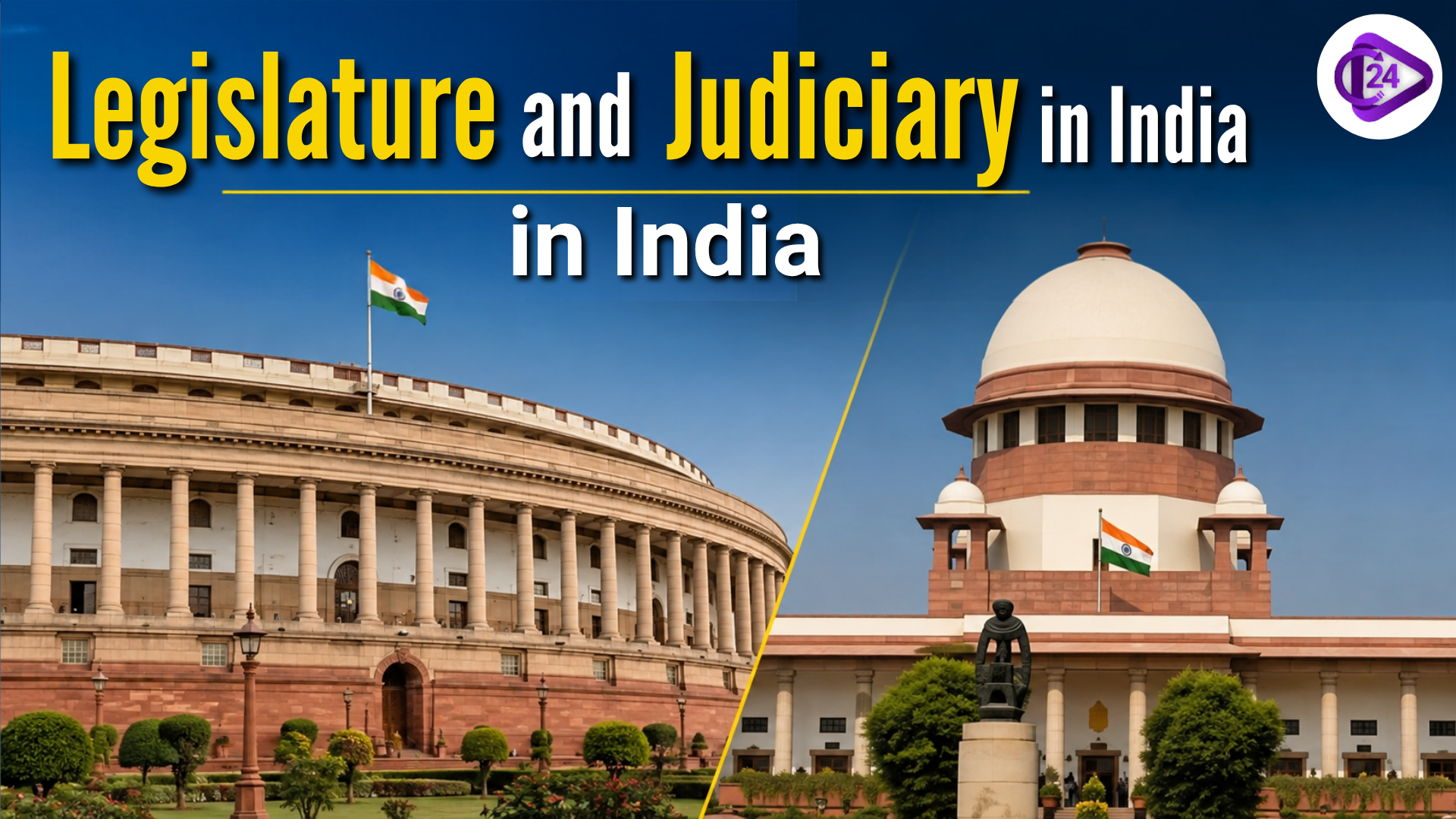
Indian Constitution recognises the Legislature and Judiciary as important organs of constitutional development. Legislature primarily deals with making laws and exercising democratic control of the Executive, whereas the Judiciary interprets laws, adjudicates disputes, preserves Fundamental Rights and defends the Constitution.
Indian Constitution does not create an entirely watertight division between the Legislature, Executive and Judiciary. Rather, it establishes a functional separation of powers with checks and balances. Every organ has its main area of power; some powers are intentionally overlapping to hold each other accountable and to be governed by a constitution.
The Parliament is the Legislature at the Union level, while the Judiciary is headed by the Supreme Court of India. At the State level, legislative powers are exercised by State Legislatures and judicial functions are mainly performed through High Courts and subordinate courts.
Legislature in India
The Legislature is a primary law-making organ of government. These functions include law-making, financial oversight, representation and broad deliberation and accountability of the Executive.
Article 79: Parliament is a body consisting of the President and the two Chambers of Parliament: Rajya Sabha and Lok Sabha
The State Legislature is composed of the Governor and two houses: a lower house (Legislative Assembly) in all states, and an upper house (Legislative Council) in those with bicameral legislatures.
In the Constitution, the Seventh Schedule divides legislative subjects between the Union and the States, containing three Lists: the Union List; the State List; and the Concurrent List.
Structure of the Legislature
India has legislatures at both Union and State levels.
| Level | Institution | Composition |
|---|---|---|
| Union | Parliament | President, Lok Sabha, Rajya Sabha |
| State | State Legislature | Governor, Legislative Assembly |
| Bicameral State | State Legislature | Governor, Legislative Assembly, Legislative Council |
Parliament of India
Parliament is the highest legislative body at the Union level. Although both Houses are engaged in law-making, their constitutional power in some areas is not the same.
Lok Sabha is a direct representation of the people; Rajya Sabha, of the States and Union Territories.
Article 79 of the Constitution states that the Parliament has a distribution of executive and associated legislative powers with the President of India.
Lok Sabha
- The Lok Sabha, or House of the People, is the only directly elected House of Parliament.
- For the most part, it has a constitutional relationship with the Council of Ministers. The Council of Ministers is collectively responsible to the Lok Sabha as per Article 75(3).
- This means that the Union government needs to maintain the trust of the Lok Sabha to remain in office.
- Money Bill can only be introduced in the Lok Sabha. Normally, after a Money Bill is passed by lok sabha, the Rajya Sabha may make recommendations within the period prescribed under the Constitution, but lok sabha are not obliged to accept such recommendations.
Rajya Sabha
- It is the Upper House in Parliament, i.e. the Council of States (Rajya Sabha).
- It represents the States and Union Territories. Unlike Lok Sabha, Rajya Sabha is a permanent House not subject to dissolution.
- Every two years, one-third of its members retire.
- The Rajya Sabha has also special constitutional powers. Under Article 249, it may authorise Parliament to legislate on a matter in the State List when that legislation is in the national interest.
- Article 312 enables the Rajya Sabha to notify Parliament to make law for the creation of one or more All India Services common to the Union and States.
Powers of the Legislature
The Legislature also has some constitutional authority over other areas such as law, finance, administration and public policy.
Legislative Powers
- The Legislature primarily has the power of law-making in its field as prescribed by the Constitution.
- Parliament makes laws in respect of the subjects enumerated in the Union List and, subject to the provisions of this Constitution, also on subjects in the Concurrent List. The main subjects of legislation for State Legislatures are the State List and the Concurrent List.
- A Bill goes through multiple stages during the process of legislative progress, including Introduction, Discussion, Consideration, Voting and, where applicable, Passage in both Houses before it is laid before the President for assent.
Financial Powers
- The Legislature has exercised significant control over public finances.
- Annual Financial Statement is presented by the Union Government before Parliament under Article 112.
- Government expenditure is examined by Parliament. Lok Sabha votes on Demands for Grants; Rajya Sabha may discuss, but does not vote.
- Parliament controlling tax and public spending ensures that taxpayers' money cannot be spent outside the Constitution.
Power to Control the Executive
- The Legislature is an essential mechanism of accountability for the Executive.
- Members of Parliament can question, debate and hold the government to account through various parliamentary procedures.
- This accountability largely depends on the collective responsibility of the Council of Ministers to the Lok Sabha.
Constitutional Amendment Power
- Article 368 empowers Parliament to amend the Constitution.
- The Basic Structure Doctrine of the Supreme Court says and lays down that Parliament cannot exercise its amending power to destroy the basic structure of the Constitution.
- This is not to say that Parliament does not have vast constituent power, but such powers do have some limits.
Functions of the Legislature
Several interrelated roles are played by the legislature in India's constitutional structure.
Law-Making Function
The Legislature provides the legal rules for how matters public and private will be handled. The Parliament and State Legislatures have the right to make laws in areas such as taxation, administration, criminal justice, economic activity and social welfare.
Representative Function
The Legislature plays a role of representation for its citizenry and expresses, through the Rajya Sabha and State-level institutions, the federal character of India.
Deliberative Function
Discussing matters of public importance, Parliament and State Legislatures provide a forum. Members can debate on issues about governance, economy, development, national security and public administration.
Financial Function
The Legislature oversees expenditures and taxes. It is therefore an essential protection from the public money being used arbitrarily.
Accountability Function
The actions and policies of the Executive are reviewed by the Legislature, largely through questions, debates and motions, as well as in legislative committees.
Judiciary in India
The judiciary is the organ responsible for administering justice, interpreting laws and resolving disputes.
India has an Integrated Judicial system with the Supreme Court at the top level, High Courts and below them, subordinate courts.
The Judiciary, in which you have been trained, is a different institution from the Legislature or at least, it ought to be. Its primary role is to appropriately resolve legal controversies under the Constitution and laws.
Structure of the Judiciary
The Indian judicial system broadly consists of three levels:
Supreme Court of India
- The Supreme Court of India is the highest judicial forum and final court of appeal under the Constitution of India.
- It is established by Article 124. Supreme Court judges retire at 65 of age.
- There are different types of jurisdiction exercised by the Supreme Court, such as Original, Appellate, Writ, Advisory and Special Leave jurisdiction.
High Courts
- At the state level, High Courts are the High Constitutional Courts.
- They have original and appellate jurisdiction in cases specified by the Constitution and laws. They also oversee lower courts within their territory.
- High Courts have power under Article 226 to issue writs for enforcement of Fundamental Rights as well as for other purposes.
Subordinate Judiciary
- The basis of the judiciary system is the district and lower courts.
- Most civil and criminal cases are handled by them, and they are the first level of access to justice.
- Above the subordinate judiciary are also the High courts that have powers of supervision over it.
Powers of the Judiciary
Various constitutional powers are exercised by the Judiciary to protect rights and sustain the rule of law.
Judicial Review
- Judicial review is the power of constitutional courts have jurisdiction to decide whether or not legislative and executive actions conform with the Constitution.
- Courts are empowered to disallow the implementation of legislation or executive action in violation of constitutional provisions and grant relief.
Writ Jurisdiction
The Supreme Court exercises writ jurisdiction under Article 32, while High Courts exercise writ jurisdiction under Article 226.
- The five constitutional writs are:
- Habeas Corpus
- Mandamus
- Prohibition
- Certiorari
- Quo Warranto
Original Jurisdiction
Article 131 provides that the Supreme Court shall have exclusive original jurisdiction in any dispute between the Union and one or more States, or between two or more States if such a dispute involves a legal right.
This jurisdiction in India assumes special significance for preserving constitutional relations in a federal system.
Appellate Jurisdiction
- The Supreme Court is the highest appellate court in India.
- It hears appeals in matters of the Constitution, civil and criminal aspects prescribed by the Constitution and relevant laws.
- The Court has the power to grant Special Leave under Article 136, which is an appealable judgment/order or decision of the courts and tribunals in India.
Legislature and Executive: Separation and Functional Overlap
The Constitution contains separate provisions dealing with Parliament and the Executive.
Article 79 establishes Parliament, while Articles 53 and 74 deal with the Union Executive and the Council of Ministers.
However, the parliamentary system itself creates significant functional overlap.
| Separation of Powers | Functional Overlap |
|---|---|
| Article 79 establishes Parliament. | Article 123 allows the President to promulgate Ordinances when Parliament is not in session. |
| Articles 107–117 establish important legislative and financial procedures. | Delegated legislation allows the Executive to make rules and regulations under authority granted by legislation. |
| Articles 53 and 74 provide for the Union Executive. | Under Article 75, the Council of Ministers is collectively responsible to Lok Sabha. |
| Parliament performs legislative functions. | The President is an integral part of Parliament under Article 79 while exercising executive powers under Article 53. |
Judicial Activism and Functional Overlap
- Judicial activism is one of the more prominent realms where the Judiciary and Legislature interact.
- Judicial activism is a broad term for cases where courts take an expansive interpretation of constitutional rights (greater than what existing laws would provide) or simply rely on the Constitution to issue remedies (where no other legal remedy exists).
- An important case is Vishaka v. State of Rajasthan (1997)
- The Vishaka judgment by the Supreme Court provides guidelines based on what constitutes sexual harassment at work, as there was no specific comprehensive legislation.
- These guidelines continued to be the statutory law of the land till Parliament passed the Sexual Harassment of Women at Workplace (Prevention, Prohibition and Redressal) Act, 2013.
Legislature and Judiciary in India: Key Takeaways
Some fundamental principles would help us understand the constitutional relationship between our Legislature and Judiciary.
- Laws are made by the Legislature (legislation); they are interpreted and applied by the Judiciary.
- Parliament consists of the President, Lok Sabha and Rajya Sabha.
- Rajya Sabha is a permanent House
- Lok Sabha, a Money Bill can be introduced.
- The Council of Ministers are collectively responsible to the Lok Sabha
- The Supreme Court is the highest court of India.
- The retirement age of the judges of the Supreme Court is 65 years, and the High Court is 62 years.
- Article 32 is a right to remedy for enforcement of Fundamental Rights.
- High Courts have writ jurisdiction under Article 226 for Fundamental Rights and other matters.
- The law declared by the Supreme Court binds all courts in India under Article 141.
- Article 143 provides advisory jurisdiction.
- Article 368 the amendment of the Constitution.
- Separation of the Judiciary from the Executive: In State public services, Article 50 of the Constitution provides for it.
- India does not have a watertight separation of powers, but follows an approach of functional separation and checks and balances.
Also Read
| Parliament of India | Supreme Court and Judicial Review |
| Indian Polity Notes for RAS | Indian Polity Topic Wise Questions |
| RAS Polity Questions | President of India |
Legislature and Judiciary in India: FAQs
The Legislature is the law-making organ of the government. At the Union level, Parliament consists of the President, Lok Sabha and Rajya Sabha under Article 79.
The Judiciary is responsible for interpreting laws, resolving disputes, protecting Fundamental Rights and ensuring that legislative and executive actions remain within constitutional limits. The Supreme Court is the highest in India.
The major functions of the Legislature include making laws, approving public expenditure, imposing taxation, representing citizens, debating public issues and holding the Executive accountable.
The Judiciary performs functions such as dispute resolution, constitutional interpretation, judicial review, protection of Fundamental Rights and interpretation and application of laws.
Separation of powers means the distribution of governmental functions among the Legislature, Executive and Judiciary. In India, this separation is not completely rigid or watertight; the Constitution permits certain functional overlaps and establishes checks and balances.
BEST SELLER
🏆 PRELIMS
RAS Pass
Prelims focused Hindi & English
₹399
✓
Prelims Topic-Wise Tests
✓
Subject-Wise Tests
✓
Full-Length Prelims Tests
✓
Daily Current Affairs Tests
✓
Prelims PYQs Tests
✓
Detailed Solutions & Analysis
✓
All Rajasthan Ranking
✓
Unlimited Reattempts
✓
Mains Tests
✓
Hindi & English Tests
✓
All Rajasthan Ranking
Trusted by 5,000+ Students
Post Category
- RAS Salary
- Result
- RAS Admit Card
- RAS Job
- RAS Cutoff
- Preparation Tips
- RAS Answer Key
- RAS Exam Analysis
- RAS Syllabus
- RAS Previous Year Papers
- RPSC RAS Exam Pattern
- RAS Interview
- RAS Exam Date
- RAS Vacancy
- RAS Test Series
- RAS Best Books
- RAS Preparation Resources
- RAS Coaching Centre
- History
- Polity
- Geography
- Economics
- Science
- Art and Culture
- RPSC RAS Application Form
- RPSC RAS Notification
- RAS Eligibility Criteria
- UPSC Exam
- RPSC RAS Mains
Visit Our RASonly Offline Center
Our Expert Faculty

Bhunesh Sir
Current Affairs · 13+ Yrs

Aamir Khan Sir
RAS-2017 · IIM Ahm.
Akash Sir
Polity · 8+ Yrs
Free Resources
Official Mobile App

RASOnly App
by OTSAdda · Free
Full Video Lectures
Mock Tests & PYQs
Daily Current Affairs
AI Mock Interview
Free Download · No subscription needed to install
RAS 2024 Toppers — RASonly
Rank 2
Virendra Charan
Rank 9
Bhoopinder Singh
Rank 26
Aanchal Nagpal
Rank 33
Lokendra Singh
Rank 45
Amar Rathore
Rank 46
Manasvini Verma

Join RASonly WhatsApp Community
Get daily current affairs, exam alerts, free study material and tips from expert faculty — right on WhatsApp.
Join for Free →RASonly Interview Guidance Program

Mr. Ashok Jain
Ex-Chief Secretary Govt of Rajasthan
- IAS officer of the 1981 batch, Rajasthan cadre.
- Passionate about mentoring the next generation of RAS officers with real-world insights.
- Got retired in Dec 2017 from the post of Chief Secretary of the state of Rajasthan.

Mr. Guru Charan Rai
Ex-ASP / SP in Jaisalmer
- Guru Charan Rai, IPS (Retd), retired as Inspector General of Police (Security), Rajasthan, Jaipur in 2017.
- Served as ASP and SP in Jaisalmer, Nagaur, Sri Ganganagar, Sawai Madhopur, Dausa, Sikar, and Karauli.
- He also held key positions as DIGP and IGP in the Law and Order division.

Mr. Rakesh Verma
Ex-IAS Officer, B.Tech, MBA, and M.A. (Economics)
- IAS officer of the 1981 batch and retired in Chief Secretary Rank.
- Civil servant of high repute and vast experience.
- Has been teaching UPSC CSE subjects for the last six years.
Related Post

Daily Current Affairs for RAS Exam Preparation 2026

Khelo Rajasthan Campaign
October 09, 2026
Apache Helicopters 30 mm Chain Gun Tested for Aerial...
October 09, 2026
CM Bhajan Lal Sharma Launches Rajasthan Portals
October 08, 2026