Chola Dynasty: Capital, Founder, Kings, Time Period and History
Citizen’s Charter in India: Meaning, Features, Principles, Importance, Challenges

Get in Touch with RASonly!

Citizen's Charter in India, launched in 1997, promotes citizen-centric governance through transparency, accountability, and defined service standards. It outlines government departments' service timelines, grievance redressal mechanisms, and citizen responsibilities. Built on six core principles, it enhances public service delivery despite challenges like weak implementation and lack of legal enforceability, making it a key administrative reform tool.

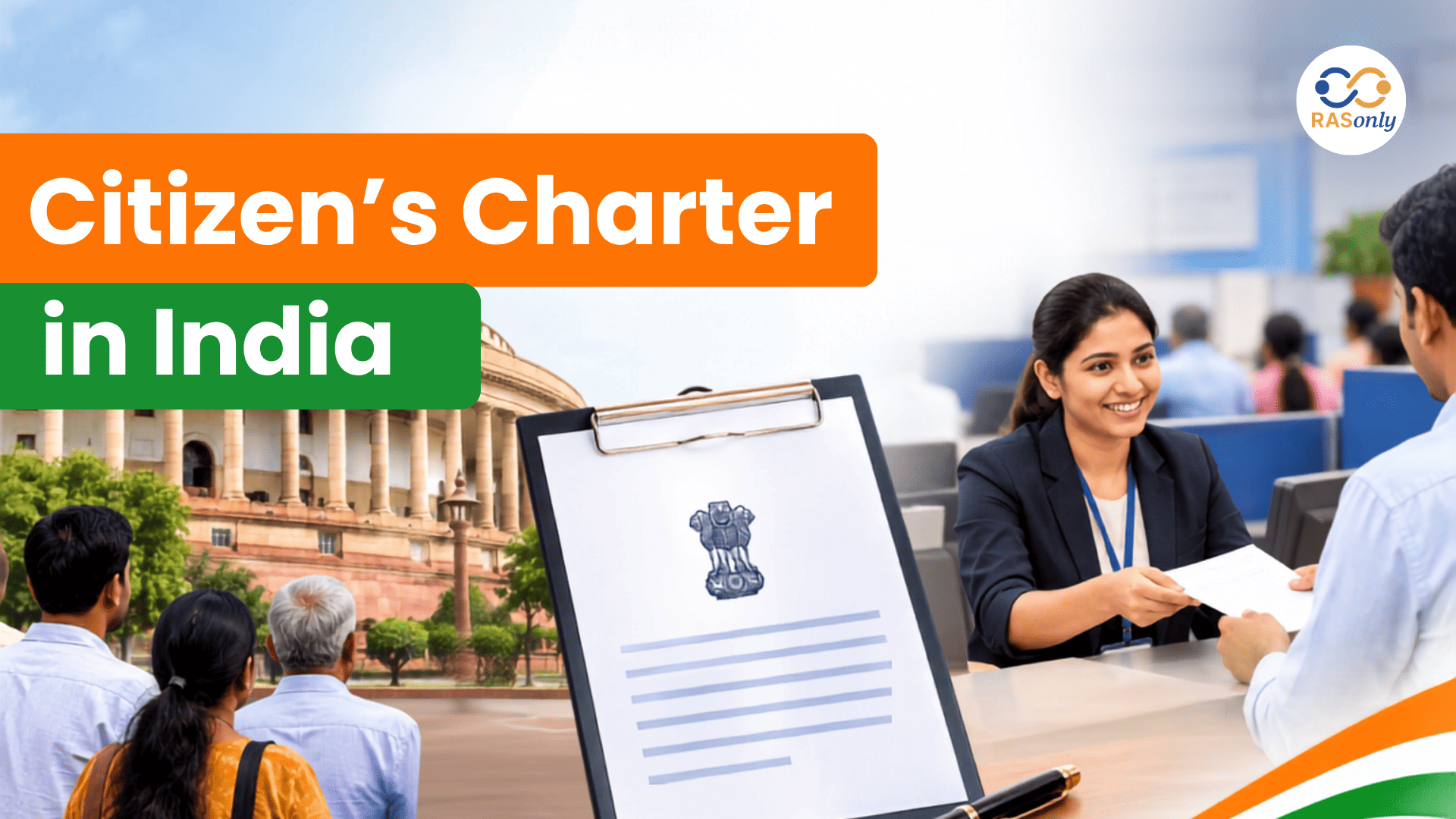
Citizen's Charter is an important tool for boosting citizen-centric governance through the quality, transparency and accountability of public services. It outlines a government department's standards, timings, and citizens' duties. The Citizen's Charter was introduced after the Action Plan for Effective and Responsive Government in 1997. The initiative seeks to improve public administration's responsiveness to the people by articulating their expectations from public service providers. A Citizen's Charter, used correctly, can enhance accountability, transparency, service and public satisfaction, and is a useful tool in good governance and administrative reform in India.
Features of Citizen’s Charter in India
- Citizen-Centric Approach: In a Citizen's Charter, citizens are put at the heart of public administration and the citizens' experience when using public administration services.
- Service Standards: The Charter defines the expected (level of) quality, the level of performance and service delivery norms to assist citizens in understanding what they can expect from receiving services.
- Time-Bounded Delivery: It sets time expectations for critical public services, helping minimise avoidable delays.
- A Citizen's Charter on 'Grievance Redressal' provides information on the process that citizens can use to complain if services are being delivered late
- Transparency: Information on procedures, acceptance criteria, documents, fees and service requirements is easily available to citizens.
- Accountability: Service administrative accountability because departments are held accountable for the services they have committed to.
- Citizen Responsibilities: Indian Citizens' Charters can also define the responsibilities and obligations citizens can be expected to do when using public services.
- Feedback Mechanism: Citizen feedback is solicited to help identify areas for improvement and enhance service delivery quality.
- Periodic Review: Charters need to be revised and updated regularly to accommodate shifting administrative needs.
- In 1997, India launched a Citizen's Charter initiative as a step towards responsive, transparent and citizen-oriented administration
Principles of Citizen’s Charter in India
The Citizen's Charter is built around six key principles which seek to make public services more transparent, responsive and citizen-friendly:
- Published Standards: Government Departments should articulate the standards for services available to the public and also specify quality and time of service delivery.
- Access to Rules, Procedures, Eligibility, Fees, Services and Grievance: Citizens are easily able to access relevant information on rules, procedures, eligibility, fees, services and grievance. Citizens and administration benefit from reduced information gap through transparency.
- Ensuring citizens receive courtesy and helpfulness: when citizens interact directly with government facilities, they expect public officials to be courteous, respectful and helpful.
- Public Services: Public services are largely funded using public resources and the taxpayer's money, and should be delivered efficiently and responsibly.
Importance of Citizen’s Charter in India
- Enhances Public Service Delivery: A Citizen's Charter clearly outlines the services citizens can expect and the expected delivery timeframes, helping departments deliver high-quality service.
- Enhances transparency: It provides citizens with access to important information on procedures, eligibility, fees, and document and service standards.
- Makes Service Levels Public: Departments promise a particular level of service; citizens will be able to see if it has been delivered.
- Improves the identification of unnecessary delays: Setting time limits for services helps to identify delays that don't need to occur, pushing officials to implement defined service delivery standards.
- Reduces Administrative Delays: citizens to complain when a service is delayed, denied or not up to standard.
- Provides Grievance Redressal: The Charter empowers citizens by giving them information on their rights, services available and complaint processes, allowing them to interact with government offices with increased confidence.
- Enables Citizen-centred Governance: It focuses the administration away from procedure and towards addressing citizens' needs and expectations.
- Supports Better Official-Citizen Relations: In the spirit of courtesy and helpfulness, citizens are treated with the greatest respect at the points by which the government delivers services.
- Promotes Continuous Improvement: Departments can learn about areas that might need to be adjusted by listening to Citizen feedback, complaints and service-performance reviews.
- Important Indian Reform: The Citizens Charter initiative in India was launched in 1997 as an important reform in the public administration with an aim of making it more responsive and citizen-oriented.
Challenges of the Citizen’s Charter in India
- Lacking Legal Enforceability: Citizen's Charters are administrative, not a legally enforceable right. Citizens have few remedies if service levels are not met.
- Citizens have inadequate awareness of services, hours, and grievance processes described in Charters; much of this is due to a lack of awareness in rural and disadvantaged communities.
- Unrealistic Service Standards: Departments set both general and results targets and do not consider the workloads, staffing levels, infrastructure and “ground” capability, etc.
- Weak Implementation: The presence of a Charter does not necessarily improve service delivery when preparing it and publishing it. In a few instances, implementation and monitoring are poor.
- Insufficient Citizen Consultation: Citizens and real service users are not always fully consulted when drawing up or amending Charters, which can mean some promises are less about what happens in reality.
- Lack of measurable indicators and evaluation makes it difficult to find out whether the departments are achieving their stated standards of performance; this may be improving by default if no one is monitoring.No measurable standards of performance are being achieved or known at regular intervals - this may be improving by default if there is no monitoring in place.
- Poorly Staffed or Lacking Resources: A lack of staffing, facilities, tools and funding can result in departments failing to achieve promised service-delivery timelines.
- Resistance to Administrative Change: Institutions and officials oppose increased levels of transparency, performance monitoring and citizen feedback if used more than they are used now.
- Periodic updating: Only some Charters are periodically updated in response to law, tech, procedures and citizens.
- One-Size-Fits-All Approach: This approach is not appropriate for the needs of departments, regions and categories of public services.
- Weak Feedback Mechanism: Citizen feedback is not always gathered, analysed and used in service delivery reforms.
Also Read
| Ethical Governance in Rajasthan | Public Policy |
| Local Self-Government in India | Panchayati Raj System in Rajasthan |
| Legislature and Judiciary in India | Fundamental Rights – Articles 12 to 35 |
Frequently Asked Questions on Citizen’s Charter in India
A Citizen’s Charter is a public document that specifies the services provided by a government department, expected service standards, delivery timelines, grievance redressal mechanisms and responsibilities of citizens.
The Citizen’s Charter initiative was launched in 1997 as part of efforts to make public administration more responsive, transparent and citizen-centric.
Its main objective is to improve public service delivery by establishing clear service standards, increasing transparency and accountability, and providing mechanisms for citizen feedback and grievance redressal.
The six core principles are Published Standards, Openness and Information, Choice and Consultation, Courtesy and Helpfulness, Redress and Value for Money.
The Department of Administrative Reforms and Public Grievances (DARPG) under the Ministry of Personnel, Public Grievances and Pensions has played a key role in promoting and guiding the Citizen’s Charter initiative at the Union Government level.
BEST SELLER
🏆 PRELIMS
RAS Pass
Prelims focused Hindi & English
₹399
✓
Prelims Topic-Wise Tests
✓
Subject-Wise Tests
✓
Full-Length Prelims Tests
✓
Daily Current Affairs Tests
✓
Prelims PYQs Tests
✓
Detailed Solutions & Analysis
✓
All Rajasthan Ranking
✓
Unlimited Reattempts
✓
Mains Tests
✓
Hindi & English Tests
✓
All Rajasthan Ranking
Trusted by 5,000+ Students
Post Category
- RAS Salary
- Result
- RAS Admit Card
- RAS Job
- RAS Cutoff
- Preparation Tips
- RAS Answer Key
- RAS Exam Analysis
- RAS Syllabus
- RAS Previous Year Papers
- RPSC RAS Exam Pattern
- RAS Interview
- RAS Exam Date
- RAS Vacancy
- RAS Test Series
- RAS Best Books
- RAS Preparation Resources
- RAS Coaching Centre
- History
- Polity
- Geography
- Economics
- Science
- Art and Culture
- RPSC RAS Application Form
- RPSC RAS Notification
- RAS Eligibility Criteria
- UPSC Exam
- RPSC RAS Mains
Visit Our RASonly Offline Center
Our Expert Faculty

Bhunesh Sir
Current Affairs · 13+ Yrs

Aamir Khan Sir
RAS-2017 · IIM Ahm.

Akash Sir
Polity · 8+ Yrs
Free Resources
Official Mobile App

RASOnly App
by OTSAdda · Free
Full Video Lectures
Mock Tests & PYQs
Daily Current Affairs
AI Mock Interview
Free Download · No subscription needed to install
RAS 2024 Toppers — RASonly
Rank 2
Virendra Charan
Rank 9
Bhoopinder Singh
Rank 26
Aanchal Nagpal
Rank 33
Lokendra Singh
Rank 45
Amar Rathore
Rank 46
Manasvini Verma

Join RASonly WhatsApp Community
Get daily current affairs, exam alerts, free study material and tips from expert faculty — right on WhatsApp.
Join for Free →RASonly Interview Guidance Program

Mr. Ashok Jain
Ex-Chief Secretary Govt of Rajasthan
- IAS officer of the 1981 batch, Rajasthan cadre.
- Passionate about mentoring the next generation of RAS officers with real-world insights.
- Got retired in Dec 2017 from the post of Chief Secretary of the state of Rajasthan.

Mr. Guru Charan Rai
Ex-ASP / SP in Jaisalmer
- Guru Charan Rai, IPS (Retd), retired as Inspector General of Police (Security), Rajasthan, Jaipur in 2017.
- Served as ASP and SP in Jaisalmer, Nagaur, Sri Ganganagar, Sawai Madhopur, Dausa, Sikar, and Karauli.
- He also held key positions as DIGP and IGP in the Law and Order division.

Mr. Rakesh Verma
Ex-IAS Officer, B.Tech, MBA, and M.A. (Economics)
- IAS officer of the 1981 batch and retired in Chief Secretary Rank.
- Civil servant of high repute and vast experience.
- Has been teaching UPSC CSE subjects for the last six years.
Related Post




Daily Current Affairs for RAS Exam Preparation 2026

Ustad Bismillah Khan Yuva Puraskar
October 24, 2026
Marwar Festival 2026
October 24, 2026
Kundan Art Display in Hong Kong
October 23, 2026