Gupta Empire, Founder, Time Period, Rulers, Map, Capital City
High-Weightage Subjects in RAS 2026: Complete Guide

Get in Touch with RASonly!

Discover high-weightage subjects in RAS 2026, including Rajasthan GK, History, Polity, Geography, Economy, Science, and Current Affairs. Explore Prelims and Mains exam patterns, subject-wise preparation strategies, previous year paper analysis, study plans, and revision tips for effective RAS preparation.

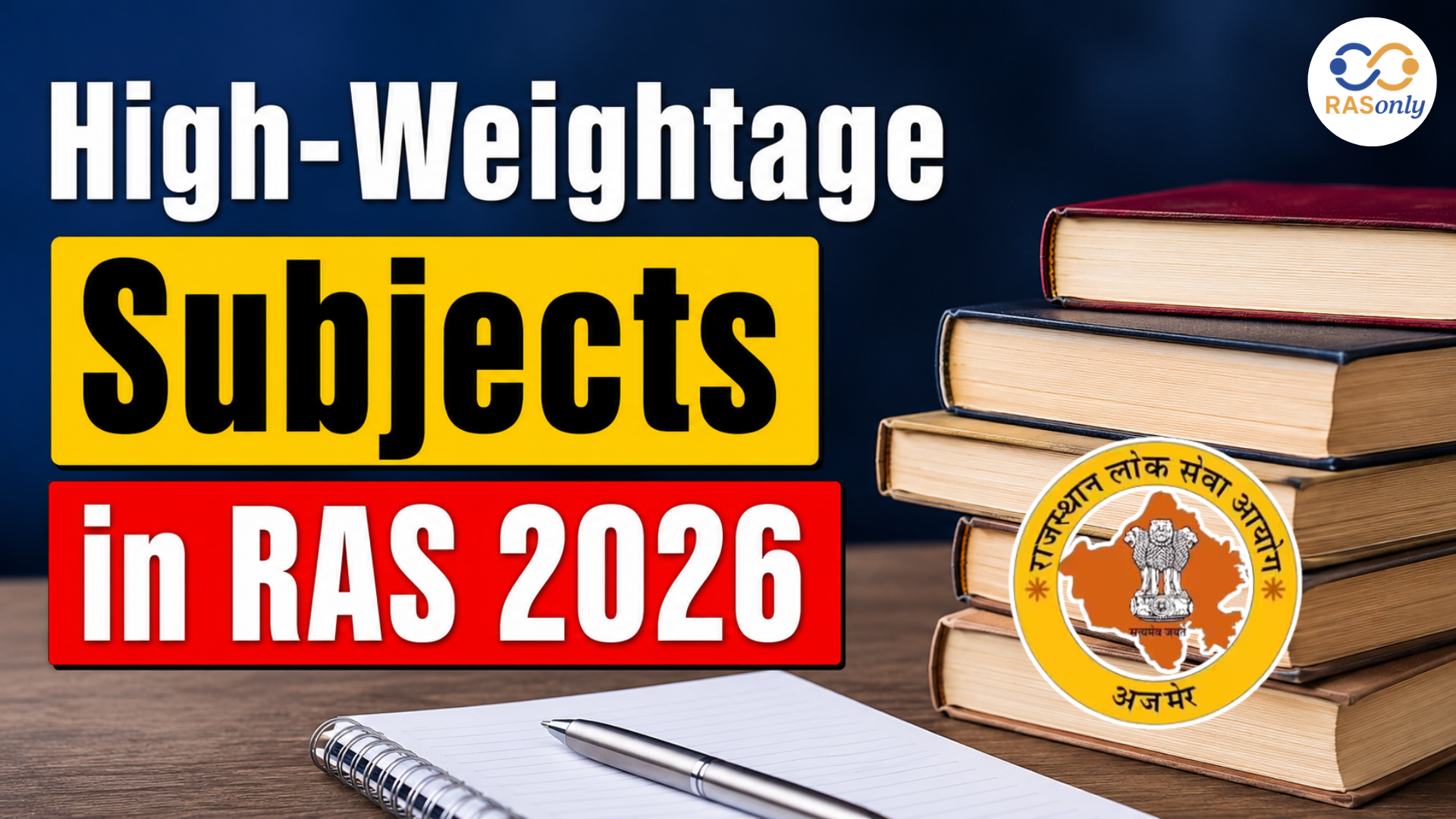
High-weightage subjects in RAS 2026 play an important role in helping aspirants plan their preparation, prioritize important topics, and manage their study time effectively. The Rajasthan Administrative Service (RAS) examination, conducted by the Rajasthan Public Service Commission (RPSC), attracts lakhs of candidates competing for a limited number of posts. Students can be aware of question trends for each topic, solve previous-year model papers, and follow the latest syllabus to know the important areas to focus on. A lot of the RAS syllabus can be handled if you prepare it well, revise it regularly, and practice it well.
The RPSC RAS examination consists of three stages: Prelims, Mains, and Interview. Every stage assesses various components of candidates' knowledge, analytical skills, and personality. Subjects such as Rajasthan History, Art and Culture, Indian Polity, Geography, Economy, Science, and Current Affairs are important components of preparation. Prelims is based on objective question solving and accuracy, while Mains is based on clarity of concept, structuring of answers, and presentation. In this detailed course guide, students will learn the subjects that carry more weightage for the RAS 2026, the examination pattern of the exam, the preparation strategies for each subject, the trend of previous year question papers, the recommended study plan for the exam, how to revise their studies, and some common mistakes to avoid.
What Are High-Weightage Subjects in RAS 2026?
High-weightage subjects are the areas of the syllabus that consistently give a significant number of questions and marks. They are usually identified by studying previous years' papers and the official syllabus. Note that RPSC does not publish an official subject-wise weightage, so these priorities come from question trends.
- Previous year question paper analysis
- The latest official RPSC syllabus
- Topics that repeat across exam cycles
- Rajasthan-specific content
- Current trends in governance and the economy
Why High-Weightage Subjects Matter in RAS Preparation
The syllabus for RAS is too large, and no candidate is able to write on all the topics in detail. You can focus your limited time on the subjects that have the most questions, and therefore the most marks. It also simplifies revision and makes it more frequent, so that accuracy is increased.
| Advantage | Explanation |
|---|---|
| Better score | Important subjects contribute more marks |
| Smarter use of time | Effort goes to topics that matter most |
| Higher accuracy | Repeated revision improves recall |
| More confidence | Strong core subjects reduce exam anxiety |
| Better rank potential | A stronger base improves selection chances |
RAS 2026 Exam Pattern at a Glance
Notice the pattern includes a clue about what is being tested and the number of marks awarded in each. The RAS exam has three stages: a qualifying Prelims, a descriptive Mains, and a 100-mark Interview. Before finalizing your plan, always check the latest information on the official RPSC Website.
RAS Prelims Exam Pattern
The Prelims is a single objective paper on General Knowledge and General Science. Its marks are not included in the final merit list as it is a screening test. Candidates must still score above the cut-off to reach the Mains.
| Particulars | Details |
|---|---|
| Paper | General Knowledge & General Science |
| Question type | Objective (MCQ) |
| Total marks | 200 |
| Duration | 3 hours |
| Negative marking | 1/3 mark deducted per wrong answer |
| Purpose | Qualifying and shortlisting for Mains |
RAS Mains and Interview Pattern
The Mains is descriptive and tests depth of knowledge, analysis, and answer-writing skills. It has four compulsory papers of 200 marks each, and there is no optional subject. Mains & Interview marks are used to determine final merit.
| Stage | Details | Marks |
|---|---|---|
| Mains Papers I–III | General Studies (descriptive) | 200 each |
| Mains Paper IV | General Hindi & General English | 200 |
| Mains total | Four compulsory papers | 800 |
| Interview | Personality test | 100 |
| Final merit total | Mains + Interview | 900 |
Top High-Weightage Subjects in RAS 2026 for Prelims
The Prelims are based on the following sections: History, Geography, Polity, Economy, Science, Reasoning, Current Affairs, and what is in the news in Rajasthan? Some of these regularly carry more questions than others, so they deserve extra time. The subjects below are the most important to prioritise.
Rajasthan History, Art & Culture
This is one of the most critical sections since it has context-specific questions and is unique to the state. Preparation at this level can be a key area of advantage over those who use only national-level material. It's important to revise regularly, as it's a fact-packed topic.
- Rajput dynasties and major battles
- Folk dances, music and instruments
- Fairs and festivals
- Forts, palaces, temples and architecture
- Handicrafts and paintings
- Important personalities and movements
Indian Polity and Constitution
Polity is widely regarded as a scoring subject because questions are mostly conceptual and come from a stable set of topics. Once you've learned the fundamentals, the topic is easily changed. Previous years' papers provide clues as to which institution/ articles are being repeatedly asked.
- Fundamental Rights and DPSP
- Parliament, President and Prime Minister
- Judiciary and constitutional bodies
- Emergency provisions
- Panchayati Raj and Rajasthan administration
Geography of India and Rajasthan
The candidates who study Geography with maps and diagrams are rewarded in Geography. The physical features of Rajasthan, rivers, minerals, and climate are particularly useful as they have a mix of static knowledge and regional relevance. Match topics from Rajasthan with the key geography chapters of India.
- India: mountains, rivers, climate, agriculture, minerals, soils and vegetation
- Rajasthan: desert regions, rivers and dams, climate zones, minerals, industries, national parks and wildlife
Current Affairs
Current affairs links the static syllabus to real events and is a dynamic part of the paper. The news of Rajasthan is of such significance that it should be given due consideration with the national and international news. Daily reading and monthly notes are more effective than trying to cram more for the month.
- Rajasthan government schemes and the state budget
- Awards, honours and sports events
- National and international events
- Science and technology updates
Indian and Rajasthan Economy
Economy is hard once you get the concepts, but easy when you don't. Questions are frequently linked with budgets, schemes, and development at the state level. First, establish a base to adhere to, then follow the recent budget highlights.
- Inflation, banking and taxation
- Budget and economic planning
- Agriculture and rural economy
- Rajasthan's economic development and welfare schemes
Science & Technology
The science questions tend to be basic and application-based, so they are a good source of consistent marks. NCERT-level concepts plus recent developments cover most of what is needed. Avoid missing out on current scientific news, which can help to formulate questions.
- Biotechnology and health programmes
- Space and defence technology
- Computer and ICT basics
- Environmental science
Reasoning & Mental Ability
There is not much theory in reasoning, only the practice of it, and it will be rewarded. Practice makes perfect, and speed will be important in a paper of 3 hours with negative marking. It's also one of the most convenient methods to maintain your overall score.
- Coding-decoding and blood relations
- Direction sense and number series
- Seating arrangement
- Ratio, percentage and probability
Environment & Ecology
The issues of climate and conservation have been introduced into policy discussion, and the environment has become more important. Rajasthan's wildlife and ecosystems are natural areas for questions. Connect theory to real-life issues to reinforce learning.
- Climate change and biodiversity
- National parks and wildlife conservation
- Pollution and environmental organisations
- Rajasthan's ecology and protected areas
High-Weightage Subjects in RAS 2026 for Mains
The Mains is descriptive, and success will depend upon clearly presenting ideas rather than knowledge of facts. The syllabus is divided into topics like History, Culture, Geography, Polity, Governance, Economy, Science and Administration. For the exact paper-wise distribution, please consult the official RPSC Syllabus.
| Focus area | How to prepare |
|---|---|
| History, art and culture | Use facts and examples in every answer |
| Geography and environment | Add maps and diagrams |
| Polity and governance | Write structured, balanced answers |
| Economy | Support points with data and schemes |
| Science and technology | Focus on applications and recent developments |
| General Hindi & English | Practise writing regularly, since the paper is compulsory |
Answer Writing for the Mains
Writing the answer is a skill which cannot be improved without practice. Aim for a clear introduction, relevant points and a short conclusion in each answer. Structured writing is a way to guide an examiner through your ideas.
- Practise answer writing daily
- Prepare short notes for revision
- Use examples, data and flowcharts where useful
- Do not neglect the language paper
Priority Table of High-Weightage Subjects in RAS 2026
This table shows how much attention each subject deserves, based on syllabus coverage and question trends. It is a preparation guide and not an official RPSC figure. Modify it after studying papers and your own abilities.
| Subject | Priority level | Why it matters |
|---|---|---|
| Rajasthan GK (history, art, culture) | Very high | Direct, state-specific questions |
| Indian Polity | Very high | Conceptual and repeatable |
| Geography | High | Combines India and Rajasthan topics |
| Current Affairs | High | Links static topics to real events |
| Economy | Medium-high | Scoring with clear concepts |
| Science & Technology | Medium | Basic, NCERT-based |
| Reasoning | Medium | Easy marks with practice |
| Environment | Medium | Growing relevance |
Most Scoring Subjects in RAS 2026
Scoring subjects are those that are concept-based, repetitive, and easier to revise. It pays to invest the time here, as it will pay off in the short term than it will starting with the hard topics. Use them to build a safe base of marks before tackling tougher areas.
- Indian Polity
- Rajasthan GK, including culture
- Reasoning & Mental Ability
- Geography
- Current Affairs
Subject-Wise Preparation Strategy
One size does not fit all, so it is wasteful to use one method for all subjects. Match your technique to the nature of the subject, whether it is memory-based, concept-based, or practice-based. To get started, the table below provides a simple place to start.
| Subject | Best strategy |
|---|---|
| Rajasthan GK | Revise facts and cultural details regularly |
| Polity | Focus on concepts and previous year questions |
| Geography | Learn with maps and diagrams |
| Economy | Understand basic concepts first |
| Current Affairs | Daily reading and monthly notes |
| Science | Study NCERT basics and recent updates |
| Reasoning | Solve practice questions daily |
Previous Year Question Paper Trend Analysis
Previous years' papers will give you an idea of the actual examination as compared to guessing. By studying them, you will find that there are repeated topics, difficulty level, and a balance between static and current subjects. It is common to solve the last 5-10 years of papers.
What to Look for in Previous Papers
Good analysis is more than the solution to a question. Highlight the repetitive topics, time-consuming sections, and areas of the exam where you lost marks. Here are these patterns to refresh your priority list.
- Frequently repeated topics
- Difficulty level of each section
- Subject-wise question trends
- Current affairs areas that appear often
Benefits of PYQ Analysis
Regular analysis gives a true sense of the examination and takes the element of surprise off the table on test day. It also comes in handy when making decisions on what to avoid and what to edit again. As you practice more and more, your accuracy and confidence grow.
- Clear preparation direction
- Better understanding of the pattern
- Improved confidence and time management
Study Plan for High-Weightage Subjects in RAS 2026
Your preparation is consistent, and you don't forget to cover important subject areas. Divide the day between static subjects, current affairs, and practice. The plan below is a suggested structure, so adjust it to your schedule.
Daily Study Plan
Divide up the day by the type of task used, and prevent memory-intensive and practice-intensive work from competing. Study static subjects when your focus is highest. Have questions before the evening; revise before the night.
| Time | Activity |
|---|---|
| Morning | Static subjects such as Polity and History |
| Afternoon | Current affairs and note-making |
| Evening | MCQ and mock test practice |
| Night | Revise short notes |
Weekly Targets
You will be held responsible and not let revision build up if you set weekly goals. Complete a specified amount of one subject each week. Get ready for next week by testing yourself on the weekend and adding to your notes.
- Complete one major topic or subject each week
- Attempt at least one mock test
- Review and update notes every Sunday
Common Mistakes to Avoid During RAS Preparation
Many intelligent candidates lose marks for unnecessary habits and not due to their lack of ability. Those errors will be obvious to you if you catch them early enough to fix them before you take the test. The majority of these are due to a lack of planning or practice.
- Ignoring Rajasthan GK
- Skipping regular revision
- Not solving previous year papers
- Reading without making notes
- Avoiding mock tests
- Using too many sources instead of a few reliable ones
Tips to Score Maximum Marks in RAS 2026
Good marks are the reward of consistent approaches and not a matter of last-minute effort. Focusing on key areas of study and regular testing and revision. Prelims is a negative-marked exam – accuracy is as important as speed.
- Follow a fixed timetable.
- Revise regularly
- Take a mock test every week
- Improve your answer-writing skills
- Give extra time to high-weightage subjects in RAS 2026
- Stay updated with current affairs
- Avoid blind guessing in Prelims
Final Revision Strategy for High-Weightage Subjects in RAS 2026
In the last few months, revision matters more than new material. Consolidate what you have already studied and identify weak areas through mock tests. Starting fresh books at this stage usually adds confusion and not marks.
- Focus mainly on revision
- Avoid starting new resources
- Solve mock papers regularly
- Practise Mains answer writing
- Revisit facts in different formats, such as tables and charts
Also Read
| RAS Preparation Tips | How to Prepare Current Affairs for RAS |
| Previous Year Question Papers | How to Prepare for RAS Prelims |
| RAS Exam Analysis | RAS Prelims Revision Plan |
Conclusion
To prepare for the upcoming RAS 2026 exam, one should devise a proper plan, revise it regularly, and be aware of the examination pattern and syllabus. Candidates should prioritise important areas such as Rajasthan GK, History, Art & Culture, Polity, Geography, Economy and Current Affairs while covering the complete syllabus. There is no official statement from RPSC for subject-wise weightage, and for this reason, the subject-wise weightage as per previous years should be taken as a reference for preparation only. Solving PYQs, mock tests, taking notes, and Mains answer writing can help in preparation and weak areas identification. An organised programme that includes a balance of static subjects, current affairs, practice, and revision can help to make preparation more organised. By planning strategically, practicing consistently, and being prepared, aspirants can confidently face the RAS 2026 exam.
FAQs
Rajasthan GK, History, Art and Culture, Indian Polity, Geography, Current Affairs, and Economy are important subjects for RAS 2026. There is also a need to consistently prepare students for science, reasoning, and environment. Prioritisation of topics should be done through analysis of the previous years' papers and the latest official syllabus.
No, RPSC does not publish an official subject-wise weightage for the RAS examination. The subject priorities are usually determined by the previous year's question paper, a study of the syllabus, and the trends of questions. These are estimates to use as guidelines rather than guaranteed distributions of questions.
Rajasthan History, Art and Culture, Indian Polity, Geography, Current Affairs, Economy, Science and Technology, Reasoning, and Environment are key areas for Prelims preparation. Students must also practice for MCQs and past papers to gain accuracy and time management.
Candidates need to focus on History, Art and Culture, Geography, Polity and Governance, Economy, Science and Technology, General Hindi, and General English for the RAS Mains Examinations. Regular answer-writing practice, relevant examples, data, and structured presentation are essential.
Candidates can identify important topics by analysing the latest RPSC syllabus and solving previous year question papers. Repeated topics, trends in the questions across subjects, and knowledge of current affairs linkages can help set priorities for preparation.
BEST SELLER
🏆 PRELIMS
RAS Pass
Prelims focused Hindi & English
₹399
✓
Prelims Topic-Wise Tests
✓
Subject-Wise Tests
✓
Full-Length Prelims Tests
✓
Daily Current Affairs Tests
✓
Prelims PYQs Tests
✓
Detailed Solutions & Analysis
✓
All Rajasthan Ranking
✓
Unlimited Reattempts
✓
Mains Tests
✓
Hindi & English Tests
✓
All Rajasthan Ranking
Trusted by 5,000+ Students
Post Category
- RAS Salary
- Result
- RAS Admit Card
- RAS Job
- RAS Cutoff
- Preparation Tips
- RAS Answer Key
- RAS Exam Analysis
- RAS Syllabus
- RAS Previous Year Papers
- RPSC RAS Exam Pattern
- RAS Interview
- RAS Exam Date
- RAS Vacancy
- RAS Test Series
- RAS Best Books
- RAS Preparation Resources
- RAS Coaching Centre
- History
- Polity
- Geography
- Economics
- Science
- Art and Culture
- RPSC RAS Application Form
- RPSC RAS Notification
- RAS Eligibility Criteria
- UPSC Exam
- RPSC RAS Mains
Visit Our RASonly Offline Center
Our Expert Faculty

Bhunesh Sir
Current Affairs · 13+ Yrs

Aamir Khan Sir
RAS-2017 · IIM Ahm.

Akash Sir
Polity · 8+ Yrs
Free Resources
Official Mobile App

RASOnly App
by OTSAdda · Free
Full Video Lectures
Mock Tests & PYQs
Daily Current Affairs
AI Mock Interview
Free Download · No subscription needed to install
RAS 2024 Toppers — RASonly
Rank 2
Virendra Charan
Rank 9
Bhoopinder Singh
Rank 26
Aanchal Nagpal
Rank 33
Lokendra Singh
Rank 45
Amar Rathore
Rank 46
Manasvini Verma

Join RASonly WhatsApp Community
Get daily current affairs, exam alerts, free study material and tips from expert faculty — right on WhatsApp.
Join for Free →RASonly Interview Guidance Program

Mr. Ashok Jain
Ex-Chief Secretary Govt of Rajasthan
- IAS officer of the 1981 batch, Rajasthan cadre.
- Passionate about mentoring the next generation of RAS officers with real-world insights.
- Got retired in Dec 2017 from the post of Chief Secretary of the state of Rajasthan.

Mr. Guru Charan Rai
Ex-ASP / SP in Jaisalmer
- Guru Charan Rai, IPS (Retd), retired as Inspector General of Police (Security), Rajasthan, Jaipur in 2017.
- Served as ASP and SP in Jaisalmer, Nagaur, Sri Ganganagar, Sawai Madhopur, Dausa, Sikar, and Karauli.
- He also held key positions as DIGP and IGP in the Law and Order division.

Mr. Rakesh Verma
Ex-IAS Officer, B.Tech, MBA, and M.A. (Economics)
- IAS officer of the 1981 batch and retired in Chief Secretary Rank.
- Civil servant of high repute and vast experience.
- Has been teaching UPSC CSE subjects for the last six years.
Related Post

Daily Current Affairs for RAS Exam Preparation 2026

CM Bhajan Lal Sharma Launches Rajasthan Portals
October 08, 2026
Rajasthani Film ‘Omlo’ Selected for Cannes Film Market
October 08, 2026
Rajasthan Initiative to Build India’s First UNESCO Global Geopark
October 07, 2026