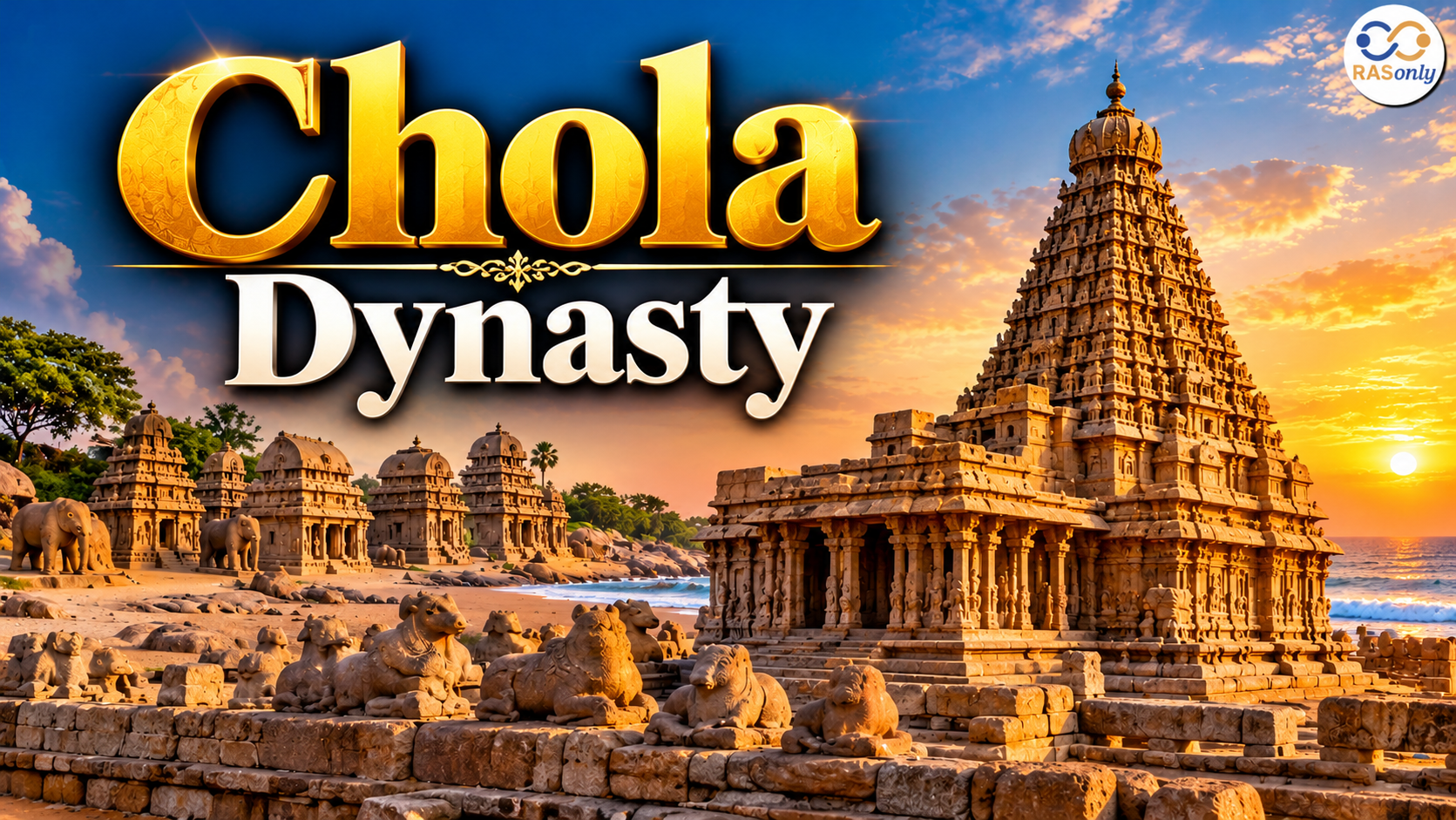
Chola Dynasty: Capital, Founder, Kings, Time Period and History
Current Affairs for RAS 2026: Study Plan & Notes

Get in Touch with RASonly!

Prepare current affairs for RAS 2026 with a structured study plan covering Rajasthan, national and international events, government schemes, economy, science, and technology. Learn effective note-making, reliable sources, daily study routines, and monthly revision strategies for Prelims, Mains, and Interview.

Current affairs for RAS 2026 is one of the most scoring and unpredictable parts of the Rajasthan Administrative Service examination, which is conducted by the Rajasthan Public Service Commission (RPSC). It is useful at all three stages: Prelims, Mains, and Interview. Aspirants have to have a clear plan as questions come from various sectors like governance, economy, environment, science and technology, government schemes, etc.
They are: prioritizing Rajasthan-specific development, using a few reliable sources, making short notes, and revising on a fixed time frame; these are good strategies. This guide covers all four, along with the important topics, a daily routine, a monthly revision plan, and the common mistakes to avoid. Adhere to it, and you can avoid information overload in the current affairs section.
Why Is Current Affairs Important for RAS?
RAS is an administrative service, so the commission expects candidates to understand what is happening in the state, the country, and the world. Current affairs also links with static topics such as polity, economy, geography, and history. It is for this reason that it should be taught as an integral part of preparation rather than as a subject in its own right.
Importance in RAS Prelims
Prelims tests your awareness of recent events, and questions can be factual or concept-based. Rajasthan-related developments, schemes, reports, and environmental issues are the safest areas to prepare thoroughly.
- Direct questions on recent state, national, and international events
- Government schemes, reports, and indices
- Economic and environmental developments
Importance in RAS Mains
Current affairs in mains gives you the ability to write analytical type answers with their recent examples. A new example or piece of data can turn an average answer into a good answer. It also strengthens the introduction and conclusion of your answers.
- Recent examples to support arguments
- Improvement of fact/analysis balance in the document
- Stronger conclusions with a policy-based approach
Importance in RAS Interview
Interview panels assess your knowledge of current issues and ability to articulate your balanced opinion. Questions about your home district, state governance, and public policy are common. Clear, neutral, and well-informed answers create a good impression.
- Awareness of state, national, and global issues
- Balanced views on governance and social issues
- Knowledge of your own district and region
Priority Order for Current Affairs for RAS 2026
Not all news carries equal weight in this exam. The order of study saves time and ensures that you study topics with the most return on effort. Focus on the top items first and allot limited time to the bottom items.
| Priority | Topic | Why It Matters |
|---|---|---|
| 1 | Rajasthan Current Affairs | State-level exam with a strong regional focus |
| 2 | National Current Affairs | Policy and governance relevance |
| 3 | Indian Economy | Links with budget, schemes and growth |
| 4 | Polity and Governance | Core subject for administrative services |
| 5 | Environment and Ecology | Frequently asked in competitive exams |
| 6 | Science and Technology | Growing share of questions |
| 7 | International Relations | Impact on India’s economy and security |
| 8 | Awards, Sports and Reports | Quick scoring facts |
Rajasthan Current Affairs
Rajasthan current affairs deserves the highest priority because RAS is a state-level examination. Focus on policies, schemes, economic initiatives, environmental programmes and cultural developments linked to the state. Always prepare from official or highly reliable sources.
Rajasthan Budget
The state budget is presented every year and reflects the government’s priorities. Aspirants should note the major announcements, new schemes and sector-wise focus areas, and understand the purpose behind each. Short notes with the expected impact on development work best.
| Area | What to Note |
|---|---|
| Budget Highlights | Major announcements and allocations |
| New Schemes | Objectives and target beneficiaries |
| Infrastructure | Roads, urban, water and transport projects |
| Education and Health | New institutions, reforms and insurance schemes |
| Agriculture | Irrigation, subsidies and farmer welfare |
Rajasthan Government Schemes
The most repeated Current affairs topics include Schemes. Questions usually ask about the objective, beneficiaries, implementing department, and recent changes. Have another scheme book and refer to it frequently.
| Component | What to Study |
|---|---|
| Objective | Why the scheme was launched |
| Beneficiaries | Who gets the benefit |
| Features | Main provisions and benefits |
| Funding Pattern | State-funded or centrally sponsored |
| Recent Updates | Latest changes and achievements |
Rajasthan Economy
Rajasthan’s economy is linked to agriculture, mining, tourism, industry, and renewable energy. Candidates should track new policies, investment initiatives, and major projects. For instance, the Rising Rajasthan Global Investment Summit was organized in Jaipur in December 2024, and investment events like these are worth keeping an eye on.
- Tourism circuits, festivals and new projects
- Solar and wind energy initiatives
- Industrial policies, MSME and startup support
- Export and investment promotion measures
Rajasthan Environment and Ecology
Rajasthan has a unique desert ecosystem and rich wildlife, which makes this area important for both Prelims and Mains. Study conservation programmes, protected areas and water management initiatives together with their geographical locations. Keoladeo National Park and Sambhar Lake are well-known Ramsar sites of the state, and Ranthambore, Sariska, Mukundra Hills and Ramgarh Vishdhari are among its tiger reserves.
| Category | Key Areas |
|---|---|
| Wildlife | Conservation programmes and species protection |
| Protected Areas | National parks, sanctuaries and tiger reserves |
| Water Conservation | River rejuvenation and rainwater harvesting |
| Climate Change | Adaptation and mitigation measures |
Rajasthan Culture and Heritage
Culture-based current affairs questions are usually linked with static history and art and culture topics. Track new heritage recognitions, restoration projects, festivals and GI-tagged products. The city of Jaipur was added to the UNESCO World Heritage List in 2019, while the Hill Forts of Rajasthan were added in 2013.
- Fairs and festivals such as Pushkar Fair and the Desert Festival
- Folk music, dance and traditional crafts
- GI-tagged products of Rajasthan
- Heritage conservation and archaeological discoveries
National Current Affairs for RAS 2026
National developments form the second most important block after state news. The officers of the RAS operate in the context of the national policy, so it is important that they are aware of the central laws, schemes, and reforms. Make sure to relate each event to its administrative significance for the state.
Indian Polity and Governance
Governance topics are directly related to the role of an administrative officer. Learn about constitutional change, new legislation, electoral reform and digital governance efforts. To remember the date of a reform is helpful, but not as much as to know why.
- Constitutional and legislative developments
- Public administration and service delivery reforms
- Election-related changes
- Digital governance initiatives
Indian Economy
Current affairs on the economy cover inflation rate, banking changes, taxation changes, and growth indicators. Digital payments such as UPI and financial inclusion programmes are also regularly in the news. Focus on concepts and policy objectives, not just numbers.
- Inflation and growth indicators
- Banking and financial sector updates
- Taxation reforms
- Employment and financial inclusion programmes
Social Issues
Social issues are valuable for Mains answer writing because they need analysis, not just facts. Prepare the problem, its causes, the government response, and possible solutions. Education, health, women empowerment, child welfare and skill development are key themes.
Science and Technology Current Affairs
The questions in science and technology are of the "how" and "what" variety, rather than technical detail. Follow major developments and understand how they help governance, security, and development. Keep your notes short and application-oriented.
Space Technology
The space programme of India is featured in news and exams frequently. To be aware of, Chandrayaan-3 was successfully soft-landed in the vicinity of the south pole of the Moon in August 2023, and the Aditya-L1 solar mission was launched. Track upcoming missions and satellite launches by ISRO.
Artificial Intelligence
Governance, healthcare, education, and agriculture are all benefiting from AI. Aspirants should know its applications, benefits, and ethical concerns such as privacy and bias. This topic is useful for both factual questions and Mains analysis.
Biotechnology
Biotechnology links with health, agriculture, and the environment. Prepare recent research, medical advances and government initiatives in the sector. Focus on practical impact and policy relevance.
Defence Technology
Defence topics are related to national security and the self-reliance drive. Note indigenous defence projects, modernisation efforts and strategic technologies. It is more important to understand the purpose of each project rather than technical specifications.
International Current Affairs for RAS
International events can affect India’s trade, energy, security and economy, and they indirectly affect Rajasthan too. A basic understanding of global organisations and groupings is enough for this exam. Keep this section brief and well-organised.
International Organisations and Groupings
Prepare the objectives, headquarters, and recent initiatives of major bodies. The summits, theme-based reports and membership changes generate questions.
- Organisations: United Nations, World Bank, International Monetary Fund, World Trade Organization
- Groupings: G20, BRICS, SCO, Quad
- Global issues: Climate change, energy security, food security and the global economy
Best Sources for RAS Current Affairs
Too many sources will confuse the reader, so choose a few trustworthy sources and stick with them. Prefer official and well-known sources for accuracy. Always verify facts like dates, names, and figures from the source.
| Source | Use |
|---|---|
| RPSC official website | Syllabus and exam notices |
| PIB (Press Information Bureau) | Central government schemes and policies |
| Rajasthan DIPR | State government announcements |
| Rajasthan Economic Review | State economy and development data |
| A good daily newspaper | Daily news and editorials |
| A monthly current affairs magazine | Revision and practice |
Daily Study Plan for Current Affairs for RAS 2026
Brief and regular is better than long and infrequent. Most candidates require 1-2 hours a day of this. Divide reading and note-making time to make revision easy.
| Session | Time | Task |
|---|---|---|
| Morning | 30–45 minutes | Read key news and highlight important points |
| Evening | 20–30 minutes | Make short notes and revise earlier notes |
Monthly Revision Strategy
It's helpful to read daily, but revision is the key to recalling for the test. A monthly review keeps schemes, reports and events fresh and prevents the syllabus from piling up. Pick one day a month to do this.
- Revise all notes of the month.
- Review important schemes and reports.
- Solve current affairs MCQs
- Update missing facts and developments
How to Make Effective Current Affairs Notes
Good notes are brief, topic-wise, and easily modifiable. Write the event, its background, its importance, and its link to a static topic. Don't copy lengthy news articles – leave one particular section for news on Rajasthan alone.
- Use headings such as Rajasthan, Economy, Environment, and Polity.
- Write in points and add a one-line significance
- Add data only from reliable sources
- Link each topic with static subjects
Common Mistakes in Current Affairs Preparation
Hard work is a factor for many aspirants, but they end up losing marks due to avoidable errors. If you know these pitfalls at the outset, then you will save months of work. Correct them early before they become a habit.
- Too many sources: Leads to confusion and poor revision
- Ignoring state news: Rajasthan topics should always come first
- Without notes: Reading without notes means forgetting rapidly
- No revision: Information fades without repetition
- Rote learning: Understanding the background works better than memorising
Also Read
| RAS Current Affairs | RAS Mains Exam Pattern |
| RAS Mains Syllabus | RAS Mains Answer Writing |
| RAS Previous Year Papers | RAS Preparation Tips |
Conclusion
Consistency and smart note-making with regular revision are the key to current affairs for RAS 2026. Start with Rajasthan-specific topics, then cover national, science and technology, and international developments in the order of priority. Use a few trusted sources, as this could waste time on repeating or unimportant information. Understand the background and impact of each event, because this helps in Prelims, Mains, and the Interview alike. A fixed daily routine and monthly review can keep you updated and help you perform confidently in the exam.
FAQs on Current Affairs for RAS 2026
Current affairs is important in Prelims, Mains, and the Interview. It helps you answer direct questions, add examples in Mains answers, and show awareness during the personality test.
One to one and a half hours daily is enough for most aspirants. Add one fixed day every month for full revision and MCQ practice.
Rajasthan current affairs, government schemes, the state and national economy, polity and governance, and environment are the most important. Science and technology and international affairs follow in priority.
Yes, because RAS is a state-level examination and has a strong regional focus. Cover Rajasthan topics first and then move on to national and international news.
Keep notes short, topic-wise, and linked to static subjects. Write the key fact, its background, and its significance in two or three lines.
BEST SELLER
🏆 PRELIMS
RAS Pass
Prelims focused Hindi & English
₹399
✓
Prelims Topic-Wise Tests
✓
Subject-Wise Tests
✓
Full-Length Prelims Tests
✓
Daily Current Affairs Tests
✓
Prelims PYQs Tests
✓
Detailed Solutions & Analysis
✓
All Rajasthan Ranking
✓
Unlimited Reattempts
✓
Mains Tests
✓
Hindi & English Tests
✓
All Rajasthan Ranking
Trusted by 5,000+ Students
Post Category
- RAS Salary
- Result
- RAS Admit Card
- RAS Job
- RAS Cutoff
- Preparation Tips
- RAS Answer Key
- RAS Exam Analysis
- RAS Syllabus
- RAS Previous Year Papers
- RPSC RAS Exam Pattern
- RAS Interview
- RAS Exam Date
- RAS Vacancy
- RAS Test Series
- RAS Best Books
- RAS Preparation Resources
- RAS Coaching Centre
- History
- Polity
- Geography
- Economics
- Science
- Art and Culture
- RPSC RAS Application Form
- RPSC RAS Notification
- RAS Eligibility Criteria
- UPSC Exam
- RPSC RAS Mains
Visit Our RASonly Offline Center
Our Expert Faculty

Bhunesh Sir
Current Affairs · 13+ Yrs

Aamir Khan Sir
RAS-2017 · IIM Ahm.

Akash Sir
Polity · 8+ Yrs
Free Resources
Official Mobile App

RASOnly App
by OTSAdda · Free
Full Video Lectures
Mock Tests & PYQs
Daily Current Affairs
AI Mock Interview
Free Download · No subscription needed to install
RAS 2024 Toppers — RASonly
Rank 2
Virendra Charan
Rank 9
Bhoopinder Singh
Rank 26
Aanchal Nagpal
Rank 33
Lokendra Singh
Rank 45
Amar Rathore
Rank 46
Manasvini Verma

Join RASonly WhatsApp Community
Get daily current affairs, exam alerts, free study material and tips from expert faculty — right on WhatsApp.
Join for Free →RASonly Interview Guidance Program

Mr. Ashok Jain
Ex-Chief Secretary Govt of Rajasthan
- IAS officer of the 1981 batch, Rajasthan cadre.
- Passionate about mentoring the next generation of RAS officers with real-world insights.
- Got retired in Dec 2017 from the post of Chief Secretary of the state of Rajasthan.

Mr. Guru Charan Rai
Ex-ASP / SP in Jaisalmer
- Guru Charan Rai, IPS (Retd), retired as Inspector General of Police (Security), Rajasthan, Jaipur in 2017.
- Served as ASP and SP in Jaisalmer, Nagaur, Sri Ganganagar, Sawai Madhopur, Dausa, Sikar, and Karauli.
- He also held key positions as DIGP and IGP in the Law and Order division.

Mr. Rakesh Verma
Ex-IAS Officer, B.Tech, MBA, and M.A. (Economics)
- IAS officer of the 1981 batch and retired in Chief Secretary Rank.
- Civil servant of high repute and vast experience.
- Has been teaching UPSC CSE subjects for the last six years.
Related Post

Daily Current Affairs for RAS Exam Preparation 2026

Rajasthan AVGC-XR Summit on International Animation Day
October 26, 2026
Inauguration of the Khet Bachao Abhiyan 2026
October 26, 2026
Ustad Bismillah Khan Yuva Puraskar
October 24, 2026