Kushan Empire: History, Rulers, Administration, Economy, Art, Decline
Rajasthan Manufacturing and Mining Growth Targets 2047

Get in Touch with RASonly!

Rajasthan Vision 2047 outlines an ambitious roadmap to strengthen industrial growth, expand mining capacity, boost manufacturing GSVA, increase exports, generate large-scale employment, and enhance skill development. The strategy focuses on sustainable investment, innovation, MSME expansion, and green technologies to transform Rajasthan into a globally competitive and self-reliant economy.

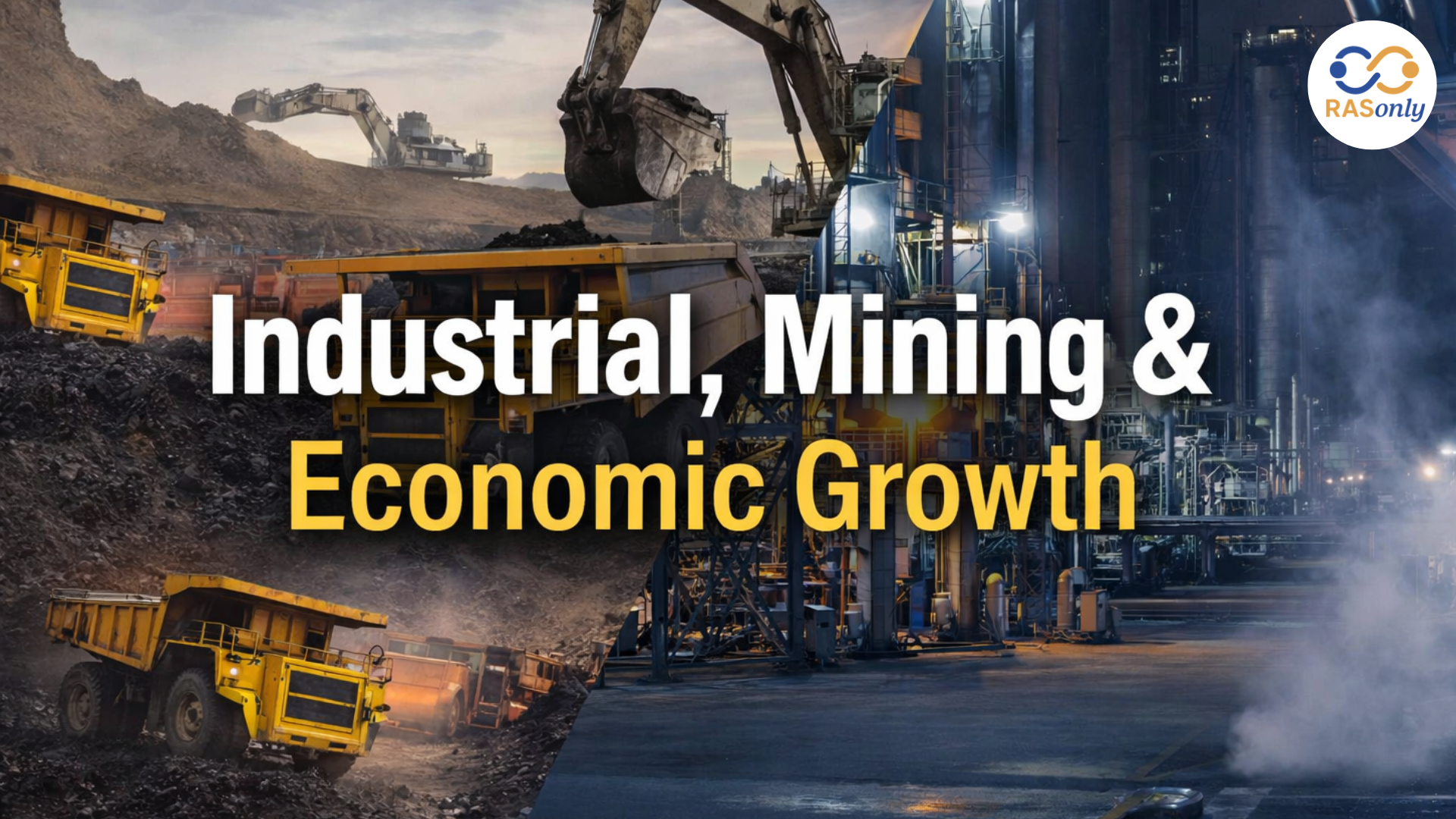
Rajasthan, India's largest state, is a key industrial hub with strong transport connectivity, abundant mineral resources and a skilled workforce. The state leads in mining, ceramics, cement, textiles, gems & jewellery and automotive industries, contributing 15% to state's GSVA (2024 -25)
With 81 mineral reserves, significant mining revenues and pioneering skill development programs, Rajasthan is set to drive sustainable industrialisation, employment and economic expansion by 2047.
- Rajasthan contributes 100% of India's lead-zinc, wollastonite, selenite
- Produces 90% of India's granite and marble (famous Makrana marble)
- 3,018 major mineral leases, 14,089 minor mineral leases, 17,185 quarry licenses
- Mining sector contributes 3.3% to Rajasthan's GSVA (2024-25)
- 426 industrial areas developed by RIICO across more than 94,448 acres of land
- 10 Inland Container Depots (ICDs), 11 operational airports
- 3rd largest highway network, 2nd largest railway network in India
- Rajasthan Skill & Livelihoods Development Corporation (RSLDC) pioneers skill programmes
- First state to launch a Mission on Livelihoods (RSLDC, 2015)
- Major skill schemes: DDU-GKY, SANKALP, MMYKY, MNSKSY, MMKVY (category I, II, III), MMYSY
VISION 2047
By 2047, Rajasthan will be India's leading industrial and investment hub, fostering sustainable, inclusive and technology-driven industrialisation with a strong emphasis on MSMEs, eco-friendly manufacturing and minimal regulatory barriers.
A globally recognised sustainable mining and petroleum sector will drive economic diversification, while a future-ready skill ecosystem will empower youth with cutting-edge skills, innovation and employment opportunities, ensuring resilient, adaptable and globally competitive human capital for sustained economic growth.
Thrust Areas
- Boosting Traditional & High-Value Industries: Strengthening textiles, handicrafts, ceramics and mineral-based industries with expanding high-value manufacturing.
- Emerging & Sunrise Sectors: Promoting AI, renewable energy, fintech, biotechnology and IT services as key growth drivers.
- Global Industry Collaboration: Partnering with international mineral-based companies to enhance standards, R&D and sustainability.
- Sustainable Mining Practices: Implementing eco-friendly mining techniques, reclamation projects and waste-to-wealth initiatives.
- Regulatory & Safety Reforms: Simplifying business regulations while enhancing safety measures for mining personnel.
- Workforce Upskilling & Industry-Ready Talent: Training youth & marginalised groups through hybrid, competency-based and demand-driven programmes.
- Skill Development for Future Jobs: Bridging the job-opportunity gap by aligning skills with industry needs.
- Value Addition in Mineral Resources: Encouraging processing & high-value utilisation of Rajasthan's mineral wealth for higher economic returns.
- Industry-Skill Integration: Expanding "anywhere, anytime" training models to improve workforce adaptability.
- Inclusive Industrial Growth: Promote sustainable industrialisation by leveraging green technologies, MSME support, skill development, strengthening infrastructure, policy reforms and investment-friendly initiatives to ensure equitable growth.
Industries & MSMEs
- Infrastructure Development: Creating modern, sustainable and smart industrial infrastructure, plug-and-play parks and upgrading logistics, utilities and digital connectivity to attract investments and boost industrial productivity across Rajasthan.
- Financial Strengthening: Expanding credit access and investment opportunities to support MSMEs and large-scale industries, fostering innovation and technological advancements.
- Skilled Workforce Enhancement: Investing in education, skill development and industry-specific training programmes to create a highly skilled and technology-driven workforce.
- Regulatory Ease: Streamlining permits and approvals through fast-tracked EoDB reforms to accelerate industrial investments and project implementation.
- Export Infrastructure Expansion: Establishing export-focused trade zones, sea (ICDs) and air cargo hubs to enhance global competitiveness of Rajasthan’s industries
- Boosting Rural & Cottage Industries: Strengthening infrastructure, vocational training and financial support to revitalise small-scale industries and generate rural employment.
- MSME Development & Market Access: Enhancing cluster ecosystems, reducing costs and leveraging agglomeration benefits to drive inclusive MSME growth and interstate market spillovers.
- Social Upliftment Initiatives: Promoting Walk-to-Work industrial zones with worker accommodations, skill centers and social infrastructure to increase workforce retention and productivity.
- Leveraging Private Sector Efficiencies: Engaging private sector capital and expertise for modern industrial and logistics parks, as well as support facilities such as worker hostels, plug-and-play parks and private industrial parks.
Skill Development & Entrepreneurship
- Bridging Industry-Skill Gap: Aligning training with industry needs through curriculum reform, professional collaboration and AI-assisted learning, ensuring employability in evolving sectors like IT, aviation, BFSI and hospitality.
- Digital & Hybrid Learning Models: Upgrading digital infrastructure and AI-based self-assessment frameworks, integrating hybrid learning (online & in-person), making skill training more accessible, dynamic and market-aligned.
- Up-Skilling & Re-Skilling Initiatives: Promoting continuous learning, enhancing technical and soft skills, ensuring smooth entry-exit pathways to address market transformations and future-proof workforce competencies.
- Entrepreneurship & Gig Economy Growth: Expanding freelance, short-term and self-employment opportunities, fostering startups & innovation hubs, reducing traditional employment rigidity and boosting economic self-reliance.
- Workforce Adaptability & Future Skills: Addressing changing workforce demands, incorporating dynamic skilling and promoting vocational training in emerging fields, ensuring a resilient, tech-savvy and globally competitive workforce.
Mining & Petroleum
The mining sector is witnessing rising demand for zinc, iron ore, copper, potash and lignite, fuelled by India's steel expansion, infrastructure growth, EV adoption and renewable energy transition. Gold and lead-acid batteries remain vital for industrial applications and financial stability. The state's focus on lignite gasification and cement production aligns with India's energy and infrastructure goals, strengthening its role as a critical raw material supplier.
- Zinc (Zn): 31.26 Million Tonnes resource of zinc metal in the state. Rajasthan sole producer of Zinc, produced 8.17 Lakh Tonnes in FY 2023-24
- Limestone: Rajasthan has 29 Billion Tonnes limestone and the largest producer of limestone at ~93 Million Tonnes annually in the country with a share of ~23% in FY 2022-23. Currently, Rajasthan boasts 25 established cement plants
- Copper (Cu): India contributes less than 1% in copper reserves globally, of which Rajasthan has 53% (868 Million Tonnes) and produces around 33% (1.1 Million Tonnes in FY2022-23) of Indian copper ore in the state
- Lead (Pb): 11.33 Million Tonnes resources of lead metal (88% of India's resources). Rajasthan sole producer of Lead produced 2.16 Lakh Tonnes in FY2023-24
- Lignite: 6.4 Billion Tonnes resource of lignite in the state. Rajasthan produced 10.3 Million Tonnes in FY2022-23
- Potash: 20.5 Billion Tonnes resources of potash (89% of India's resources)
- Iron ore: 35.5 Million Tonnes resources of iron ore in the state. Rajasthan produced 5.6 Million Tonnes of iron ore in FY2022-23
- Gold: Rajasthan has 126 Million Tonnes of gold resources
- Global Mineral Demand Surge: By 2040, clean energy will quadruple mineral demand, with copper demand projected to rise 900% by 2030 due to EVs, renewable energy and decarbonisation efforts
- Energy Transition & Urbanisation Impact: Increased EV adoption, digitalisation and urban expansion will drive demand for lithium, cobalt, nickel and copper, fuelling Rajasthan's mining and mineral processing industry growth
- Expanding Oil & Gas Sector: Rajasthan contributed 3,425 Cr revenue in FY2023-24, ranks 2nd in onshore crude oil production and accounted for 4.8% of India's petroleum consumption (10,770 TMT), in 2022-23
- Rajasthan Petro Zone (RPZ) Development: RIICO is developing RPZ near Pachpadra Refinery (9 MMTPA), featuring a 2.4 MMTPA petrochemical complex producing PP, PE and aromatics, set for completion by Jan 2026
SKILL EMPLOYMENT & ENTREPRENEURSHIP
| INDICATORS | CURRENT STATUS | TARGET (2030) | TARGET (2035) | TARGET (2040) | TARGET (2047) |
|---|---|---|---|---|---|
| Pool of skilled manpower (Million) | 0.86 | 1.50 | 2.00 | 2.50 | 3.20 |
| Inclusion of new/STEM NSQF aligned courses & expansion of skill training programmes in emerging sectors (3-D Printing, Mechatronics, Drone Technology, Cyber Security, IoT, Semiconductors, Block-Chain, AI, Digital Leadership, Innovation & Design Thinking, Big Data Analytics etc.) | - | 30 Courses (0.006 Million) | 40 Courses (0.010 Million) | 60 Courses (0.025 Million) | 100 Courses (0.05 Million) |
| Development of multi-tasking courses by combining two or more job roles (Courses) | 10 | 20 | 25 | 35 | 50 |
| Empowering entrepreneurship, promoting gig employment & facilitating self-employment (Million) | 0.006 | 0.05 | 0.07 | 0.08 | 0.10 |
| Trainer Training Programmes to ensure high-quality training delivery (Trainers) | - | 2,500 | 4,000 | 6,000 | 10,000 |
| AI-Driven Skills Assessment and Certification (%) | - | 30 | 40 | 50 | 100 |
| Establishment of Model Career Centres (District) | 16 | 30 | 35 | 41 | Remaining/New Districts |
| Guidance will be provided to encourage self-employment among the youth (Numbers) | 2,000 | 14,000 | 24,000 | 34,000 | 48,000 |
| Enhance outreach of Career counselling / vocational guidance at school and college level (Lakh) | 0.25 | 1.75 | 3.00 | 4.25 | 6.00 |
| Advance Training for Instructors as per latest syllabus (%) | 25-30 | 40 | 50 | 60 | 100 |
| Training of instructor under Craft Instructor Training Scheme (CITS) (%) | 64 | 70 | 75 | 80 | 85 |
| Promotion of Self Employment/Start Ups to ITI Pass out/Trainees (%) | 5 | 15 | 20 | 25 | 35 |
INDUSTRIES
| INDICATORS | CURRENT STATUS | TARGET (2030) | TARGET (2035) | TARGET (2040) | TARGET (2047) |
|---|---|---|---|---|---|
| Targeted State's GSVA share from manufacturing sector at State Level (%) | ~11.58 | 14 | 16 | 18 | 20 |
| Value of goods exported | ₹83,704 Crore | 1.5 times | 2 times | 3 times | 5 times |
| Employment Generation (Lakh) | 14.25 (2023) | 20-24 | 24-28 | 28-30 | 30-35 |
MINING AND PETROLEUM
| INDICATORS | CURRENT STATUS | TARGET (2030) | TARGET (2035) | TARGET (2040) | TARGET (2047) |
|---|---|---|---|---|---|
| Targeted State's GSVA Share from Mining Sector at State Level (%) | ~3.3 | ~5 | ~5.5 | ~6.5 | ~8 |
| Targeted Investment (₹ In Crore) | 96,000 | ~2,00,000 | ~3,00,000 | ~5,00,000 | ~8,00,000 |
| Employment Generation (Direct & Indirect) (Lakh) | 32-36 | 50 | 60 | 80 | 100 |
| Land Under Mining (%) | 0.68 | 1.00 | 1.20 | 1.50 | 2.00 |
| Number of Minerals Under Mining | 58 | 62 | 63 | 65 | 70 |
Growth Engines
- The Rajasthan State Industrial Development and Investment Corporation (RIICO) is the key driver of industrialisation in the state, overseeing 426 developed industrial areas and 44,750+ operational units. With several sector-specific initiatives in manufacturing, MSMEs, IT, logistics and renewable energy. RIICO is expanding its reach with new industrial areas offering advanced infrastructure and business-friendly policies. These developments aim to enhance Rajasthan's industrial ecosystem, ensuring continued growth and investment opportunities for businesses.
- The Bureau of Investment Promotion (BIP) facilitates investments in Rajasthan by streamlining approvals and promoting industries. It aims to attract global investors, enhance ease of doing business and support key sectors. The Rising Rajasthan Global Investment Summit 2024 (Dec 9-11, Jaipur) secured 10,000+ MoUs worth ₹35 Lakh Cr in Renewable Energy, Tourism, Infrastructure, MSMEs, IT, AVGC-XR. Major MoUs include solar power plants, luxury hotels and industrial zones. Rajasthan's investor-friendly climate offers incentives, robust infrastructure and strategic connectivity, making it a top investment hub. Key achievements include policy reforms, industry partnerships and economic growth.
- The Rajasthan Export Promotion Council (REPC) was established following a government notification on November 8, 2019, to enhance the state's export potential. Officially registered in July 2020, REPC plays a vital role in promoting export activities across Rajasthan. In July 2022, the first elected Governing Board was formed, followed by various initiatives such as Buyer-Seller Meets, training programs and seminars in September 2022. Notable events like the 'Mission Niryatak Bano' Phase-2 training in December 2022 and the Rajasthan International Expo (March 2023) have further strengthened its outreach. REPC has also signed MoUs with organisations like EEPC, ICAR-CEERI and St. Xavier's College to enhance collaboration and export growth.
- Rajasthan State Mines and Minerals Limited (RSMML) is a key government enterprise advancing exploration and mining of Rock Phosphate, Limestone, Lignite and Gypsum. Supplying 95% of India's indigenous Rock Phosphate, it supports major industries and operates Lignite mines in Barmer and Nagaur. RSMML promotes sustainability through 106.3 MW wind and 5 MW solar projects, driving economic growth regionally and nationally. Additionally, RSMML is setting up an exploration department to enhance the mineral exploration in the state.
- The Rajasthan Skill and Livelihoods Development Corporation (RSLDC) is the nodal agency for skill development and livelihood activities in the state of Rajasthan. Its unique selling proposition (USP) lies in its comprehensive approach to facilitating effective integration of various institutions such as ITIs and the Directorate of Employment, ensuring that the youth of Rajasthan are skilled to meet the emerging market demands. Key facts about RSLDC include its implementation of both centrally sponsored schemes like the Deen Dayal Upadhyay Grameen Kaushalya Yojana (DDU-GKY) and Skill Acquisition and Knowledge Awareness for Livelihood Promotion (SANKALP) as well as state-sponsored schemes such as the Mukhyamantri Yuva Kaushal Yojana (MMYKY) and Mukhyamantri Kaushal Vikas Yojana (MMKVY). The corporation is navigating key trends such as industry integration, upgrading digital infrastructure and AI-assisted learning to enhance specific competencies and bridge the gap between job opportunities and job seeker skill set.
Strategies to Achieve 'Vision 2047'
Strategy 1: Infrastructure Development
Develop new industrial corridors along the Amritsar-Jamnagar Expressway and DMIC to decongest industrial clusters along NH-48 and diversify industrial growth across the state. These parks would be self-sustainable and inclusive industrial projects based on the concept of 'Walk to Work'.
- Logistics & Export Infrastructure: Develop large logistics infrastructure including Multi Modal Logistics Parks (MMLPs) along DMIC network.
- Geographical Diversification: Decentralise industrial growth by identifying district-specific economic sectors for balanced development.
- IT/ITeS Zones: Developing dedicated zones of IT/ITeS and AI based data processing industries including FINTECH for enhancing employment and service sector growth.
Strategy 2: Mega Industrial Townships (Up to 5,000 ha.)
Establish four integrated industrial townships at the four geographic corners of Rajasthan to drive balanced regional growth.
- North Region: Extension of industrial development from Haryana-Rajasthan belt towards Jhunjhunu and Churu, aligning with NCR.
- East Region: Leverage Delhi Mumbai Expressway for industrial synergy with Uttar Pradesh, focusing on aerospace and defence sectors.
- South Region: Promote water intensive industries by capitalising on Gujarat's ecosystem in Kota, Udaipur, Chittorgarh and Banswara.
- West Region: Develop Jodhpur-Pali-Marwar Industrial Area (JPMIA) overcoming arid climate constraints for industrial expansion.
[Map Labels:]
- Amritsar Jamnagar – an opportunity to industrialise central Rajasthan
- Delhi Mumbai Expressway – Service sector & export corridor for Rajasthan
- Major Industrial Area Clusters
Strategy 3: SMART, Sustainable, ESG Compliant Industrial Infrastructure
Focus on infrastructure augmentation to meet global Environmental, Social and Governance standards and integrating Industry 4.0 technologies such as AI, robotics and automation. Emphasise social sustainability and enhance efficiency through worker support infrastructure.
- Water Assurance: As a water-deficient state, Rajasthan will ensure industrial grade water supply via treated wastewater with an SPV dedicated to industrial water augmentation.
- SMART Infrastructure: Implementing AI-driven monitoring systems, digital governance and blockchain-based transaction processes to enhance industrial efficiency and sustainability.
- Sustainable Development: Upgrade industrial areas for using renewable energy and efficient industrial practices for net-zero emissions.
- Support Infrastructure: Establishing a robust infrastructure, including connectivity & power supply, solid waste management, Plug-and-Play industrial facilities including worker hostels, women hostels and common effluent treatment plants (CETPs).
Strategy 4: MSME Strengthening
- Skill Development: Establishing skill institutes, virtual capacity-building programs and MSME supplier bases.
- Export Facilitation: Developing export hubs, EXIM-linked research centers for export-oriented manufacturing.
- Innovation & Start-ups: Fostering MSME innovation through research collaborations and startup funding.
- Agriculture & Rural Growth: Strengthen agri-exports, post-harvest management including storage facilities and farmer industry partnerships.
Strategy 5: Ease of Doing Business and Policy Reforms
Rajasthan aims to revolutionise its mining sector through technological advancements, ESG initiatives, skill development and strategic projects. Key priorities include:
- Technology & Digitalisation: Establishing centralised portals for streamlined processes, integrating GIS, GPS, RFID and drone-based monitoring and fostering global collaboration for advanced mining techniques.
- Sustainable Mining & ESG: Promoting zero-waste mining, M-sand production, sustainable reclamation practices and incentives for tailing recovery. Dedicated areas for afforestation will be managed collectively by leaseholders.
- Skill Development & Community Engagement: Setting up a Mining Institute in Udaipur and Petro Campus in Jodhpur, expanding ITIs, introducing silicosis prevention programs and ensuring annuity-based compensation for affected communities.
- Strategic Growth Initiatives: Supporting value-added industries like Petro Zone, Ceramic Hub and multi-metal mining. Focused exploration of critical minerals (tungsten, lithium, REEs) in Barmer will drive economic growth.
Mid-Term Action Plan
- SMART Industrial Parks: Develop sustainable, technologically advanced 5 Industrial parks, integrating worker facilities and worker hostels, efficient O&M of industrial parks, renewable energy and waste recycling.
- Export & MSME Boost: Promote sector-specific zones (textiles, ceramics, handicrafts), industrial clusters and dedicated logistics policies to improve market access and exports.
- Ease of Doing Business & Engaging PPP: Streamline land aggregation, private park policies, include PPP-based O&M of industrial areas and digital approvals for industrial expansion and investment.
- Textile & Heavy Industry Growth: Establish a mega textile park in Bhilwara, boost construction & heavy equipment industries and enhance domestic & global trade potential.
- EV & Green Transition: Promote electric vehicles in industrial parks, treated water reuse and zero-waste mining to ensure sustainable industrial practices.
- Rail & Logistics Expansion: Connect new railway stations to WDFC, expand air & sea cargo and develop plug-and-play factory infrastructure for industrial efficiency.
- R&D & Technology Upgradation: Set up Centres of Excellence in every district, foster advanced manufacturing technologies and integrate AI, automation and IoT.
- Mineral Exploration & Processing: Invest in Rare Earth Elements (REEs) labs, pilot projects and enhance mineral mapping for sustainable extraction.
- Mining & Workforce Development: Establish a Mining Institute, ensuring skilled workforce availability and advanced training in the mining sector.
- Digital Repository & Drone Monitoring: Implement digital records for mineral resources and mandatory drone surveillance for large & sensitive mining areas.
- Plug & Play: Create Plug & Play flatted factory complexes & Plug & Play Work- sheds to promote MSMEs.
- Petroleum Growth: Increase crude oil output by 1.5x and double natural gas production, ensuring energy security & economic benefits, by putting efforts in discovery of new oil and natural gas fields.
- Refinery & Petrochemical Expansion: Rajasthan Refinery Project to commence operations by 2025, supporting 9 MMTPA refining & 2.4 MMTPA petrochemical capacity.
- Silicosis & Worker Safety: Implement silicosis mitigation programs, enforce mine reclamation plans and improve worker health & safety standards.
- Renewable Energy Transition: Expand clean energy generation, promote green technologies and integrate waste-to-energy solutions in industries.
- Skill Development & Employability: Establish Skill Development Centres in all districts, train youth in emerging sectors and upskill workforce.
- Women Entrepreneurship & Training: Focus on women's participation in skill programmes, offer entrepreneurial support and integrate training for self-reliance.
- Tech-Driven Workforce: Design multi-tasking courses, AI-based training modules and integrate MIS for efficient skill development tracking.
- Public Awareness on Skilling: Display success stories in railway stations, post offices and digital platforms to encourage youth participation.
- Employment Incentives: Recognise "Skill Icons" & "Ambassadors", promote entrepreneurial opportunities and provide financial support for MSME expansion.
- School & College Training Programs: Implement vocational skilling in educational institutions, ensuring future-ready workforce adaptability to industry demands.
Long-Term Action Plan
Regional Industrial Hubs
Establish new industrial land banks and Integrated parks to expand industries beyond traditional zones and ensure regional balance.
Support Infrastructure
Facilitate plug-and-play factories, provide logistics parks and promote worker housing & support infrastructure for MSMEs and startups.
Renewable Energy Manufacturing
Develop green energy equipment manufacturing hubs, promote solar, wind & hydrogen energy and establish recycling facilities for industrial waste.
Pharma & Medical Devices Parks
Set up 2 large integrated pharma and medical devices parks. Set up 2 medical and 3 pharma small parks
Sustainable Resource Utilisation
Promote treated wastewater reuse, industrial waste recycling and transition industries to eco-friendly & digital-first operations.
Rare Earth & Lithium Exploration
Harness lithium & rare earth deposits to develop high-tech industries, including EVs, aerospace & defence manufacturing.
Product & Market Diversification
Ensure industrial resilience by expanding into region-specific manufacturing, product diversification and boosting export markets.
Live-Work-Play Economic Zones
Develop inclusive regional industrial hubs that integrate housing, workspaces and leisure infrastructure for better workforce retention.
Advanced Mining Technologies
Use AI, drone-based exploration and zero-waste mining techniques to optimise mineral extraction and reduce environmental impact.
Create Industrial Mega Townships
Create integrated industrial townships focussed on industrial and socio-economic growth across key regions and expressway corridors built on principles of sustainability, inclusiveness and "walk to work" principle
Green Mining & Reclamation
Convert abandoned mines into water reservoirs, eco-parks & renewable energy hubs, ensuring sustainable post-mining land use.
Mining Sector Reforms
Simplify minor mineral regulations, enhance mineral value chain industries and improve ease of doing business for investors.
Mining R&D Investments
Establish cutting-edge research centers for efficiency, mineral conservation and new resource recovery technologies.
Block-Level Skill Development Centers
Set up training hubs in all districts to upskill youth in emerging industries, including tech, AI and EVs.
Industry-Academia Linkages
Bridge the skill gap by integrating training programs with industry needs, ensuring high employability for trainees.
Hybrid Learning & Digital Training
Implement AI-driven digital learning platforms to make vocational training accessible in urban & rural areas.
Career Mapping & Psychometric Assessments
Personalise career pathways based on individual aptitude, ensuring job-market alignment and efficient workforce placement.
Recognition & Public Awareness
Showcase skill success stories at public places, recognise Skill Icons and promote vocational careers via digital & print media.
Employment & Entrepreneurship
Encourage youth entrepreneurship, create gig economy opportunities and provide government-backed financial support for new-age businesses.
Create IT/ITeS & Service Economy Hubs
Create integrated FINTECH, IT/ITeS, AI and GCC based service economy hubs across major cities having State of the art institutional office spaces, MICE convention centres, integrated housing and socio-economic facilities on the concepts of "walk to work" and "live-work-play"
This action plan will transform industries and empower workforce for a sustainable, high-tech and inclusive economy for 'Viksit Rajasthan@2047'.
Policies
The Rajasthan Investment Promotion Scheme (RIPS) 2024 is a flagship initiative designed to attract investments and boost industrialisation in the state. RIPS 2024 offers three tiers of incentives based on sectors, State priorities and investor flexibility, including 7 standard packages (Manufacturing, Services, MSMEs, Start-ups, Industrial Infrastructure, R&D, GCC & Test Labs) and 3 State priorities (green growth, export promotion and capability development).
Rajasthan MSME Policy 2024 aims to build a globally competitive MSME sector by providing a one-stop solution for incentives. Key provisions include interest subsidies, 50% assistance for technology adoption, quality certification support, participation aid for trade fairs and reimbursement for digitalisation and e-commerce costs, fostering innovation, expansion and market access for MSMEs.
Integrated Cluster Development Scheme 2024 aims to enhance productivity and market competitiveness in handicrafts, handloom and MSME sectors. Key provisions include INR 50 lakh for skill development, 8% interest subsidy for raw material banks, 80-90% assistance for Common Facility Centres and support for infrastructure in MSME clusters, fostering sustainable industrial growth in non-RIICO areas.
Rajasthan Export Promotion Policy 2024 aims to position Rajasthan among India's top 10 exporting states with a target of INR 1.5 lakh crore in exports. Key provisions include freight and logistics subsidies, marketing assistance, production and quality support, e-commerce export incentives and export credit insurance support, fostering export growth across engineering, textiles, gems & jewellery, agro-processing and handicrafts.
Rajasthan ODOP Policy 2024 aims to develop district-specific products into centers of excellence, boosting local economies. Key provisions include subsidies for new enterprises, technology adoption, quality certification and trade fair participation, along with support for e-commerce integration and cataloguing, empowering artisans, agriculturists and entrepreneurs through targeted value chain interventions.
Rajasthan Mineral Policy 2024 promotes sustainable mining, investment and employment while ensuring environmental protection. Key targets include expanding mineral concessions, increasing production, boosting GSDP contribution, tripling revenue and creating 1 crore jobs by 2047. The policy focuses on streamlined regulations, advanced technology, strategic mineral exploration and ease of doing business to support a 'Viksit Rajasthan' and 'Viksit Bharat' vision.
Rajasthan M-Sand Policy 2024 promotes sustainable construction by reducing reliance on river sand and protecting ecosystems. It aims to increase M-Sand production, utilise mining overburden and encourage construction waste recycling. The policy incentivises M-Sand units, ensures quality standards and creates local employment opportunities, supporting Rajasthan's eco-friendly growth and infrastructure development.
The Rajasthan Skills Policy 2025 aims to build a strong skill development ecosystem to empower youth, promote entrepreneurship and meet labour market demands. With a growing working-age population and increasing enrolment in higher education, the policy focuses on bridging the skills gap, enhancing employability and fostering innovation to drive sustainable economic growth. Addressing key challenges like skill-industry mismatches, inadequate career guidance and limited entrepreneurship training, the policy integrates technology, industry linkages and public-private partnerships. Rajasthan envisions transforming into a skilled manpower hub by 2029, training 10 lakh individuals and positioning itself as a $350 billion economy through inclusive education, continuous learning and a technology-driven skill development framework.
The Rajasthan Logistics Policy 2025 aims to position logistics as a key driver of economic growth, investment and competitiveness. It seeks to enhance supply chain efficiency through modern infrastructure, multi-modal connectivity and technology adoption. The policy promotes private participation, sustainability and ease of doing business—enabling Rajasthan to become a leading logistics hub that supports inclusive and environmentally responsible development.
The Rajasthan Textile and Apparel Policy 2025 aims to strengthen the state's position as a leading hub in the textile, apparel, leather and footwear industries. By promoting modern manufacturing, sustainable processing and design innovation, the policy supports value addition across the value chain—from wool and leather processing to ready-made garments and accessories. Focused on technological advancement, skill development and sustainability, the policy fosters competitiveness, boosts employment and aligns Rajasthan with global quality standards.
The Rajasthan Data Centre Policy 2025 recognises the pivotal role of data centres in enabling cloud computing, digital services and enterprise scalability. As organisations transition to cloud-native infrastructure, the policy aims to position Rajasthan as a leading destination for data centre investments by offering a supportive regulatory ecosystem, infrastructure incentives and simplified compliance. This policy affirms the Government's commitment to ensuring robust digital infrastructure, promoting innovation and facilitating secure, scalable and sustainable data centre development across the state.
The Rajasthan AVGC-XR Policy 2025 aims to position the state as a vibrant hub for Animation, Visual Effects, Gaming, Comics and Extended Reality (AVGC-XR), a sunrise sector projected to grow from $3 billion to $26 billion by 2030. Recognising its potential to drive innovation, employment and economic growth, the policy seeks to create a conducive ecosystem through targeted incentives, technological and infrastructural support and promotion of entrepreneurship and skilling. By leveraging Rajasthan's rich cultural heritage and local talent, the policy envisions regional development and global competitiveness, establishing the state as a key player in India's media and entertainment landscape. 67
The Rajasthan Civil Aviation Policy 2024 acknowledges the vital role of the aviation sector in driving economic growth, tourism, employment and regional development. Civil aviation enhances connectivity, boosts efficiency in goods and passenger movement and supports allied industries such as airports, airlines, MROs, cargo and aviation training. In alignment with the National Civil Aviation Policy 2016, Rajasthan aims to create an integrated aviation ecosystem that ensures safety, sustainability and ease of doing business through technological adoption, regulatory simplification and infrastructure development. The policy focuses on expanding air connectivity, promoting tourism and fostering investment across the entire aviation value chain, there by positioning Rajasthan as a key player in India's civil aviation landscape.
The Rajasthan Youth Policy envisions a state where youth are empowered as catalysts of growth within an inclusive ecosystem that ensures equitable access to education, healthcare, employment and basic entitlements. It aims to equip young individuals—especially the marginalised—with skills, values and opportunities that foster leadership, self-reliance and civic participation. The policy promotes social entrepreneurship, volunteering and engagement across social, economic, political and cultural spheres, while also nurturing talent in arts, sports and literature. With a focus on gender equality, cultural pride and digital empowerment, the policy strives for holistic youth development guided by the principle of Leaving No One Behind.
The Rajasthan Tourism Unit Policy-2024 aims to accelerate growth in the tourism sector by encouraging private investment through streamlined processes and targeted fiscal incentives. Recognising Rajasthan's status as a leading tourist destination, the policy seeks to double the tourism economy in five years by expanding accommodation, dining and entertainment options. Building on earlier versions (2007, 2015), the updated policy grants Industry Status to the tourism and hospitality sector, enabling benefits like industrial electricity rates and reduced development charges-there by creating an investor-friendly environment and revitalising the sector post-pandemic.
The Rajasthan Renewable Energy Policy aims to position the State as a leading contributor toward India's 500 GW national renewable energy target by promoting a stakeholder-driven, technology-enabled approach. It focuses on achieving an optimal energy mix by integrating solar, wind, hybrid and emerging technologies like energy storage and green hydrogen. The policy emphasises efficient grid management, productive use of wastelands, development of RE manufacturing ecosystems and promotion of repowering, waste-to-energy and biomass projects. It also supports R&D, human resource development and infrastructure growth to ensure sustainable energy security, employment generation and environmental protection.
Conclusion
Rajasthan’s Vision 2047 presents a clear and structured roadmap to transform the state into a leading manufacturing, mining and investment powerhouse. With strong mineral reserves, expanding industrial corridors, MSME-focused reforms and future-ready skill development initiatives, the state is building a balanced growth model that combines infrastructure, sustainability and employment generation.
By strengthening value addition in minerals, promoting sunrise sectors, improving ease of doing business and aligning skilling with industry demand, Rajasthan is positioning itself for long-term economic resilience. The integrated approach across manufacturing, petroleum, logistics, renewable energy and entrepreneurship ensures that growth remains inclusive, technology-driven and globally competitive as the state moves toward becoming a developed economy by 2047.
BEST SELLER
🏆 PRELIMS
RAS Pass
Prelims focused Hindi & English
₹399
✓
Prelims Topic-Wise Tests
✓
Subject-Wise Tests
✓
Full-Length Prelims Tests
✓
Daily Current Affairs Tests
✓
Prelims PYQs Tests
✓
Detailed Solutions & Analysis
✓
All Rajasthan Ranking
✓
Unlimited Reattempts
✓
Mains Tests
✓
Hindi & English Tests
✓
All Rajasthan Ranking
Trusted by 5,000+ Students
Post Category
- RAS Salary
- Result
- RAS Admit Card
- RAS Job
- RAS Cutoff
- Preparation Tips
- RAS Answer Key
- RAS Exam Analysis
- RAS Syllabus
- RAS Previous Year Papers
- RPSC RAS Exam Pattern
- RAS Interview
- RAS Exam Date
- RAS Vacancy
- RAS Test Series
- RAS Best Books
- RAS Preparation Resources
- RAS Coaching Centre
- History
- Polity
- Geography
- Economics
- Science
- Art and Culture
- RPSC RAS Application Form
- RPSC RAS Notification
- RAS Eligibility Criteria
- UPSC Exam
- RPSC RAS Mains
Visit Our RASonly Offline Center
Our Expert Faculty

Bhunesh Sir
Current Affairs · 13+ Yrs

Aamir Khan Sir
RAS-2017 · IIM Ahm.

Akash Sir
Polity · 8+ Yrs
Free Resources
Official Mobile App

RASOnly App
by OTSAdda · Free
Full Video Lectures
Mock Tests & PYQs
Daily Current Affairs
AI Mock Interview
Free Download · No subscription needed to install
RAS 2024 Toppers — RASonly
Rank 2
Virendra Charan
Rank 9
Bhoopinder Singh
Rank 26
Aanchal Nagpal
Rank 33
Lokendra Singh
Rank 45
Amar Rathore
Rank 46
Manasvini Verma

Join RASonly WhatsApp Community
Get daily current affairs, exam alerts, free study material and tips from expert faculty — right on WhatsApp.
Join for Free →RASonly Interview Guidance Program

Mr. Ashok Jain
Ex-Chief Secretary Govt of Rajasthan
- IAS officer of the 1981 batch, Rajasthan cadre.
- Passionate about mentoring the next generation of RAS officers with real-world insights.
- Got retired in Dec 2017 from the post of Chief Secretary of the state of Rajasthan.

Mr. Guru Charan Rai
Ex-ASP / SP in Jaisalmer
- Guru Charan Rai, IPS (Retd), retired as Inspector General of Police (Security), Rajasthan, Jaipur in 2017.
- Served as ASP and SP in Jaisalmer, Nagaur, Sri Ganganagar, Sawai Madhopur, Dausa, Sikar, and Karauli.
- He also held key positions as DIGP and IGP in the Law and Order division.

Mr. Rakesh Verma
Ex-IAS Officer, B.Tech, MBA, and M.A. (Economics)
- IAS officer of the 1981 batch and retired in Chief Secretary Rank.
- Civil servant of high repute and vast experience.
- Has been teaching UPSC CSE subjects for the last six years.

Daily Current Affairs for RAS Exam Preparation 2026

Niharika Rathore Wins MIS Global India Title
October 03, 2026
Rajasthan Achieves 90.19 Lakh Farmer ID Target
October 03, 2026
Chandra Shekhar Sain Receives Lalit Kala Akademi National Award
October 01, 2026