Chalukya Dynasty: Origin, Rulers, Three Branches and Architecture
Rajasthan Social Security & Inclusion Vision 2047

Get in Touch with RASonly!

Rajasthan is advancing towards an inclusive and equitable future through focused social security reforms, women and child welfare initiatives, tribal and minority empowerment, labour rights protection and youth development. Vision 2047 aims to ensure dignity, equal opportunity and sustainable progress for all sections of society across the state.

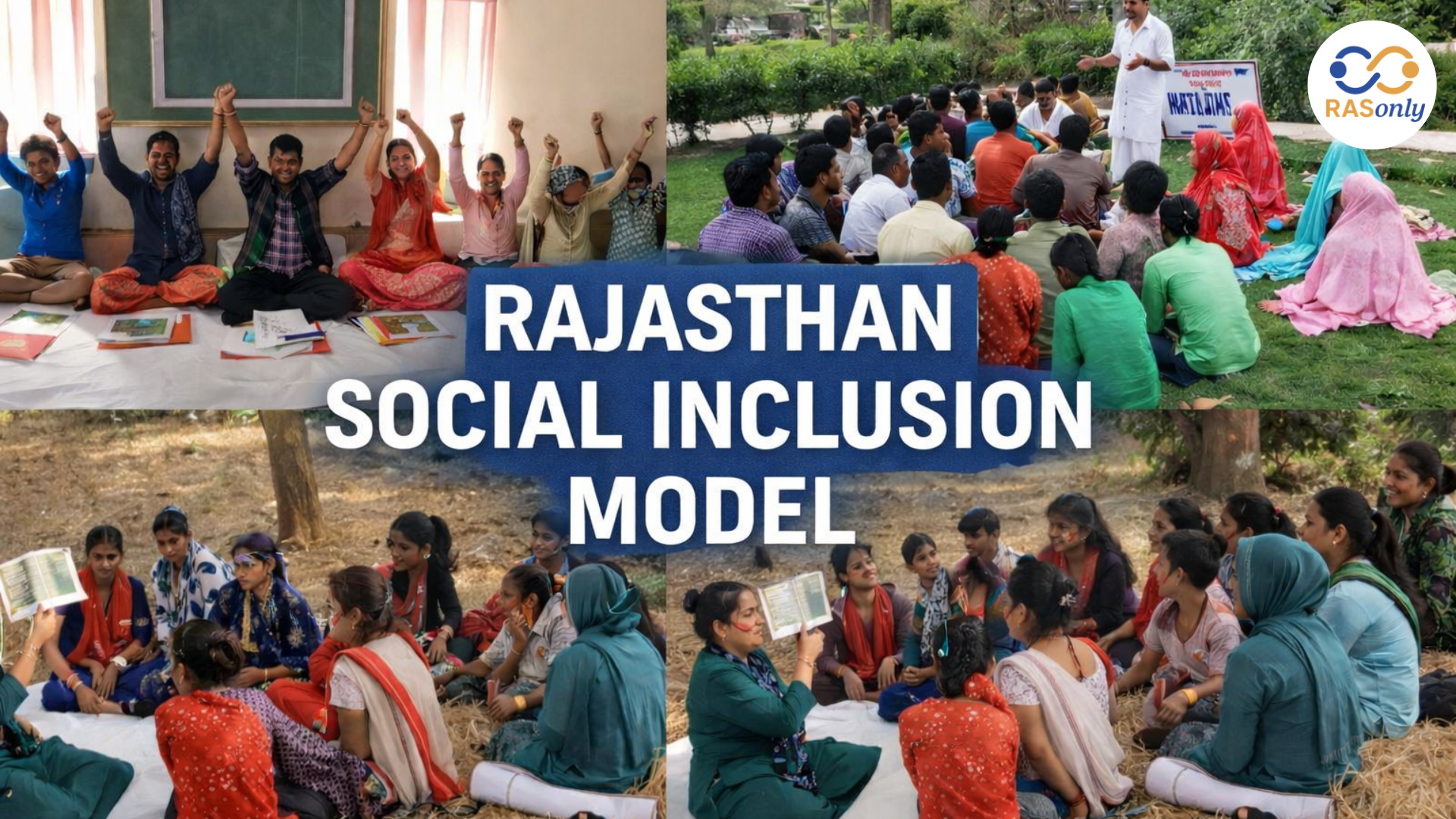
Rajasthan is committed to inclusive social development, ensuring the welfare of marginalised communities, women, children, labourers, minorities, youth and specially abled person.
With dedicated departments for tribal, minority, labour, women and child development and youth affairs, the state focuses on education, healthcare, employment, sports and gender equality. Policies and schemes aim at economic upliftment, social justice and workforce empowerment, fostering a progressive and inclusive Rajasthan by 2047.
92.38 lakh
(Census 2011)
Scheduled Tribe population
(13.5% of state population)
122.21 lakh
(Census 2011)
Scheduled Caste population
(17.83% of state population)
Minority population 78.18 lakh
(Census 2011)
(11.41% of total state population)
Dedicated Department for Child Rights established in 2014
5th Schedule grants
Rajasthan special powers for tribal governance
Women-focused policies
on health, education, skilling and protection
Labour Department ensures fair
wages and industrial harmony
Skill development
for youth through
'Rajasthan Skill Policy 2025'
Tribal Area Development
Department established in 1975 for tribal upliftment
Dedicated Department for Minorities established in 2009
Modern sports infrastructure to foster youth fitness and excellence
VISION 2047
By 2047, Rajasthan will be a more equitable, inclusive and prosperous state, ensuring holistic development for all, especially weaker and vulnerable sections.
Scheduled Tribes, Scheduled Castes and Minorities will be socially, politically and economically empowered and women and children will have equitable access to opportunities and live life full of dignity and complete sense of security.
A resilient workforce and skilled youth will drive economic growth. Sports, fitness and talent development will be prioritised, ensuring global excellence and national recognition for Rajasthan.
Thrust Areas
Empowering Weaker Sections
Rajasthan is committed to uplifting marginalised communities through education, skilling and employment opportunities.
Empowerment of Specially Abled Person
Expanding inclusive education, skill training and financial aid to ensure equal opportunities.
Senior Citizen Welfare
Establishing care homes, healthcare support and social security benefits for the elderly population.
Women & Child Welfare
Strengthening social safety net and socio-economic-political empowerment for women and children, including most vulnerable.
Maternal & Child Health
Promoting improved nutrition and healthcare to ensure better survival and developmental outcomes for women and children.
Beggar Free Rajasthan
Eliminate beggary by identifying & rehabilitating beggars through shelter, food, skill development and NGO-supported social reintegration.
DNT (Denotified Tribes) Welfare
Enhance the socio-economic status of Denotified, Nomadic and Semi-Nomadic Tribes through welfare schemes, skill development and mainstream inclusion.
Minority Upliftment
Enhancing education in Madarsas, providing livelihood opportunities and developing basic infrastructure in minority-dominated areas.
Labour Rights & Welfare
Promoting social protection and enforcing strong labour laws for worker security.
Youth & Sports Development
Investing in world-class sports infrastructure, athlete support and talent identification programs.
Sustainable Tourism & Indigenous Identity
Promoting eco-friendly tourism while preserving tribal culture and indigenous knowledge.
Climate Resilience & Social Well-being
Implementing climate adaptation strategies, environmental conservation and integrating women in climate action.
Transgender Welfare
The empowerment and inclusion of the transgender community through ID issuance, skill training, access to welfare schemes and awareness campaigns.
De-addiction Centres
Combating substance abuse through state-wide centres offering rehabilitation, counselling, medical support and community awareness programs.
Social Justice & Welfare
Rising Ageing Population
Rajasthan's senior citizen population is projected to grow from 5.1 million (2011) to 13 million (2047), demanding strong social security and elderly care measures i.e. Old-age pensions.
Expanding Social Safety for Destitute Children
The Palanhar scheme provides monthly cash assistance to 7 lakh+ children, alongside foster care and institutional programs to support vulnerable children needing care and protection.
Comprehensive Welfare Framework
With 30% of Rajasthan's population from weaker sections, state policies, laws and social programs ensure holistic development and empowerment of marginalised communities.
Educational Outcomes Need Focused Attention
SC and OBC students demonstrate strong performance in primary education, showcasing great potential. With continued support and targeted interventions, there is a significant opportunity to sustain and enhance learning outcomes at the elementary and secondary levels.
Minority Affairs
Expanding Access to Education for Minorities
Minority Student's enrolment in Government Schools is 6.88% lower than their 11.40% population. To bridge the gap, Department of Minority Affairs started 32
Residential Schools having 3,427 students enrolled. Additionally, 3,696 Madrasas provide primary education to minority students, contributing to improved enrolment rates. Initiatives such as minority hostels, scholarships and scooty distribution further support the educational upliftment of minority communities.
Enhancing Minority Economic Participation
Loan facilities, market linkages and business support programs promote economic empowerment and employment opportunities for minority communities, reducing financial disparities and fostering self-sufficiency.
Infrastructure & Minority Rights Protection
Basic amenities are developed under PM Jan Vikas Karyakram. The Rajasthan State Commission for Minorities (RSCM) ensures protection and progress of minority communities.
- Welfare of Other Backward Class (OBC) & Most Backward Classes (MBC)
- Welfare of Scheduled Caste (SC), Scheduled Tribe (ST)
- Care and support to Senior Citizens
- Empowerment of Specially Abled Persons
- Welfare of Economically Backward Classes (EBC)
- Welfare of destitute Women and Children
- Support of other vulnerable groups such as Transgender, Silicosis affected person, victims of alcoholism and substance abuse, etc.
Tribal Development
Expanding Tribal Education Access
Over 43,000 tribal students benefit from 437 hostels, 50 residential schools, 11 college hostels, 8 multi-purpose hostels and 3,000 Maa Baari Centres, ensuring better education opportunities.
Bridging the Digital Divide
Smart classrooms in 140+ hostels and residential schools promote e-learning, benefiting 20,000+ tribal children with digital education resources for improved learning outcomes.
Education to Employment Pathway
The CM Anuprati Coaching Scheme supports tribal students in competitive exam preparation, enhancing higher education access and employability.
Promoting Tribal Arts & Culture
Tribal Research Institute initiatives boost tribal tourism, art and cultural heritage, mainstreaming tribal identity while developing scheduled areas into tourist hubs.
Health, Agriculture & Infrastructure Development
Sickle cell anaemia screening, 'Van Dhan' centers, solar pumps and dairy support programs improve health, agriculture and livelihoods for Rajasthan's tribal communities.
Women & Child Development
Improving Sex Ratio & Delaying Child Marriages
Focused interventions like PCPNDT & BBBP improved sex ratio at birth and multi-stakeholder actions led to a significant drop in child marriages rates from 65% (2005-06) to 25% (2019-21).
Better Maternal Survival & Healthcare
Maternal Mortality Ratio declined by 28 points (2017-20); institutional deliveries reached 95%, and health insurance coverage jumped from 18.7% (2015-16) to 88% (2019-21), which is best in the country.
Though Improving, Malnutrition Remains a Challenge
Stunting dropped from 39% to 32%, underweight from 37% to 28%. The anaemia rising among women (+7%) and children (+11%), is still an area of concern.
Workforce Participation and Entrepreneurship
Female Labour Force Participation Rate (LFPR) at 51% (PLFS 2023) surpasses national average (40%) and 2.2 Lakh+ women MSMEs in Rajasthan have generated more than 10 Lakh jobs.
Visible Role in Decision Making
Women's role in household decision-making has grown visibly, rising from 82% to 88% between 2015-16 and 2019-21. Ownership of house or land by women increased from 24% to 26.6%, while the percentage of women with self-operated bank accounts saw a sharp rise from 58.2% to 79.6%.
Focus on improving political participation
Women in Panchayati Raj Institutions dropped from 56% (2015) to 51% (2020); State Assembly representation fell from 14% (2013) to 10% (2023).
Ensuring Wage Parity & Economic Equity
Women earn INR 6,288 less in monthly salaries, INR 64/day less in casual labour and INR 8,992 less in self-employment (PLFS 2023) than men.
Focus on sustaining educational progress
Girls Gross Enrolment Ratio declines from 101.9 (elementary) to 66.3 (higher secondary) and 26 (tertiary); Gender Parity Index (0.9) for higher secondary.
Labour
Rural-Urban & Gender Employment Divide
Labour Force Participation Rate (LFPR) is strong with male at 56.4% in rural and 56.8% in urban. Female have participation rate of 43% in rural and 23.5% in urban. Unemployment rate with male at 3.5% in rural and 6.5% in urban, while female at 2.7% in rural and 10.9% in urban areas.
Persistent Child Labour Issues
Despite efforts, many children remain in hazardous labour, requiring multi-pronged strategies to eradicate child labour and break the cycle of poverty.
Support for Construction Workers
The BOCW Board provides scholarships, insurance, maternity benefits & accident assistance to improve the well-being of construction workers and their families. A total of 3,07,401 workers are benefited from BOCW scheme. (1 April to 31 December 2024)
Rajasthan Leads in Gig Worker Rights
First state to introduce Platform-Based Gig Workers (Registration & Welfare) Bill 2023.
Expanding Social Security for Unorganised Workers
1.46 crore workers in Rajasthan are registered on e-shram portal, enabling them to access government benefits and social security schemes.
Youth Affairs & Sports
Empowering Youth through Engagement & Leadership
Rajasthan promotes youth civic engagement, personality development & leadership programs, ensuring active participation in social responsibility and nation-building initiatives.
Expanding Grassroots Sports Infrastructure
50 block-level stadiums completed, 30 more by 2025; open gyms & playgrounds at Panchayat level as per Sankalp Patra 2023 & Budget 2024-25.
Athlete Support & Recognition
Increased grants for Olympic, Asian & Commonwealth winners, 2% horizontal reservation for outstanding sportspersons in government jobs and enhanced Maharana Pratap & Guru Vashishth awards.
State-of-the-Art Sports Science & Training
Jaipur's high-performance center offers rehabilitation & training with advanced sports science labs, ensuring modern facilities for athlete development.
Sports Policy & Budget Expansion
Rajasthan Sports Policy 2025, Khelo Rajasthan Games, One District-One Sport academies, Maharana Pratap Sports University & Sports Life Insurance Scheme reflect the state's commitment to sports modernisation.
Social Justice and Empowerment
| Indicators | Current Status | Target (2030) | Target (2035) | Target (2040) | Target (2047) |
|---|---|---|---|---|---|
| Capacity for institutional assistance through old age and day care centers etc. (Numbers) | 10,000 | 30,000 | 40,000 | 50,000 | 1,00,000 |
| Senior Citizen pension through smart system by saturation approach | 61 Lakh | 85% | 90% | 95% | 100% |
| Number of widows getting pension | 23 Lakh | 85% | 90% | 95% | 100% |
| Number of specially abled getting pension | 6.4 Lakh | 80% | 90% | 95% | 100% |
| SC/ST children covered by post-matric scholarships | 7.0 Lakh | 80% | 90% | 95% | 100% |
| Enrolment ratio of children with specially abled children (%) | 47 | 70 | 80 | 85 | 100 |
| Certification of identified specially abled persons (%) | 30 | 70 | 80 | 85 | 100 |
| Silicosis compensation (Numbers) | 18,274 | 7,125 | 5,500 | 4,660 | 1,500 |
Women and Child Development
| Indicators | Current Status | Target (2030) | Target (2035) | Target (2040) | Target (2047) |
|---|---|---|---|---|---|
| Sex ratio at birth | 920 | 930 | 935 | 940 | >950 |
| Girl child aged 12-23 months who are fully vaccinated (%) | 81 | >85 | >90 | >95 | 100 |
| Children under 5 years who are stunted (%) | 32 | <20 | <15 | <10 | <5 |
| Children under 5 years who are wasted (%) | 17 | <10 | <7 | <5 | <1 |
| Children under 5 years who are underweight (%) | 28 | <15 | <12 | <10 | <5 |
| Prevalence of anaemia among girls aged 15-19 years (<12.0 g/dl) (%) | 59 | <40 | <25 | <15 | <5 |
| Female labour force participation rate (%) | 33.2 | 35 | 40 | >45 | >60 |
| Women aged 20-24 years married before age 18 years (%) | 25.4 | <15 | <10 | <5 | 0 |
| Seats held by women in state assembly (%) | 10 | >20 | >25 | >30 | >40 |
Tribal Area Development
| INDICATORS | CURRENT STATUS | TARGET (2030) | TARGET (2035) | TARGET (2040) | TARGET (2047) |
|---|---|---|---|---|---|
| Scheduled tribe households having access to a toilet facility (Rural) (%) | 49 | >70 | >80 | >90 | 100 |
| ST children aged 6-17 years attending school (%) | 85 | 95 | 100 | 100 | 100 |
| Children aged under 5 years belonging to ST households that are stunted (%) | 36 | <20 | <10 | <5 | 0 |
| ST children aged 6-59 months who are anaemic (%) | 77 | <20 | <10 | <5 | 0 |
Minority
| INDICATORS | CURRENT STATUS | TARGET (2030) | TARGET (2035) | TARGET (2040) | TARGET (2047) |
|---|---|---|---|---|---|
| Hostels operating at free of cost for minority boys and girls (Numbers) | 54 | 75 | 80 | 85 | 100 |
| Minority boys and girls residential schools operation (Numbers) | 32 | 50 | 60 | 75 | 100 |
| Loan distribution (vocational and educational) (Numbers) | 129 | 3,600 | 5,000 | 8,000 | 12,100 |
Mid-Term Action Plan
Smart Infrastructure for Weaker Sections
Upgrade schools & hostels with digital learning, solar power & smart classrooms in 70% SC/ST/OBC-dominated villages.
Senior Citizens' Well-being
Launch INR 2,000/month pension, INR 4,000/month old-age home subsidy, daycare centers & 24x7 helplines for elderly support.
Enhanced Child & Women Welfare
Increase Palanhar cash transfer to INR 4,000/month, digitalise child institution monitoring and integrating mental health support.
Empowerment of Specially Abled Person
Introduce grants, block-level service desks and home-based education with assistive tech for children (0-18 years).
Tribal Education & Skill Development
Ensure 100% school enrolment, teacher availability & market-driven skills in agriculture, forestry & entrepreneurship.
Healthcare for Tribals
Expand rural healthcare, eradicate sickle cell anaemia and integrate millets in nutrition programs like ICDS & Mid-Day Meals.
Tribal Environment & Livelihoods
Strengthen Van Dhan centers, involve SHGs in forest trade and enforce the Forest Rights Act.
Tribal Cultural Preservation
Promote tribal arts & heritage, ensuring compliance with the PESA Act for self-governance in scheduled areas.
Tribal Tourism & Infrastructure
Enhance rural transport, develop eco-tourism circuits and boost Mangarh Dham & Kalibai Temple tourism.
Maternal & Child Health
Develop Anganwadi Centres as smart and inclusive spaces to promote continuum of care for holistic health and nutrition well-being of mother and child.
Skilling & Economic Empowerment of Women
Establishing a system of skill financing and promote women's entrepreneurship through grants, microfinance support, mentorship and support services women friendly policies.
Women's Safety & Gender Equality
Undertake campaigns to address gender stereotypes and societal norms, strengthen women helpline and response system, promote gender-sensitive policing and introduce self-defense training in schools and colleges.
Minority Education & Skill Development
Launch education loans, district-level minority schools and madarsa modernisation with digital learning.
Labour Rights & Employment
Introduce AI-based child labour tracking, incentive based school enrolment and universal health coverage for gig workers.
Real-Time Labour Market Monitoring
Develop a real-time labour database, track policy impacts and enhance grievance redressal through digital platforms.
Grassroot Sports Infrastructure
Establish sports nurseries in 10,000 villages, mini-stadiums at block levels and world-class sports academies.
Olympic Talent Identification
Implement state TOPS (Target Olympic Podium Scheme), scouting and elite athlete training.
Major Sporting Events & Digitalisation
Organise Khelo India & Khelo Rajasthan, conduct district/state-level tournaments and digitise sports management.
Youth Civic Engagement
Expand NCC/NSS in government schools, launch leadership training programmes and conduct cross-state youth exchange visits.
Women-led Climate Adaptation
Promote active engagement of women SHGs in renewable energy and mainstream gender perspectives in climate policies and disaster mitigation strategies.
Long-Term Action Plan
Excellence in Education for Weaker Sections
Establish divisional-level residential schools with skill development centers, international student exchange and career counselling for holistic empowerment of marginalised youth.
Multi-Dimensional Social Security
Develop a vulnerability assessment framework for identifying and assisting the most disadvantaged families, ensuring targeted and effective social security interventions.
Enhanced Senior Citizen Welfare
Build senior citizen homes in every district, set quality standards and introduce geriatric nursing in medical curricula for improved elderly care services.
Digital Healthcare for Elderly
Implement AI-powered smart health monitoring, virtual nursing, telemedicine and specialised elderly care systems to enhance accessibility and efficiency.
Integrated Child Protection Schemes
Unify Palanhar, Vatsalya and other child welfare programs under a single umbrella to ensure holistic care and family-based alternatives for vulnerable children.
Technology-Enabled Social Security
Develop digital platforms for application tracking, grievance redressal and monitoring of social security schemes, ensuring transparency and accessibility.
Comprehensive Specially Abled Welfare
Establish early diagnostic centers, district-level rehabilitation facilities and digital employment portals while mandating specially abled certification and UDID issuance.
Advanced Skilling for Tribal Communities
Provide state-of-the-art skill training centers in tribal blocks, ensuring backward and forward linkages for sustainable livelihood development.
Modernised Minority Education & Training
Upgrade madrasa infrastructure, establish multilingual education centers and introduce psychological counselling for minority students.
Technological Advancement in Sports
Utilise AI, blockchain and data analytics for athlete training, expand sports quotas from 2% to 5% and host national and international competitions.
Gender-Responsive Development Policies
Strengthen collection and use of gender-disaggregated data and conduct regular gender budgeting for effective gender-based policy and decision making.
Cutting Edge Anganwadi Services
Promote use of solar energy and integrate AI in delivery of Anganwadi Services, ensure 100% digital anthropometric tracking and reduce dependency on supplementary nutrition through adoption of improved feeding practices at household level.
Strengthening Design & Delivery of Nutrition Programmes
Establish a state-of-the-art resource, research and knowledge centre for improving nutritional outcomes among women and children.
Holistic Women Friendly Eco-System for Economic Empowerment
Develop single-window system of financing, introduce finishing schools and expand micro-finance support for women-led enterprises including specialised financial products to meet the needs of first-generation women entrepreneurs.
Ensuring Wage Parity & Equal Opportunities
Conduct wage equality audits, promote traditional crafts as women-led businesses and provide mentorship for female entrepreneurs.
Comprehensive Women's Safety Mechanism
Develop a unified helpline and response system, deploy AI-driven security measures for rapid response to women in distress.
Women-led Climate Response
Use AI and geo-spatial mapping tools for climate risk mapping, enforce gender-disaggregated environmental data collection and promote women-led sustainability initiatives.
Eradication of Child Labour
Implement strict penalties, integrate community justice systems and introduce statewide databases to eliminate child labour.
Inclusive & Smart Labour Policies
Enforce gig worker social security, introduce safe migration laws and ensure fair wages and working conditions using AI-based monitoring.
These initiatives align with the long-term vision of Rajasthan for a more inclusive, equitable and technology-driven society by 2047.
BEST SELLER
🏆 PRELIMS
RAS Pass
Prelims focused Hindi & English
₹399
✓
Prelims Topic-Wise Tests
✓
Subject-Wise Tests
✓
Full-Length Prelims Tests
✓
Daily Current Affairs Tests
✓
Prelims PYQs Tests
✓
Detailed Solutions & Analysis
✓
All Rajasthan Ranking
✓
Unlimited Reattempts
✓
Mains Tests
✓
Hindi & English Tests
✓
All Rajasthan Ranking
Trusted by 5,000+ Students
Post Category
- RAS Salary
- Result
- RAS Admit Card
- RAS Job
- RAS Cutoff
- Preparation Tips
- RAS Answer Key
- RAS Exam Analysis
- RAS Syllabus
- RAS Previous Year Papers
- RPSC RAS Exam Pattern
- RAS Interview
- RAS Exam Date
- RAS Vacancy
- RAS Test Series
- RAS Best Books
- RAS Preparation Resources
- RAS Coaching Centre
- History
- Polity
- Geography
- Economics
- Science
- Art and Culture
- RPSC RAS Application Form
- RPSC RAS Notification
- RAS Eligibility Criteria
- UPSC Exam
- RPSC RAS Mains
Visit Our RASonly Offline Center
Our Expert Faculty

Bhunesh Sir
Current Affairs · 13+ Yrs

Aamir Khan Sir
RAS-2017 · IIM Ahm.
Akash Sir
Polity · 8+ Yrs
Free Resources
Official Mobile App

RASOnly App
by OTSAdda · Free
Full Video Lectures
Mock Tests & PYQs
Daily Current Affairs
AI Mock Interview
Free Download · No subscription needed to install
RAS 2024 Toppers — RASonly
Rank 2
Virendra Charan
Rank 9
Bhoopinder Singh
Rank 26
Aanchal Nagpal
Rank 33
Lokendra Singh
Rank 45
Amar Rathore
Rank 46
Manasvini Verma

Join RASonly WhatsApp Community
Get daily current affairs, exam alerts, free study material and tips from expert faculty — right on WhatsApp.
Join for Free →RASonly Interview Guidance Program

Mr. Ashok Jain
Ex-Chief Secretary Govt of Rajasthan
- IAS officer of the 1981 batch, Rajasthan cadre.
- Passionate about mentoring the next generation of RAS officers with real-world insights.
- Got retired in Dec 2017 from the post of Chief Secretary of the state of Rajasthan.

Mr. Guru Charan Rai
Ex-ASP / SP in Jaisalmer
- Guru Charan Rai, IPS (Retd), retired as Inspector General of Police (Security), Rajasthan, Jaipur in 2017.
- Served as ASP and SP in Jaisalmer, Nagaur, Sri Ganganagar, Sawai Madhopur, Dausa, Sikar, and Karauli.
- He also held key positions as DIGP and IGP in the Law and Order division.

Mr. Rakesh Verma
Ex-IAS Officer, B.Tech, MBA, and M.A. (Economics)
- IAS officer of the 1981 batch and retired in Chief Secretary Rank.
- Civil servant of high repute and vast experience.
- Has been teaching UPSC CSE subjects for the last six years.
Related Post




Daily Current Affairs for RAS Exam Preparation 2026
Vedanta to Increase Oil Production in Rajasthan
October 06, 2026
Rajasthan Longest High-Level Bridge
October 06, 2026
Financial Approval Granted for the Development of Religious Sites
October 05, 2026