Kushan Empire: History, Rulers, Administration, Economy, Art, Decline
Maratha in Rajasthan 2026: Causes, Expansion, Battles, Role, Impact & Complete Analysis (RAS)

Get in Touch with RASonly!

Maratha expansion in Rajasthan represents a key phase of political instability, economic exploitation, and regional power shift after the decline of the Mughal Empire. It highlights how internal disunity among Rajputs allowed external forces to dominate through indirect control and taxation. This period ultimately paved the way for British intervention, making it a crucial topic for RPSC RAS 2026.

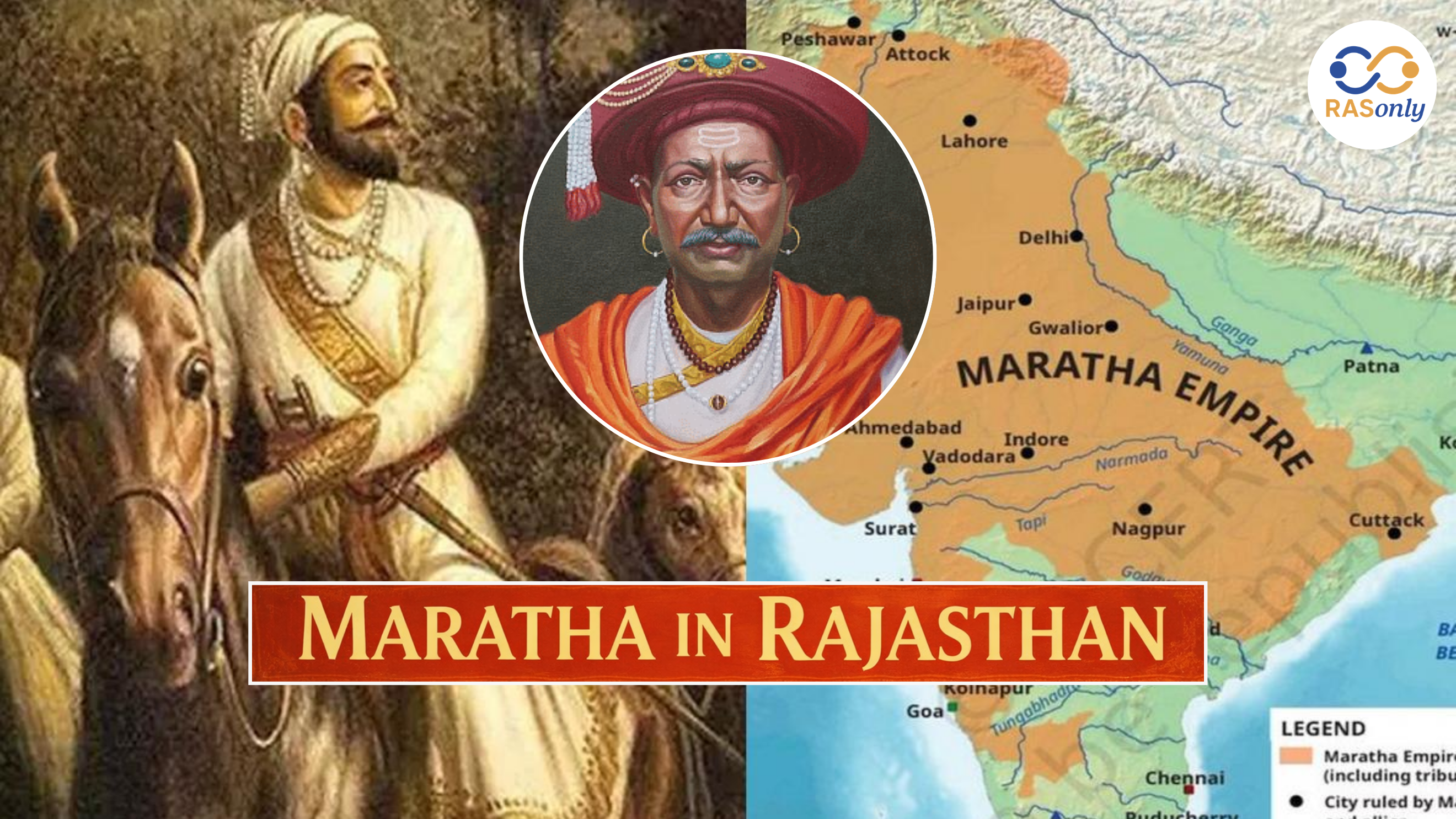
The topic Maratha in Rajasthan represents a major political transformation in 18th century India, where the decline of the Mughal Empire created space for new regional powers like the Marathas. Rajasthan (Rajputana), which was once politically strong under Rajput rulers, became vulnerable due to internal conflicts and weak unity, allowing Marathas to expand into the region.
For RPSC RAS 2026, Rajasthan GK, and History, the topic is very crucial as it articulates the power change (Mughals to Marathas and then to British) and political instability, economic manipulation (Chauth), as well as sovereignty of the Rajput. It also assists in writing critical responses regarding failure of governance, politics within the regions, and colonial intrusion.
Historical Background of Maratha Entry
The Maratha invasion of Rajasthan is inexplicable without considering the greater political shift in India following the death of Aurangzeb (1707). The Mughal Empire began to fall and its administrative authority became significantly weak in the North of India.
Meanwhile the Marathas of the Peshwas pursued a policy of aggressive expansion in order to gain control over the country beyond the Deccan. Once they had gained control over Malwa, Rajasthan had become strategically and economically appealing and thus they gradually infiltrated into the Rajput states.
Reasons for Maratha Arrival in Rajasthan
The introduction of the Marathas in Rajasthan was not accidental but the outcome of a number of political, economic, and strategic processes. It was internal disunity and the pressure of the outside world that made Rajasthan an easy target.
Marathas were even invited by the Rajput rulers themselves to sort out succession disputes and this paved way to permanent intervention. After that, Marathas became not allies but controllers.
Detailed Causes
| Cause | Explanation |
|---|---|
| Decline of Mughal Power | Loss of central authority after Aurangzeb |
| Expansion Policy of Peshwa Baji Rao I | Aim to dominate North India |
| Internal Conflicts in Rajput States | Succession disputes weakened unity |
| Economic Motive | Collection of Chauth & Sardeshmukhi |
| Strategic Importance | Control over trade routes & Delhi access |
| Invitations by Rajputs | External help in internal conflicts |
Early Relations between Rajputs and Marathas
The relations between the Rajput and Marathas were not hostile in the beginning but indirect in nature and they observed each other. The initial significant contact between them came in the Deccan, on Mughal military operations, when Rajput chiefs saw the development of the power of the Marathas under Shivaji and his heirs. This stage was characterized by interest and respect and not conflict.
These initial encounters had the effect of developing a sense among Rajputs that the Marathas were a well-developed and solid military that could take on the Mughals. This non-hostile relation however, changed slowly over time as Marathas spread to the north and started meddling into the inner politics to gain strategic and economic interests.
From Alliance to Domination
In the initial phase of Maratha expansion, some Rajput rulers saw them as useful allies rather than threats. For example, rulers of Jaipur and other states indirectly supported Maratha activities in Malwa to weaken Mughal control and expand their own influence. This cooperation was based on short-term political advantage.
However, this alliance soon became dominant as the Marathas started demanding Chauth (tax), interference in the succession disputes and pressure on the administration. Over time Rajput states lost autonomy and Marathas moved from being political partners to being dominant outside controllers and Rajput power was in decline.
Maratha Expansion Strategy in Rajasthan
The Marathas had a well-planned and strategic approach while expanding into Rajasthan. Instead of direct conquest in the beginning, they were all about the indirect control through a mix of military pressure and diplomacy, along with financial extraction. Malwa was an important base to attack Rajputana.
Their strategy was highly flexible and practical. They supported rival claimants in succession disputes, imposed tribute, and used repeated raids to establish dominance without taking full administrative responsibility. This allowed them to maintain control with minimal governance burden.
Key Strategy Points
- Use of Malwa as strategic base
- Expansion under Peshwa leadership
- Combination of military action + diplomacy
- Focus on Chauth and revenue extraction
- Indirect political control over Rajput states
Maratha Raids and Economic Exploitation
One of the most important aspects of the expansion of the Marathas into Rajasthan was the constant raids for economic exploitation. They levied taxes such as Chauth (25%) and Sardeshmukhi which proved to be a huge financial burden for the Rajput states and local population.
These repeated invasions disturbed agriculture, trade and local administration and resulted in economic instability. The incessant outflow of wealth made the economic base of Rajasthan weaker and it lowered the ability of Rajput rulers to govern strongly and also resist militarily.
Key Features
- Frequent military raids across regions
- Heavy taxation system (Chauth & Sardeshmukhi)
- Looting of villages and urban centers
- Decline in agriculture and trade
- Economic weakening of Rajput states
Battle of Mandsaur (1733) – Turning Point
The Battle of Mandsaur (1733) was a turning point in the history of Rajasthan that has clearly established the supremacy of the Marathas in Malwa and adjoining areas. It exposed the military weakness of Rajput rulers and strengthened Maratha authority in North India.
Maratha leaders like Malhar Rao Holkar forced Sawai Jai Singh to accept heavy tribute and territorial concessions. This defeat not only weakened the position of Jaipur, but also indicated that Rajputs were no longer in a position to successfully resist the Maratha expansion, and thus it was a turning point in the power dynamics of the region.
Significance
- Establishment of Maratha dominance in Malwa
- Weakening of Jaipur’s political strength
- Beginning of large-scale Maratha interference
- Shift in regional power balance
Maratha Intervention in Rajput States
Maratha involvement in Rajasthan was greatly caused by conflicts within Rajput states. In various states, such as Bundi, Jaipur, and Marwar, they often interfered in the succession issues siding one group against the other for their political and financial gains.
This continuous interference destabilized the political structure of Rajasthan. Instead of strengthening governance, it increased dependency on external powers, weakened sovereignty, and created long-term instability in regional administration.
Hurda Conference (1734) – Failed Unity
The Hurda Conference of 1734 was an important attempt by Rajput rulers to unite against the growing Maratha threat. It showed that Rajput leaders were aware of the danger posed by Maratha expansion and wanted to resist collectively.
However, due to lack of unity, mutual distrust and weak coordination the conference did not produce any effective results. This failure led to the further expansion of the Marathas without any tough combined resistance.
Key Facts
| Feature | Details |
|---|---|
| Year | 1734 |
| Objective | Formation of united front |
| Outcome | Failure due to disunity |
Case Study: Jaipur, Bundi & Marwar
Jaipur
After the death of Sawai Jai Singh, succession disputes weakened Jaipur, and Marathas intervened by supporting different claimants. This led to political instability and increased financial burden due to tribute payments.
Bundi
In Bundi, Marathas played a decisive role in installing and removing rulers. In return, they gained territorial control and financial benefits, increasing their influence in the region.
Marwar
Marwar faced similar issues where internal conflicts allowed Marathas to interfere. Their involvement weakened the state's independence and increased reliance on external forces.
Consequences of Maratha Intervention
Maratha intervention had far-reaching consequences on the political, economic and social setup of Rajasthan. Their dominance undermined traditional power systems and did much to instill a sense of instability all throughout the region.
The economic exploitation and political interference caused the Rajput states to lose strength and were vulnerable to future control by the external world, particularly the British.
Impact Analysis
| Aspect | Impact |
|---|---|
| Political | Decline of sovereignty |
| Economic | Heavy taxation, economic drain |
| Social | Instability and insecurity |
| Administrative | External interference |
Historiographical Perspective (Advanced)
Historians have different interpretations of Maratha expansion in Rajasthan. Some consider it a natural outcome of Mughal decline and a legitimate rise of regional powers in India.
However, others argue that Maratha policies were exploitative in nature, focusing more on revenue collection than governance. This limited their ability to create stable political systems in Rajasthan.
Timeline of Major Events
| Year | Event |
|---|---|
| 1707 | Death of Aurangzeb |
| 1720s | Maratha expansion begins |
| 1733 | Battle of Mandsaur |
| 1734 | Hurda Conference |
| 1740s–50s | Deep Maratha intervention |
Transition to British Rule
The weakening of Rajput states due to continuous Maratha intervention created a political vacuum in Rajasthan. This situation was strategically used by the British to expand their influence in the region.
Through treaties and subsidiary alliances, the British gradually replaced Maratha dominance. By the early 19th century, most Rajput states came under British protection, marking the end of Maratha power in Rajasthan.
Conclusion
The Maratha expansion in Rajasthan was an important stage in the process of political change, when the decline of the Mughal power and the disunity in the Rajput states opened the way to external intervention. What the Marathas did was to establish dominance by indirect control, economic extraction and political interference, rather than a stable rule.
Their policies reduced the political, economic and administrative system of Rajasthan, which ultimately led to the power vacuum that helped the British expansion. Thus, Maratha period serves as a transitional period in the history of Rajasthan between the decline of the medieval period and the advent of colonial rule, and hence it holds much importance in the context of RPSC RAS 2026.
FAQs
Marathas entered Rajasthan due to the decline of Mughal power, internal conflicts among Rajputs, and economic motives like collection of Chauth and control over trade routes.
Chauth was a tax (around 25% of revenue) collected by Marathas from Rajput states as a symbol of their dominance and protection.
It marked the establishment of Maratha dominance in Malwa and showed the military weakness of Rajput rulers.
The Hurda Conference (1734) failed due to lack of unity, trust, and coordination among Rajput rulers.
Maratha intervention led to political instability, economic exploitation, administrative weakness, and ultimately paved the way for British control.

BEST SELLER
🏆 PRELIMS
RAS Pass
Prelims focused Hindi & English
₹399
✓
Prelims Topic-Wise Tests
✓
Subject-Wise Tests
✓
Full-Length Prelims Tests
✓
Daily Current Affairs Tests
✓
Prelims PYQs Tests
✓
Detailed Solutions & Analysis
✓
All Rajasthan Ranking
✓
Unlimited Reattempts
✓
Mains Tests
✓
Hindi & English Tests
✓
All Rajasthan Ranking
Trusted by 5,000+ Students
Post Category
- RAS Salary
- Result
- RAS Admit Card
- RAS Job
- RAS Cutoff
- Preparation Tips
- RAS Answer Key
- RAS Exam Analysis
- RAS Syllabus
- RAS Previous Year Papers
- RPSC RAS Exam Pattern
- RAS Interview
- RAS Exam Date
- RAS Vacancy
- RAS Test Series
- RAS Best Books
- RAS Preparation Resources
- RAS Coaching Centre
- History
- Polity
- Geography
- Economics
- Science
- Art and Culture
- RPSC RAS Application Form
- RPSC RAS Notification
- RAS Eligibility Criteria
- UPSC Exam
- RPSC RAS Mains
Visit Our RASonly Offline Center
Our Expert Faculty

Bhunesh Sir
Current Affairs · 13+ Yrs

Aamir Khan Sir
RAS-2017 · IIM Ahm.

Akash Sir
Polity · 8+ Yrs
Free Resources
Official Mobile App

RASOnly App
by OTSAdda · Free
Full Video Lectures
Mock Tests & PYQs
Daily Current Affairs
AI Mock Interview
Free Download · No subscription needed to install
RAS 2024 Toppers — RASonly
Rank 2
Virendra Charan
Rank 9
Bhoopinder Singh
Rank 26
Aanchal Nagpal
Rank 33
Lokendra Singh
Rank 45
Amar Rathore
Rank 46
Manasvini Verma

Join RASonly WhatsApp Community
Get daily current affairs, exam alerts, free study material and tips from expert faculty — right on WhatsApp.
Join for Free →RASonly Interview Guidance Program

Mr. Ashok Jain
Ex-Chief Secretary Govt of Rajasthan
- IAS officer of the 1981 batch, Rajasthan cadre.
- Passionate about mentoring the next generation of RAS officers with real-world insights.
- Got retired in Dec 2017 from the post of Chief Secretary of the state of Rajasthan.

Mr. Guru Charan Rai
Ex-ASP / SP in Jaisalmer
- Guru Charan Rai, IPS (Retd), retired as Inspector General of Police (Security), Rajasthan, Jaipur in 2017.
- Served as ASP and SP in Jaisalmer, Nagaur, Sri Ganganagar, Sawai Madhopur, Dausa, Sikar, and Karauli.
- He also held key positions as DIGP and IGP in the Law and Order division.

Mr. Rakesh Verma
Ex-IAS Officer, B.Tech, MBA, and M.A. (Economics)
- IAS officer of the 1981 batch and retired in Chief Secretary Rank.
- Civil servant of high repute and vast experience.
- Has been teaching UPSC CSE subjects for the last six years.

Daily Current Affairs for RAS Exam Preparation 2026

India Wins Gold in 10m Air Pistol
September 26, 2026
India’s Rank in Travel And Tourism Development Index 2026
September 26, 2026
India Wins Bronze Medal in Men’s Double Sculls
September 25, 2026