Chola Dynasty: Capital, Founder, Kings, Time Period and History
Most Repeated Questions in RAS: Topic-Wise Analysis 2026

Get in Touch with RASonly!

Explore the most repeated questions in RAS 2026 through subject-wise PYQ analysis. Discover important topics in Rajasthan History, Geography, Polity, Economy, Science, and Current Affairs to plan effective revision, strengthen conceptual clarity, and improve your exam preparation strategy.


Most Repeated Questions in RAS is one of the most-searched topics among RAS 2026 aspirants. Studying Previous Year Questions (PYQs) shows which subjects, concepts, and themes the Rajasthan Public Service Commission (RPSC) keeps returning to. Exact questions are rarely repeated word for word. However, the same high-priority areas are seen in multiple Prelims and Mains questions in both sections, making PYQ analysis a crucial element of smart preparation.
The exam is not about predicting the next paper because many candidates look for repeated questions in an attempt to do this. The important points that RPSC typically asks about are the same, but they are rephrased or come in a different context, level of difficulty, or question format. Rather than rote learning the questions, students must find out the common threads in each question and develop conceptual clarity, and allocate additional time to the questions with consistent weightage. This article analyzes these common areas, one by one, to help you plan for a targeted RAS 2026 strategy.
What Do the Most Repeated Questions in RAS Really Mean?
A "repeated question" in RAS usually means a repeated topic, not an identical question. The key points are revisited in each cycle and explored in a new light, so it is the concept that is important, not the option that was presented in the past.
Typical examples of recurring themes include:
- Rajasthan forts, which appear in multiple exams in different formats.
- Folk dances and folk music of Rajasthan.
- Fundamental Rights and constitutional bodies in Indian Polity.
- Rivers, lakes and national parks of Rajasthan.
Why Are Previous Year Questions Important for RAS 2026?
PYQs give an idea of the pattern of the exam, the variety of questions asked, and the topics that remain relevant over time. The most common questions in RAS can be used to prioritize your study time and determine which areas are less important and can be saved for later. Candidates who do a lot of analysis of past papers are also likely to notice their weak points quicker.
Key benefits of PYQ analysis:
- Helps you understand the exam pattern and difficulty level.
- Identifies high-priority topics and frequently asked concepts.
- Improves question-solving speed and accuracy.
- Makes revision planning easier and reduces uncertainty.
Most Repeated Questions in RAS: Subject-Wise Topic Analysis
The sections below list the topic areas that have regularly featured in RAS papers, based on the core syllabus and general PYQ patterns. It is to be used as a revision map and never as a prediction list, and always compare it with the current official RPSC syllabus.
Rajasthan History and Culture
Rajasthan History and Culture is one of the most important sections of the RAS exam and produces many of the most repeated questions in RAS year after year. Questions range from dynasties, battles, forts, art, fairs, festivals, and saints to format changes, even though the topic remains the same.
| Topic Category | Frequently Asked Areas |
|---|---|
| Rajput Dynasties | Sisodia, Rathore, Chauhan, Kachwaha |
| Important Battles | Haldighati, Khanwa, Dewair |
| Forts and Monuments | Chittorgarh, Kumbhalgarh, Ranthambore, Jaisalmer, Amber, Gagron, Mehrangarh |
| Folk Dances | Ghoomar, Kalbelia, Bhavai, Gair, Chari |
| Folk Music and Instruments | Ravanhatha, Algoza, Sarangi, Morchang |
| Fairs and Festivals | Pushkar Fair, Beneshwar Fair, Gangaur, Teej |
| Paintings and Art Schools | Phad Painting, Kishangarh School, Rajasthani Miniature Painting |
| Handicrafts | Blue Pottery, Molela Terracotta, Thewa Art, Block Printing |
| Saints and Traditions | Meera Bai, Dadu Dayal, Jambhoji, Ramdev Ji |
| Architecture and Heritage | Temples, Baoris (stepwells), Palaces, UNESCO sites |
A useful fact to remember: six hill forts of Rajasthan (Chittorgarh, Kumbhalgarh, Ranthambore, Gagron, Amber and Jaisalmer) were inscribed as a UNESCO World Heritage Site in 2013. Focus on features, historical significance and cultural importance rather than isolated facts.
Rajasthan Geography
The Rajasthan Geography is a high-scoring portion because topics remain unchanged and are related to the economy and environment of the state. Candidates should be well-versed in rivers and lakes, soils, climate, and protected areas, as well as their map locations, since district-based and map-based questions are frequently asked.
| Topic Category | Frequently Asked Areas |
|---|---|
| Rivers | Chambal, Banas, Luni, Mahi, Sabarmati |
| River Concepts | Origin, tributaries, drainage system, river valley projects |
| Lakes | Sambhar, Jaisamand, Rajsamand, Fateh Sagar, Ana Sagar |
| Soil Types | Desert, Black, Red, Alluvial |
| National Parks and Sanctuaries | Ranthambore, Sariska, Desert National Park, Keoladeo |
| Climate | Arid climate, temperature, rainfall distribution, monsoon |
| Natural Vegetation | Desert vegetation, forest types, grasslands |
| Minerals | Zinc, Copper, Gypsum, Marble, Limestone |
| Agriculture | Major crops, irrigation, agricultural zones |
Indian Polity
Indian Polity is one of the most reliable areas to score in; questions revolve around the Constitution, governance and institutions. The concepts come back in other formats, and it is better to understand the articles and their uses than to memorize them.
| Topic Category | Frequently Asked Areas |
|---|---|
| Fundamental Rights | Article 14, Article 19, Article 21, Article 32 (Constitutional Remedies) |
| DPSP | Welfare state, social justice, economic democracy |
| Parliament | Lok Sabha, Rajya Sabha, legislative procedure, committees |
| Constitutional Bodies | Election Commission, Finance Commission, UPSC, CAG |
| President and Governor | Appointment, powers, functions, removal procedure |
| Judiciary | Supreme Court, High Courts, judicial review, PIL |
| Amendments | Important amendments and their significance |
| Local Governance | Panchayati Raj, urban local bodies |
Rajasthan Polity and Administration
This section tests how the state government and its institutions function. Questions are frequently a mix of constitution and administration; match each institution with its role, powers, and terms of appointment.
| Topic Category | Frequently Asked Areas |
|---|---|
| Governor of Rajasthan | Appointment, powers, functions |
| State Legislature | Legislative Assembly, procedures, sessions |
| Council of Ministers | Chief Minister, cabinet structure, responsibilities |
| Panchayati Raj | Gram Panchayat, Panchayat Samiti, Zila Parishad |
| State Administration | Chief Secretary, Secretariat, departments, District Collector |
| State Commissions | State Election Commission, State Finance Commission |
| Governance | E-governance, transparency, state government schemes |
This section tests how the state government and its institutions function. Questions are frequently a mix of constitution and administration; match each institution with its role, powers, and terms of appointment.
Indian Economy
Indian Economy questions mix basic concepts with current developments. Good basic banking, budgeting and growth indicators will assist you with responding to questions that are direct and application-based.
| Topic Category | Frequently Asked Areas |
|---|---|
| Banking System | RBI functions, monetary policy, inflation, repo and reverse repo rate |
| Budget and Fiscal Policy | Fiscal deficit, revenue deficit, capital expenditure |
| Economic Development | GDP, GNP, inflation, economic growth |
| Government Schemes | Financial inclusion, rural development, employment programmes |
Rajasthan Economy
Rajasthan Economy regularly contributes questions on agriculture, minerals, industries and tourism. The structure of the economy of a state is important for answering factual and analytical questions.
| Topic Category | Frequently Asked Areas |
|---|---|
| Agriculture | Major crops, irrigation, agricultural zones, horticulture |
| Mineral Resources | Zinc, copper, gypsum, marble |
| Industries | Textile, cement, handicraft |
| Tourism | Heritage, desert and eco tourism |
Science and Technology
Science and Technology questions focus on basic scientific concepts and recent technological progress. Update NCERT basics and incorporate recent advancements in space technology, biotechnology, and digital governance.
| Topic Category | Frequently Asked Areas |
|---|---|
| Biology | Human body systems, diseases, nutrition, vitamins |
| Physics | Motion, light, electricity, sound |
| Chemistry | Acids and bases, elements, chemical reactions |
| Technology | Artificial Intelligence, biotechnology, space technology, digital governance |
Environment and Ecology
Environment and Ecology has gained importance in recent years, and the most repeated questions in RAS here relate to conservation, climate change, and protected areas. The national parks and sanctuaries of Rajasthan are an opportunity you will have to get in touch with local and global issues easily.
| Topic Category | Frequently Asked Areas |
|---|---|
| Biodiversity | Conservation, endangered species |
| Climate Change | Global warming, greenhouse effect, carbon emissions |
| Protected Areas | National parks, wildlife sanctuaries, biosphere reserves |
| Organisations | UNEP, IUCN, international environmental initiatives |
Current Affairs
Current Affairs is the most dynamic section, which requires constant preparation. Include state and national events, and make updates each month rather than waiting until the end of several weeks.
- Rajasthan: government initiatives, state budget highlights, awards and important events.
- National: policies, constitutional developments, economic updates and science news.
- International: organisations, global summits, reports and indices.
Reasoning and Mental Ability
The reasoning section is a scoring section that gets better and better with practice. Questions are concept-based, and speed and accuracy are more important than memory.
- Logical Reasoning: coding-decoding, blood relations, series, analogy.
- Analytical Ability: direction test, ranking, number series.
How to Use the Most Repeated Questions in RAS for 2026 Preparation
Simply reading PYQs is not enough, because the real benefit comes from analysing them. An organised strategy transforms old papers into an easy-to-follow study plan, chapter-wise, and keeps your revision on track.
- Analyse previous papers: review at least the last 10 years of RAS papers to understand patterns and difficulty.
- List repeated topics: keep a separate notebook or digital file of frequently appearing themes.
- Focus on high-weightage topics: devote more time to the topics of Rajasthan GK, Polity, Economy, Geography, and Current Affairs.
- Take mock tests regularly: they improve speed, accuracy, and highlight weak areas.
- Revise often: revisit frequently asked topics several times before the exam.
RAS 2026 Subject Priority Framework
The table below is a general guide based on how consistently each subject has featured in past papers. Customize it to fit your abilities and the current official syllabus.
| Subject | Priority Level |
|---|---|
| Rajasthan History and Culture | Very High |
| Rajasthan Geography | Very High |
| Indian Polity | Very High |
| Rajasthan Polity and Administration | High |
| Economy | High |
| Science and Technology | High |
| Environment and Ecology | High |
| Current Affairs | High |
| Reasoning and Mental Ability | Medium |
Also Read
| RPSC RAS Mains PYQs | RPSC RAS Prelims PYQs |
| RAS Prelims Exam Date | RPSC RAS Recruitment |
| RPSC RAS Interview Preparation | Free AI Mock Interview |
Conclusion
One of the smartest tricks to prepare is to understand the most repeated questions in RAS, but this is possible only if you consider questions as topics to learn instead of picking and memorising them. Except Exact questions, there is no repetition of questions in all the cycles, but all the other question papers of Rajasthan History, Culture, Geography, Polity, Economy, Environment, Science, and Current Affairs appear in every cycle. Analyse previous year trends, note the recurring themes, and build strong concepts around them. Do this with frequent revision and mock tests, and always check the details against the latest RPSC syllabus. Your focus and confidence will be better, and your chances of success will be higher with a plan that's focused on a specific topic.
FAQs
Rajasthan History and Culture, Rajasthan Geography, Indian Polity, Economy, Environment and Current Affairs are among the most frequently tested areas. These themes appear in nearly every cycle, though in different formats.
RPSC rarely repeats identical questions. It typically restates key topics and concepts in different terms, possibilities, or degrees of difficulty, so that concept understanding is more important than recalling old questions.
Rajput dynasties, major battles such as Haldighati and Khanwa, forts, folk dances, fairs, paintings, handicrafts, and saints are the most commonly repeated areas.
The most common topics for revision are: rivers, lakes, soils, climate, national parks, minerals, and district-based map questions.
Fundamental Rights, DPSP, Parliament, constitutional bodies, the President and Governor, the judiciary, amendments, and Panchayati Raj are the key areas to prepare.
BEST SELLER
🏆 PRELIMS
RAS Pass
Prelims focused Hindi & English
₹399
✓
Prelims Topic-Wise Tests
✓
Subject-Wise Tests
✓
Full-Length Prelims Tests
✓
Daily Current Affairs Tests
✓
Prelims PYQs Tests
✓
Detailed Solutions & Analysis
✓
All Rajasthan Ranking
✓
Unlimited Reattempts
✓
Mains Tests
✓
Hindi & English Tests
✓
All Rajasthan Ranking
Trusted by 5,000+ Students
Post Category
- RAS Salary
- Result
- RAS Admit Card
- RAS Job
- RAS Cutoff
- Preparation Tips
- RAS Answer Key
- RAS Exam Analysis
- RAS Syllabus
- RAS Previous Year Papers
- RPSC RAS Exam Pattern
- RAS Interview
- RAS Exam Date
- RAS Vacancy
- RAS Test Series
- RAS Best Books
- RAS Preparation Resources
- RAS Coaching Centre
- History
- Polity
- Geography
- Economics
- Science
- Art and Culture
- RPSC RAS Application Form
- RPSC RAS Notification
- RAS Eligibility Criteria
- UPSC Exam
- RPSC RAS Mains
Visit Our RASonly Offline Center
Our Expert Faculty

Bhunesh Sir
Current Affairs · 13+ Yrs

Aamir Khan Sir
RAS-2017 · IIM Ahm.

Akash Sir
Polity · 8+ Yrs
Free Resources
Official Mobile App

RASOnly App
by OTSAdda · Free
Full Video Lectures
Mock Tests & PYQs
Daily Current Affairs
AI Mock Interview
Free Download · No subscription needed to install
RAS 2024 Toppers — RASonly
Rank 2
Virendra Charan
Rank 9
Bhoopinder Singh
Rank 26
Aanchal Nagpal
Rank 33
Lokendra Singh
Rank 45
Amar Rathore
Rank 46
Manasvini Verma

Join RASonly WhatsApp Community
Get daily current affairs, exam alerts, free study material and tips from expert faculty — right on WhatsApp.
Join for Free →RASonly Interview Guidance Program

Mr. Ashok Jain
Ex-Chief Secretary Govt of Rajasthan
- IAS officer of the 1981 batch, Rajasthan cadre.
- Passionate about mentoring the next generation of RAS officers with real-world insights.
- Got retired in Dec 2017 from the post of Chief Secretary of the state of Rajasthan.

Mr. Guru Charan Rai
Ex-ASP / SP in Jaisalmer
- Guru Charan Rai, IPS (Retd), retired as Inspector General of Police (Security), Rajasthan, Jaipur in 2017.
- Served as ASP and SP in Jaisalmer, Nagaur, Sri Ganganagar, Sawai Madhopur, Dausa, Sikar, and Karauli.
- He also held key positions as DIGP and IGP in the Law and Order division.

Mr. Rakesh Verma
Ex-IAS Officer, B.Tech, MBA, and M.A. (Economics)
- IAS officer of the 1981 batch and retired in Chief Secretary Rank.
- Civil servant of high repute and vast experience.
- Has been teaching UPSC CSE subjects for the last six years.
Related Post

Daily Current Affairs for RAS Exam Preparation 2026

Kundan Art Display in Hong Kong
October 23, 2026
Rajasthan International Folk Festival 2026
October 23, 2026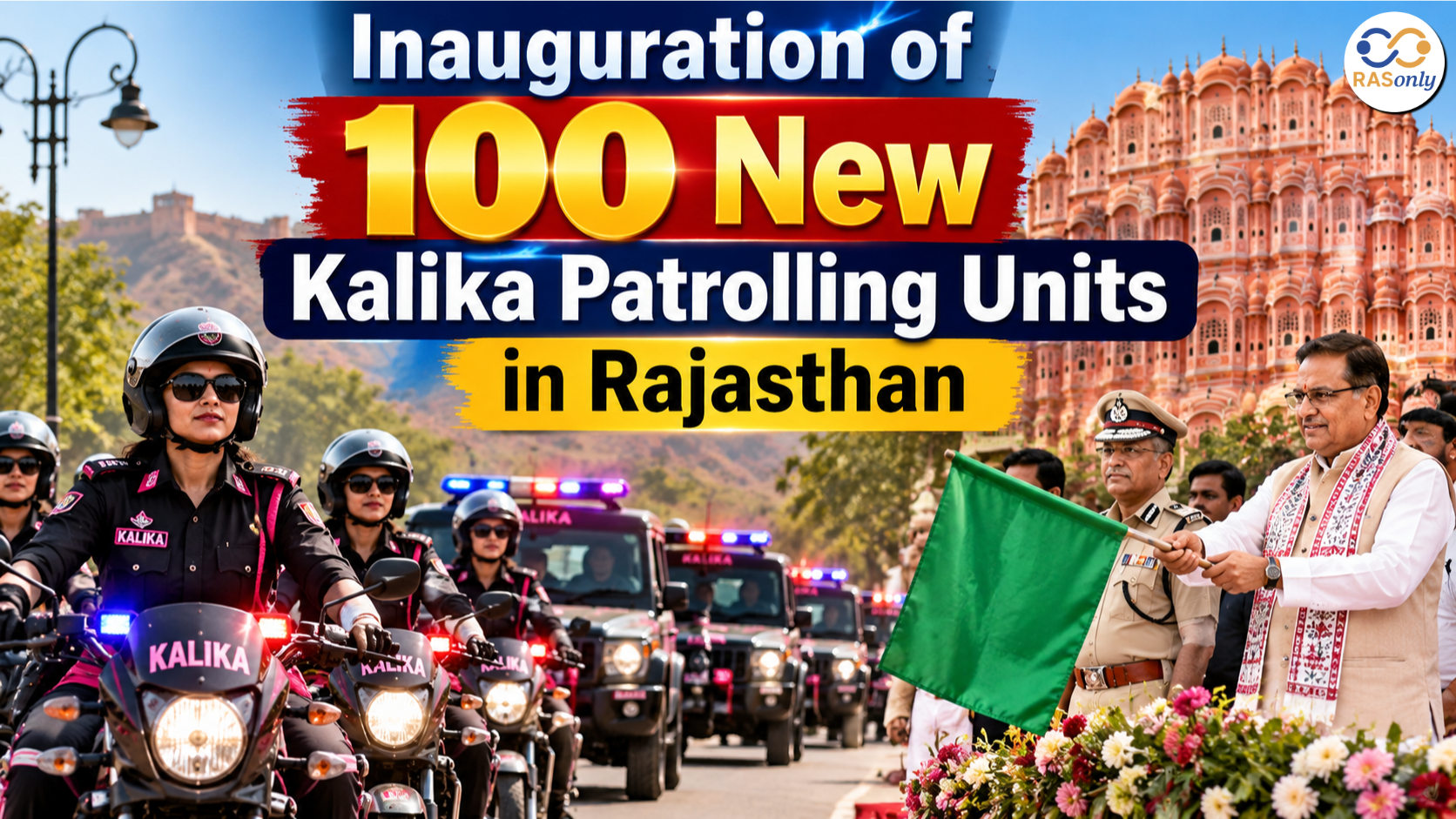
Inauguration of 100 New Kalika Patrolling Units in Rajasthan
October 21, 2026