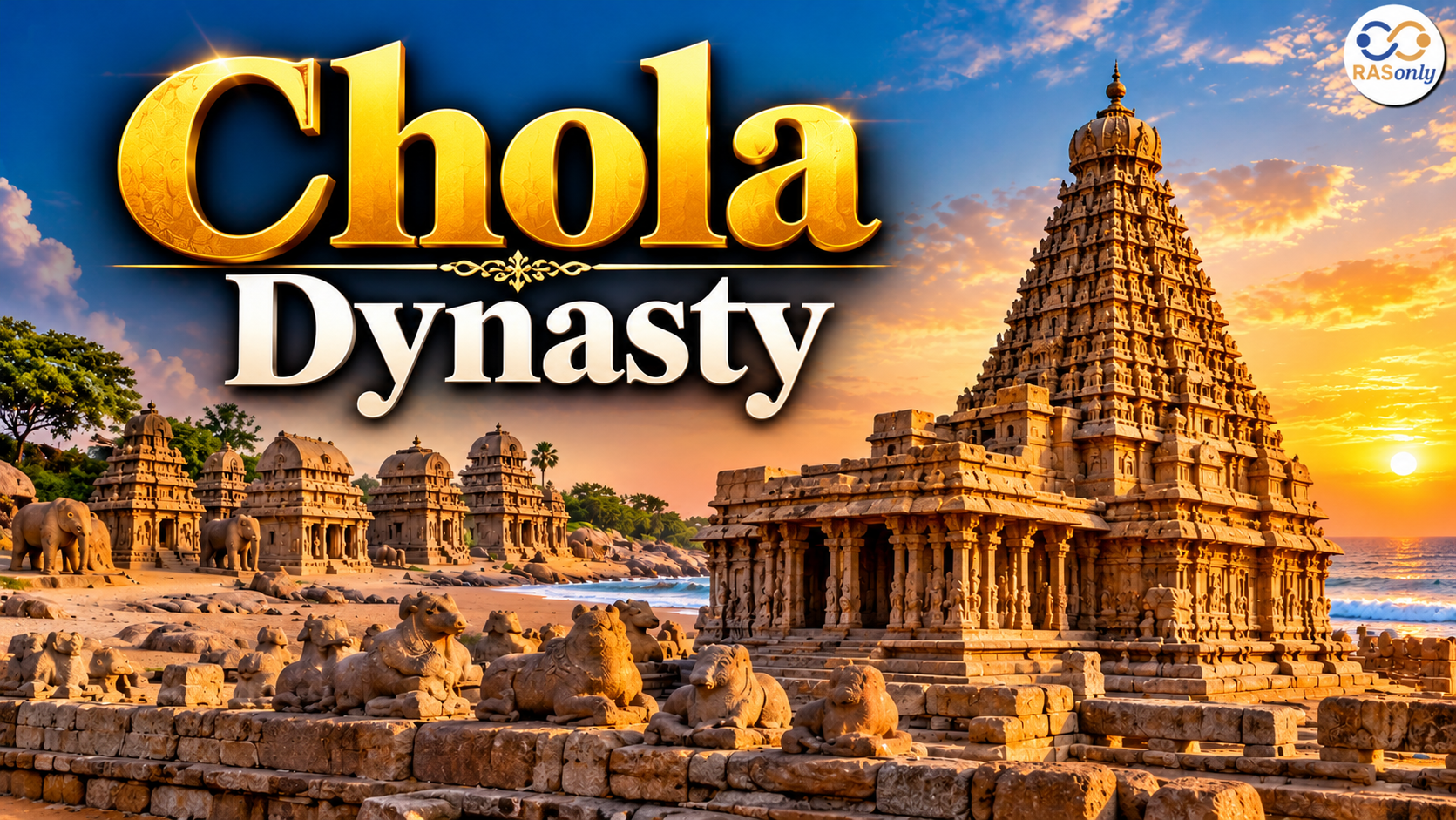
Chola Dynasty: Capital, Founder, Kings, Time Period and History
RAS Polity Questions 2026 for RPSC RAS Exam Preparation

Get in Touch with RASonly!

The RAS Polity Questions 2026 help candidates prepare effectively for the RPSC RAS Exam by covering important topics from Indian Polity, the Constitution of India, constitutional amendments, governance institutions, and democratic system. Practicing RAS Polity MCQs and previous year RPSC polity questions improves conceptual clarity and exam performance. These Indian Polity questions for RAS Prelims focus on important constitutional articles, fundamental rights, constitutional bodies, and governance structure.

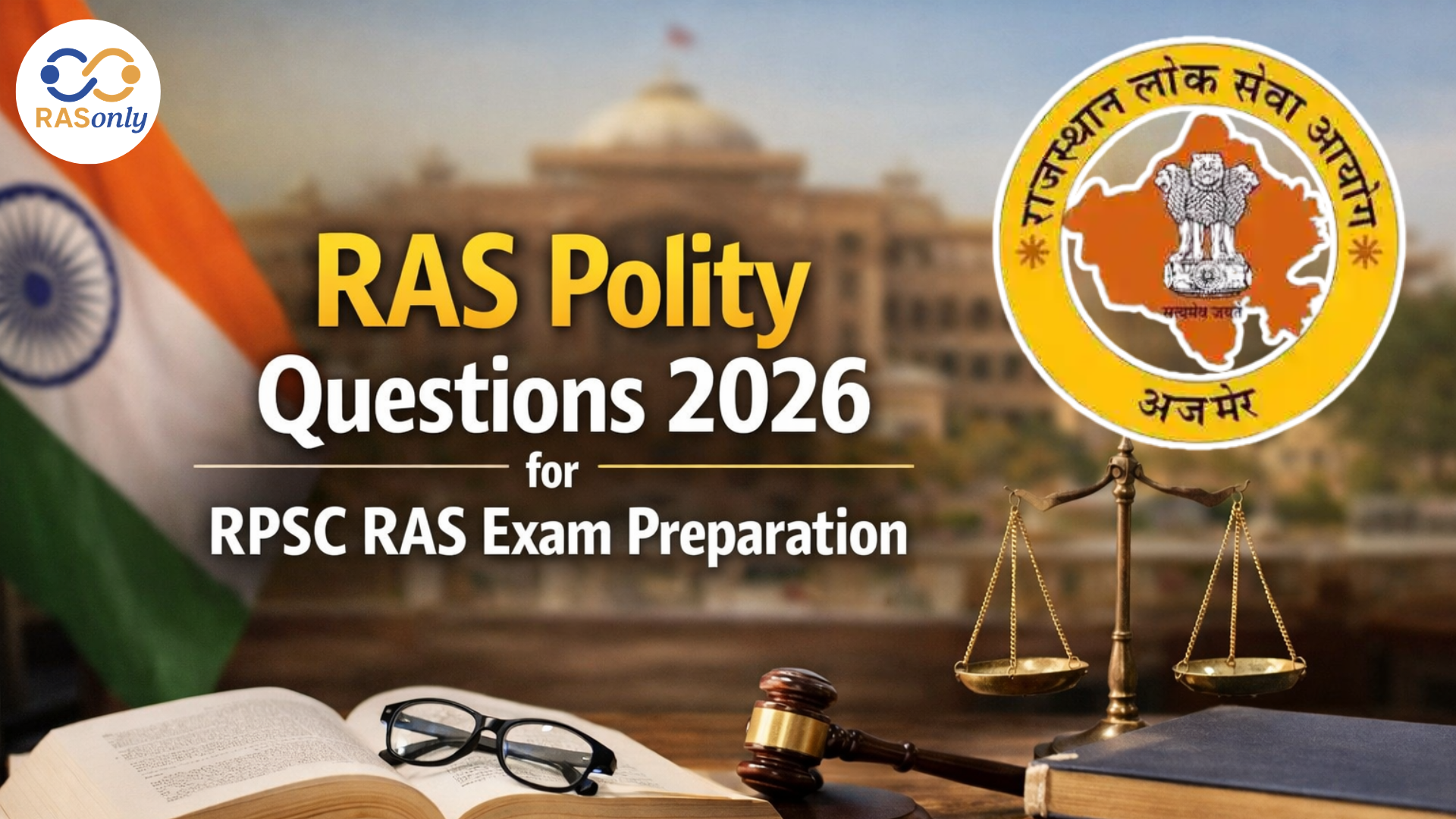
The RAS Polity Questions 2026 are an essential part of preparation for the RPSC RAS Exam 2026 conducted by the Rajasthan Public Service Commission (RPSC). Indian Polity for RAS Exam is one of the most important subjects in the RAS Prelims syllabus and RAS Mains syllabus, covering topics such as the Indian Constitution, fundamental rights, directive principles, constitutional bodies, governance system, democratic institutions, and public administration.
When the candidate is preparing to take the RPSC RAS Examination, it is very essential to practice RAS Polity Important Questions, Indian Polity MCQs, RAS Polity Notes, past year RPSC polity questions etc. The questions in the RAS Prelims Polity section tend to be asked directly in the form of topics like constitutional amendments, Parliament of India, State Legislature, Election Commission, Public Service Commissions, fundamental rights and constitutional provisions.
Therefore, Indian Polity MCQ for RAS, RPSC RAS Prelims Polity questions, and RAS polity practice question is useful as it provides an Aspirant to enhance the conceptual understanding of the Indian Constitution and the system of governance and aids greatly in preparation strategy of RAS exam.
Importance of Polity in RAS Exam 2026
The Polity section in the RAS Exam syllabus plays a crucial role in evaluating a candidate’s understanding of the Indian Constitution, democratic governance, constitutional institutions, and political system of India. In the RPSC RAS Prelims examination, questions are frequently asked from constitutional articles, amendments, fundamental rights, governance institutions, and administrative structure.
Important topics covered in the RAS Polity syllabus and Indian Polity for RAS exam include:
- Indian Constitution and its important features
- Fundamental Rights and Directive Principles of State Policy
- Parliament of India and State Legislature
- Constitutional Amendments and Article 368
- Union Public Service Commission and State Public Service Commission
- Election Commission of India and democratic institutions
- Human Rights and governance mechanisms
- Important constitutional articles and provisions
A strong understanding of these topics through RAS Polity Important Questions, RPSC RAS Polity MCQs, and Indian Constitution practice questions, will make the candidates score high in the RPSC RAS Prelims Examination 2026.
Key Topics in Indian Polity for RAS Exam
Candidates preparing RAS Polity Questions for RPSC RAS Exam 2026 should focus on the following important topics from the Indian Polity syllabus for RAS exam.
1. Indian Constitution and Constituent Assembly
The Indian Constitution is the highest law of India which is the basis of the Indian system of democratic governance. The task of the Constituent Assembly of India was to create the Constitution and to form the system of Indian democracy, governance, and the administration of the country.
| Feature | Details |
|---|---|
| Constituent Assembly formed | 9 December 1946 |
| Constitution adopted | 26 November 1949 |
| Constitution came into force | 26 January 1950 |
The Constituent Assembly for the Indian Constitution formed several committees to draft different parts of the Constitution.
| Committee | Chairman |
|---|---|
| Drafting Committee | B. R. Ambedkar |
| Union Powers Committee | Jawaharlal Nehru |
| Advisory Committee on Fundamental Rights | Sardar Patel |
| Steering Committee | Dr Rajendra Prasad |
Questions related to the Constituent Assembly, drafting committee, constitutional committees, and constitution making process are frequently asked in RAS Polity Questions and RPSC Polity MCQs.
2. Fundamental Rights and RTI Act
The Right to information act 2005 is a significant legislation in the Indian governance and administration of the people and it fosters transparency, accountability and involvement of the citizens in the democratic governance process.
Key objectives of the RTI Act for Indian Polity include:
- Empower citizens to access government information
- Promote transparency in public administration
- Reduce corruption in government institutions
- Strengthen democratic governance and citizen rights
Under the RTI Act 2005, citizens can request information from public authorities and government departments within 30 days.
Questions related to RTI Act, transparency laws, governance reforms, and citizen rights frequently appear in RAS Polity Important Questions.
3. Constitutional Amendments
The Constitution of India can be amended through the procedure defined under Article 368 of the Constitution. Constitutional Amendment related questions on Indian Polity are highly frequent in RPSC RAS Polity Questions.
Some important amendments frequently asked in RAS Polity MCQs include:
| Amendment | Key Provision |
|---|---|
| 81st Amendment | Reservation in backlog vacancies |
| 91st Amendment | Limit on size of Council of Ministers |
| 97th Amendment | Right to form cooperative societies |
| 99th Amendment | National Judicial Appointments Commission |
Understanding important constitutional amendments for RAS exam preparation is very important for scoring well in the Indian Polity section of RPSC RAS Exam.
4. Constitutional Bodies in India
Several institutions in India derive their authority directly from the Indian Constitution. These institutions are known as constitutional bodies in Indian polity.
| Constitutional Body | Article |
|---|---|
| Election Commission of India | Article 324 |
| Finance Commission | Article 280 |
| Union Public Service Commission | Article 315 |
| State Election Commission | Article 243K |
The State Election Commission plays an important role in conducting elections for Panchayati Raj Institutions and Urban Local Bodies, making it an important topic in RAS Polity Questions and Rajasthan GK Polity.
5. Public Service Commissions
The Indian Constitution provides for Public Service Commissions to ensure fair recruitment to government services and administrative posts.
| Commission | Appointment Authority |
|---|---|
| Union Public Service Commission (UPSC) | President of India |
| State Public Service Commission (SPSC) | Governor of the State |
| Joint State Public Service Commission | President of India |
Members of the Public Service Commission hold office for six years or until reaching the prescribed age limit, as defined under Article 316 of the Constitution of India.
Questions related to UPSC, State PSC, Joint PSC, and constitutional provisions for recruitment bodies frequently appear in RAS Polity Important Questions.
RAS Polity Important Questions and Answers
RASP Polity Important Questions and Answers RAS Polity is a major subject to be practiced by the candidates who are preparing to take the RPSC RAS Examinations in 2026. These questions are founded on Indian Polity, constitution of India, bodies of constitution, institutions of governance and democratic system, which are generally provided in the RAS Prelims Polity and Rajasthan GK section.
1. What is the main objective of the Right to Information Act?
Answer: To promote transparency and accountability in the functioning of the government.
The Right to Information Act (RTI) 2005 enables the citizens to seek information from governmental authorities and provides transparency in government administration. The Act enhances the democratic form of governance by granting citizens the right to obtain government documentations and judgments.
Summary:
The RTI Act 2005 empowers citizens and promotes transparency and accountability in government functioning.
2. Who said “A Constitution is a lifeless thing; it acquires life because of the men who control it”?
Answer: Dr Rajendra Prasad
Dr Rajendra Prasad made this statement during discussions in the Constituent Assembly of India. He emphasized that the success of the Constitution depends on the honesty and dedication of the leaders who implement it.
Summary:
Dr Rajendra Prasad highlighted that the effectiveness of the Indian Constitution depends on the integrity of those who govern the country
3. Who was the chairman of the Drafting Committee of the Constituent Assembly?
Answer: Dr B. R. Ambedkar
Dr B. R. Ambedkar was the chairman of the Drafting Committee in the Constituent Assembly which drafted the final edition of the Constitution of India. He was instrumental in developing the democracy of India.
Summary:
Dr B. R. Ambedkar was the chairman of the Drafting Committee and is widely regarded as the chief architect of the Indian Constitution.
4. Which authority appoints the chairman of a Joint Public Service Commission?
Answer: The President of IndiaAccording to Article 315 and Article 316 of the Constitution of India, the chairman and members of a Joint State Public Service Commission are appointed by the President of India.
Summary:
The President of India appoints the chairman and members of a Joint Public Service Commission.
5. What type of procedure is used for impeachment of the President of India?
Answer: Quasi judicial procedure
The impeachment of the President of India is conducted through a quasi judicial procedure initiated by either House of Parliament. The charges must be investigated and approved by a two-thirds majority of both Houses.
Summary:
The impeachment process of the President of India follows a quasi judicial procedure and requires a two-thirds majority in Parliament.
Rajasthan Polity MCQ Practice Questions
Practicing Rajasthan Polity MCQ Practice Questions is very important for candidates preparing for the RPSC RAS Prelims Exam 2026. Multiple choice questions from Indian Polity, constitutional provisions, fundamental rights, constitutional amendments, and governance institutions are frequently asked in the RAS Prelims examination. Solving these RAS Polity MCQs helps aspirants strengthen their understanding of the Indian Constitution, political system, and important constitutional bodies.
Question 1
Which Article of the Constitution provides for the Election Commission of India?
A. Article 280
B. Article 324
C. Article 315
D. Article 368
Correct Answer: Article 324
Explanation:
Article 324 of the Constitution of India establishes the Election Commission of India, which is responsible for conducting and supervising elections to Parliament, State Legislatures, and the offices of the President and Vice President.
Question 2
Which constitutional amendment introduced the right to form cooperative societies?
A. 91st Amendment
B. 97th Amendment
C. 81st Amendment
D. 99th Amendment
Correct Answer: 97th Amendment
Explanation:
The 97th Constitutional Amendment Act, 2011 recognized the right to form cooperative societies as a fundamental right under Article 19(1)(c) and aimed to promote democratic functioning and autonomy of cooperative societies.
Question 3
Who appoints the Chairman of the State Public Service Commission?
A. President of India
B. Prime Minister
C. Governor of the State
D. Chief Justice of India
Correct Answer: Governor of the State
Explanation:
According to Article 316 of the Constitution of India, the Chairman and members of the State Public Service Commission (SPSC) are appointed by the Governor of the respective state.
Question 4
Which body conducts elections to Panchayati Raj Institutions in a state?
A. Election Commission of India
B. State Election Commission
C. State Government
D. District Administration
Correct Answer: State Election Commission
Explanation:
The State Election Commission, established under Article 243K of the Constitution, is responsible for conducting elections to Panchayati Raj Institutions and urban local bodies within a state.
Preparation Strategy for RAS Polity
RAS Polity Questions will be prepared only after having a clear understanding of the Indian Constitution, political system, provisions given in the constitution, and governance institutions. Polity is a significant part of the RPSC RAS Prelims and Mains syllabus, and thus, an examinee must have a progressive plan to enhance clarity of ideas and be better at the test.
Preparation Tips
- Study the Indian Constitution, fundamental rights, directive principles, and important constitutional articles carefully.
- Practice RAS Polity MCQs and previous year RPSC RAS questions to understand the exam pattern and frequently asked topics.
- Focus on constitutional bodies, statutory bodies, and important constitutional amendments related to governance.
- Regularly revise important articles, committees of the Constituent Assembly, and key constitutional provisions.
Conclusion
Practicing RAS Polity Questions and Indian Polity MCQs is essential for candidates preparing for the RPSC RAS Exam 2026. The section of polity majorly addresses the Indian Constitution, fundamental rights, constitutional amendments, institutions of governance and the democratic system. Answering RAS Polity MCQs, past year RPSC polity questions, and article questions in the constitution on a regular basis, candidates can ensure that their knowledge of Indian Polity is solid, and that they have a high probability of performing well in the RAS Prelims and Mains examination.
FAQ
RAS Polity Questions mainly cover Indian Constitution, fundamental rights, constitutional amendments, parliament, governance institutions, and constitutional bodies.
Yes, Indian Polity is one of the most important subjects in the RAS Prelims and Mains syllabus and many questions are asked from constitutional provisions and governance topics.
Important articles include Article 12–35 (Fundamental Rights), Article 280 (Finance Commission), Article 324 (Election Commission), Article 315 (Public Service Commission), and Article 368 (Constitutional Amendment).
Candidates should study the Indian Constitution, practice RAS Polity MCQs, revise important constitutional amendments, and solve previous year RPSC polity questions regularly.
Yes, multiple choice questions from Indian Polity and constitutional provisions are frequently asked in the RPSC RAS Prelims examination.
BEST SELLER
🏆 PRELIMS
RAS Pass
Prelims focused Hindi & English
₹399
✓
Prelims Topic-Wise Tests
✓
Subject-Wise Tests
✓
Full-Length Prelims Tests
✓
Daily Current Affairs Tests
✓
Prelims PYQs Tests
✓
Detailed Solutions & Analysis
✓
All Rajasthan Ranking
✓
Unlimited Reattempts
✓
Mains Tests
✓
Hindi & English Tests
✓
All Rajasthan Ranking
Trusted by 5,000+ Students
Post Category
- RAS Salary
- Result
- RAS Admit Card
- RAS Job
- RAS Cutoff
- Preparation Tips
- RAS Answer Key
- RAS Exam Analysis
- RAS Syllabus
- RAS Previous Year Papers
- RPSC RAS Exam Pattern
- RAS Interview
- RAS Exam Date
- RAS Vacancy
- RAS Test Series
- RAS Best Books
- RAS Preparation Resources
- RAS Coaching Centre
- History
- Polity
- Geography
- Economics
- Science
- Art and Culture
- RPSC RAS Application Form
- RPSC RAS Notification
- RAS Eligibility Criteria
- UPSC Exam
- RPSC RAS Mains
Visit Our RASonly Offline Center
Our Expert Faculty

Bhunesh Sir
Current Affairs · 13+ Yrs

Aamir Khan Sir
RAS-2017 · IIM Ahm.

Akash Sir
Polity · 8+ Yrs
Free Resources
Official Mobile App

RASOnly App
by OTSAdda · Free
Full Video Lectures
Mock Tests & PYQs
Daily Current Affairs
AI Mock Interview
Free Download · No subscription needed to install
RAS 2024 Toppers — RASonly
Rank 2
Virendra Charan
Rank 9
Bhoopinder Singh
Rank 26
Aanchal Nagpal
Rank 33
Lokendra Singh
Rank 45
Amar Rathore
Rank 46
Manasvini Verma

Join RASonly WhatsApp Community
Get daily current affairs, exam alerts, free study material and tips from expert faculty — right on WhatsApp.
Join for Free →RASonly Interview Guidance Program

Mr. Ashok Jain
Ex-Chief Secretary Govt of Rajasthan
- IAS officer of the 1981 batch, Rajasthan cadre.
- Passionate about mentoring the next generation of RAS officers with real-world insights.
- Got retired in Dec 2017 from the post of Chief Secretary of the state of Rajasthan.

Mr. Guru Charan Rai
Ex-ASP / SP in Jaisalmer
- Guru Charan Rai, IPS (Retd), retired as Inspector General of Police (Security), Rajasthan, Jaipur in 2017.
- Served as ASP and SP in Jaisalmer, Nagaur, Sri Ganganagar, Sawai Madhopur, Dausa, Sikar, and Karauli.
- He also held key positions as DIGP and IGP in the Law and Order division.

Mr. Rakesh Verma
Ex-IAS Officer, B.Tech, MBA, and M.A. (Economics)
- IAS officer of the 1981 batch and retired in Chief Secretary Rank.
- Civil servant of high repute and vast experience.
- Has been teaching UPSC CSE subjects for the last six years.
Related Post
Daily Current Affairs for RAS Exam Preparation 2026
Rajasthan’s First Sitaphal Processing Unit in Chittorgarh
October 19, 2026
Rajasthan Foundation Expansion New Chapters Announced
October 19, 2026
Continuous Biomass Torrefaction Reactor
October 17, 2026