Chola Dynasty: Capital, Founder, Kings, Time Period and History
RAS vs REET: Which Rajasthan Govt Career Is Better?

Get in Touch with RASonly!

Compare RAS and REET careers across eligibility, selection process, salary, job profile, difficulty, career growth, work-life balance, and job security. Understand the key differences between administrative services and teaching careers to choose the path that best matches your goals.

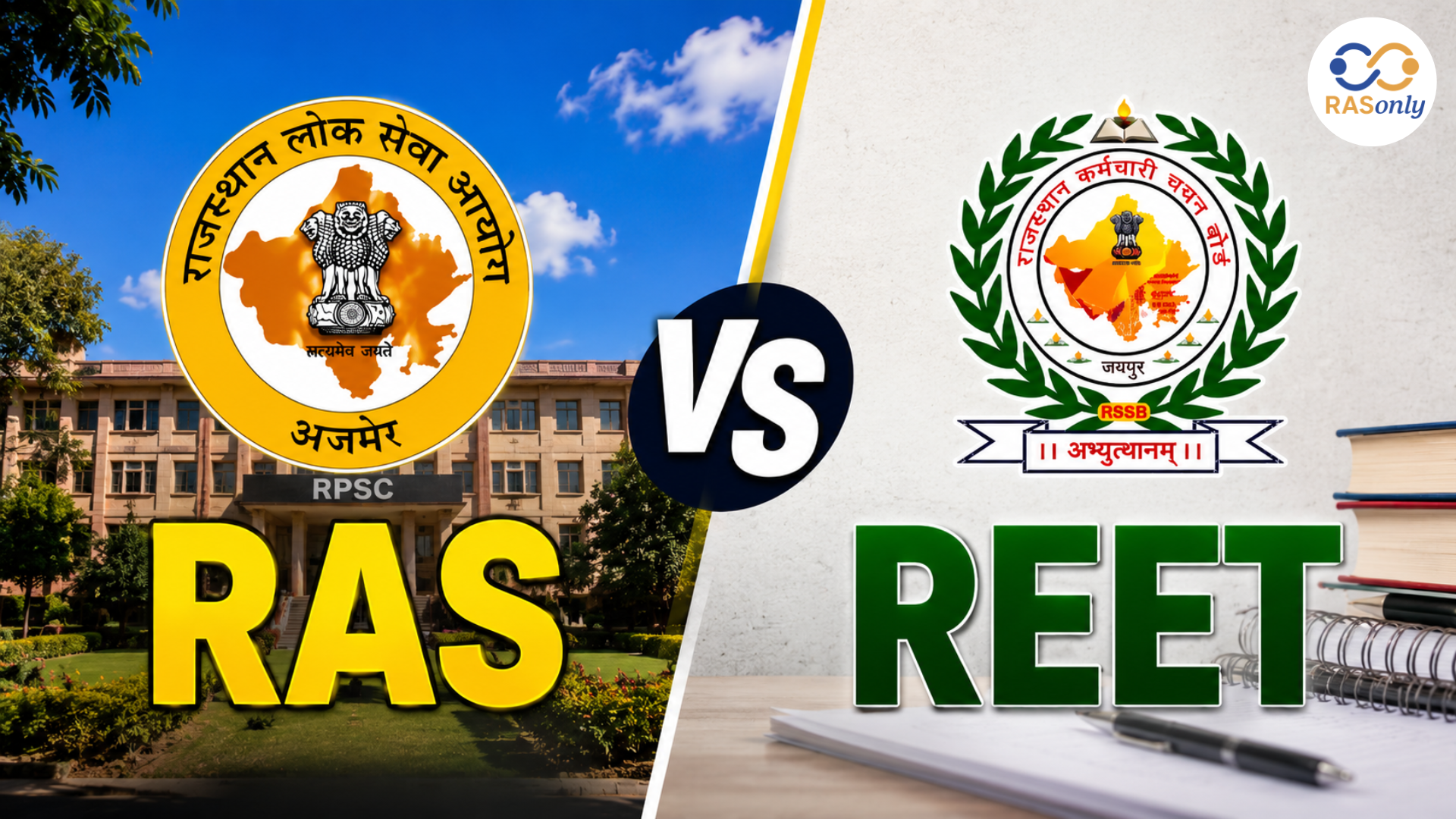
RAS vs REET is one of the most common questions among Rajasthan government job aspirants. The two paths are very different. If you appear for RAS (Rajasthan Administrative Service), you can get a job in administration and governance; if you appear for REET (Rajasthan Eligibility Examination for Teachers), you can get a job in a state government school. Both offer job security and social value but differ in exam stages, work culture, salary, and growth.
This guide provides an overview of both careers, including eligibility, the selection process, difficulty, salary, career growth, work-life balance, and job security. The following information is based on the official exam structure and current pay matrix information. Please check dates, fees, and age limitations in the most up-to-date official notification before applying.
What is RAS?
RAS is the state civil service of Rajasthan, and the Rajasthan Public Service Commission (RPSC) conducts its recruitment. It is a part of the Combined Competitive Examination of RAS/RTS, which fills the vacant posts in State Services and Subordinate Services. Officers implement the policy; they perform revenue work and also handle district-level administration.
Key Responsibilities of an RAS Officer
Officers work at the point where government policy meets the public. Their duties depend on the post, such as SDM or DySP, but they usually include:
- Implementing government schemes and welfare programmes
- Handling revenue administration and land matters
- Maintaining law and order in their area
- Resolving public grievances
- Supervising and coordinating government departments
What is REET?
REET is an eligibility test conducted by the Board of Secondary Education, Rajasthan (BSER). It's not a job in itself. Eligibility for REET does not qualify candidates for teacher recruitment, which is done separately. It has two levels: Level 1 for classes 1 to 5 and Level 2 for classes 6 to 8.
Key Responsibilities of a REET-Qualified Teacher
The teacher's job is to focus on the classroom and pupil achievement. Main duties include:
- Teaching the prescribed curriculum
- Preparing lesson plans and study material
- Conducting tests and evaluating performance
- Guiding students academically and personally
- Taking part in school activities and parent meetings
Key Differences Between RAS and REET
The purpose, conduct, and daily work of the two careers are different. RAS is an administrative career with wide public contact, while REET leads into the education department. The table below gives a quick overview.
| Parameter | RAS | REET |
|---|---|---|
| Career field | Administration | Education |
| Conducting body | RPSC | BSER |
| Nature of exam | Direct recruitment exam | Eligibility (qualifying) test |
| Typical role | SDM, DySP and other officer posts | Primary or upper primary teacher |
| Work nature | Governance and field administration | Teaching and student development |
| Public interaction | Extensive | Mainly students and parents |
RAS vs REET Eligibility Criteria
Before you work on your preparation, you need to check who is eligible. While REET demands a teaching qualification, the latter, RAS, is open to students from any stream. The age and qualification details can be updated; please check the latest notification.
RAS Eligibility
RAS needs a bachelor's degree in any discipline from a recognised university. In most cases, candidates should be between the ages of 21-40 years, with relaxation as per reserved categories. There is no maximum age limit for widows and divorced women with valid proof.
REET Eligibility
Eligibility for REET is based on the level. The levels are for primary (1-5) and upper primary (6-8). They both have their own academic and teacher-training requirements, including D.El.Ed or B.The person who is being addressed by 'Ed'.
| Criteria | RAS | REET |
|---|---|---|
| Graduation required | Yes | Depends on level (as per notification) |
| Teaching qualification (D.El.Ed/B.Ed) | Not required | Required |
| Age limit | 21 to 40 years (relaxation for reserved categories) | As per BSER notification |
| Stream restriction | None | Teaching qualification mandatory |
RAS vs REET Selection Process
The selection process is where the two paths differ most. RAS has three stages with heavy competition. REET is a single qualifying exam, after which you still have to apply and compete in a separate teacher recruitment.
RAS Selection Stages
RPSC conducts the RAS selection in three stages:
- Preliminary Exam: a screening test
- Main Exam: a descriptive written exam
- Interview: a personality and aptitude assessment
The final merit list combines the Mains and Interview scores.
REET Selection Stages
REET has Level 1 and Level 2 papers, each with 150 questions for 150 marks. Once you've qualified, you'll be given an eligibility certificate. Then apply in a teacher recruitment drive; selection and document verification will be done according to the rules of the notification.
RAS vs REET Exam Difficulty
Generally, RAS is tougher as it has a big syllabus, descriptive Mains, an interview, and is very competitive. REET is mostly objective and focuses on teaching-related subjects. Even so, the final teacher selection can be competitive, depending on the number of vacancies.
Why RAS Is Harder
- Very wide syllabus, including Rajasthan-specific topics
- Descriptive answer writing in Mains
- Interview stage
- A large number of applicants for limited posts
Why REET Is More Focused
- Objective, multiple-choice format
- Syllabus built around child development, pedagogy, language, and subjects
- No interview stage in REET itself
- Separate, level-wise preparation
RAS vs REET Salary Comparison
RAS officers in State Services start at Pay Matrix Level 14, with a starting basic pay of ₹56,100 per month. Other allowances like Dearness Allowance and HRA are added to it. There is no single figure for the pay of the teacher, depending on the grade and level of the post. It generally starts lower than RAS, and the exact amount is given in the recruitment notification.
| Component | RAS Officer (State Services) | Teacher (REET-qualified) |
|---|---|---|
| Starting basic pay | ₹56,100 (Level 14) | Varies by post and grade |
| DA and HRA | Yes | Yes |
| Medical benefits | Yes | Yes |
| Travel allowance | Yes | As per rules |
| Typical growth in pay | Faster promotions | Steady, grade-wise |
Extra Benefits to Consider
RAS posts may include official accommodation and vehicle facilities, depending on the post. Teaching jobs come with fixed school hours and academic-calendar holidays. The benefits you can get can be as important as the salary when you are looking at a career
RAS Officer vs REET Teacher Job Profile
The daily routine in the two roles is very different. An RAS officer works in an office and in the field, handling people, files, and emergencies. The teacher is the guide and planner in a school and leads students on the academic route throughout the year.
Daily Work of an RAS Officer
- Reviewing development and welfare projects
- Hearing public grievances
- Coordinating with police, revenue, and other departments
- Handling emergencies such as floods or law-and-order situations
Daily Work of a Teacher
- Delivering classroom lessons
- Checking assignments and conducting exams
- Tracking student progress
- Meeting parents and joining school programmes
RAS vs REET Career Growth and Promotion
Both professions follow a formal career progression, and the nature and pace of progression vary. RAS officers move up through administrative ranks and can reach senior state-level positions. Teachers progress within the education department, usually into senior teaching and school leadership roles.
RAS Career Path
An RAS officer usually starts in a post such as SDM or DySP. They can be promoted to Additional Collector and other senior departmental positions over the years. The officers eligible for induction may also be considered for induction in the IAS as per the promotion quota of the state, subject to rules.
Teacher Career Path
Teachers can be promoted to senior teacher, vice-principal and principal as per departmental rules. Some move into education administration. Growth is steady and is reliant on seniority, qualifications and vacancies.
| Aspect | RAS | Teaching (via REET) |
|---|---|---|
| Promotion speed | Faster | Moderate |
| Leadership scope | District and state level | School and education-department level |
| Administrative authority | High | Limited |
RAS vs REET Work-Life Balance
The routine for teaching is more predictable and has set school hours and holidays. RAS work is very busy, with irregular hours, outings, and emergency work. Some officers appreciate this diversity; others struggle to cope with family life.
Work-Life Balance in RAS
RAS officers face frequent postings across districts and long working hours. The role brings strong authority and visible public impact. The trade-off is less personal time and higher stress during crises.
Work-Life Balance in Teaching
Teachers have fixed school hours and holidays following the school calendar. Exam duty, evaluation work, and school activities add to the workload. Overall, the schedule is usually more family-friendly.
RAS vs REET for Female Candidates
When it comes to these two professions, many women decide to go with the one that allows them to combine leadership with their own time. Both paths are open to them. RAS provides administrative control and rapid growth, and teaching provides a stable and structured routine. For RAS, widows and divorced women with valid proof have no upper age limit.
Why Women Choose RAS
- Leadership and decision-making roles
- Higher starting pay and faster promotion
- Strong public impact and prestige
Why Women Choose Teaching
- Fixed working hours and holidays
- Stable, community-based work environment
- Direct contribution to children's education
RAS vs REET Job Security
On selection, both of these professions are guaranteed permanent government jobs with fixed salaries, allowances, medical schemes, and leave. Retirement benefits follow the rules the state government has in force at the time. The job security in both professions, therefore, is good.
Benefits Common to Both
- Regular salary with DA and other allowances
- Paid leave and medical facilities
- Retirement benefits as per state rules
- Social respect and long-term stability
Who Should Choose RAS?
RAS is for candidates who wish to pursue an administrative career and are prepared for a long and competitive examination. It is a good job for those who enjoy making decisions, serving the public, and taking on responsibility, and who can work well under stress and on frequent postings.
You may prefer RAS if you:
- Want authority in governance and policy implementation
- Are comfortable with irregular hours and transfers
- Aim for faster promotion and leadership roles
- Can commit to a long preparation period
Who Should Choose REET?
The candidates who wish to go into the teaching profession and have already got or are pursuing the relevant qualification are suitable for REET. It's best suited for those who are looking for stability, regular working hours, and an opportunity to make an impact on students' lives.
You may prefer REET if you:
- Enjoy teaching and working with children
- Want a structured routine and school holidays
- Prefer a calmer workplace with less transfer pressure
- Hold or are pursuing D.El.Ed or B.Ed
Conclusion
RAS vs REET is not a comparison of the best career; rather, it is about which is suitable for you. RAS provides a higher status, a starting salary of Level 14, and quicker advancement – but some exams are intense and rigorous, hours are long, and postings are frequent. Teaching through REET offers a focused, objective qualifying exam, a stable routine, and the satisfaction of working with students. First, determine eligibility and then consider your interests, strengths, and lifestyle. So it will be better for you to select the route that suits your temperament rather than just one based on salary or status.
FAQs
Neither is better for everyone. RAS is for people who wish for an administrative and leadership role, and REET is for people who wish to have a teaching career.
Yes, in general. RAS has three stages (Prelims, Mains, and Interview) and very high competition, while REET is a single objective-type qualifying exam.
RAS State Services posts start at Pay Level 14 with ₹56,100 basic pay, which is usually higher than a teacher's starting pay. Teacher pay depends on the post and grade in the notification.
No. REET is an eligibility test. Qualifying means that you are eligible to apply in teacher recruitment, with a separate selection process afterwards.
Yes. A bachelor's degree in any stream is enough, along with the age limit of 21 to 40 years (relaxation for reserved categories).
BEST SELLER
🏆 PRELIMS
RAS Pass
Prelims focused Hindi & English
₹399
✓
Prelims Topic-Wise Tests
✓
Subject-Wise Tests
✓
Full-Length Prelims Tests
✓
Daily Current Affairs Tests
✓
Prelims PYQs Tests
✓
Detailed Solutions & Analysis
✓
All Rajasthan Ranking
✓
Unlimited Reattempts
✓
Mains Tests
✓
Hindi & English Tests
✓
All Rajasthan Ranking
Trusted by 5,000+ Students
Post Category
- RAS Salary
- Result
- RAS Admit Card
- RAS Job
- RAS Cutoff
- Preparation Tips
- RAS Answer Key
- RAS Exam Analysis
- RAS Syllabus
- RAS Previous Year Papers
- RPSC RAS Exam Pattern
- RAS Interview
- RAS Exam Date
- RAS Vacancy
- RAS Test Series
- RAS Best Books
- RAS Preparation Resources
- RAS Coaching Centre
- History
- Polity
- Geography
- Economics
- Science
- Art and Culture
- RPSC RAS Application Form
- RPSC RAS Notification
- RAS Eligibility Criteria
- UPSC Exam
- RPSC RAS Mains
Visit Our RASonly Offline Center
Our Expert Faculty

Bhunesh Sir
Current Affairs · 13+ Yrs

Aamir Khan Sir
RAS-2017 · IIM Ahm.

Akash Sir
Polity · 8+ Yrs
Free Resources
Official Mobile App

RASOnly App
by OTSAdda · Free
Full Video Lectures
Mock Tests & PYQs
Daily Current Affairs
AI Mock Interview
Free Download · No subscription needed to install
RAS 2024 Toppers — RASonly
Rank 2
Virendra Charan
Rank 9
Bhoopinder Singh
Rank 26
Aanchal Nagpal
Rank 33
Lokendra Singh
Rank 45
Amar Rathore
Rank 46
Manasvini Verma

Join RASonly WhatsApp Community
Get daily current affairs, exam alerts, free study material and tips from expert faculty — right on WhatsApp.
Join for Free →RASonly Interview Guidance Program

Mr. Ashok Jain
Ex-Chief Secretary Govt of Rajasthan
- IAS officer of the 1981 batch, Rajasthan cadre.
- Passionate about mentoring the next generation of RAS officers with real-world insights.
- Got retired in Dec 2017 from the post of Chief Secretary of the state of Rajasthan.

Mr. Guru Charan Rai
Ex-ASP / SP in Jaisalmer
- Guru Charan Rai, IPS (Retd), retired as Inspector General of Police (Security), Rajasthan, Jaipur in 2017.
- Served as ASP and SP in Jaisalmer, Nagaur, Sri Ganganagar, Sawai Madhopur, Dausa, Sikar, and Karauli.
- He also held key positions as DIGP and IGP in the Law and Order division.

Mr. Rakesh Verma
Ex-IAS Officer, B.Tech, MBA, and M.A. (Economics)
- IAS officer of the 1981 batch and retired in Chief Secretary Rank.
- Civil servant of high repute and vast experience.
- Has been teaching UPSC CSE subjects for the last six years.
Related Post




Daily Current Affairs for RAS Exam Preparation 2026
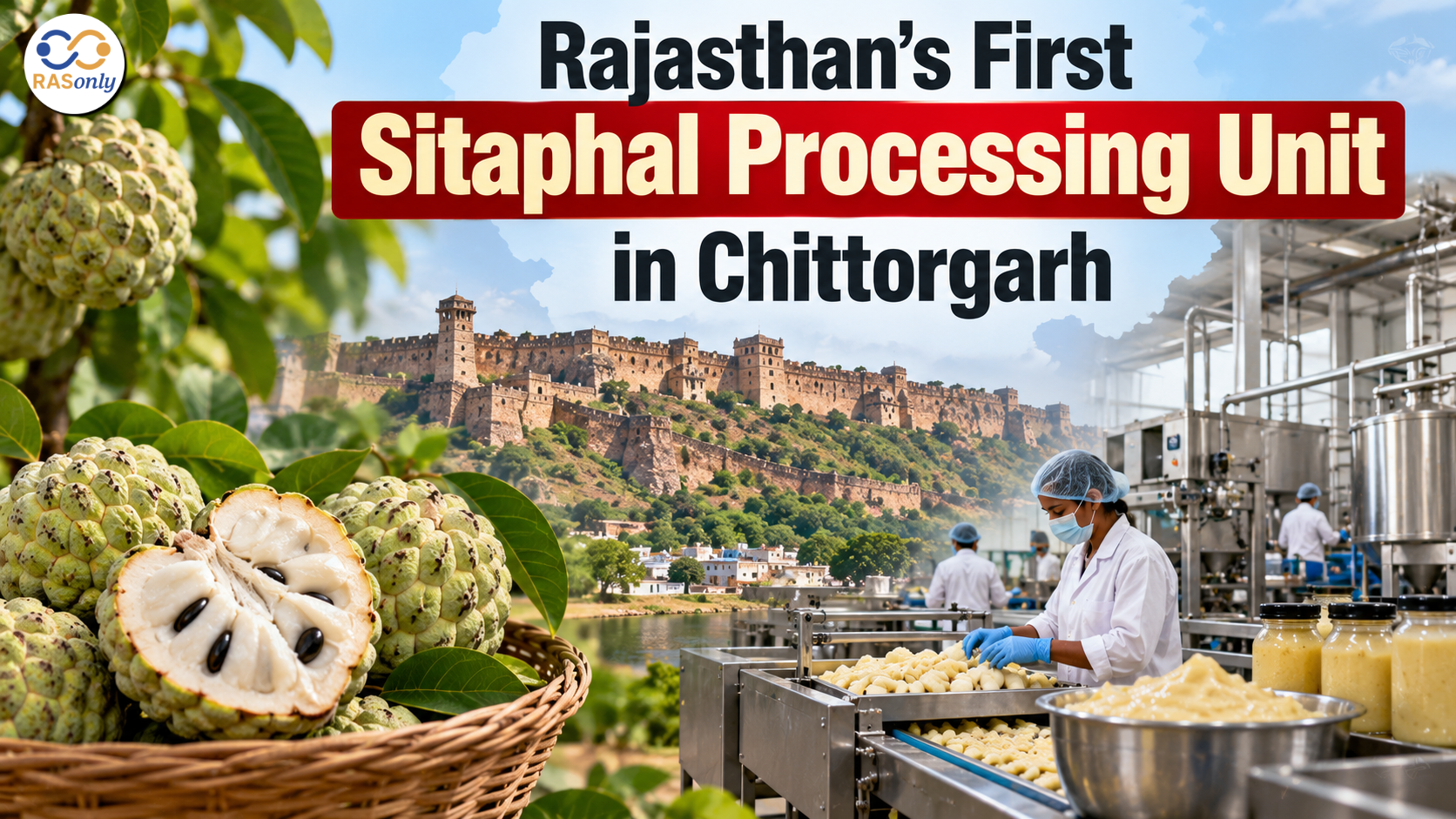
Rajasthan’s First Sitaphal Processing Unit in Chittorgarh
October 19, 2026
Rajasthan Foundation Expansion New Chapters Announced
October 19, 2026
Continuous Biomass Torrefaction Reactor
October 17, 2026