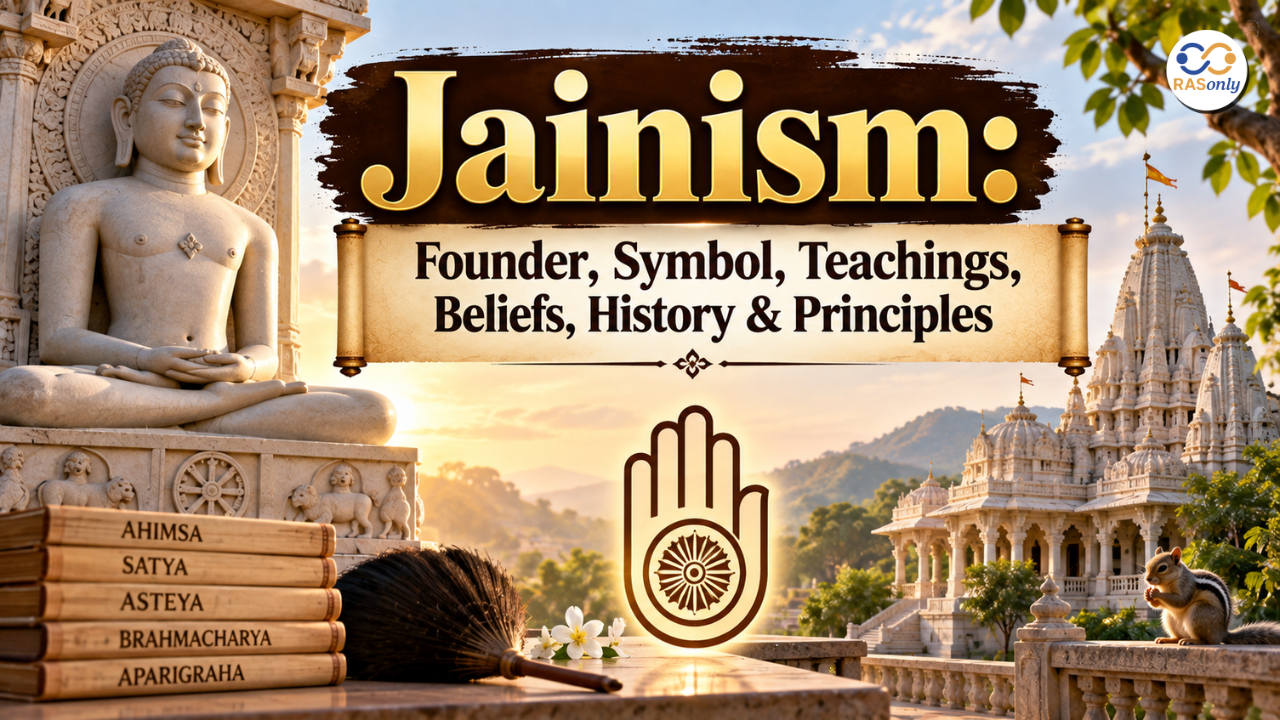
Jainism: Founder, Symbol, Teachings, Beliefs, History & Principles
Is RAS Tougher Than UPSC? Exam Difficulty, Syllabus & Career Comparison 2026

Get in Touch with RASonly!

Wondering whether RAS is tougher than UPSC? Explore the complete comparison of RAS vs UPSC 2026, including exam difficulty, syllabus, pattern, competition, salary, job profile, and career opportunities. Understand which exam suits your goals and whether RAS preparation can help in UPSC success.

Is RAS tougher than UPSC? This is one of the most frequently asked questions by civil service aspirants, especially in Rajasthan. Though both exams have three stages (Prelims, Mains, and Interview), there are significant differences between them in terms of syllabus, competition level, examination pattern, and post-examination career opportunities. The UPSC Civil Services Examination is a national-level examination, whereas the RPSC RAS Exam is a state-level exam for administrative services in Rajasthan.
For candidates who are unsure about their choice of path, understanding the comparison between RAS and UPSC is essential. In this article, we will compare the difficulty level of the RAS exam with UPSC, understand the syllabus and exam pattern, discuss the success rate, salary, and job profile, and help you understand which one is better for your career goals: RPSC RAS Exam vs UPSC Civil Services Examination
Is RAS Tougher Than UPSC? A Quick Comparison
No, UPSC is generally considered tougher than the RPSC RAS Exam. Both exams have a three-stage selection process, though UPSC takes place at a national level and is more competitive, with candidates coming from all over India and a wider syllabus. On the other hand, RAS is a state-level examination in which the competition is comparatively less and the emphasis is given on subjects related to the state of Rajasthan. However, clearing the RAS exam still requires dedicated preparation and a thorough understanding of the syllabus.
RAS vs UPSC: Key Differences at a Glance
| Particulars | RAS Exam | UPSC CSE |
|---|---|---|
| Conducting Body | Rajasthan Public Service Commission (RPSC) | Union Public Service Commission (UPSC) |
| Level | State Level | National Level |
| Selection Process | Prelims, Mains, Interview | Prelims, Mains, Interview |
| Service Area | Rajasthan State | Entire India |
| Optional Subject in Mains | No | Yes |
| Competition | Moderate | Very High |
| Difficulty Level | High | Very High |
| Job Posting | Rajasthan Only | Across India |
RAS vs UPSC: Which Exam Is More Difficult?
The Civil Services Examination (CSE) is usually tougher than the RAS because it is highly competitive, has a broad syllabus, and is highly analytical. Although both exams require dedicated preparation, the overall UPSC difficulty is higher than the RAS exam level for the following reasons:
1. Larger Competition
The UPSC receives applications of about 10 lakh each year while the number of candidates appearing in the RPSC RAS Exam is far lower.
2. Wider Syllabus
The UPSC syllabus covers a vast range of subjects and includes optional papers in Mains. RAS focuses more on Rajasthan-related topics.
3. Lower Success Rate
The success rate in the UPSC is less than 1%, making it one of India's toughest exams.
4. Higher Analytical Demand
UPSC questions require deeper conceptual understanding and analytical abilities compared to RAS.
Therefore, in terms of overall difficulty, UPSC is more challenging than RAS, although both exams demand consistent preparation and a strong grasp of concepts.
Difference Between RAS and IAS Exam Pattern
RAS and UPSC have three stages of selection - Prelims, Mains, and Interview, but the exam pattern is quite different for each. The UPSC exam pattern is wider and tougher, has more papers and optional subjects, whereas the RPSC RAS exam pattern is comparatively simpler and more focused on Rajasthan-specific topics.
| Stage | RAS Exam Pattern | UPSC (IAS) Exam Pattern |
|---|---|---|
| Prelims | One paper (GK & General Science) | Two papers – GS Paper I and CSAT |
| Number of Questions | 150 Questions | GS Paper I: 100 Questions CSAT: 80 Questions |
| Marks | 200 Marks | 200 Marks each |
| Nature of Exam | Objective Type | Objective Type |
| Special Focus | Rajasthan GK and General Science | National and International Issues |
| Mains | Four descriptive papers | Nine papers including Essay, GS Papers, and Optional Subjects |
| Marks in Mains | 200 marks each paper | Varies by paper |
| Interview/Personality Test | 100 Marks | 275 Marks |
| Overall Difficulty | High | Very High |
Overall, the UPSC exam pattern is more comprehensive and demanding than the RAS exam pattern, primarily because of its larger syllabus, optional subjects, and higher weightage given to the Personality Test.
RAS vs UPSC Syllabus Comparison 2026
Both exams have the same syllabus but with varying scope and depth as far as History, Geography, Economy, Polity, and current affairs are concerned. The RPSC RAS syllabus places special emphasis on Rajasthan-specific topics, whereas the UPSC Civil Services Examination syllabus is broader and includes additional subjects like Ethics, International Relations, and Optional Papers.
| Subject Area | RAS Syllabus | UPSC Syllabus |
|---|---|---|
| History | Indian History and Rajasthan History | Indian and World History |
| Geography | Geography of Rajasthan and India | Indian and World Geography |
| Economy | Indian Economy and Rajasthan Economy | Indian Economy and Economic Development |
| Polity | Indian Polity | Indian Polity and Governance |
| Current Affairs | National, International, and Rajasthan Current Affairs | National and International Current Affairs |
| Science & Technology | Included | Included |
| Environment & Ecology | Basic Coverage | Detailed Coverage |
| Art and Culture | Special Focus on Rajasthan Art and Culture | Indian Art and Culture |
| International Relations | Limited Coverage | Extensive Coverage |
| Ethics | Not Included | Included |
| Essay Writing | No Separate Paper | Separate Essay Paper |
| Optional Subjects | Not Applicable | Included in Mains |
Overall, the UPSC syllabus is more extensive and diverse, while the RAS syllabus requires in-depth knowledge of Rajasthan's history, geography, culture, and economy. This way, UPSC preparation is more general in nature while RAS preparation is more State specific.
RAS vs UPSC Difficulty Level: Which Exam Is Tougher?
Many aspirants wonder, "How hard is the RAS exam compared to the UPSC? Both exams are equally competitive, but the UPSC Civil Services Examination is generally tougher because of its wide syllabus, high competition and less success rate. The following comparison highlights the major differences in difficulty between the two exams.
| Factors | RPSC RAS Exam | UPSC CSE |
|---|---|---|
| Syllabus Coverage | State-specific with emphasis on Rajasthan | Vast and national-level coverage |
| Optional Subjects | Not Included | Included in Mains |
| Competition Level | Moderate to High | Extremely High |
| Interview Process | Comparatively Easier | More Comprehensive and Analytical |
| Nature of Questions | Conceptual and factual | Analytical and application-based |
| Selection Ratio | Higher than UPSC | Very Low |
| Overall Difficulty Level | High | Very High |
Overall, in the IAS vs RAS debate, UPSC CSE remains more difficult due to its extensive syllabus, intense competition, and highly analytical nature. But the RPSC RAS Exam is also quite difficult exam which requires consistent preparation and good understanding of the concepts.
Can RAS Preparation Help in UPSC?
Yes, it can be an asset in the preparation of UPSC because there are some compulsory subjects common to both examinations. Aspirants preparing for RAS already cover important areas such as:
- History
- Geography
- Economy
- Polity
- Current Affairs
But the preparation for UPSC requires more in-depth analysis, an understanding of answers, writing capability and also has more subjects like Ethics, Essay and optional subjects. Therefore, while RAS preparation can give candidates a head start, extra effort is required to succeed in the UPSC Civil Services Examination.
RAS Officer vs IAS Officer: Salary and Job Profile
Both RAS Officers and IAS Officers enjoy attractive salaries and prestigious administrative roles. While the starting salary for both services is around ₹56,100 per month, their scope of work and career opportunities differ significantly. An IAS Officer is an All India service officer that can be posted anywhere in the country and has more career options at his disposal while a RAS Officer is posted in Rajasthan and is expected to work accordingly.
| Particulars | RAS Officer | IAS Officer |
|---|---|---|
| Starting Salary | ₹56,100 per month (Level 14) | ₹56,100 per month |
| Service Area | Rajasthan | Across India |
| Nature of Service | State Civil Service | All India Service |
| Posting | Within Rajasthan | Anywhere in India |
| Responsibilities | State Administration | State and Central Administration |
| Career Scope | Limited to Rajasthan | Broader and More Diverse |
Overall, although the initial salary is similar, IAS officers enjoy wider responsibilities, greater authority, and broader career opportunities than RAS officers.
Should I Prepare for RAS or UPSC After Graduation?
The choice between RAS and UPSC depends on your career goals and interests. You should consider RAS if:
- You want to serve Rajasthan.
- You prefer a relatively smaller and state-specific syllabus.
- You aspire to join Rajasthan State Services.
- You have a strong interest in Rajasthan GK and culture.
On the other hand, UPSC may be the right choice if:
- You aspire to become an IAS officer.
- You want postings and opportunities across India.
- You are willing to dedicate several years to preparation.
- You are comfortable with intense competition and a broader syllabus.
In the end both exams can lead to great jobs and it is a matter of what you are looking for and how much hard work you are willing to put in.
Pros and Cons of Preparing for RAS Over UPSC
Choosing RAS over UPSC has its own advantages and limitations. The RPSC RAS Exam offers comparatively lower competition and a more focused syllabus, making it an attractive option for candidates who wish to build their careers within Rajasthan. However, it also comes with certain limitations in terms of service area and career growth.
Advantages of RAS
- Comparatively less competition than UPSC.
- No optional subjects in the Mains examination.
- Better work-life balance in most postings.
- Rajasthan-focused syllabus, making preparation more targeted.
- Higher probability of selection compared to UPSC.
Disadvantages of RAS
- Service and postings are limited to Rajasthan.
- Administrative authority is comparatively lower than that of IAS officers.
- Promotion opportunities and career progression are relatively limited.
- Less exposure to central government administration and policymaking.
Overall, RAS is an excellent choice for candidates who want to serve Rajasthan and prefer a relatively focused preparation strategy, while UPSC offers broader career opportunities and greater administrative responsibilities.
Also Read
| RAS Syllabus 2026 | RAS Exam Pattern |
| How to Prepare for RAS | Best Books for RAS Preparation |
| RAS Eligibility Criteria | RAS Previous Year Question Papers |
Conclusion
When comparing RAS vs UPSC, it is clear that the UPSC Civil Services Examination is generally more challenging due to its broader syllabus, intense competition, and lower success rate. However, the RPSC RAS Exam is also a prestigious and competitive examination that requires dedicated preparation and a strong understanding of Rajasthan-specific topics. Ultimately, the choice between RAS and UPSC should depend on your career aspirations, preferred service area, and willingness to tackle varying levels of competition. Both exams offer rewarding careers and the opportunity to serve society in meaningful ways.
FAQs
No, the UPSC Civil Services Examination is generally considered tougher than the RPSC RAS Exam because of its wider syllabus, higher competition, and lower success rate.
Yes, both exams have several common subjects such as History, Geography, Polity, Economy, and Current Affairs, making simultaneous preparation possible.
The RAS exam has a comparatively higher success rate, whereas the success rate in UPSC is less than 1%.
If you want to serve Rajasthan and prefer a state-specific syllabus, RAS is an excellent choice. If you aspire to become an IAS officer and work across India, UPSC is the better option.
Yes, RAS preparation provides a strong foundation for UPSC, but additional preparation is required for subjects like Ethics, Essay, and Optional Papers.
BEST SELLER
🏆 PRELIMS
RAS Pass
Prelims focused Hindi & English
₹399
✓
Prelims Topic-Wise Tests
✓
Subject-Wise Tests
✓
Full-Length Prelims Tests
✓
Daily Current Affairs Tests
✓
Prelims PYQs Tests
✓
Detailed Solutions & Analysis
✓
All Rajasthan Ranking
✓
Unlimited Reattempts
✓
Mains Tests
✓
Hindi & English Tests
✓
All Rajasthan Ranking
Trusted by 5,000+ Students
Post Category
- RAS Salary
- Result
- RAS Admit Card
- RAS Job
- RAS Cutoff
- Preparation Tips
- RAS Answer Key
- RAS Exam Analysis
- RAS Syllabus
- RAS Previous Year Papers
- RPSC RAS Exam Pattern
- RAS Interview
- RAS Exam Date
- RAS Vacancy
- RAS Test Series
- RAS Best Books
- RAS Preparation Resources
- RAS Coaching Centre
- History
- Polity
- Geography
- Economics
- Science
- Art and Culture
- RPSC RAS Application Form
- RPSC RAS Notification
- RAS Eligibility Criteria
- UPSC Exam
- RPSC RAS Mains
Visit Our RASonly Offline Center
Our Expert Faculty

Bhunesh Sir
Current Affairs · 13+ Yrs

Aamir Khan Sir
RAS-2017 · IIM Ahm.

Akash Sir
Polity · 8+ Yrs
Free Resources
Official Mobile App

RASOnly App
by OTSAdda · Free
Full Video Lectures
Mock Tests & PYQs
Daily Current Affairs
AI Mock Interview
Free Download · No subscription needed to install
RAS 2024 Toppers — RASonly
Rank 2
Virendra Charan
Rank 9
Bhoopinder Singh
Rank 26
Aanchal Nagpal
Rank 33
Lokendra Singh
Rank 45
Amar Rathore
Rank 46
Manasvini Verma

Join RASonly WhatsApp Community
Get daily current affairs, exam alerts, free study material and tips from expert faculty — right on WhatsApp.
Join for Free →RASonly Interview Guidance Program

Mr. Ashok Jain
Ex-Chief Secretary Govt of Rajasthan
- IAS officer of the 1981 batch, Rajasthan cadre.
- Passionate about mentoring the next generation of RAS officers with real-world insights.
- Got retired in Dec 2017 from the post of Chief Secretary of the state of Rajasthan.

Mr. Guru Charan Rai
Ex-ASP / SP in Jaisalmer
- Guru Charan Rai, IPS (Retd), retired as Inspector General of Police (Security), Rajasthan, Jaipur in 2017.
- Served as ASP and SP in Jaisalmer, Nagaur, Sri Ganganagar, Sawai Madhopur, Dausa, Sikar, and Karauli.
- He also held key positions as DIGP and IGP in the Law and Order division.

Mr. Rakesh Verma
Ex-IAS Officer, B.Tech, MBA, and M.A. (Economics)
- IAS officer of the 1981 batch and retired in Chief Secretary Rank.
- Civil servant of high repute and vast experience.
- Has been teaching UPSC CSE subjects for the last six years.


Daily Current Affairs for RAS Exam Preparation 2026
25th SCO Foreign Trade Ministers' Meeting
September 19, 2026
India’s flag bearer at the opening ceremony of the...
September 19, 2026
PM-YASASVI Scheme Update 2026
September 18, 2026