Chalukya Dynasty: Origin, Rulers, Three Branches and Architecture
Role of the Thar Desert in the Indian Monsoon — Detailed Notes

Get in Touch with RASonly!

The Thar Desert plays a crucial role in the Indian Monsoon by creating a thermal low-pressure area that attracts moisture-laden winds from the Arabian Sea. It influences monsoon onset, rainfall distribution, the monsoon trough, and the early withdrawal of the southwest monsoon from Rajasthan.

1. Location of the Thar Desert
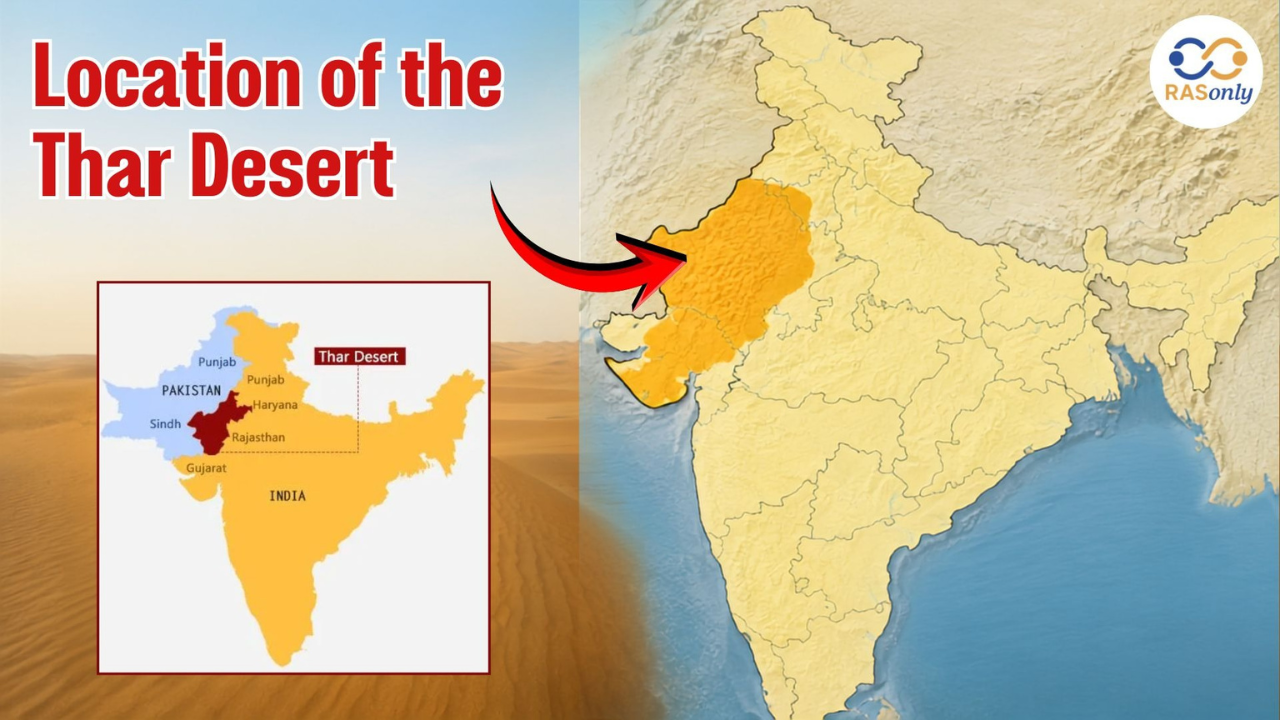
To understand the climatic role of the desert, one must first be aware of the area in which it is located and why it matters. It is so important for the dynamics of the monsoons because of its near proximity to a major sea and its large dry landmass.
- Also known as the Great Indian Desert, it is one of the largest hot deserts in the world.
- Located in northwestern India, mainly spread across Rajasthan (covering most of western Rajasthan, including Jaisalmer, Barmer, and Bikaner regions).
- Smaller parts extend into Gujarat (Kutch), Punjab, and Haryana, and it continues across the international border into Sindh and the Punjab provinces of Pakistan.
- Covers approximately 200,000+ sq. km, making it one of the most significant arid zones in South Asia.
- Its geographical location is significant, as it is near the Arabian Sea and is only separated by the Kathiawar and Kutch coastline, which means moist sea air is not far away, but the land remains extremely dry.
- This is exactly what makes it climatically powerful, being a large dry landmass plus close to a warm sea, where it can get very warm without being too far from a large source of moisture.
2. Core Mechanism: Differential Heating
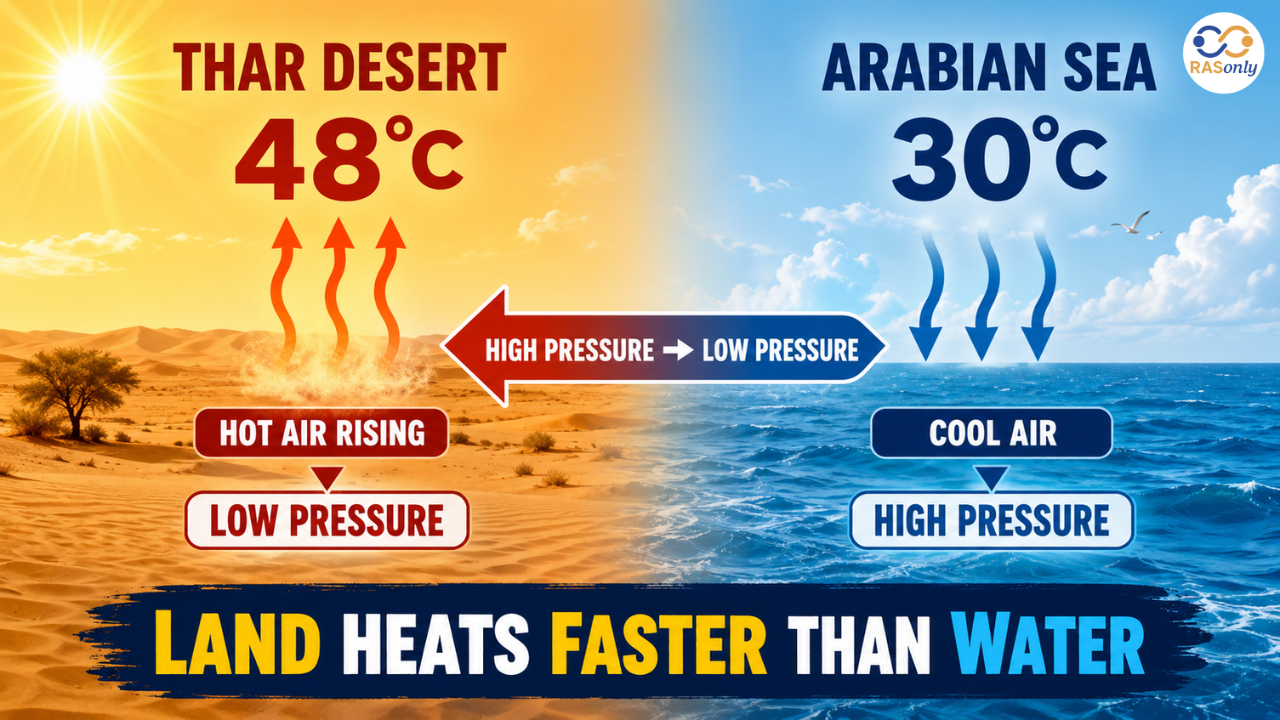
This is the starting point of the entire process. The Thar Desert's impact on the monsoon starts with one fact: Land and water heat at different rates.
- Differential heating is a basic physics principle: land heats up and cools down much faster than water, because water has a higher specific heat capacity (it takes more energy to raise water's temperature compared to land).
- During peak summer (April–June), the Thar Desert's sandy surface absorbs solar radiation very efficiently and heats up rapidly — surface temperatures often cross 45–50°C, among the highest in India.
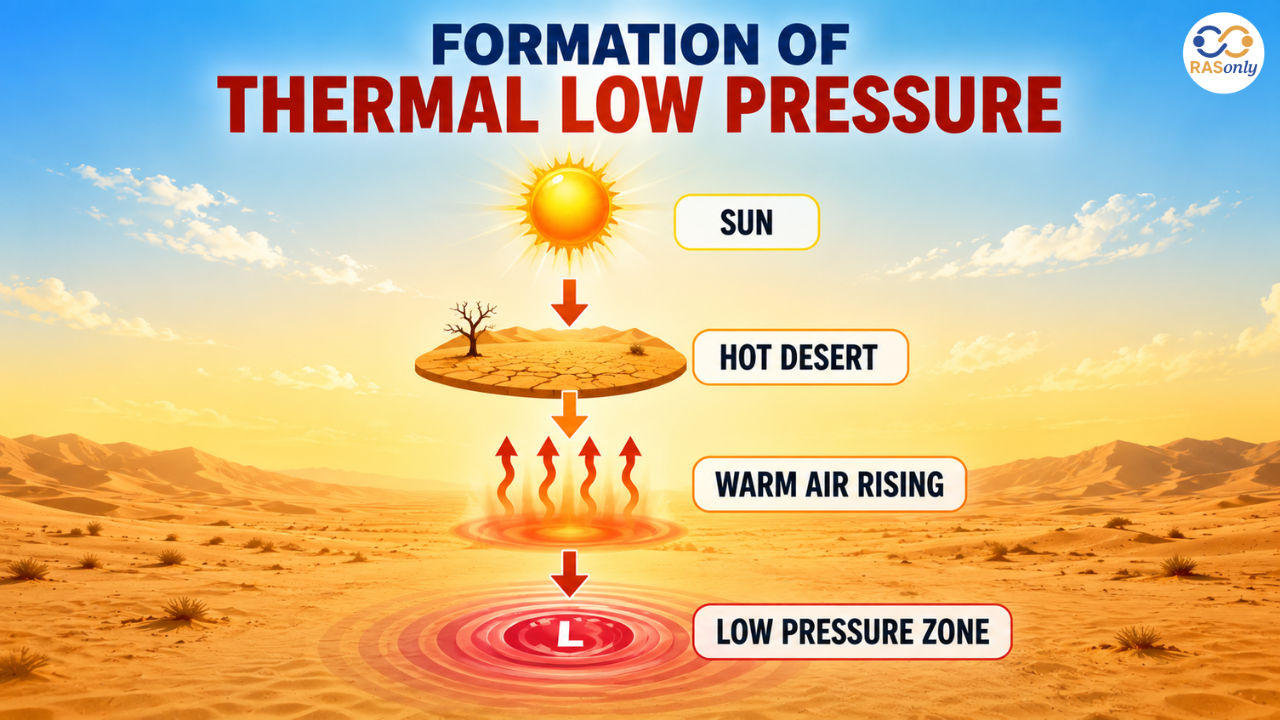
- When the ground warms up, the air above it does as well. Warm air is lighter (less dense), so it expands and rises — this rising motion of air creates a zone of low atmospheric pressure near the surface, known as a thermal low-pressure system or simply a "heat low."
- Meanwhile, the Arabian Sea and Indian Ocean don't heat up nearly as fast, so the air above them stays relatively cooler and denser — meaning higher pressure compared to the desert.
- This sets up a pressure gradient — the fundamental "difference in pressure between two points" that always drives wind movement, the same way air rushes out of a balloon from high to low pressure.
Region Heating Behavior Pressure Created Reason Thar Desert (Land) Heats rapidly Low Pressure Low specific heat capacity of sand and soil. Arabian Sea / Indian Ocean Heats slowly High Pressure (Relative) High specific heat capacity of water.
3. How the Thar Desert Triggers Monsoon Winds
Once the pressure difference is created, nature tries to balance it out. It's here that the heat of the desert officially becomes a monsoon trigger and draws winds from hundreds of kilometres away.
- A basic rule of atmospheric science: air always moves from an area of high pressure to an area of low pressure, trying to balance out the difference.
- Because the Thar Desert has created a strong low-pressure zone, and the Arabian Sea/Indian Ocean has relatively higher pressure, moist air from the ocean gets pulled inland toward Rajasthan and northwest India.
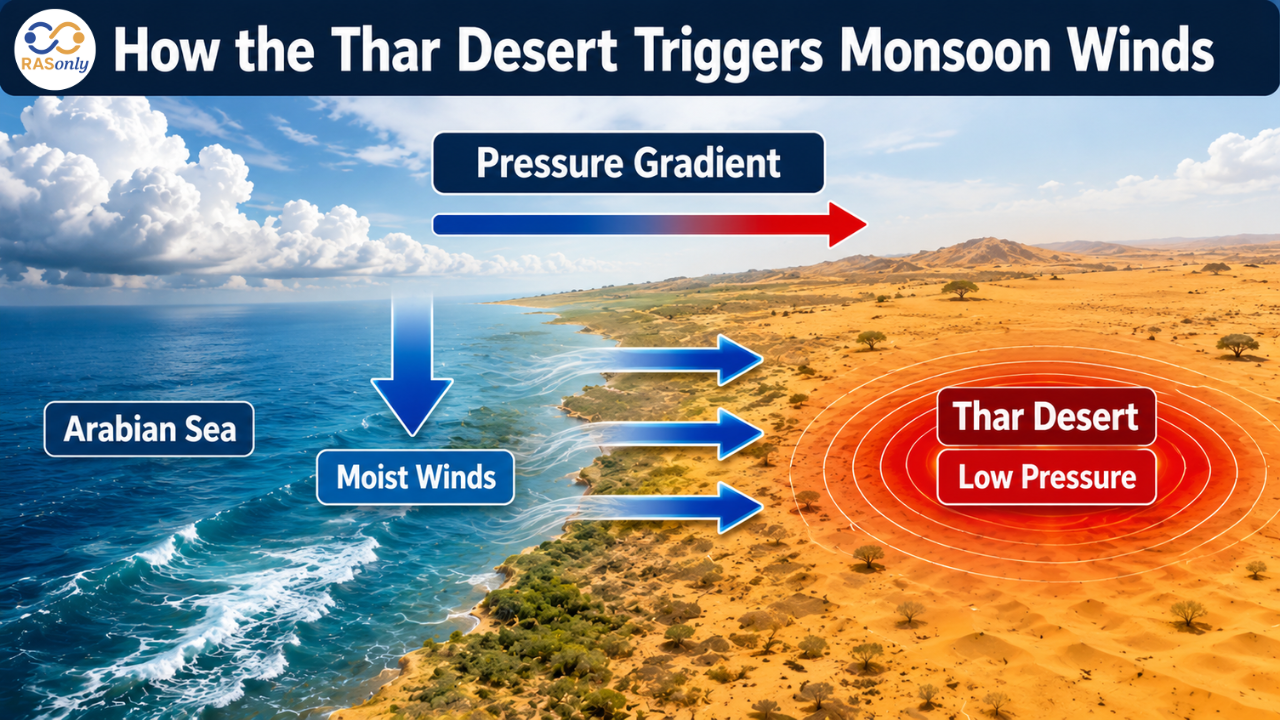
- As this moist sea air travels inland, it carries huge amounts of water vapour — this inflow of moist air is what we commonly call the southwest monsoon.
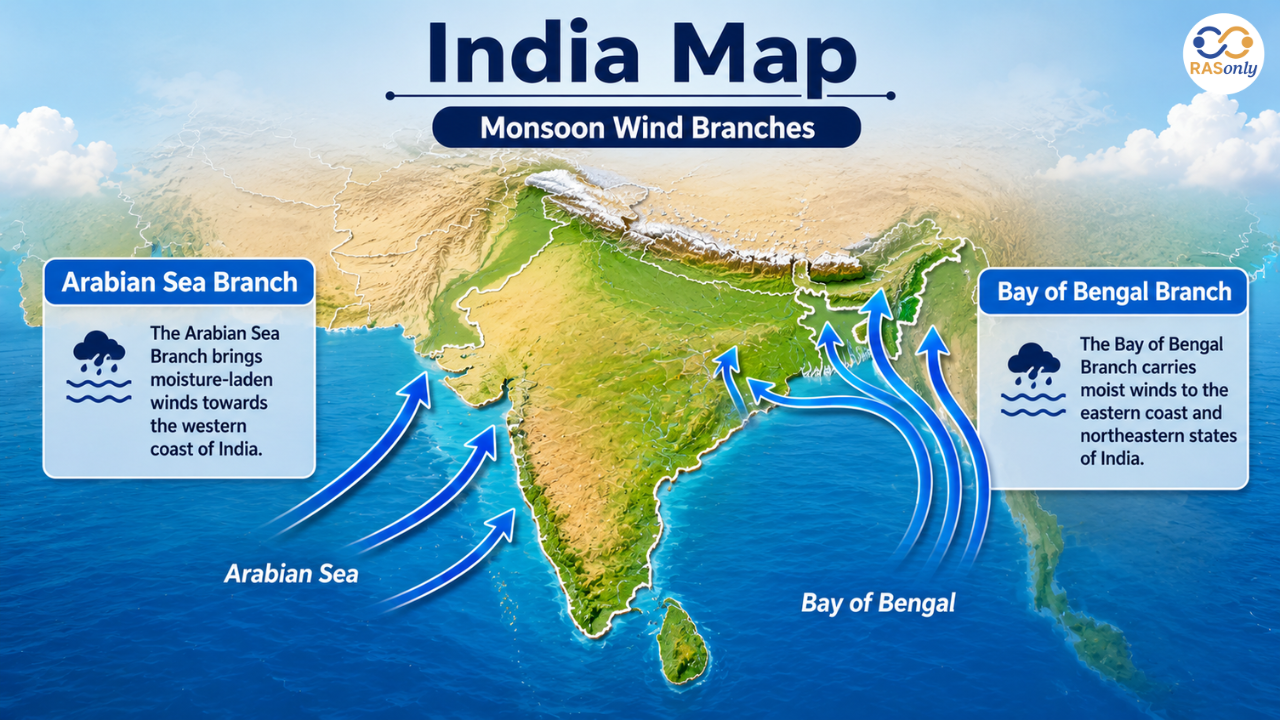
- The Indian subcontinent receives the monsoon from two major arms, both of which are affected by this pull from the pressure system:
| Monsoon Branch | Origin | Direction of Movement |
|---|---|---|
| Arabian Sea Branch | Arabian Sea | Moves toward the west coast and then advances into northwestern India, including Rajasthan. |
| Bay of Bengal Branch | Bay of Bengal | Moves toward northeastern India and then turns westward across the Gangetic Plains. |
- The pressure difference would be far lower without the strong thermal low over the desert, and the monsoon wind would not be able to reach such far distances across the landmass — hence the intensity and onset of the monsoon over India would be strongly influenced by how much the desert warms up each summer.
4. Monsoon Trough Formation
The low pressure over the desert does not become isolated as the season advances, but merges with other low-pressure systems throughout the country in a vast low-pressure system which brings precipitation to large areas of the country.
- As more of northern India heats up, the low-pressure zone over the Thar Desert links up with other low-pressure areas forming across the Indo-Gangetic plains.
- These combine to form a long, narrow belt of low pressure, also called the Monsoon trough, which extends from the Thar Desert region in the northwest to the Bay of Bengal in the east.
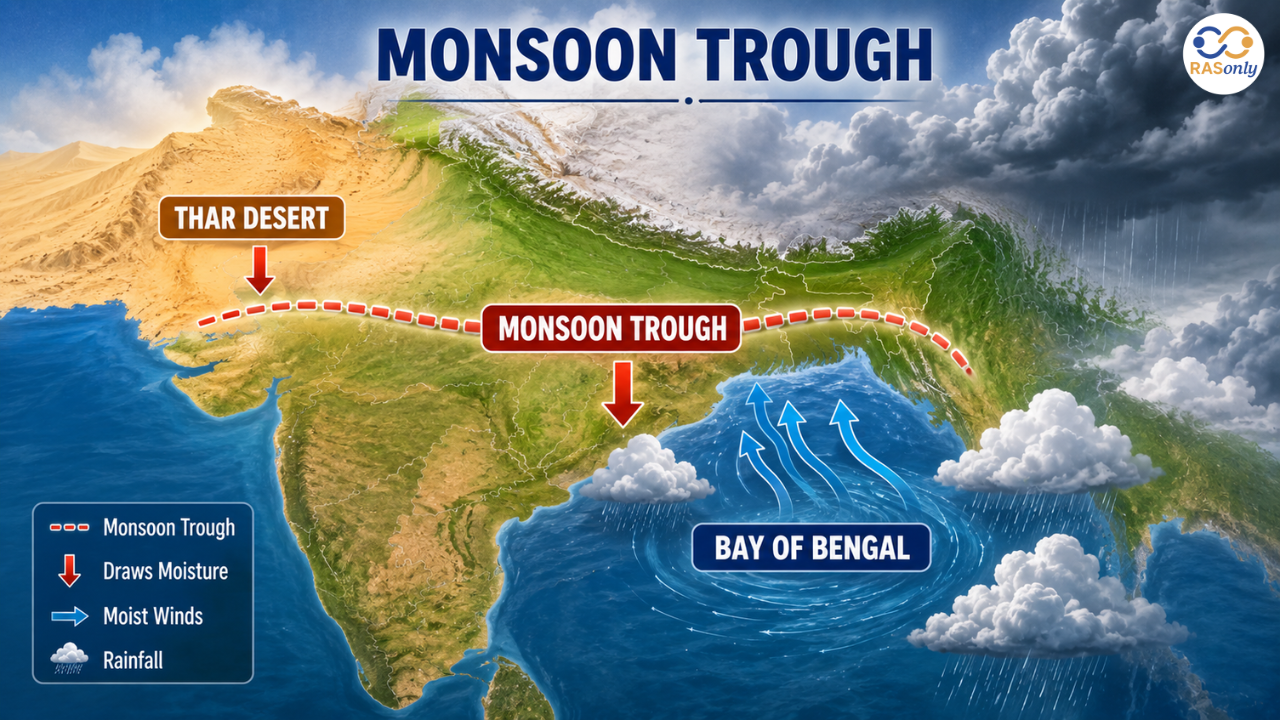
- This trough behaves like a conveyor belt or spine for the entire monsoon season: rain-bearing systems (like low-pressure areas and depressions from the Bay of Bengal) tend to travel along this trough, bringing rainfall to the regions beneath it.
- This trough is closely associated with the ITCZ (Intertropical Convergence Zone), which is a belt of trade winds found near the equator where the trade winds of both hemispheres meet. In summer, due to intense heating over the Indian subcontinent (with the Thar Desert as a major contributor), the ITCZ shifts northward over India — this shifted position is essentially what we observe as the monsoon trough.
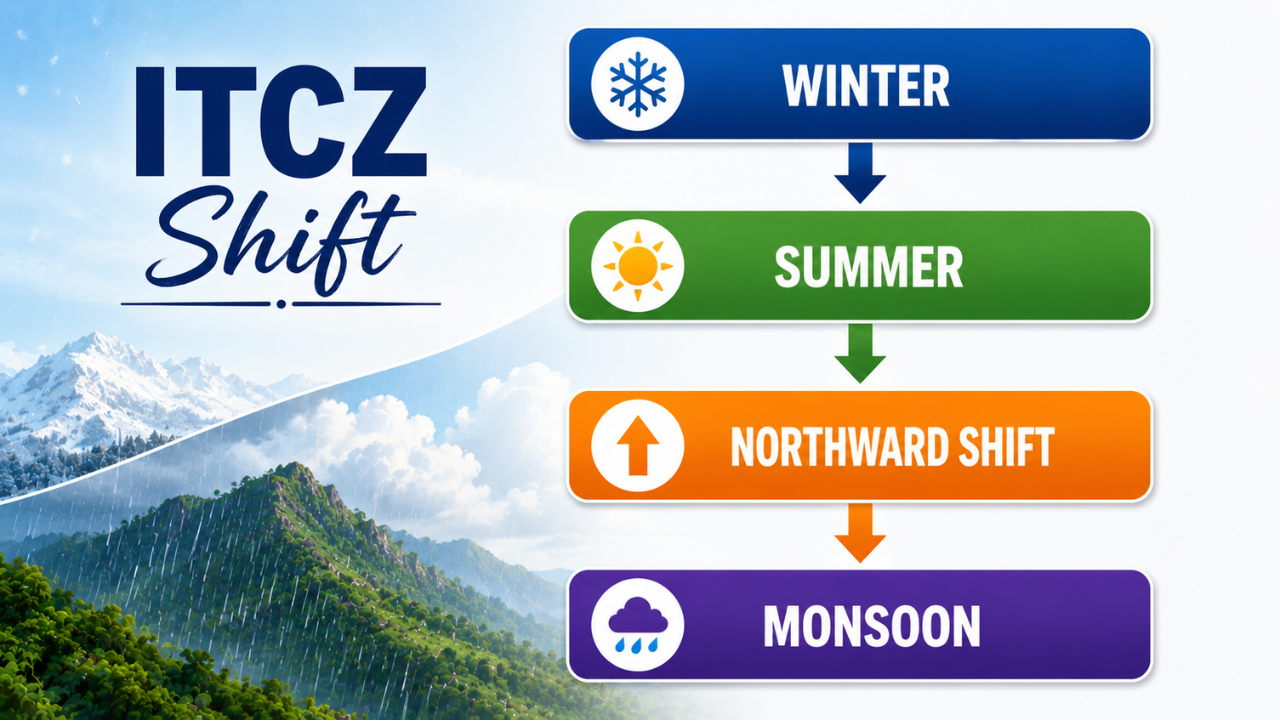
- In short, one of the factors for the displacement of the ITCZ is the extreme heat in the Thar Desert, which enables the monsoon system to penetrate far into the landmass of India rather than remaining close to the equator.
5. Why the Thar Desert Itself Gets So Little Rain (The Paradox)
Here's the twist that surprises most people: the very desert that helps trigger the monsoon barely benefits from it. This is a paradox that reduces to just one geographical feature.
- The surprising thing is that although the Arabian Sea branch of the monsoon runs right through Rajasthan, the desert receives very little rainfall, usually just 100-400mm of rain per year, and some parts of Rajasthan get less.
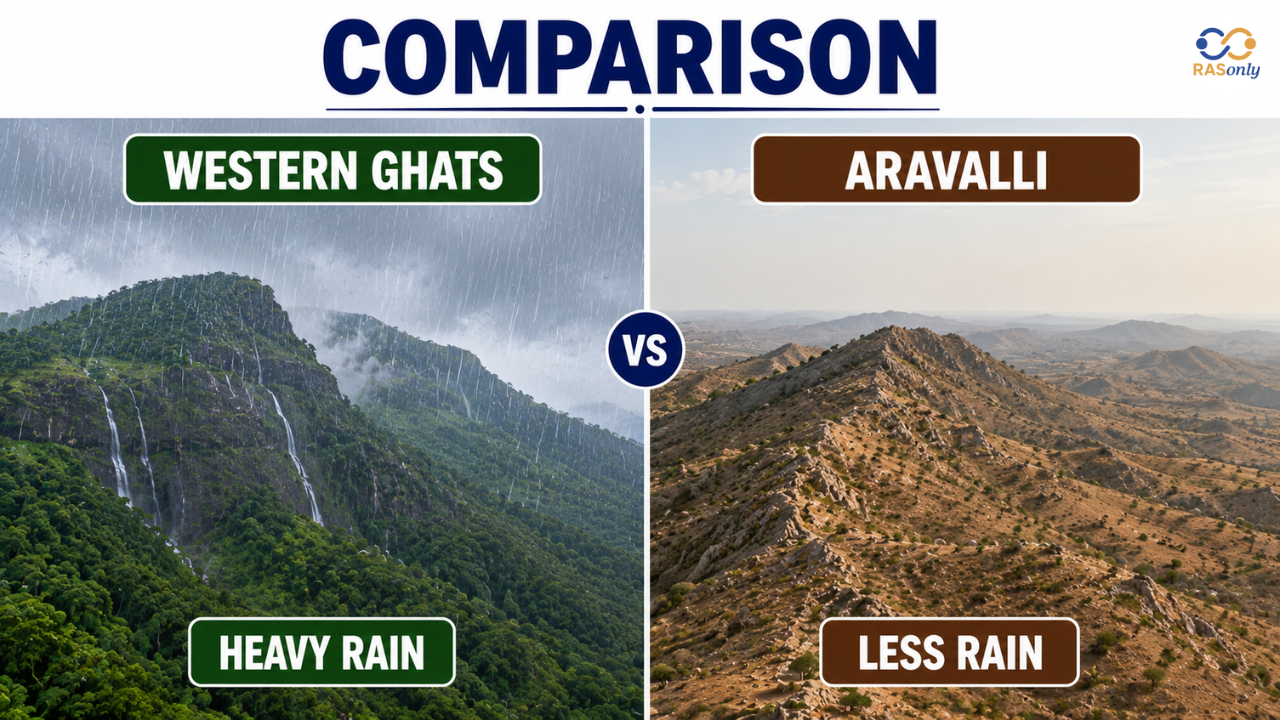
- The main reason lies in the orientation of the Aravalli Range:
- The Aravallis run in a northeast–southwest (NE–SW) direction.
- This direction happens to be parallel to the path of the incoming monsoon winds in this region, not perpendicular (crosswise) to them.
- When winds blow parallel to a mountain range, they simply flow alongside it instead of being forced to rise. Rainfall occurs when moist air is forced upward, cools down, and condenses into clouds — this "forced lifting" barely happens here.
- Compare this with the Western Ghats: there, monsoon winds hit the mountains perpendicularly, are forced to rise sharply, cool rapidly, and release heavy rainfall on the windward (western) side — which is why Kerala and coastal Karnataka get extremely high rainfall while areas just east of the Ghats (rain shadow region) stay dry.
- So the takeaway is: the Thar Desert plays a vital role in creating the pressure difference that pulls the monsoon in, but the Aravalli alignment prevents it from actually receiving much of that rainfall — a classic example of how two different geographical factors (heating vs. mountain orientation) can work in opposite directions.
6. Thar Desert and Monsoon Withdrawal
The desert's influence doesn't end with the onset — it also plays a role in ending the monsoon season. In the fall, the same warming phenomenon occurs, and its impact is felt nationwide once more.
- The desert's role isn't limited to starting the monsoon — it also plays a part in ending it each year.
- By early September, as the sun's direct rays shift southward, the Thar Desert region cools down faster than the rest of the subcontinent (again due to the land's low heat capacity — it loses heat quickly, just as it gains it quickly).
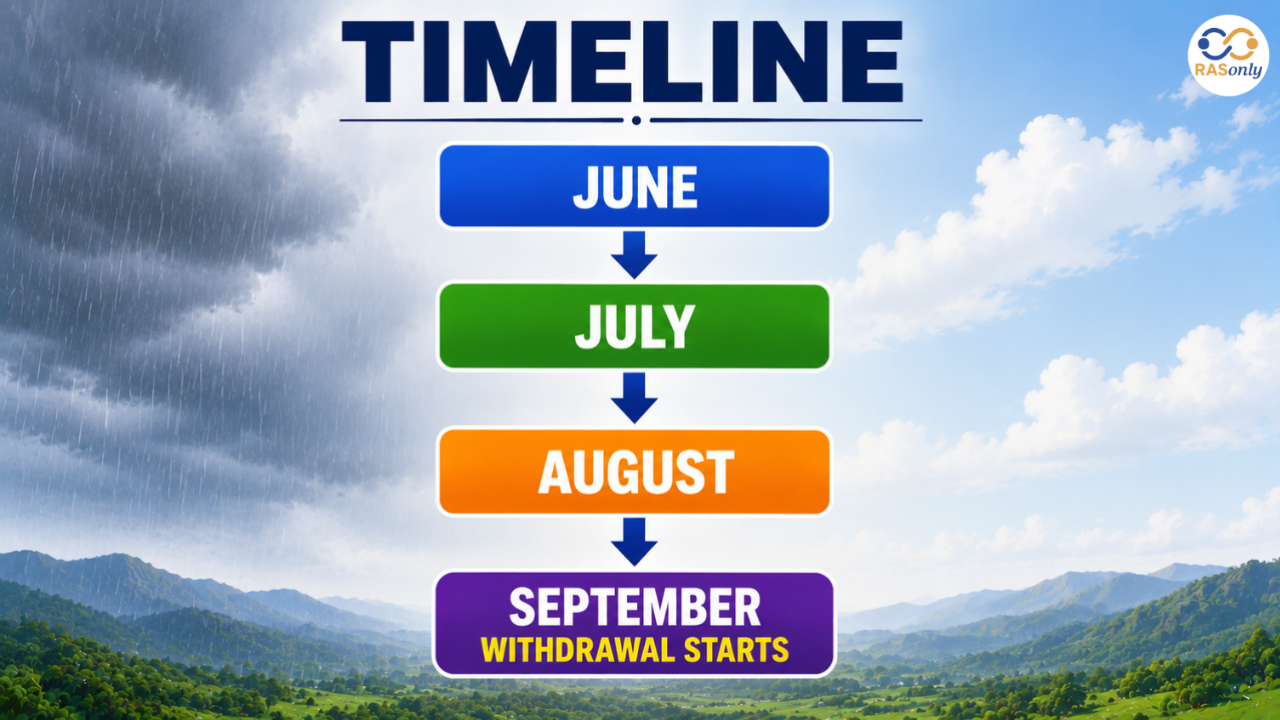
- As the desert cools, the thermal low pressure decreases, and the pressure gradient, the force that brought in moist winds from the sea, is also reduced.
- With this "pulling force" gone, the moisture supply to the region dries up first, which is why the southwest monsoon typically begins its withdrawal from Rajasthan first, usually around early to mid-September.
- The process of withdrawal continues to slowly wind its way towards the south and the east in the next few weeks, ultimately clearing the southern tip of the country by mid-October.
7. Summary Table
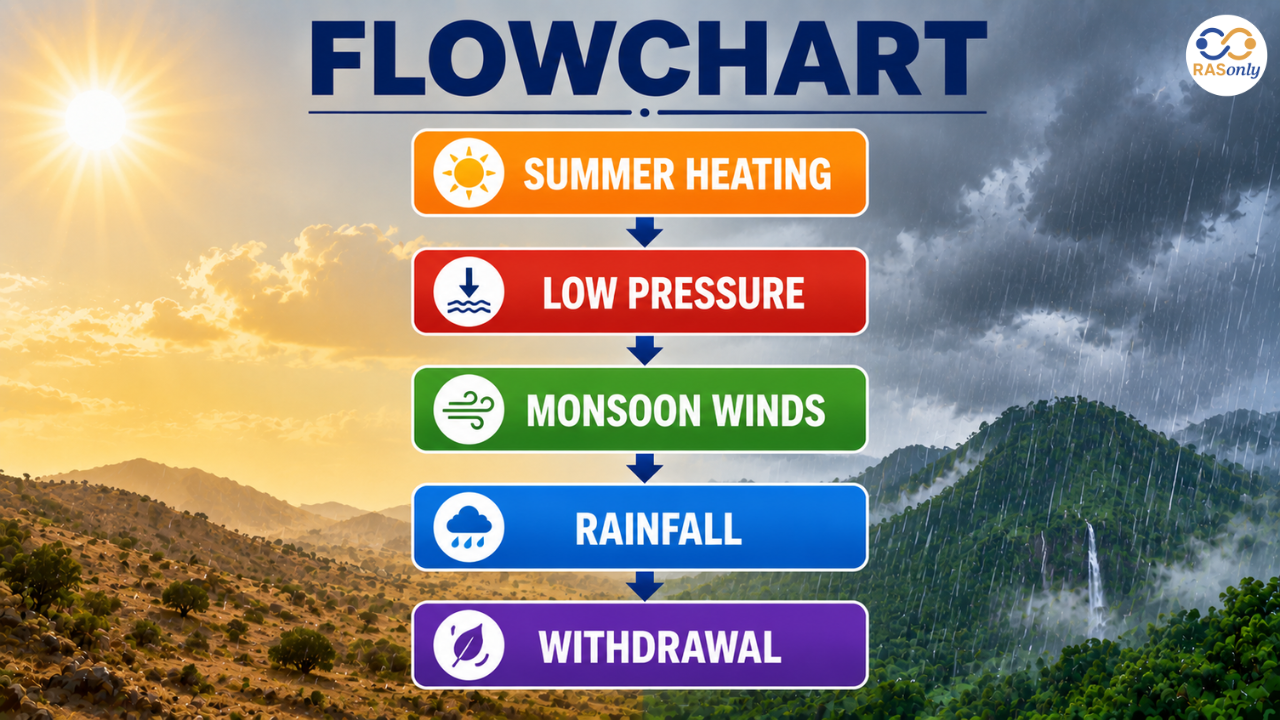
A quick recap of everything covered above — useful for revision before an exam or a glance without re-reading the full explanations.
| Factor | Role of the Thar Desert | Underlying Reason |
|---|---|---|
| Summer Heating | Creates a thermal low-pressure area. | Land heats faster than the sea due to differential heating. |
| Pressure Gradient | Pulls moist monsoon winds inland. | Air moves from high-pressure areas to low-pressure areas. |
| Monsoon Trough | Anchors the northwestern end of the monsoon trough. | Associated with the seasonal northward shift of the Intertropical Convergence Zone (ITCZ). |
| Aravalli Alignment | Results in low rainfall over the Thar Desert. | The Aravalli Range runs parallel to the southwest monsoon winds. |
| Autumn Cooling | Triggers the early withdrawal of the monsoon. | The desert cools rapidly, weakening the thermal low-pressure system. |
8. Key Terms (Quick Glossary)
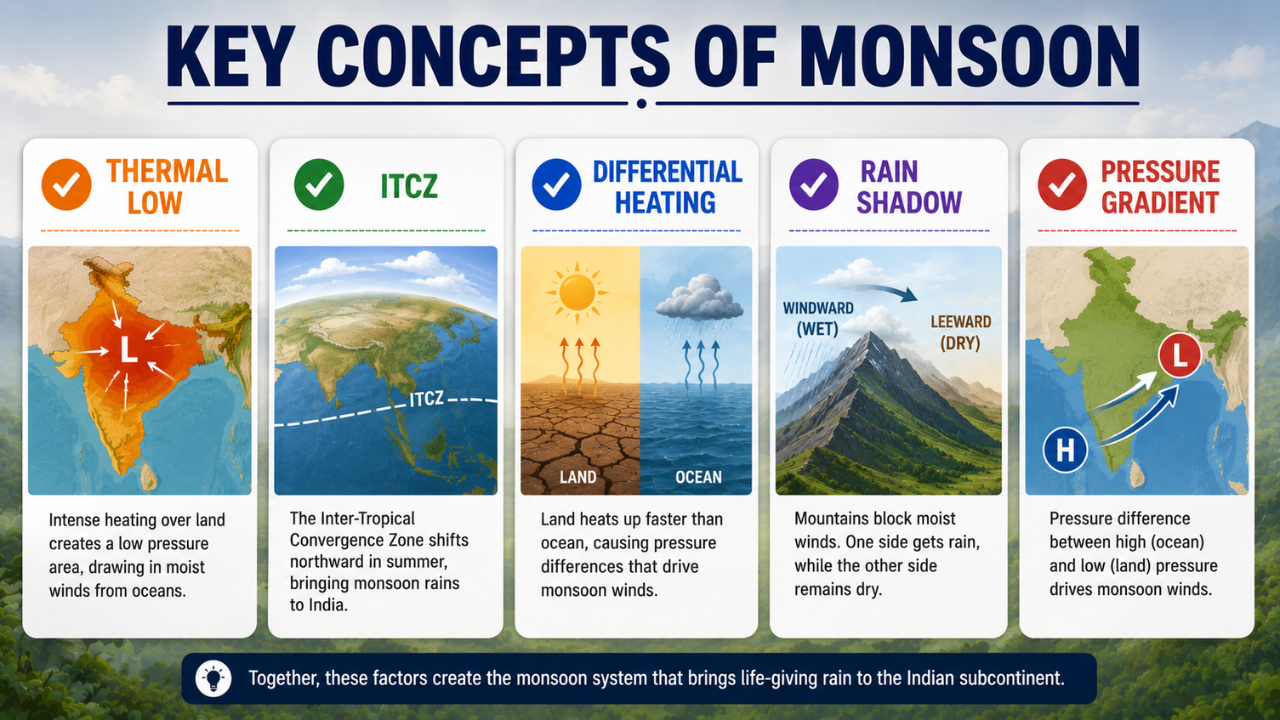
Several technical terms are used frequently in this topic. Knowing their precise meanings helps write clear, exam-ready answers.
- Thermal Low Pressure – A low-pressure zone that forms due to intense surface heating, causing air to rise; common over deserts in summer.
- Monsoon Trough – A long, low-pressure trough that lies across the northern part of India during the monsoon and directs the rain-bearing systems.
- ITCZ (Inter Tropical Convergence Zone) – The zone where northeast and southeast trade winds converge; shifts north/south seasonally with the sun's position.
- Differential Heating – The unequal rate at which land and water heat up and cool down, land being much faster in both directions.
- Aravalli Range – One of the oldest ranges of the world that runs NE–SW across the state of Rajasthan, plays an important role in wind-aligned rainfall.
- Rain Shadow Region – An area that receives little rainfall because it lies on the leeward (sheltered) side of a mountain range.
Important links
| Aravalli Range | Indian Pressure Belts & Winds Strategy |
| Climatic Characteristics of Rajasthan | Rainfall Distribution in Rajasthan |
| Desert Ecosystem of Rajasthan 2026 | Types of Sand Dunes in Rajasthan |
Conclusion
The Thar Desert is generally regarded as a dry, rainless region, but in reality, it is not the rain that matters, but the air above it. By merely differential heating, this desert alone produces the pressure gradient that helps to force the entire Indian monsoon system inland annually, thus taking the place of a "victim" of the monsoon and more of an "ignition switch". But at the end of the season, the same desert is the first to cool, silently announcing the monsoon's close as well.
FAQs
It heats up intensely in summer, creating a thermal low-pressure system that pulls moisture-laden winds from the Arabian Sea into India, effectively acting as the "trigger" for monsoon onset.
It attracts them — the low pressure created by the desert's heat draws in moist winds rather than pushing them away.
Because the Aravalli Range runs parallel to the monsoon wind direction here, the winds aren't forced upward, so very little condensation and rainfall occur.
By generating the pressure difference that organizes the monsoon trough and wind circulation, this indirectly helps distribute rainfall across northern and central India, even though the desert itself stays dry.
Because the desert cools down faster than the rest of the subcontinent by early September, weakening the thermal low pressure that was pulling in moist winds, so the moisture supply dries up here before anywhere else.
Ensure that was pulling in moist winds, the moisture supply dries up here before anywhere else.

BEST SELLER
🏆 PRELIMS
RAS Pass
Prelims focused Hindi & English
₹399
✓
Prelims Topic-Wise Tests
✓
Subject-Wise Tests
✓
Full-Length Prelims Tests
✓
Daily Current Affairs Tests
✓
Prelims PYQs Tests
✓
Detailed Solutions & Analysis
✓
All Rajasthan Ranking
✓
Unlimited Reattempts
✓
Mains Tests
✓
Hindi & English Tests
✓
All Rajasthan Ranking
Trusted by 5,000+ Students
Post Category
- RAS Salary
- Result
- RAS Admit Card
- RAS Job
- RAS Cutoff
- Preparation Tips
- RAS Answer Key
- RAS Exam Analysis
- RAS Syllabus
- RAS Previous Year Papers
- RPSC RAS Exam Pattern
- RAS Interview
- RAS Exam Date
- RAS Vacancy
- RAS Test Series
- RAS Best Books
- RAS Preparation Resources
- RAS Coaching Centre
- History
- Polity
- Geography
- Economics
- Science
- Art and Culture
- RPSC RAS Application Form
- RPSC RAS Notification
- RAS Eligibility Criteria
- UPSC Exam
- RPSC RAS Mains
Visit Our RASonly Offline Center
Our Expert Faculty

Bhunesh Sir
Current Affairs · 13+ Yrs

Aamir Khan Sir
RAS-2017 · IIM Ahm.

Akash Sir
Polity · 8+ Yrs
Free Resources
Official Mobile App

RASOnly App
by OTSAdda · Free
Full Video Lectures
Mock Tests & PYQs
Daily Current Affairs
AI Mock Interview
Free Download · No subscription needed to install
RAS 2024 Toppers — RASonly
Rank 2
Virendra Charan
Rank 9
Bhoopinder Singh
Rank 26
Aanchal Nagpal
Rank 33
Lokendra Singh
Rank 45
Amar Rathore
Rank 46
Manasvini Verma

Join RASonly WhatsApp Community
Get daily current affairs, exam alerts, free study material and tips from expert faculty — right on WhatsApp.
Join for Free →RASonly Interview Guidance Program

Mr. Ashok Jain
Ex-Chief Secretary Govt of Rajasthan
- IAS officer of the 1981 batch, Rajasthan cadre.
- Passionate about mentoring the next generation of RAS officers with real-world insights.
- Got retired in Dec 2017 from the post of Chief Secretary of the state of Rajasthan.

Mr. Guru Charan Rai
Ex-ASP / SP in Jaisalmer
- Guru Charan Rai, IPS (Retd), retired as Inspector General of Police (Security), Rajasthan, Jaipur in 2017.
- Served as ASP and SP in Jaisalmer, Nagaur, Sri Ganganagar, Sawai Madhopur, Dausa, Sikar, and Karauli.
- He also held key positions as DIGP and IGP in the Law and Order division.

Mr. Rakesh Verma
Ex-IAS Officer, B.Tech, MBA, and M.A. (Economics)
- IAS officer of the 1981 batch and retired in Chief Secretary Rank.
- Civil servant of high repute and vast experience.
- Has been teaching UPSC CSE subjects for the last six years.
Related Post


Daily Current Affairs for RAS Exam Preparation 2026
Rajasthan Initiative to Build India’s First UNESCO Global Geopark
October 07, 2026
Indigenous Tejas Mk-1 Inducted into IAF
October 07, 2026
Vedanta to Increase Oil Production in Rajasthan
October 06, 2026