Chalukya Dynasty: Origin, Rulers, Three Branches and Architecture
Dams of Rajasthan and Their Types: Complete RAS Exam Notes

Get in Touch with RASonly!

Dams of Rajasthan play a vital role in a state that is India's largest by area yet one of its driest, with less than 25 cm of average annual rainfall and very few perennial rivers. That's why this topic sits at the heart of Rajasthan Geography and keeps returning in RAS prelims, mains, and general RAS GK papers. This guide walks through dam types, major dams with their rivers and districts, key exam facts, and practice questions to help you revise faster.

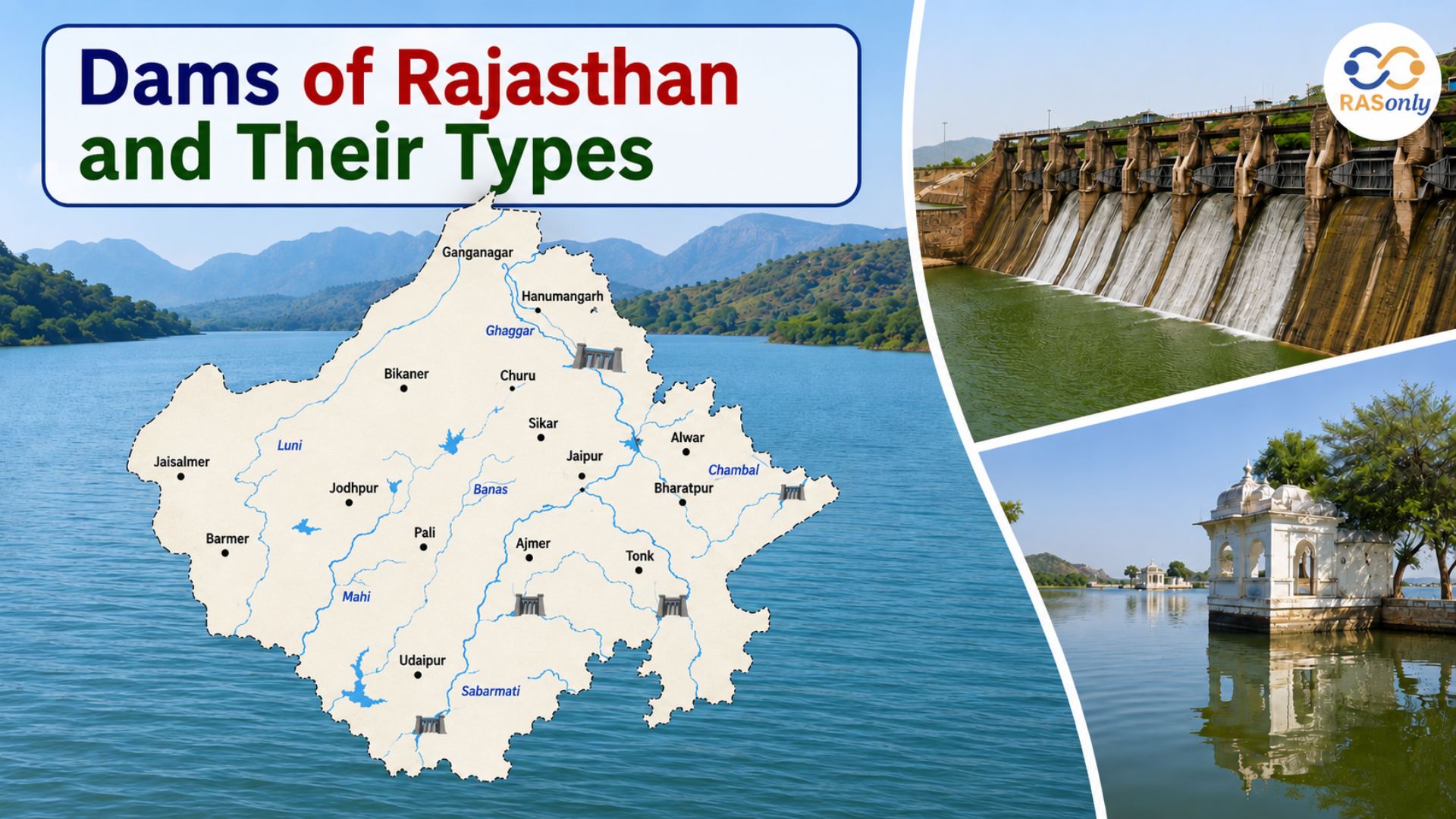
Rajasthan is India's largest state by area, but it is also one of the driest. With less than 25 cm of average annual rainfall in most regions and very few perennial rivers, the state has always depended on man-made water storage structures to survive. This is exactly why dams of Rajasthan form such an important part of Rajasthan Geography, and why the topic appears again and again in RAS prelims and mains, as well as in RAS GK and other state-level exams.
This article covers everything an RAS aspirant needs: the types of dams in Rajasthan with real examples, a complete table of major dams in Rajasthan with their rivers and districts, important exam-oriented facts, and previous year questions to help you revise faster.
Whether you are preparing Rajasthan dams GK for prelims or need deeper irrigation projects in Rajasthan notes for mains, this guide is structured to save you time and help you retain the facts that actually get asked.
Why Dams Matter So Much in Rajasthan's Geography
Rajasthan has only one truly perennial river, the Chambal. The other major rivers, including the Banas and the Luni, are seasonal and depend heavily on the monsoon. Because of this, dams and reservoirs are not just infrastructure projects; they are the backbone of drinking water supply, irrigation, and even hydroelectric power in the state.
The main rivers in Rajasthan are the Chambal, Banas and Luni, of which only the Chambal is perennial, and important dams such as Rana Pratap Sagar, Jawai Dam and Mahi Bajaj Sagar support irrigation and drinking water supply. Along with these, the Indira Gandhi Canal brings additional water into the Thar Desert region from the Sutlej and Beas rivers, but the dam network remains central to the state's water security.
Types of Dams in Rajasthan
For RAS exam purposes, dams are usually classified by the material and structural design used in their construction. Understanding these types of dams in Rajasthan helps you quickly identify the correct answer even when a question describes a dam's structure instead of naming it directly.
1. Gravity Dam
A gravity dam uses only the weight of its own construction material (usually concrete or masonry) to resist the pressure of water. It does not curve; it stays stable purely because of its mass.
- Example: Bisalpur Dam (Tonk district, on the Banas River) is a classic gravity dam built in 1999.
- Example: Jawahar Sagar Dam, part of the Chambal Valley Project, is also a concrete gravity dam.
2. Earthen (Earthfill) Dam
These dams are made mainly of compacted earth and clay rather than concrete. They are cheaper to build and are common where the foundation soil is not strong enough to support a concrete structure.
- Example: Morel Dam, near Kankariya village in Lalsot, is an earthen dam built in 1959, mainly for irrigation.
- Example: Kota Barrage has an earthfill dam section combined with a concrete spillway.
3. Arch Dam
An arch dam curves upstream so that the water pressure is transferred sideways into the canyon walls rather than straight down into the foundation. This design needs a narrow, rocky valley to work well.
- Arch dams are less common in Rajasthan compared to gravity and earthen types, since the state's terrain is mostly flat to undulating rather than deep, narrow gorges.
4. Buttress Dam
- A buttress dam has a sloped face on the water side supported by a series of buttresses (triangular supports) on the downstream side, which reduces the amount of material needed compared to a solid gravity dam.
5. Embankment Dam
- Similar to earthen dams but built using a mix of materials - soil, rock, and sometimes a concrete or clay core - to increase strength and reduce seepage.
6. Masonry Dam with Embankment Sections
- A hybrid design where part of the dam is built using stone or brick masonry and part uses embankment techniques. Sarju Sagar Dam (also known as Kot Dam) in Jhunjhunu district is an example of this masonry-with-embankment type.
Major Dams of Rajasthan: Complete List
This table brings together the most exam-relevant major dams in Rajasthan, along with the river, district, type, year of completion, and their primary purpose - everything you need for quick revision.
| Dam Name | River | District | Type of Dam | Year Completed | Purpose |
|---|---|---|---|---|---|
| Bisalpur Dam | Banas River | Tonk | Gravity Dam | 1999 | Drinking water (Jaipur, Ajmer) & Irrigation |
| Rana Pratap Sagar Dam | Chambal River | Chittorgarh (Rawatbhata) | Gravity Dam | 1970 | Hydropower, Irrigation, Part of Chambal Valley Project |
| Jawahar Sagar Dam | Chambal River | Kota | Concrete Gravity Dam | 1972 | Hydropower & Irrigation (3rd Dam of Chambal Valley Project) |
| Mahi Bajaj Sagar Dam | Mahi River | Banswara | Earthfill/Gravity Combination | 1983 | Hydroelectric Power, Irrigation, Drinking Water |
| Jawai Dam | Jawai River | Pali (Sumerpur) | Earthen/Gravity Dam | 1957 | Drinking Water for Jodhpur & Pali, Irrigation |
| Kota Barrage | Chambal River | Kota | Barrage (Earthfill + Concrete Spillway) | 1960 | Diverts Water for Irrigation via Canals |
| Meja Dam | Kothari River | Bhilwara | Earthen Dam | - | Drinking Water Supply to Bhilwara |
| Morel Dam | Morel River | Dausa (Lalsot) | Earthen Dam | 1959 | Irrigation |
| Jakham Dam | Jakham River | Pratapgarh | Masonry/Earthen Dam | 1968–70 | Irrigation |
| Gosunda Dam | - | Chittorgarh | Reservoir Dam | - | Drinking Water Supply |
| Sei Dam | Sei River (Tributary of Sabarmati) | Udaipur (Kotra) | Earthen Dam | - | Stores Water Diverted to Jawai Dam |
| Mansi Wakal Dam | Mansi River | Udaipur (Jhadol) | Earthen Dam | - | Drinking Water Supply to Udaipur |
| Sarju Sagar (Kot) Dam | - | Jhunjhunu | Masonry with Embankment | - | Water Storage |
Note: Blank entries mean the exact year/data was not consistently confirmed across sources - always cross-check the latest figures from your RAS study material or the official Water Resources Department, Rajasthan.
The Chambal Valley Project: A Special Focus Area
RAS exams frequently ask questions specifically about the Chambal Valley Project, since it is a joint venture between Rajasthan and Madhya Pradesh and includes three major dams built one after another on the same river.
- Gandhi Sagar Dam - first dam of the project (mostly in Madhya Pradesh)
- Rana Pratap Sagar Dam - second dam, located near Rawatbhata in Chittorgarh district, completed in 1970, about 54 metres high
- Jawahar Sagar Dam - third dam, located between Kota city and Rana Pratap Sagar Dam, a concrete gravity dam about 45 metres high and 393 metres long
Water released from these three dams is finally regulated by the Kota Barrage, which then distributes water for irrigation into Rajasthan and Madhya Pradesh through canals on both banks of the river.
Rajasthan Dams and Rivers: Quick Reference
Since Rajasthan dams and rivers are commonly asked together in a "match the following" format, here is a quick paragraph-style summary to help you memorise the river-to-dam pairing rather than just the table. The Banas River carries the Bisalpur Dam, which today is the single most important source of drinking water for Jaipur and Ajmer - making it arguably the largest dam in Rajasthan in terms of practical significance, even though Rana Pratap Sagar is often cited as the largest by reservoir area. The Chambal River hosts three dams in sequence (Rana Pratap Sagar, Jawahar Sagar and the Kota Barrage), making it the most "dam-dense" river in the state. The Jawai River, a tributary of the Luni, feeds the Jawai Dam - famous not just for water supply to Jodhpur but also for its population of leopards and migratory birds around the reservoir. The Mahi River in the south of the state feeds the Mahi Bajaj Sagar Dam, the second-largest dam in Rajasthan, which is important for both Rajasthan and neighboring Gujarat.
Important Facts for RAS Prelims and Mains
Use this quick-fact list for last-minute revision before your exam:
- Rana Pratap Sagar Dam is considered the largest dam in Rajasthan by area, located in Rawatbhata, Chittorgarh district, on the Chambal River.
- Mahi Bajaj Sagar Dam is the second largest dam in Rajasthan, named after Jamnalal Bajaj, built on the Mahi River near Banswara.
- Bisalpur Dam is a gravity dam on the Banas River in Tonk district and is the main drinking water source for Jaipur city.
- Jawai Dam is the largest dam in western Rajasthan and was built by Maharaja Umaid Singh of Jodhpur between 1946 and 1957.
- The Chambal River is the only perennial river of Rajasthan, which is why the Chambal Valley Project carries three dams.
- Kota Barrage is not technically a storage dam but a barrage - it regulates and diverts water rather than storing large volumes.
- Rajasthan has six major river basins: Banas, Luni, Chambal, Mahi, Banganga and Sabarmati - most major dams are located on rivers within these basins.
Previous Year RAS Questions (Practice)
- The Chambal Valley Project is a joint venture between Rajasthan and which other state?
- Which dam is known as the largest dam in western Rajasthan and is associated with leopard sightings?
- Name the gravity dam on the Banas River that is the primary drinking water source for Jaipur.
- Arrange the following in the correct sequence of the Chambal Valley Project: Kota Barrage, Rana Pratap Sagar Dam, Jawahar Sagar Dam, Gandhi Sagar Dam.
- Which dam in Rajasthan is named after Jamnalal Bajaj?
(Answers: 1. Madhya Pradesh | 2. Jawai Dam | 3. Bisalpur Dam | 4. Gandhi Sagar → Rana Pratap Sagar → Jawahar Sagar → Kota Barrage | 5. Mahi Bajaj Sagar Dam)
Conclusion - Dams of Rajasthan
The topic of dams of Rajasthan and their types is one of the highest-yield areas in Rajasthan Geography for the RAS exam, precisely because it combines physical geography (rivers, districts, terrain) with practical facts (year of completion, purpose, dam type) that are easy to frame as objective questions. Focus your revision on the Chambal Valley Project sequence, the Banas–Bisalpur–Jaipur connection, and the dam-type classification, since these three areas are the most frequently tested.
FAQs
Rana Pratap Sagar Dam, on the Chambal River in Chittorgarh district, is generally considered the largest dam in Rajasthan by area and storage, though Bisalpur Dam is the most important for drinking water supply to Jaipur.
The main types of dams in Rajasthan include gravity dams (Bisalpur, Jawahar Sagar), earthen dams (Morel Dam, Meja Dam), and masonry-with-embankment dams (Sarju Sagar Dam), based on the material and construction technique used.
The Chambal River has the most dams in sequence - Rana Pratap Sagar, Jawahar Sagar, and the Kota Barrage - as part of the Chambal Valley Project.
The Bisalpur Dam on the Banas River in Tonk district is the main source of drinking water for Jaipur and Ajmer.
Kota Barrage is technically a barrage, not a full storage dam. It diverts and regulates water released from the upstream Chambal Valley dams for irrigation.

BEST SELLER
🏆 PRELIMS
RAS Pass
Prelims focused Hindi & English
₹399
✓
Prelims Topic-Wise Tests
✓
Subject-Wise Tests
✓
Full-Length Prelims Tests
✓
Daily Current Affairs Tests
✓
Prelims PYQs Tests
✓
Detailed Solutions & Analysis
✓
All Rajasthan Ranking
✓
Unlimited Reattempts
✓
Mains Tests
✓
Hindi & English Tests
✓
All Rajasthan Ranking
Trusted by 5,000+ Students
Post Category
- RAS Salary
- Result
- RAS Admit Card
- RAS Job
- RAS Cutoff
- Preparation Tips
- RAS Answer Key
- RAS Exam Analysis
- RAS Syllabus
- RAS Previous Year Papers
- RPSC RAS Exam Pattern
- RAS Interview
- RAS Exam Date
- RAS Vacancy
- RAS Test Series
- RAS Best Books
- RAS Preparation Resources
- RAS Coaching Centre
- History
- Polity
- Geography
- Economics
- Science
- Art and Culture
- RPSC RAS Application Form
- RPSC RAS Notification
- RAS Eligibility Criteria
- UPSC Exam
- RPSC RAS Mains
Visit Our RASonly Offline Center
Our Expert Faculty

Bhunesh Sir
Current Affairs · 13+ Yrs

Aamir Khan Sir
RAS-2017 · IIM Ahm.

Akash Sir
Polity · 8+ Yrs
Free Resources
Official Mobile App

RASOnly App
by OTSAdda · Free
Full Video Lectures
Mock Tests & PYQs
Daily Current Affairs
AI Mock Interview
Free Download · No subscription needed to install
RAS 2024 Toppers — RASonly
Rank 2
Virendra Charan
Rank 9
Bhoopinder Singh
Rank 26
Aanchal Nagpal
Rank 33
Lokendra Singh
Rank 45
Amar Rathore
Rank 46
Manasvini Verma

Join RASonly WhatsApp Community
Get daily current affairs, exam alerts, free study material and tips from expert faculty — right on WhatsApp.
Join for Free →RASonly Interview Guidance Program

Mr. Ashok Jain
Ex-Chief Secretary Govt of Rajasthan
- IAS officer of the 1981 batch, Rajasthan cadre.
- Passionate about mentoring the next generation of RAS officers with real-world insights.
- Got retired in Dec 2017 from the post of Chief Secretary of the state of Rajasthan.

Mr. Guru Charan Rai
Ex-ASP / SP in Jaisalmer
- Guru Charan Rai, IPS (Retd), retired as Inspector General of Police (Security), Rajasthan, Jaipur in 2017.
- Served as ASP and SP in Jaisalmer, Nagaur, Sri Ganganagar, Sawai Madhopur, Dausa, Sikar, and Karauli.
- He also held key positions as DIGP and IGP in the Law and Order division.

Mr. Rakesh Verma
Ex-IAS Officer, B.Tech, MBA, and M.A. (Economics)
- IAS officer of the 1981 batch and retired in Chief Secretary Rank.
- Civil servant of high repute and vast experience.
- Has been teaching UPSC CSE subjects for the last six years.
Related Post

Daily Current Affairs for RAS Exam Preparation 2026
Rajasthan Initiative to Build India’s First UNESCO Global Geopark
October 07, 2026
Indigenous Tejas Mk-1 Inducted into IAF
October 07, 2026
Vedanta to Increase Oil Production in Rajasthan
October 06, 2026