Chola Dynasty: Capital, Founder, Kings, Time Period and History
How to Score 120+ Marks in RPSC RAS Prelims 2026: Complete Preparation Strategy

Get in Touch with RASonly!

Master your RPSC RAS Prelims 2026 preparation with a proven 120+ marks strategy. Discover the best study plan, subject-wise preparation tips, recommended books, revision techniques, mock test strategy, and smart exam-day approaches to improve accuracy and confidently qualify for the RAS Mains examination.

RPSC RAS Prelims 2026 is the first and most competitive stage of the Rajasthan State and Subordinate Services Combined Competitive Examination, and scoring 120+ marks out of 200 is considered a strong, safe zone for most candidates to move confidently into the RAS Mains. Now that the RPSC RAS notification has been issued out, the dates for the application form have been released from 4th of June, and the exam will be asked in a single paper of 150 objective questions with 1/3rd negative marking, a candidate needs more than just hard-working, they need a smart and focused RAS Prelims preparation strategy, which involves accuracy, Rajasthan-specific knowledge and disciplined revision.
This blog explains how to plan the preparation for RPSC RAS exam after knowing the exam pattern and syllabus and build a study plan for each and every subject, selecting books, managing negative marking, revising smartly in the last few weeks, etc. This is for beginner aspirants and for those who have failed to qualify for the RAS Prelims previously. This guide should help you put your strategy in place so that each hour spent on this book gets you one mark closer towards success.
Understanding the RPSC RAS Exam Pattern
First of all, it is important to know the structure of the paper before developing any strategy. The RPSC RAS exam pattern determines allotment of time, your riskiness of the questions and the weightage of the negative marking in the final marks.
RAS Prelims is a single paper exam of General Knowledge and General Science which has high weightage for topics falling in Rajasthan. The marks are not counted in the merit list but the candidate has to cross the cut-off to appear in the Mains examination.
| Exam Component | Details |
|---|---|
| Exam Name | RPSC RAS Prelims |
| Total Questions | 150 MCQs |
| Total Marks | 200 |
| Duration | 3 Hours |
| Negative Marking | 1/3rd (0.33) mark deducted for each incorrect answer |
| Unanswered Questions | More than 10% unattempted questions may lead to disqualification |
| Nature of Exam | Qualifying only (marks are not counted in the final merit list) |
RAS Prelims Syllabus: What You Actually Need to Cover
You can save all your precious time by having a vision of everything mentioned in the syllabus of RAS Prelims. The syllabus is quite wide but heavily focused on Rajasthan-specific subjects, and focusing on Rajasthan has the highest benefit to your study time.
The essential subjects that you should cover in depth are:
- Rajasthan History, Art, Culture, and Heritage
- Rajasthan Geography, Rivers, and Natural Resources
- Rajasthan Economy and Government Schemes
- Indian History and National Movement
- Indian Polity, Constitution, and Governance
- General Science and Technology
- Environment and Ecology
- Current Affairs (State and National)
- Reasoning and Mental Ability
Building a Realistic RAS Prelims Study Plan
The RAS Prelims study plan is the key that makes the difference between a candidate passing the cutoff and those who miss out. Organize your preparation into blocks—Foundation building, Depth and Revision—practice.
Here is a simple way to structure your months before the exam:
- Foundation Phase (first 40-50%): Grow basics from NCERT, Rajasthan GK books, Basics of polity to create a solid foundation.
- Depth Phase (next 30%): Focus on previous year patterns, static GK, and current affairs compilation.
- Revision Phase: Use this phase only for mock tests, error analysis, and last-minute revision notes.
- Allocate daily study hours subject-wise instead of studying one subject for days at a stretch — this improves retention.
- Designate one day of the week as an exclusively revision day.
Best Books for RAS Prelims Preparation
It is more important to select the right RAS Prelims books list than to gather more sources. Use only a few well-used books and change these often, rather than changing resources quickly.
The aspirants have been generalizing NCERT Textbooks (6 to 12) topics of History, Geography, Polity, and Science basics, and in History and Polity subjects, standard Rajasthan GK books (History, Culture, current schemes, etc.) are recommended. Use a fine current affairs magazine or a compilation of current affairs every month. Also, use a separate Economic Review section for the Economy, where more questions are asked or a separate Budget summary section for Economy questions.
Subject-Wise Strategy to Maximize Your Score
The key to success in RPSC RAS Prelims is to have a subject-wise plan of action where one can allocate the effort according to weightage and personal strengths. Not all subjects are created equal — some subjects have a greater weightage year on year, and require additional focus.
- Rajasthan History & Culture: High weightage section; make corrections of dynasties, monuments, fairs, festivals, and folk tradition in a detailed manner.
- Rajasthan geography: Revision on rivers, soil types, climate, mineral resources with map-based questions.
- Polity: Understand key constitutional articles, amendments, and governance structures at the state and centre level.
- Science & Technology: Keep this simple and fact-based; avoid overly technical depth.
- Current Affairs: Attempt the last 8-10 month’s affairs seriously with special attention to Rajasthan Government Schemes/Schemes in Government and Appointments.
Practicing with Previous Year Papers
One of the most authentic methods to gauge the level of difficulty, recurring topics, and examiner's pattern is solving the previous year papers related to RAS Prelims. This will also help you recognise question forms very rapidly in the actual examination.
It is important to solve papers from the last 8-10 years regularly and always refer to the answer key of RAS Prelims to recognise the topics and ambiguous questions that you are getting wrong consistently. This diagnostic approach is far more valuable than simply attempting papers without analysis.
Managing Negative Marking Smartly
Ras Prelims will have deductions for wrong answers; hence, it is vital to understand the negative marking rule so as not to lose out too much on mere guesswork. You lose a third of the marks for every incorrect response, so try to construct your approach on an idea of confident estimation rather than random guesswork.
To manage negative marking effectively:
- Only guess if you are certain that you can rule out at least two of the choices.
- Try not to guess on questions where you have no background knowledge.
- Indicate reviews for questions that are not known by circling them back after confident attempts.
- Also keep in mind that there may be such things as too many blank answers; leave no more than 10% blank; use a reasonable approach.
Time Management Tips During the Exam
Effective time strategies for the Prelims enable you to finish the paper on time without burning through the end or skipping simple questions because you ran out of time. This is only 1.2 minutes per question with 150 questions in 180 minutes, and not every question is worth an equal amount of time.
- Take the initial rapid round on questions that you know quite well.
- Move to moderately difficult questions in the second round.
- Leave very lengthy or confusing questions for the last 15–20 minutes.
- The last 10 minutes are strictly for the review of the OMR paper and the answers set in it.
Understanding the Expected Cutoff
If you follow the trend of the RAS Prelims Cut-off of last year, you'll have a realistic set goal in your mind. It doesn't matter how hard that year's paper is, or how many places there are, most serious students try to make a comfortable cut above the expected level not a skinflinch.
Based on historical trends, aiming for 120+ marks out of 200 puts most candidates in a safe zone above the general cutoff, though category-wise cutoffs (SC, ST, OBC, EWS) tend to be somewhat lower than the general category cutoff. Don't aim for the mean, aim for the 120+ mark; paper difficulty may vary from year to year.
Daily Revision Habits That Actually Work
Although revision is frequently the least done part of revision, it is the component of preparation that makes the knowledge you've acquired ‘exam-ready'. Establishing the routine of daily revision prevents topics you learned weeks ago from going away.
- Use short revision notes rather than re-reading books on a topic.
- Revising what you studied in the morning in the last 30 minutes of the day.
- Take one full-length mock test weekly during the final two months and analyze mistakes immediately.
- Revise current affairs on a rolling monthly basis rather than cramming everything at the end.
Also Read
| RPSC RAS Notification | RPSC RAS Exam Pattern |
| RPSC RAS Syllabus | Rajasthan Current Affairs for RAS |
| RAS Mains Essay Topics 2026 | How to Write a 600-Word Essay for RAS Mains |
Conclusion
With an understanding of the RPSC RAS exam pattern, strategy, and targeted study plan, consistent practice from past years' question papers, and a smart approach to negative marking, it is possible to score 120+ marks in the RPSC RAS Prelims. Being successful on this exam is less about the number of things you study and more about making sure you are studying the correct things consistently, revising regularly, and practicing in an exam-like atmosphere. If you follow a structured RPSC RAS exam preparation approach as outlined above, stay updated with the latest notification details from the official RPSC website, and maintain steady revision through the final weeks, crossing the cutoff comfortably becomes a realistic and achievable goal.
FAQs
For a lot of candidates, a score of 120+ points is safe according to the cut-off history. However, the actual cutoff depends on factors such as the difficulty level of the paper, the number of vacancies, and overall candidate performance.
The RPSC RAS Prelims consists of 150 multiple-choice questions (MCQs) carrying a total of 200 marks. Candidates are given 3 hours to complete the exam.
Yes. The RPSC RAS Prelims has 1/3 negative marking for every incorrect answer. So, candidates should avoid guesswork and choose questions strategically.
Most candidates who have followed a study plan, revised regularly basis, and solved mock tests continuously in this manner would be able to get a good preparation period of 6-8 months.
Ideally, candidates should attempt 20–30 full-length mock tests before the exam. It's just as valuable to examine errors after an examination as it is to take the exam itself.
BEST SELLER
🏆 PRELIMS
RAS Pass
Prelims focused Hindi & English
₹399
✓
Prelims Topic-Wise Tests
✓
Subject-Wise Tests
✓
Full-Length Prelims Tests
✓
Daily Current Affairs Tests
✓
Prelims PYQs Tests
✓
Detailed Solutions & Analysis
✓
All Rajasthan Ranking
✓
Unlimited Reattempts
✓
Mains Tests
✓
Hindi & English Tests
✓
All Rajasthan Ranking
Trusted by 5,000+ Students
Post Category
- RAS Salary
- Result
- RAS Admit Card
- RAS Job
- RAS Cutoff
- Preparation Tips
- RAS Answer Key
- RAS Exam Analysis
- RAS Syllabus
- RAS Previous Year Papers
- RPSC RAS Exam Pattern
- RAS Interview
- RAS Exam Date
- RAS Vacancy
- RAS Test Series
- RAS Best Books
- RAS Preparation Resources
- RAS Coaching Centre
- History
- Polity
- Geography
- Economics
- Science
- Art and Culture
- RPSC RAS Application Form
- RPSC RAS Notification
- RAS Eligibility Criteria
- UPSC Exam
- RPSC RAS Mains
Visit Our RASonly Offline Center
Our Expert Faculty

Bhunesh Sir
Current Affairs · 13+ Yrs

Aamir Khan Sir
RAS-2017 · IIM Ahm.

Akash Sir
Polity · 8+ Yrs
Free Resources
Official Mobile App

RASOnly App
by OTSAdda · Free
Full Video Lectures
Mock Tests & PYQs
Daily Current Affairs
AI Mock Interview
Free Download · No subscription needed to install
RAS 2024 Toppers — RASonly
Rank 2
Virendra Charan
Rank 9
Bhoopinder Singh
Rank 26
Aanchal Nagpal
Rank 33
Lokendra Singh
Rank 45
Amar Rathore
Rank 46
Manasvini Verma

Join RASonly WhatsApp Community
Get daily current affairs, exam alerts, free study material and tips from expert faculty — right on WhatsApp.
Join for Free →RASonly Interview Guidance Program

Mr. Ashok Jain
Ex-Chief Secretary Govt of Rajasthan
- IAS officer of the 1981 batch, Rajasthan cadre.
- Passionate about mentoring the next generation of RAS officers with real-world insights.
- Got retired in Dec 2017 from the post of Chief Secretary of the state of Rajasthan.

Mr. Guru Charan Rai
Ex-ASP / SP in Jaisalmer
- Guru Charan Rai, IPS (Retd), retired as Inspector General of Police (Security), Rajasthan, Jaipur in 2017.
- Served as ASP and SP in Jaisalmer, Nagaur, Sri Ganganagar, Sawai Madhopur, Dausa, Sikar, and Karauli.
- He also held key positions as DIGP and IGP in the Law and Order division.

Mr. Rakesh Verma
Ex-IAS Officer, B.Tech, MBA, and M.A. (Economics)
- IAS officer of the 1981 batch and retired in Chief Secretary Rank.
- Civil servant of high repute and vast experience.
- Has been teaching UPSC CSE subjects for the last six years.
Related Post




Daily Current Affairs for RAS Exam Preparation 2026
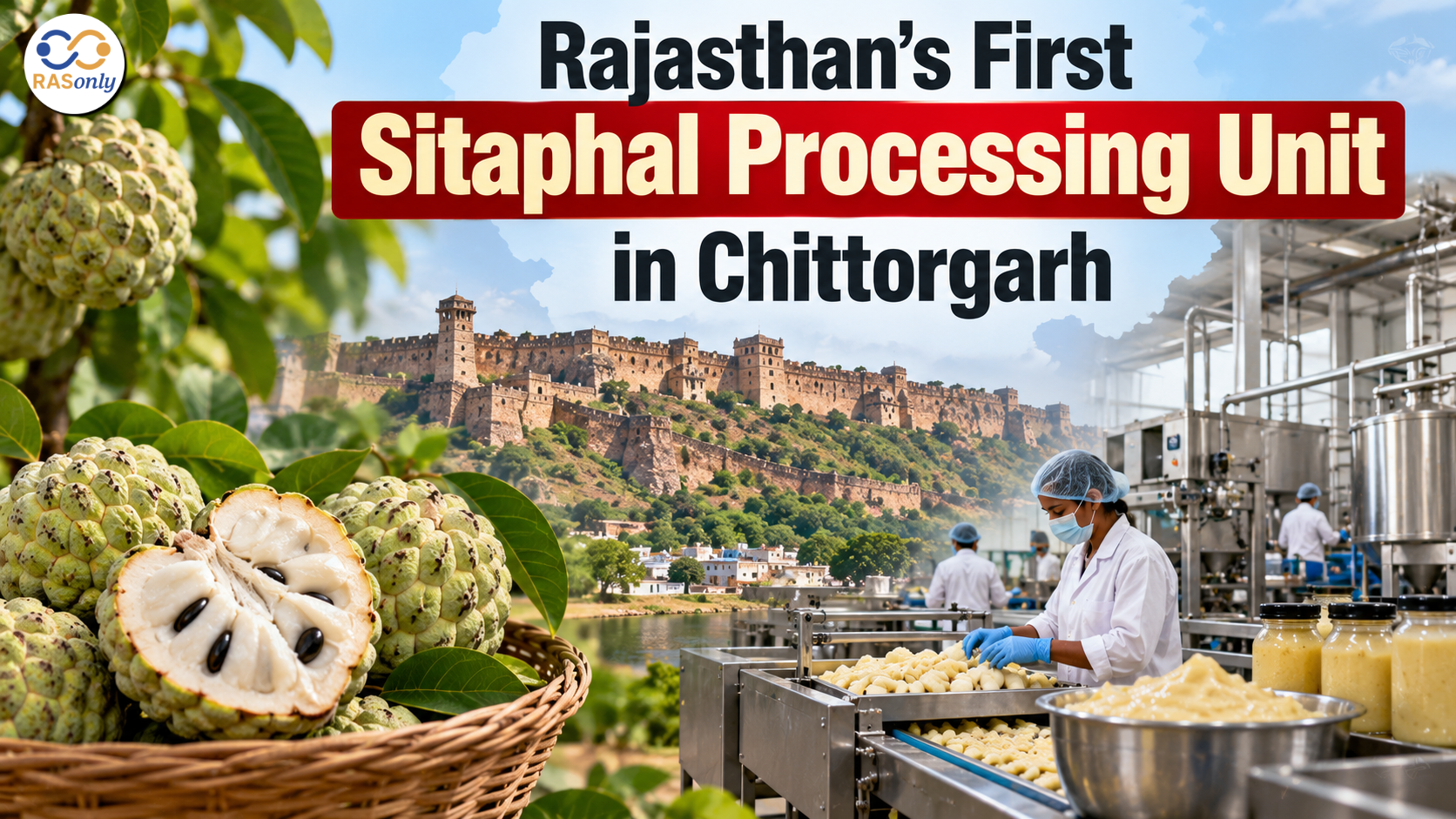
Rajasthan’s First Sitaphal Processing Unit in Chittorgarh
October 19, 2026
Rajasthan Foundation Expansion New Chapters Announced
October 19, 2026
Continuous Biomass Torrefaction Reactor
October 17, 2026