RAS 2026 vs RAS 2027: Overlap Guide for Aspirants
How to Fill DAF for RAS Interview: A Step-by-Step Guide

Get in Touch with RASonly!

Learn how to fill the RAS DAF for the interview with this step-by-step guide covering eligibility, required documents, personal and educational details, work experience, hobbies, common mistakes, submission process, and practical tips to prepare effectively.

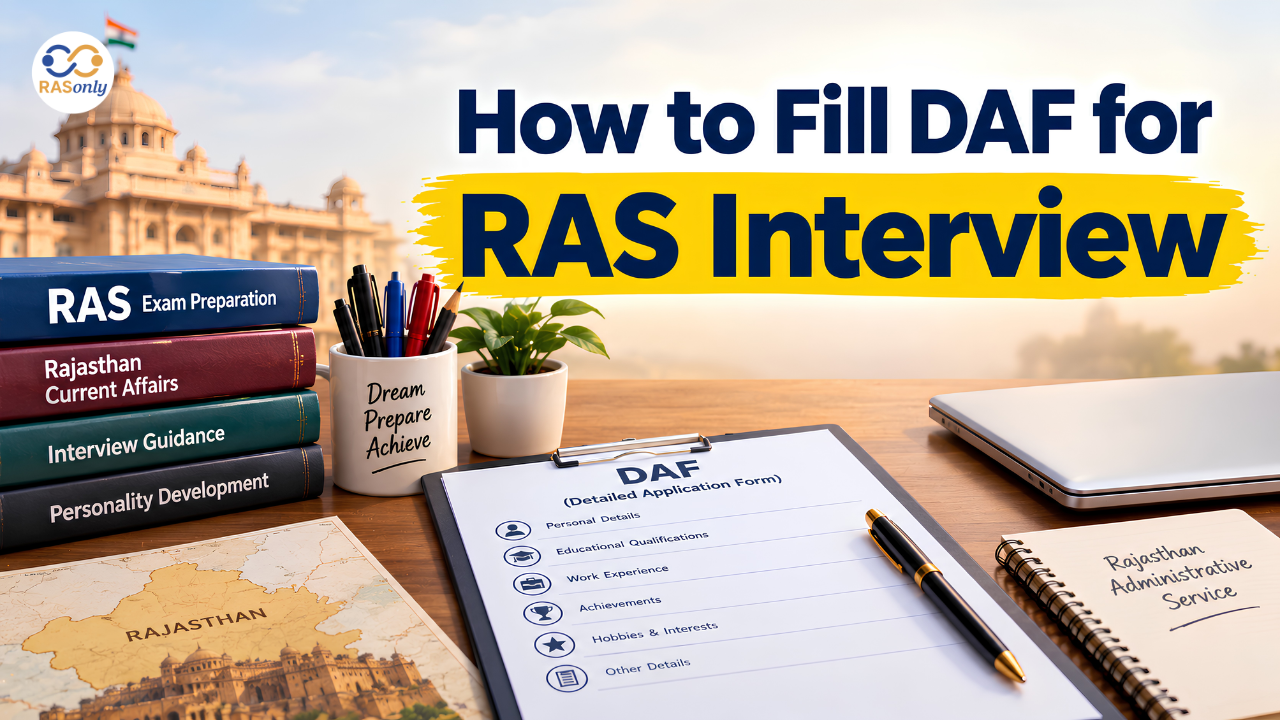
Correctly filling the DAF for the RAS interview is one of the most important tasks for each and every candidate who has passed the RAS Mains exam, as this is the beginning of the entire personality test. The RAS DAF, rather than being a formality, is the document from which the interview board poses the majority of its questions, and each detail written in it should be accurate, honest, and thought through.
This guide is designed to take you through the entire process of completing the DAF for RAS and breaks down each section of the form into understandable language, while providing some tips and tricks to prevent common pitfalls. Whether you are filling it for the first time or want to double-check your entries before submission, this step-by-step blog will make the entire RAS interview DAF process easy to understand.
What is the DAF and Why Does It Matter?
The Detailed Application Form is filled out online by candidates who qualify for the RAS Mains examination and are shortlisted for the interview round. It also outlines your personal, educational, and professional history in detail, enabling you to be judged on your written exam scores and more.
The questions in this format are generally designed by RPSC panel members based on what you have written; hence, this form is an indirect influence on the direction of your personality test. If the DAF is well prepared, it will allow you to direct the discussion to the questions you can answer comfortably, and if it is poorly prepared, it may give you some very awkward and difficult questions.
Eligibility and Timeline for RAS DAF Submission
The candidates who successfully clear the mains written examination will be called to attend the DAF, which opens shortly after the declaration of the RPSC mains result on the RPSC official portal. The commission normally provides a few days for online submission, so candidates should not wait until the last minute.
When the deadline is missed, or documents are incomplete, there could be serious issues later, such as possible rejection at the document verification stage. Regularly look for official announcements to keep up to date on the exact dates.
| RAS Mains Result Declaration | After evaluation of mains answer sheets |
| DAF Online Submission Window Opens | Within days of result declaration |
| Last Date to Submit DAF | As notified by RPSC (check official site) |
| Interview Call Letter Release | A few weeks before the scheduled interview |
| Personality Test (Interview) | As per RPSC interview schedule |
Documents Required Before You Start Filling the DAF
It is wise to collect all your documents beforehand before you can start the RPSC RAS DAF filling process online so that you may not have to interrupt the process midway and look for certificates. When everything is organised, it also minimises the risk of typing mistakes, as you can compare all of your information with the original document.
Here is a list of documents required for RAS DAF submission:
- Class 10th marksheet and certificate (used as age proof)
- Class 12th marksheet and certificate
- Graduation degree certificate and marksheets (semester-wise or consolidated)
- Post-graduation certificates, if applicable
- Valid government-issued photo ID (Voter ID, PAN Card, Aadhaar, etc.)
- Rajasthan domicile certificate, where applicable
- Caste or category certificate, if claiming reservation benefits
- Work experience certificates, if you are currently or previously employed
- Passport-size colour photographs (recent)
- RAS Mains admit card and application fee receipt
Step-by-Step Process to Fill DAF for RAS Interview
Knowing a bit of how to fill DAF step by step should make this process a lot less stressful – particularly for those who are new to the process. The following is the general procedure that most candidates followed to fill the online application form on the official RPSC portal:
- Log in to the official RPSC website with the already registered credentials on the mains application.
- Locate the DAF link under the recruitment or candidate login section once it becomes active.
- Fill in personal information such as name, father's/mother's name, date of birth, address, and contact details exactly as per your certificates.
- Fill in the educational qualification – Board/University, Year of Pass, Percentage, CGPA, and Subjects.
- Include any subject you opted for in the main examination (in case of taking one) and also the academic background for that subject.
- Fill the work experience section, mentioning designation, organisation, duration, and nature of duties, if applicable.
- Honestly talk about hobbies, extra-curriculars, and achievements in specific terms.
- Upload scanned documents and a photograph as per the specified format and size.
- Pay attention to each section before submitting, as there may not be any changes accepted after submission.
- Submit the form and download two printed copies for the interview day.
Key Sections of the RAS DAF Explained
Every portion of the RPSC RAS DAF has a particular function to include in your board's knowledge of your background. The attention you pay to the presentation of information for each portion can make a definite impact on how the interview goes.
Personal Information Section
This area contains basic information about yourself, your family background, your home area, and your category. It also frequently determines the region-specific or administrative questions that the board may ask you, particularly with regard to schemes, issues, or geography from your home region.
Educational Qualification Details
In this section, every academic qualification should be clearly stated from school to graduation and beyond. The optional subject or specialisation will often be a part of the interview board, and you should ensure that it is consistent with the certificates that you submitted.
Work Experience Section RAS DAF
This area is important to discuss if you have experience in another government or private sector organization. Panel members will ask what you learned and what your role and main responsibilities were, so you should be prepared to answer these questions in a way that makes sense to them.
Hobbies and Achievements
This is one of the most heavily analysed areas of the form, as students often include a spurious hobby that they cannot comment on. Only mention hobbies and achievements you can genuinely talk about in depth during the interview.
Common Mistakes to Avoid While Filling RAS DAF
During document verification or the interview itself, many candidates make mistakes that cause some problems. Being aware of these common mistakes to avoid while filling RAS DAF can save you from unnecessary stress.
- Using a generic or vague 'hobby' for the sake of length
- Mismatched spellings of name or address compared to certificates
- Leaving the work experience section blank despite having relevant experience
- Overstating achievements that cannot be substantiated with proof
- Not using the preview feature before submitting your work.
- Uploading blurred or incorrectly sized photographs and signatures
- Forgetting to keep a copy of the submitted form for personal records
How to Correct Mistakes in RAS DAF After Submission
In case you find any mistake in the form after submission, do not panic, as sometimes RPSC provides a window to correct such mistakes depending on the recruitment cycle. Always refer to the official notification or helpline for the most accurate guidance on this.
If there is no correction window, be ready to tell the panel, in a respectful way, if there is a mismatch in their interview about the RAS. It is better to explain a true clerical error than to try and cover it up.
Tips to Prepare for RAS Interview Using Your DAF
After you have sent your RAS DAF form, the next step is to do extensive preparation work on all the details that you have listed on the form. Since the interview board frequently begins with questions based on your form, revising it repeatedly before the interview date is extremely important.
- Re-read your entire DAF a few days before the interview and prepare 10–12 possible questions for each major entry.
- Have specific, concrete examples for your hobbies, work experience, and accomplishments, instead of general language.
- Revise your home district's profile, including its industries, heritage, rivers, and current issues.
- Stay updated with recent state government schemes and Rajasthan's current affairs.
- Practice mock interviews specifically on your entries in the DAF.
- Maintain an unflappable, confident, and relaxed attitude while in the session.
Documents to Carry on Interview Day
In addition to the printable RAS DAF form, candidates will need to bring a number of documents and photocopies to be matched in the venue for the interview.
| Two printed copies of DAF | Submission and reference during interview |
| DAF fee receipt | Proof of successful form submission |
| Original certificates with photocopies | Age, education, and category verification |
| Valid photo ID proof | Identity verification |
| Recent passport-size photographs | Attached to forms as required |
| Domicile certificate | State-specific eligibility, where applicable |
Also Read
| RAS Mains exam | RAS interview |
| RAS Mains Syllabus | Rajasthan's current affairs |
| RAS Preparation Tips | RAS Exam Pattern |
Conclusion
Crafting the DAF for the RAS interview process is as significant as the written test itself because it can affect the interview conversation that takes place with a board of interviewers. Once you know what is expected in each section of the RAS DAF form, know which items to avoid, and get the documents ready ahead of time, you'll have a lot more confidence and clarity going into the RPSC RAS DAF process. Don't fall into the trap of being overly dramatic when using this form; it isn't about trying to impress with claims; it's about giving a clear, organized picture of yourself. Give it plenty of time to fill out; do it carefully, and make sure you update it as often as you need to when you are getting ready for your RAS interview, as this can make your personality test go more smoothly and confidently.
FAQs
The Detailed Application Form (DAF) is an online form filled by candidates who qualify for the RAS Mains examination and are shortlisted for the interview.
Candidates who successfully clear the RAS Mains written examination and are shortlisted for the interview round need to complete the DAF.
Candidates are advised to carry the following documents: Class 10th certificate, 12th certificate, graduation certificate, photo ID, domicile and category certificate (if applicable), work experience certificates, photographs, RAS Mains admit card, and fee receipt.
Details in the DAF include personal information, educational background, work experience, hobbies, achievements, and other background information.
If RPSC has a correction window for that recruitment year, then it may be possible to correct it. The candidates are requested to verify their information from the appropriate notification and helpline.
BEST SELLER
🏆 PRELIMS
RAS Pass
Prelims focused Hindi & English
₹399
✓
Prelims Topic-Wise Tests
✓
Subject-Wise Tests
✓
Full-Length Prelims Tests
✓
Daily Current Affairs Tests
✓
Prelims PYQs Tests
✓
Detailed Solutions & Analysis
✓
All Rajasthan Ranking
✓
Unlimited Reattempts
✓
Mains Tests
✓
Hindi & English Tests
✓
All Rajasthan Ranking
Trusted by 5,000+ Students
Post Category
- RAS Salary
- Result
- RAS Admit Card
- RAS Job
- RAS Cutoff
- Preparation Tips
- RAS Answer Key
- RAS Exam Analysis
- RAS Syllabus
- RAS Previous Year Papers
- RPSC RAS Exam Pattern
- RAS Interview
- RAS Exam Date
- RAS Vacancy
- RAS Test Series
- RAS Best Books
- RAS Preparation Resources
- RAS Coaching Centre
- History
- Polity
- Geography
- Economics
- Science
- Art and Culture
- RPSC RAS Application Form
- RPSC RAS Notification
- RAS Eligibility Criteria
- UPSC Exam
- RPSC RAS Mains
Visit Our RASonly Offline Center
Our Expert Faculty

Bhunesh Sir
Current Affairs · 13+ Yrs

Aamir Khan Sir
RAS-2017 · IIM Ahm.

Akash Sir
Polity · 8+ Yrs
Free Resources
Official Mobile App

RASOnly App
by OTSAdda · Free
Full Video Lectures
Mock Tests & PYQs
Daily Current Affairs
AI Mock Interview
Free Download · No subscription needed to install
RAS 2024 Toppers — RASonly
Rank 2
Virendra Charan
Rank 9
Bhoopinder Singh
Rank 26
Aanchal Nagpal
Rank 33
Lokendra Singh
Rank 45
Amar Rathore
Rank 46
Manasvini Verma

Join RASonly WhatsApp Community
Get daily current affairs, exam alerts, free study material and tips from expert faculty — right on WhatsApp.
Join for Free →RASonly Interview Guidance Program

Mr. Ashok Jain
Ex-Chief Secretary Govt of Rajasthan
- IAS officer of the 1981 batch, Rajasthan cadre.
- Passionate about mentoring the next generation of RAS officers with real-world insights.
- Got retired in Dec 2017 from the post of Chief Secretary of the state of Rajasthan.

Mr. Guru Charan Rai
Ex-ASP / SP in Jaisalmer
- Guru Charan Rai, IPS (Retd), retired as Inspector General of Police (Security), Rajasthan, Jaipur in 2017.
- Served as ASP and SP in Jaisalmer, Nagaur, Sri Ganganagar, Sawai Madhopur, Dausa, Sikar, and Karauli.
- He also held key positions as DIGP and IGP in the Law and Order division.

Mr. Rakesh Verma
Ex-IAS Officer, B.Tech, MBA, and M.A. (Economics)
- IAS officer of the 1981 batch and retired in Chief Secretary Rank.
- Civil servant of high repute and vast experience.
- Has been teaching UPSC CSE subjects for the last six years.

Daily Current Affairs for RAS Exam Preparation 2026
Rajasthan Ranks First in Mission Karmayogi
September 16, 2026
CAR-T Cell Therapy
September 16, 2026
Swami Vivekananda Government Model Schools Rajasthan
September 15, 2026