Chola Dynasty: Capital, Founder, Kings, Time Period and History
Top 10 Myths About RAS Exam — Busted With Facts

Get in Touch with RASonly!

Confused by RAS exam rumours? This guide busts 10 common myths about eligibility, coaching, age, attempts, exam medium, Mains pattern, Prelims marks, preparation, and interviews to help aspirants understand the facts and build a more effective RAS preparation strategy.

Rumours about the RAS exam circulate among aspirants far more rapidly than the news about the actual exam, and each year, new sets of candidates are left with no option but to choose for the exam based on rumours rather than facts. So myths about RAS exam preparation may come from an old forum, a half-heard WhatsApp message, or a person's poor experience that has become a “rule”. The problem is that these misconceptions don't just waste time—they can genuinely derail a serious candidate's strategy before the real preparation even begins.
In this blog, we will discuss the truth about RAS exam preparation, one by one, keeping only the authentic information on the eligibility criteria, exam pattern, and selection process as notified by the Rajasthan Public Service Commission (RPSC). At the end, you should have a clear comparison of facts versus myths for the RAS exam that you can use, not secondhand information.
Myth 1: RAS Exam Is Only for Candidates From Rajasthan
It is one of the most common misconceptions about the RAS that deters many good candidates from other states from even applying for the exam. Aspirants also believe that RAS is a state service and only the residents of that state can appear for it, but that is not the case as per the eligibility conditions for the exam. In fact, RPSC only looks at nationality at the application level, and domicile only matters for certain benefits later. Making this distinction early on can help save the best candidates from out-of-state who might otherwise be disqualified.
- Candidates must be Indian citizens; there is no domicile restriction for applying to the RAS.
- Rajasthan-domicile candidates get certain reservation and age-relaxation benefits, but non-domicile candidates from the general category can still apply and compete.
- Over the years, many non-Rajasthan candidates have secured RAS in the general category.
Myth 2: You Cannot Clear RAS Without Joining Expensive Coaching
As mentioned, it is a myth that's pushed by the coaching marketing industry, which must be dispelled. It results in the false notion that a candidate's success is more dependent on the coaching brand he joins rather than his preparation discipline. The truth is that RPSC publishes a completely public syllabus, old papers, and an exam pattern that is sufficient for a self-motivated candidate to create a study plan around. The key elements that differentiate selected candidates from the remainder are not the fee they paid for guidance, but consistency and structured revision.
- The RAS syllabus is fully public and based on standard reference books, NCERTs, and current affairs—all self-study friendly.
- Many of the RAS toppers, including recent toppers, have attributed their success to self-study with proper daily answer writing rather than paying for coaching.
- What actually matters is consistency, mock tests, and regular revision—not the coaching brand name.
Myth 3: Only Fresh Graduates in Their Early 20s Can Succeed
It is assumed that RAS is for the youth aged 22–24 years, which demotivates those who are older or working. The perception is typically that young people who are toppers get the attention of the media, whereas the older ones in their thirties who are working hard remain out of the fray. It's not as short as people think, and there are more relaxations than that for several categories. This should make RAS one of the more age-friendly exams as opposed to being restricted to freshers.
- The minimum age required is 21 years, and the maximum age is 40 years for the General category, with age relaxation for the Reserved category.
- There is a relaxation of 5 years for women in the General category and SC/ST/OBC candidates from Rajasthan, who get relaxation of up to 10 years depending on gender and category.
- Women of any age can participate in RAS; there is no age limit for widows and divorced women
| Category | Upper Age Limit (approx.) |
| General (Male) | 40 years |
| General (Female) | 45 years |
| SC/ST/OBC (Male, Rajasthan domicile) | 45 years |
| SC/ST/OBC (Female, Rajasthan domicile) | 50 years |
| Widows / Divorced Women | No upper limit |
Myth 4: You Get Unlimited Attempts Regardless of Category
One of the most perplexing subjects is the number of attempts since they have been altered from one notification period to another and can even be inconsistently reported by the exam portal. Some candidates think that anyone can attempt everything, and some think that there is a hard and fast limit on everyone. Neither of these is completely accurate. The truth is somewhere in the middle, and rules are dependent on category and subject to changes by RPSC. The confusion starts when relying on last year's notification or that of a friend rather than the current notification.
- If there are attempt limits, they are usually different for different categories, and reserved categories may have more attempts or looser requirements than the general category.
- For most candidates, it's the age limit itself that proves to be the ultimate determining factor, as candidates continue to apply as long as they're under the maximum age limit.
- These rules can be updated, so the best way to break the myth of preparation for the RAS exam is to always check the official notification of the RPSC for the current year, instead of believing in the figures of last year.
Myth 5: English Medium Is Compulsory for RAS
Many aspirants think that the format of the RAS is the same as that of English medium exams, which is not correct, and it demoralises good Hindi medium candidates. The belief is probably carried over from other competitive exams where English skills are considered a necessity. However, RPSC has always allowed Hindi and English as valid mediums for the exam for all stages. Candidates from either linguistic background can compete on equal footing as long as their language and expression skills are solid.
- The RAS Prelims question paper is available in both Hindi and English.
- In the Mains exam, candidates can attempt the General Studies papers in either Hindi or English medium.
- There is a separate paper on General Hindi and General English of compulsory nature, in which the basic language skills at senior-secondary level are tested for all the candidates irrespective of the medium of their choice.
Myth 6: RAS Mains Has an Optional Subject Like UPSC
Some aspirants who have prepared for the UPSC exams also think that the structure of the optional subjects is the same in the two exams, but it is not. This mix-up often leads candidates to needlessly prepare an optional subject that RAS doesn't even require, wasting valuable preparation time. RAS Mains is more standardised, where all candidates sit for the same compulsory papers. This knowledge from the outset enables effort to be concentrated on the actual four-paper structure.
- RAS Mains has no optional subject; it consists of four compulsory papers only.
- The papers are General Studies I (200 marks), General Studies II (200 marks), General Hindi & General English (200 marks), and General Studies III (200 marks).
| Mains Paper | Marks | Duration |
| General Studies I | 200 | 3 hours |
| General Studies II | 200 | 3 hours |
| General Studies III | 200 | 3 hours |
| General Hindi & General English | 200 | 3 hours |
| Total | 800 | — |
Myth 7: Prelims Marks Are Added to the Final Merit List
This myth contributes to unnecessary anxiety after Prelims results as the candidate thinks that every Prelims mark will "carry forward" and impact his/her final rank. Some candidates even overshoot the bull's eye in the Prelims and attempt to achieve maximum marks in the hope that all the effort will count towards the final list because they are not sure if any marks will drop out. In RAS, however, the Prelims stage is only meant for narrowing down the number of candidates to be eligible for the Mains stage. If a candidate passes the prelims cut-off, then that particular score does not further influence the outcome.
- The RAS Prelims exam is only a screening test for the Mains exam.
- Marks scored in prelims are not added to the final merit list.
- Final selection is made based on the overall performance in the written test (Mains) and Interview
Myth 8: The Mains Pattern Never Changes, So Old Papers Are Enough
Assuming the exam pattern is frozen forever is a risky myth, especially since RPSC has periodically revised the Mains question format to test deeper understanding rather than memorisation. Candidates who prepare only years-old papers without taking a look at the recent notifications may turn up to the exam hall with the old format. The recent cycles reveal a definite trend towards moving from short recall-type responses to more analytical, example-based responses. It is essential to keep up to date with these pattern changes, as well as the syllabus.
- Two-mark objective-style questions have been phased out of the Mains descriptive papers.
- The pattern of the current syllabus is based on 5-mark and 10-mark descriptive answers which require explanation, connecting ideas and examples; not just recall.
- In the language paper, translation and essay writing take the place of administrative terminology, so that now it is truly a scoring or losing factor, not just a formality.
Myth 9: Working Professionals Cannot Prepare for RAS Alongside a Job
This myth suggests that candidates should study in the preparation room 24/7; this would not allow them to work and may make it seem impossible for them to do both. The actual time frame of the exam itself (ie., Prelims, Mains, and Interview, spread out over many months) is naturally suited for phased preparation. Many working candidates have found success in studying during the hours of the day or night that are best for them, and around their work schedule. It's not about how many hours you have in the day; it's about how effectively you use them.
- The "staged" nature of the exam (through Prelims, Mains, and Interview over several months) of course provides time for preparation to be staged rather than one big sprint.
- Many successful candidates from each cycle are working and studying during their time off work.
- It is not hours that are important; it's focused daily answer writing and consistent current affairs tracking.
Myth 10: A Weak Interview Can Be Balanced Out by a Strong Written Score
Some candidates feel the interview is a small side issue which shouldn't mar a good Mains performance – this is not the way the final merit is realised. This can result in incomplete preparation for the interview itself, and the true nature of the interview is not treated as a scored part of the process, but more like a casual conversation. In RAS, however, the marks obtained in the interview are directly added to the marks obtained in the main exam to prepare the final merit list, and thus they have real weight in the final merit list. When it comes to interviews, even with good written work, it can really make or break the candidate.
- The interview is a separate, weighted assessment of a candidate, which takes place only for candidates who meet the Mains cut-off.
- Final merit is a combination of Mains marks and interview marks, which means that a poor performance in the interview can offset a very good written performance.
- Treating the interview stage as optional preparation is one of the costliest RAS exam preparation myths candidates fall for late in their journey.
Quick Myth vs Fact Summary
| Myth | Fact |
| Only for Rajasthan candidates | Open to all Indian citizens; domicile only affects relaxations |
| Coaching is mandatory | Self-study with discipline is equally viable |
| Only for candidates in their early 20s | Eligible age range is 21–40, with wide relaxations |
| Attempts are unlimited for everyone | Attempt rules vary by category; always confirm current notification |
| English medium is compulsory | Hindi and English are both accepted mediums |
| Mains has an optional subject | Only four compulsory papers, no optional |
| Prelims marks count in final merit | Prelims is qualifying only; merit uses Mains + Interview |
| Exam pattern never changes | Question format has been revised in recent cycles |
| Working professionals can't prepare | Staged exam timeline allows preparation alongside a job |
| Interview barely matters | Interview marks are combined with Mains for final merit |
Also Read
| RAS Eligibility Criteria | RAS Age Limit |
| How Many Attempts Are Allowed in RAS? | RAS Syllabus |
| RAS Exam Pattern | RAS Revision Strategy |
Conclusion
Separating RAS exam facts vs myths is arguably as important as studying the syllabus itself, because a wrong assumption about eligibility, attempts, or the selection process can quietly shape — and limit — an aspirant's entire strategy. But as this list reveals, the reality of RAS exam preparation is really more expansive and well-planned than the rumours may have had you believe: The exam is not restricted to students from Rajasthan, it doesn't require a ton of money for coaching, it can be taken in both Hindi and English mediums, and it is based on continuous and diligent effort rather than rote learning. The most reliable habit any serious candidate can build is to verify every rule — age limits, attempts, exam pattern, and selection criteria — directly from the official RPSC notification for the current cycle, since these details are periodically updated. With the myths cleared up, the route ahead is plain before you: it is to learn the true pattern and practice answer paper writing regularly, keep abreast of affairs, and prepare for the interview with the same seriousness as the answer papers.
Myths About RAS Exam: FAQs
No. Indian citizens can apply for RAS, and there is no domicile restriction for appearing in the exam. Some reservation and age relaxation benefits can be availed under Rajasthan domicile.
Yes. The RAS syllabus, standard knowledge books, NCERTs, current affairs, mock tests, revision, and regular answer writing are enough to do self-study.
According to the blog, the age limit is a minimum of 21 years, and the maximum age is 30 years in the general course and there is relaxation for the eligible categories.
No. The RAS Prelims paper is available in Hindi and English, and candidates can attempt the Mains General Studies papers in either Hindi or English.
No. RAS Mains consists of four compulsory papers and does not have an optional subject.
BEST SELLER
🏆 PRELIMS
RAS Pass
Prelims focused Hindi & English
₹399
✓
Prelims Topic-Wise Tests
✓
Subject-Wise Tests
✓
Full-Length Prelims Tests
✓
Daily Current Affairs Tests
✓
Prelims PYQs Tests
✓
Detailed Solutions & Analysis
✓
All Rajasthan Ranking
✓
Unlimited Reattempts
✓
Mains Tests
✓
Hindi & English Tests
✓
All Rajasthan Ranking
Trusted by 5,000+ Students
Post Category
- RAS Salary
- Result
- RAS Admit Card
- RAS Job
- RAS Cutoff
- Preparation Tips
- RAS Answer Key
- RAS Exam Analysis
- RAS Syllabus
- RAS Previous Year Papers
- RPSC RAS Exam Pattern
- RAS Interview
- RAS Exam Date
- RAS Vacancy
- RAS Test Series
- RAS Best Books
- RAS Preparation Resources
- RAS Coaching Centre
- History
- Polity
- Geography
- Economics
- Science
- Art and Culture
- RPSC RAS Application Form
- RPSC RAS Notification
- RAS Eligibility Criteria
- UPSC Exam
- RPSC RAS Mains
Visit Our RASonly Offline Center
Our Expert Faculty

Bhunesh Sir
Current Affairs · 13+ Yrs

Aamir Khan Sir
RAS-2017 · IIM Ahm.

Akash Sir
Polity · 8+ Yrs
Free Resources
Official Mobile App

RASOnly App
by OTSAdda · Free
Full Video Lectures
Mock Tests & PYQs
Daily Current Affairs
AI Mock Interview
Free Download · No subscription needed to install
RAS 2024 Toppers — RASonly
Rank 2
Virendra Charan
Rank 9
Bhoopinder Singh
Rank 26
Aanchal Nagpal
Rank 33
Lokendra Singh
Rank 45
Amar Rathore
Rank 46
Manasvini Verma

Join RASonly WhatsApp Community
Get daily current affairs, exam alerts, free study material and tips from expert faculty — right on WhatsApp.
Join for Free →RASonly Interview Guidance Program

Mr. Ashok Jain
Ex-Chief Secretary Govt of Rajasthan
- IAS officer of the 1981 batch, Rajasthan cadre.
- Passionate about mentoring the next generation of RAS officers with real-world insights.
- Got retired in Dec 2017 from the post of Chief Secretary of the state of Rajasthan.

Mr. Guru Charan Rai
Ex-ASP / SP in Jaisalmer
- Guru Charan Rai, IPS (Retd), retired as Inspector General of Police (Security), Rajasthan, Jaipur in 2017.
- Served as ASP and SP in Jaisalmer, Nagaur, Sri Ganganagar, Sawai Madhopur, Dausa, Sikar, and Karauli.
- He also held key positions as DIGP and IGP in the Law and Order division.

Mr. Rakesh Verma
Ex-IAS Officer, B.Tech, MBA, and M.A. (Economics)
- IAS officer of the 1981 batch and retired in Chief Secretary Rank.
- Civil servant of high repute and vast experience.
- Has been teaching UPSC CSE subjects for the last six years.
Related Post




Daily Current Affairs for RAS Exam Preparation 2026
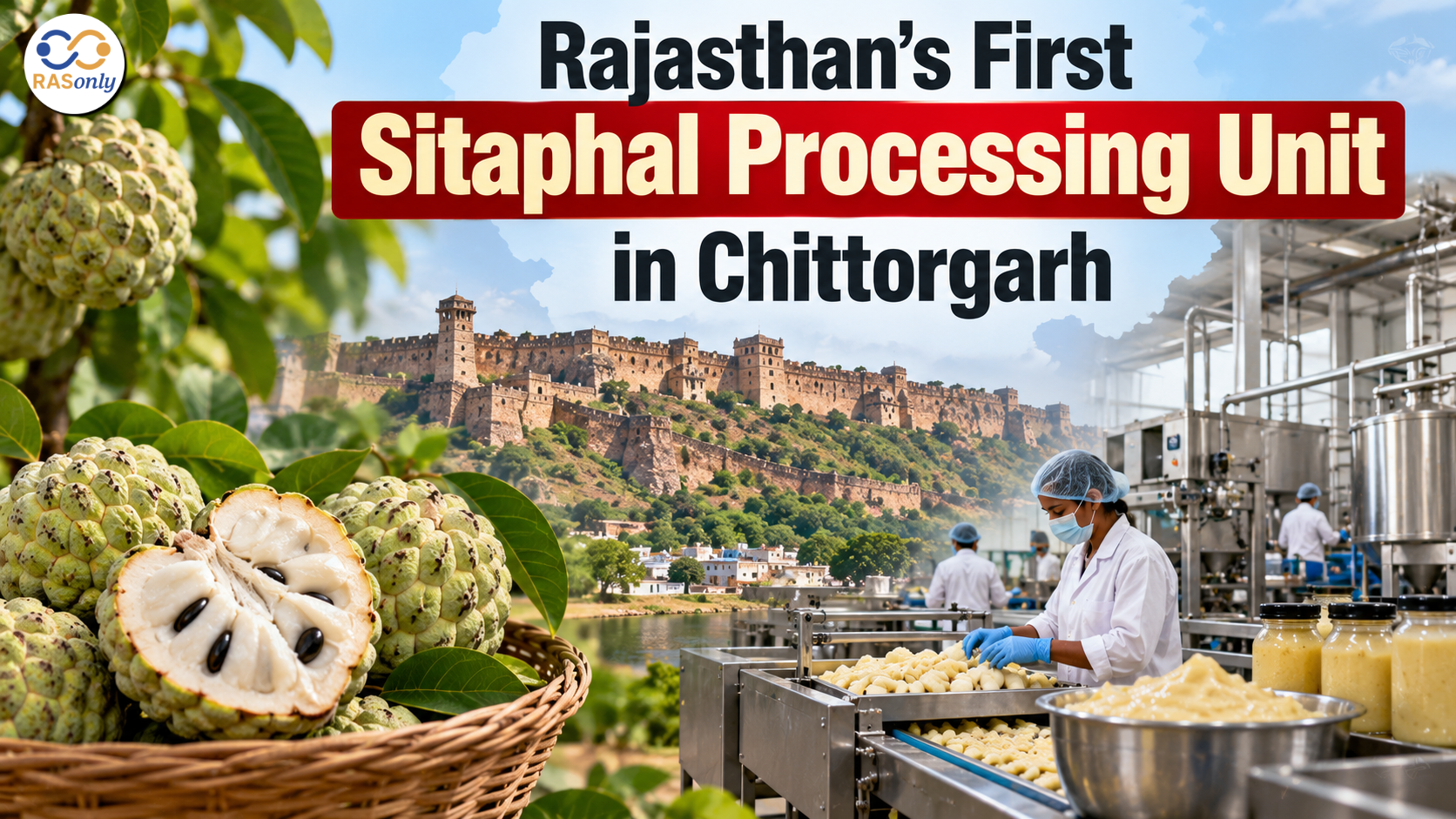
Rajasthan’s First Sitaphal Processing Unit in Chittorgarh
October 19, 2026
Rajasthan Foundation Expansion New Chapters Announced
October 19, 2026
Continuous Biomass Torrefaction Reactor
October 17, 2026