Kushan Empire: History, Rulers, Administration, Economy, Art, Decline
RAS Mains Exam Core Subject Strategy & Paper-Wise Answer Writing Frameworks

Get in Touch with RASonly!

Prepare smarter for RAS Mains 2026 with paper-wise strategies, answer writing techniques, current affairs integration, time management tips, PYQ analysis, and common mistakes to avoid. Build structured answers and improve your performance through consistent practice, revision, and self-assessment.

This guide is designed to help you succeed in the RAS Mains 2026, rather than just attempt the exam, by providing a well-planned strategy. It can help you get the maximum marks in RAS Mains with a logical plan for exam preparation that follows the official syllabus, paper-wise weightage, and a reliable answer-writing scheme, irrespective of whether it is your first attempt at this exam or you have faced failure previously. This blog explains the RPSC RAS Mains exam paper's questions with answers and provides a practical and easy-to-follow solution to each question on the paper.
The RAS Mains examination is not a test of the amount of knowledge you possess, but rather one of how you present and express your knowledge within a limited word limit and time. Numerous well-read candidates lose marks due to lack of structure, relevant keywords, and presentation. This is the reason why it is much better to have a sound RAS Mains syllabus strategy and to practice answer writing than mere reading. The exam pattern, subject-wise strategy, answer writing, and time management tips are covered in the following sections to prepare better for the exam.
Understanding the RPSC RAS Mains Exam Pattern
It is necessary to know the RPSC RAS Exam Pattern before constructing a subject strategy, as the entire preparation should be based on this Exam Pattern. The Mains stage comprises four descriptive papers and gets the highest weightage as compared to the interview stage and therefore is the most critical stage of selection.
| Paper | Subject Area | Marks | Duration |
|---|---|---|---|
| Paper I | General Studies I (History, Art & Culture, Geography) | 200 | 3 hours |
| Paper II | General Studies II (Polity, Governance, Social Issues) | 200 | 3 hours |
| Paper III | General Studies III (Economy, Science & Technology, Environment, Security) | 200 | 3 hours |
| Paper IV | General Hindi & General English | 200 | 3 hours |
Each General Studies paper is generally divided into three parts based on word limits — short answers (around 15 words), medium answers (around 50 words), and long/descriptive answers (around 100 words), with marks allotted accordingly. It's important to understand this internal division as it has a direct influence on the way the answer writing needs to be done for every category.
RAS GS Paper 1 Strategy: History, Culture & Geography
The focus areas of this paper are History, Art & Culture, Geography, and Indian and World History; hence, it is advisable to make the strategy around these topics in relation to Rajasthan. The aspirants fail to take into account the depth needed for topics which have a bearing on Rajasthan, as they are usually of high marks.
- This is a high-weightage area, so pay special attention to: Rajasthan History, its dynasties, the freedom movement and regional culture.
- Develop a good foundation in Indian and World History, focusing on cause and effect, and comparing and contrasting dates rather than memorising them.
- Cover Physical and Human Geography of Rajasthan along with India in a linked manner, using maps for better retention.
- Revise Art, Architecture, Folk Traditions, Fairs and Festivals of Rajasthan through short, revisable notes.
RAS GS Paper 2 Strategy: Polity, Governance & Social Issues
This paper is designed to evaluate your knowledge of the Constitution, governance systems and issues related to society, and is not just a descriptive definition paper; it requires application-based answers as well. For this paper, a good strategy for the RAS Mains syllabus is to make static polity content as relevant as the contemporary debates touching on governance.
- Master the Indian Constitution, Fundamental Rights, Directive Principles, and constitutional bodies with their latest amendments.
- Know about the governance systems and institutions of the Panchayati Raj system and the machinery of administration in Rajasthan.
- Prepare social issues such as education, health, women and child welfare, and social justice schemes with data-backed points.
- Practice linking current government policies and schemes with the underlying constitutional or governance principle being tested.
RAS GS Paper 3 Strategy: Economy, Science, Environment & Security
RAS GS Paper 3 strategy must cover a wide canvas — Indian and Rajasthan economy, science and technology developments, environmental issues, and internal security — making it one of the most dynamic papers to prepare for. The candidates who can make current affairs a part of static questions can do a little better in this section.
- Develop a good grasp of the Indian Economy and the economic profile of Rajasthan, including Budget highlights and major schemes of the Government of Rajasthan.
- Stay updated on Science & Technology developments, especially those relevant to agriculture, IT, and space applications in the Indian context.
- Cover Environment and Ecology topics like Biodiversity, Climate Change, and conservation efforts related to the Geography of Rajasthan.
- Revise Internal Security and Disaster Management concepts with recent examples to strengthen application-based answers.
General Hindi & English Paper Strategy
Paper IV is a language test (Hindi and English), and it is not considered primary, but if you score well, it can significantly increase your Mains score. This paper does not become a weak link if grammar, comprehension, and translation exercises are practised regularly.
- Write essays, precis writing, and letter writing in both languages.
- Make edits to grammar rules, common mistakes, and vocabulary development assignments so as not to lose quick points.
Practise translation and comprehension texts on a regular basis to develop speed and accuracy in tests.
Building an Effective RAS Answer Writing Framework
Candidates need the most improvement in the creation of a strong answer writing framework to convert their subject knowledge into scoring answers – this is what makes the difference. The examiner is looking for clarity, relevance, and structure within the given word limit, not just an information dump.
- Use simple responses that include facts and no unnecessary elaboration or filler language for short answers (approx. 15 words).
- In medium answers (about 50 words), provide a brief introduction and then 2-3 main points, clearly presented.
- For long/descriptive answers (around 100 words), follow an introduction–body–conclusion structure, using subheadings or bullet points wherever relevant.
- Use diagrams, flowcharts, or simple maps in Geography, Economy, and Polity answers to enhance presentation and save writing time.
- Keep a repository of keywords, data points, and committee/report names for each topic to strengthen answer quality.
RAS Mains Time Management During the Exam
Time management is as crucial as the content of the answers for RAS Mains, as even well-prepared candidates are prone to fail the exam due to lack of time in the descriptive papers. The best way to develop this skill is to complete the full-length papers in the given time.
- Allow time in proportion to marks — allocate more time per mark to high-mark descriptive questions and less to short answer questions.
- Start with the easiest questions to get the momentum going and get the easy points.
- Keep the last 10–15 minutes for revision, ensuring word limits and question numbers are correctly matched.
- Do not spend too long on one question, at the expense of others.
RAS Current Affairs Strategy and Rajasthan GK Integration
A specific RAS current affairs approach should be followed to go along with the static preparation of the subjects throughout the entire time frame of the study, and a significant percentage of questions in all the 3 papers of the GS will be related to current affairs. The importance of current affairs in relation to static topics is that the topics should not be studied separately so as to retain them and get more relevant answers.
- Keep the monthly notes on current affairs in various categories like Polity, Economy, Environment, Science & Technology, etc.
- Stay updated on the latest news from Rajasthan, such as government policies, schemes, and budget updates.
- Update current affairs in more detail for the last 12-15 months, as current affairs are more likely to be tested as opposed to the pre-existing ones.
- Make notes on all of the big current events and connect them to their related static topics, instead of just noting down facts.
RAS Mains Previous Year Question Analysis
Through the analysis of previous year questions for RAS Mains exam, you can understand the common topics, trends, and the level of comprehension that the examiners are looking for. This analysis should inform your topic prioritisation and not be used to focus on every topic equally.
- Solve at least the last five years of Mains papers, paper-wise, under timed conditions.
- Identify frequently repeated themes within Rajasthan History, Polity, and Economy sections.
- Check your practice answers with the model answers or the toppers' to find out the structural gaps.
- Note the average word count and marks pattern to fine-tune your own answer length during practice.
Common Mistakes Candidates Should Avoid
Poorly presented and strategically poorly placed answers can cost a very well-prepared candidate marks even if they are correct. It is important to understand these common mistakes in advance so that you can avoid them well ahead of the test date.
- Writing overly lengthy answers for low-mark questions, leaving insufficient time for high-value questions later in the paper.
- Answering questions which have a national and state dimension but not considering the dimensions of Rajasthan.
- Ignoring the exam pattern's word limit, using this only in the last month before the exam instead of throughout preparation.
- Neglecting the General Hindi & English paper despite it carrying equal weightage to the General Studies papers.
Also Read
| RAS Mains Exam Pattern | RAS Mains Syllabus |
| RAS preparation tips | RAS previous year papers |
| Rajasthan current affairs | RAS 2026 Eligibility for Other State Candidates |
Conclusion
Extensive reading alone is not enough to pass the RAS Mains exam; you need to develop a strategy and practice a lot of answer writing to succeed in the exam. Knowing the exam pattern, having a strategy for each of the GS papers, knowing current affairs, and combining it with static knowledge and practising answer writing with a fixed time will help candidates a lot. The only sure-shot recipe to crack the RAS Mains examination is consistency, revision, and self-assessment by taking mock tests and analysing previous-year question papers.
FAQs
Pay attention to the syllabus, use a paper-wise approach, write answers multiple times, rewrite answers, and solve the papers from earlier years under time constraints.
RAS Mains consists of four descriptive papers: GS Paper I, GS Paper II, GS Paper III, and General Hindi & General English. Each paper carries 200 marks.
Focus on Rajasthan history, art & culture, geography, Indian history, and world history. Improve retention through the use of maps and short revision notes.
Prepare the Constitution, Fundamental Rights, Directive Principles, Constitutional Bodies, Governance, Panchayati Raj, Administration, and Social Issues. Connect static topics with current government policies and schemes.
Cover the Indian and Rajasthan economy, science & technology, environment, ecology, internal security, and disaster management, while linking static topics with current affairs.
BEST SELLER
🏆 PRELIMS
RAS Pass
Prelims focused Hindi & English
₹399
✓
Prelims Topic-Wise Tests
✓
Subject-Wise Tests
✓
Full-Length Prelims Tests
✓
Daily Current Affairs Tests
✓
Prelims PYQs Tests
✓
Detailed Solutions & Analysis
✓
All Rajasthan Ranking
✓
Unlimited Reattempts
✓
Mains Tests
✓
Hindi & English Tests
✓
All Rajasthan Ranking
Trusted by 5,000+ Students
Post Category
- RAS Salary
- Result
- RAS Admit Card
- RAS Job
- RAS Cutoff
- Preparation Tips
- RAS Answer Key
- RAS Exam Analysis
- RAS Syllabus
- RAS Previous Year Papers
- RPSC RAS Exam Pattern
- RAS Interview
- RAS Exam Date
- RAS Vacancy
- RAS Test Series
- RAS Best Books
- RAS Preparation Resources
- RAS Coaching Centre
- History
- Polity
- Geography
- Economics
- Science
- Art and Culture
- RPSC RAS Application Form
- RPSC RAS Notification
- RAS Eligibility Criteria
- UPSC Exam
- RPSC RAS Mains
Visit Our RASonly Offline Center
Our Expert Faculty

Bhunesh Sir
Current Affairs · 13+ Yrs

Aamir Khan Sir
RAS-2017 · IIM Ahm.

Akash Sir
Polity · 8+ Yrs
Free Resources
Official Mobile App

RASOnly App
by OTSAdda · Free
Full Video Lectures
Mock Tests & PYQs
Daily Current Affairs
AI Mock Interview
Free Download · No subscription needed to install
RAS 2024 Toppers — RASonly
Rank 2
Virendra Charan
Rank 9
Bhoopinder Singh
Rank 26
Aanchal Nagpal
Rank 33
Lokendra Singh
Rank 45
Amar Rathore
Rank 46
Manasvini Verma

Join RASonly WhatsApp Community
Get daily current affairs, exam alerts, free study material and tips from expert faculty — right on WhatsApp.
Join for Free →RASonly Interview Guidance Program

Mr. Ashok Jain
Ex-Chief Secretary Govt of Rajasthan
- IAS officer of the 1981 batch, Rajasthan cadre.
- Passionate about mentoring the next generation of RAS officers with real-world insights.
- Got retired in Dec 2017 from the post of Chief Secretary of the state of Rajasthan.

Mr. Guru Charan Rai
Ex-ASP / SP in Jaisalmer
- Guru Charan Rai, IPS (Retd), retired as Inspector General of Police (Security), Rajasthan, Jaipur in 2017.
- Served as ASP and SP in Jaisalmer, Nagaur, Sri Ganganagar, Sawai Madhopur, Dausa, Sikar, and Karauli.
- He also held key positions as DIGP and IGP in the Law and Order division.

Mr. Rakesh Verma
Ex-IAS Officer, B.Tech, MBA, and M.A. (Economics)
- IAS officer of the 1981 batch and retired in Chief Secretary Rank.
- Civil servant of high repute and vast experience.
- Has been teaching UPSC CSE subjects for the last six years.

Daily Current Affairs for RAS Exam Preparation 2026

Niharika Rathore Wins MIS Global India Title
October 03, 2026
Rajasthan Achieves 90.19 Lakh Farmer ID Target
October 03, 2026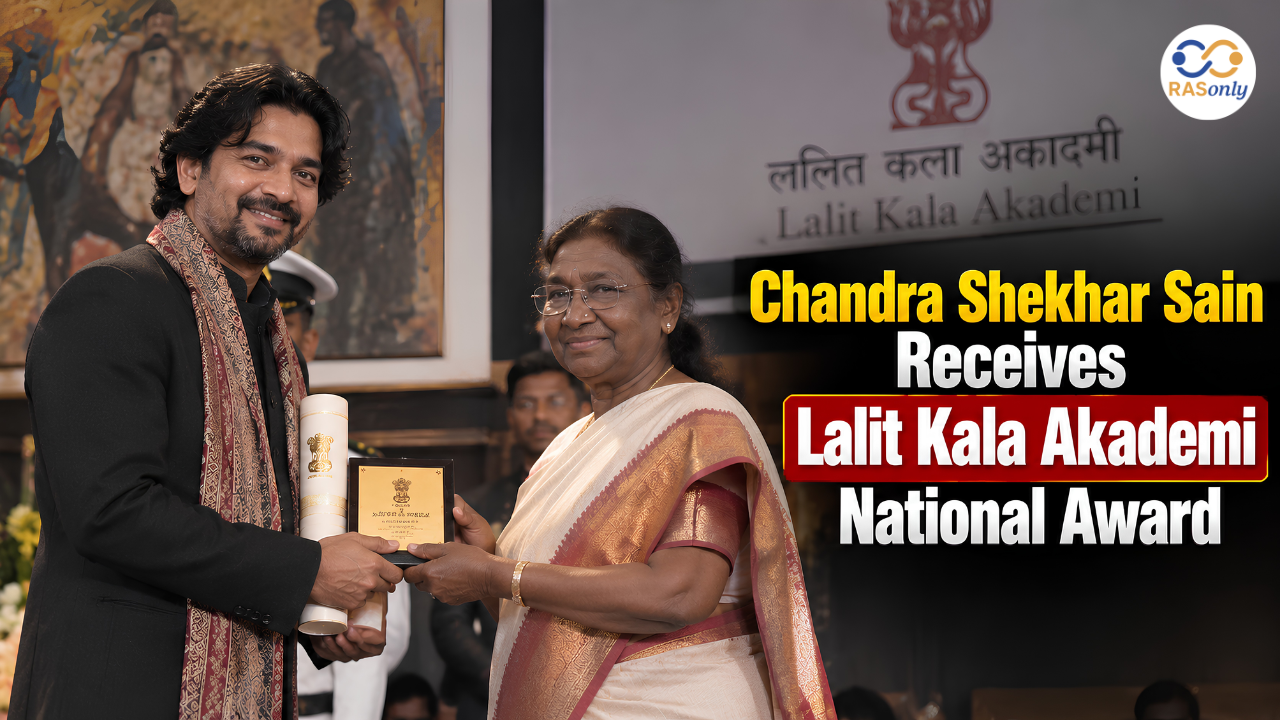
Chandra Shekhar Sain Receives Lalit Kala Akademi National Award
October 01, 2026