Kushan Empire: History, Rulers, Administration, Economy, Art, Decline
Constituent Assembly of India, Formation, Members, Committees

Get in Touch with RASonly!

The Constituent Assembly of India played a crucial role in drafting the Constitution. Formed in 1946, it debated constitutional principles, established key committees, and adopted the Constitution on 26 November 1949, which came into force on 26 January 1950.

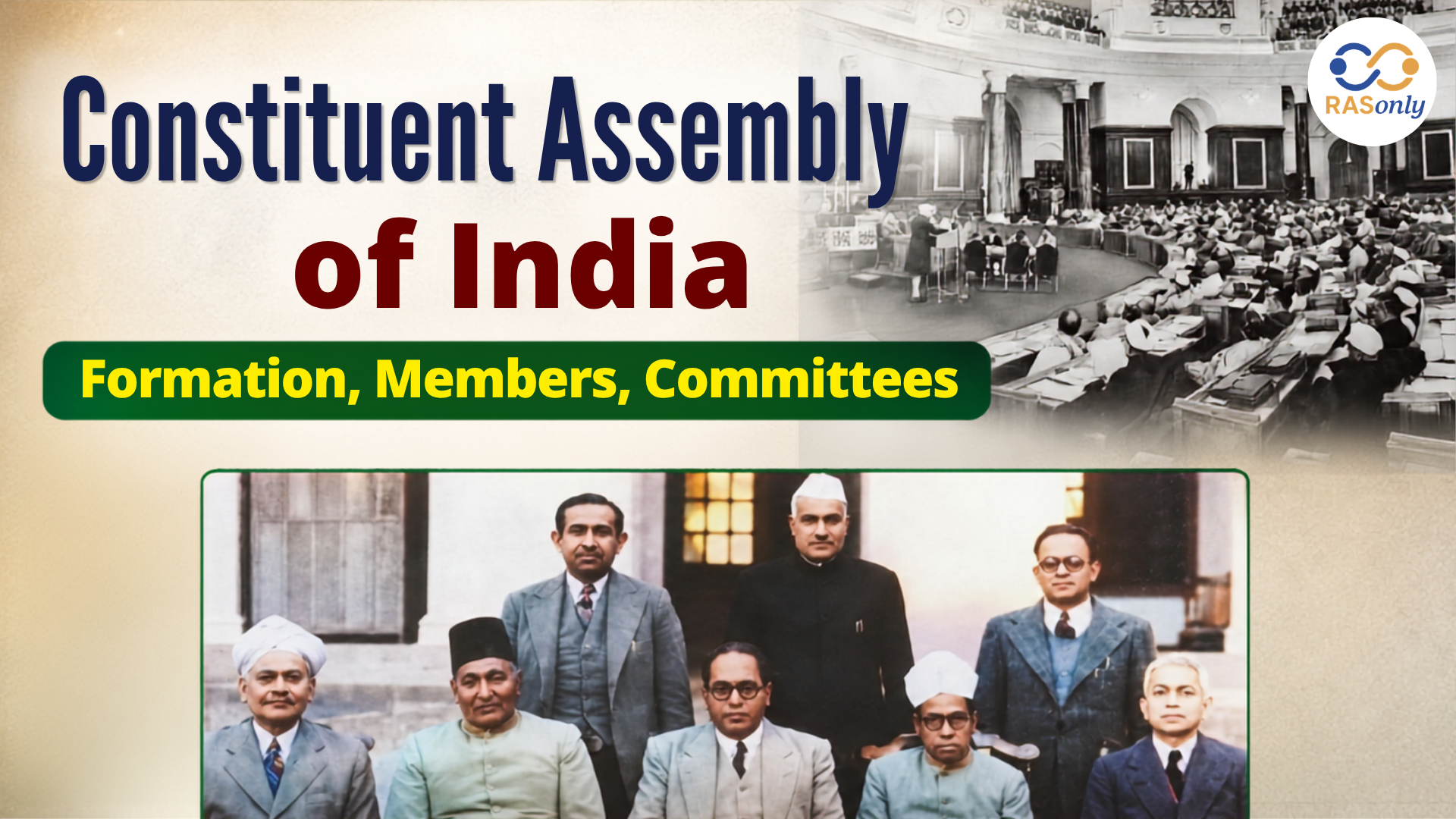
The Constitution of India is the supreme law of the country. It forms the basic structure for government functioning, delineates the powers of constitutional institutions and provides a relationship between the Union vs States. It also offers a structure for rights, individual liberties and upholding democratic governance. The Constitution was drafted by the Constituent Assembly, which began in 1946. Following various debates and deliberations, the Constitution was adopted on 26 November 1949 and came into force on 26 January 1950. Through its implementation, India was declared a republic and started working under its own constitutional framework.
Constituent Assembly of India
The Constituent Assembly of India was which was specifically constituted to draft the Constitution of independent India. It was established as a partly elected and partly nominated body in 1946 under the Cabinet Mission Plan of 1946. It was primarily responsible for deciding the constitutional framework and laying down rules for India’s political system.
- First Meeting: The Constituent Assembly was held in New Delhi on 9 December 1946. Its primary purpose was to consider and draft the Constitution of India, which embodies the ideals of the Indian people and represents a system of self-government.
- Provisional Parliament: The Constituent Assembly came into force on 24 January 1950, after fulfilling its constitutional functions. After the Constitution came into effect on 26 January 1950, it operated as the Provisional Parliament of India until a new Parliament was formed after the first general elections in 1951–52.
Background of the Constituent Assembly of India
Constitutional reforms introduced by the Government of India Act, 1919 and later in the Government of India Act,1935 provided some limited self-government, but key areas like defence, finance and foreign affairs remained solely under British control.
Demand for a Constitution Made by Indians
The widespread dissatisfaction with such restrictive arrangements fueled the case for total sovereignty. Leaders like Mahatma Gandhi, Jawaharlal Nehru and Dr B. R. Ambedkar had stressed that India needed a Constitution prepared by Indians, representing the multitude of social, cultural and political realities in India.
Demand for a Constituent Assembly: Timeline
The demand for a Constituent Assembly developed gradually during India’s freedom struggle. The following timeline highlights the major milestones:
| Year | Event |
|---|---|
| 1934 | M. N. Roy first put forward the idea of a Constituent Assembly for India. |
| 1935 | The Indian National Congress formally demanded a Constituent Assembly elected based on adult franchise. |
| 1938 | Jawaharlal Nehru declared that India’s Constitution should be framed by a Constituent Assembly elected by the people of India. |
| 1940 | The August Offer accepted, in principle, the idea that Indians would frame their own Constitution. |
| 1942 | The Cripps Mission proposed the creation of a constitution-making body after World War II, but its proposals were rejected by Indian leaders. |
| 1946 | The Cabinet Mission Plan provided the framework for establishing the Constituent Assembly. |
| 9 December 1946 | The Constituent Assembly held its first meeting in New Delhi. |
Composition of the Constituent Assembly
- Constituent Assembly: Overall, the Cabinet Mission Plan of 1946 envisaged a Constituent Assembly of 389 members.
- States were represented by 292 members from the British Indian provinces.
- The princely states nominated 93 members.
- 4 members were from Chief Commissioners' Provinces.
- Provincial representatives were chosen indirectly by the members of the provincial legislative assemblies.
- The rulers of the princely states nominated representatives.
- After the Partition of India in 1947, the strength of the Assembly was decreased to 299 members.
- The Assembly combined lawyers, administrators and political leaders among its members, as well as social reformers and representatives from regional interests.
- Its President was Dr Rajendra Prasad, with Dr B. R. Ambedkar as Chair of the Drafting Committee.
How the Constituent Assembly Shaped the Indian Constitution
The Constitution of India at a lengthy process of deliberations by the Constituent Assembly. Its members deliberated over constitutional principles, considered reports of committees, suggested amendments, and debated particular provisions until they came to a conclusion. Here are the milestones of this process:
Beginning of Constitution-Making
- 9 December 1946: The first meeting of the Constituent Assembly took place in New Delhi. The interim Chairman was Dr Sachchidananda Sinha.
- 11 December 1946: Dr Rajendra Prasad was elected President of the Assembly. H. C. Mookherjee and V. T. Krishnamachari became Vice-Presidents; B.N. Rau was Constitutional Adviser.
- 13 December 1946: The Objectives Resolution was by Jawaharlal Nehru in the Constituent Assembly, outlining a blueprint for an independent India and constitutional goals.
- 22 January 1947: The Objectives Resolution through Assembly, which subsequently serves as a key component of the Preamble.
Constitution Drafting and Examination
- 22 July 1947: The Constituent Assembly adopted the National Flag of India
- 29 August 1947: Establishment of the Drafting Committee headed by Dr B. R. Ambedkar to draft the Constitution
- February 1948: Publication of the Draft Constitution for discussion. It had 315 Articles and 8 Schedules.
- 04 November 1948: Dr Ambedkar presented the draft Constitution before the assembly.
- 15 November 1948 to 17 October 1949: Members scrutinised the draft article by article and debated amendments to crucial constitutional provisions.
Final Approval of the Constitution
- May 1949: The Assembly voted to make India a free and equal member of the British Commonwealth.
- 14-26 November 1949: The Assembly concluded the third and last phase of debate over the Constitution.
- 26 November 1949: The Constitution of India was adopted and enacted by the Constituent Assembly.
- 24 January 1950: Members signed the Constitution; Jana Gana Mana and Vande Mataram were established as the National Anthem and National Song
- 26 January 1950: The Constituent Assembly then served as the Provisional Parliament until the first Lok Sabha elections.
Constituent Assembly Drafting Committee
The Drafting Committee was one of the most significant committees formed by the Constituent Assembly. Set up on 29 August 1947 to draft the Constitution based on decisions taken by the Assembly and reports of different committees. The Chairman was Dr B. R. Ambedkar, and he had a major role in drafting it.
Members of the Drafting Committee
There were initially seven members of the committee:
- Dr B. R. Ambedkar – Chairman
- N. Gopalaswami Ayyangar
- Alladi Krishnaswami Ayyar
- K. M. Munshi
- Mohammad Saadulla
- B. L. Mitter
- D. P. Khaitan
B. L. Mitter resigned from the Drafting Committee and was replaced by N. Madhava Rau. After the death of D. P. Khaitan, T. T. Krishnamachari joined the Drafting Committee. Dr B. R. Ambedkar continued as its Chairman.
Important Committees of the Constituent Assembly
The Constituent Assembly formed several committees to examine specific constitutional subjects. Their reports and recommendations played an important role in shaping the final Constitution.
| Committee | Chairman | Main Role / Description |
|---|---|---|
| Drafting Committee | Dr. B. R. Ambedkar | Prepared and revised the draft Constitution on the basis of the Assembly's decisions and committee reports. |
| Union Powers Committee | Jawaharlal Nehru | Examined the distribution of powers between the Union and the provinces/states. |
| Union Constitution Committee | Jawaharlal Nehru | Considered the structure and constitutional framework of the Union government. |
| Provincial Constitution Committee | Sardar Vallabhbhai Patel | Examined the constitutional structure and functioning of provincial governments. |
| Advisory Committee on Fundamental Rights, Minorities and Tribal & Excluded Areas | Sardar Vallabhbhai Patel | Considered Fundamental Rights, minority safeguards, and arrangements for tribal and excluded areas. |
| Fundamental Rights Sub-Committee | J. B. Kripalani | Examined and recommended provisions relating to Fundamental Rights. |
| Minorities Sub-Committee | H. C. Mookherjee | Considered safeguards and constitutional provisions concerning minority communities. |
| Rules of Procedure Committee | Dr. Rajendra Prasad | Framed the rules and procedures for conducting the Assembly's business. |
| Steering Committee | Dr. Rajendra Prasad | Coordinated the Assembly's work and helped organise its agenda and proceedings. |
| States Committee | Jawaharlal Nehru | Dealt with constitutional matters concerning the princely states and their relationship with the Union. |
| Finance and Staff Committee | Dr. Rajendra Prasad | Looked after the Assembly's financial and administrative matters. |
Also Read
Conclusion
The Constituent Assembly of India was foundational in the making of a constitutional framework for independent India. With informed discussions, specialised committees and year-long deliberations, it built a Constitution that embodied the values of democracy, justice, equality, liberty and nationalism. The Constitution was adopted on 26 November 1949 and came into effect on 26 January 1950, which marked a historic shift from colonialism to a constitutional republic. All of this underpins its work, which continues to lay the groundwork for India's democratic governance.
FAQs
The Constituent Assembly was the body formed to draft, debate, and adopt the Constitution of independent India. It worked through detailed discussions and specialised committees.
It was formed in 1946 under the Cabinet Mission Plan, which provided the framework for establishing the constitution-making body.
The Assembly held its first meeting on 9 December 1946 in New Delhi. Dr Sachchidananda Sinha served as the temporary Chairman.
Dr Rajendra Prasad was elected the permanent President of the Constituent Assembly on 11 December 1946.
Dr B. R. Ambedkar was appointed Chairman of the Drafting Committee on 29 August 1947.

BEST SELLER
🏆 PRELIMS
RAS Pass
Prelims focused Hindi & English
₹399
✓
Prelims Topic-Wise Tests
✓
Subject-Wise Tests
✓
Full-Length Prelims Tests
✓
Daily Current Affairs Tests
✓
Prelims PYQs Tests
✓
Detailed Solutions & Analysis
✓
All Rajasthan Ranking
✓
Unlimited Reattempts
✓
Mains Tests
✓
Hindi & English Tests
✓
All Rajasthan Ranking
Trusted by 5,000+ Students
Post Category
- RAS Salary
- Result
- RAS Admit Card
- RAS Job
- RAS Cutoff
- Preparation Tips
- RAS Answer Key
- RAS Exam Analysis
- RAS Syllabus
- RAS Previous Year Papers
- RPSC RAS Exam Pattern
- RAS Interview
- RAS Exam Date
- RAS Vacancy
- RAS Test Series
- RAS Best Books
- RAS Preparation Resources
- RAS Coaching Centre
- History
- Polity
- Geography
- Economics
- Science
- Art and Culture
- RPSC RAS Application Form
- RPSC RAS Notification
- RAS Eligibility Criteria
- UPSC Exam
- RPSC RAS Mains
Visit Our RASonly Offline Center
Our Expert Faculty

Bhunesh Sir
Current Affairs · 13+ Yrs

Aamir Khan Sir
RAS-2017 · IIM Ahm.

Akash Sir
Polity · 8+ Yrs
Free Resources
Official Mobile App

RASOnly App
by OTSAdda · Free
Full Video Lectures
Mock Tests & PYQs
Daily Current Affairs
AI Mock Interview
Free Download · No subscription needed to install
RAS 2024 Toppers — RASonly
Rank 2
Virendra Charan
Rank 9
Bhoopinder Singh
Rank 26
Aanchal Nagpal
Rank 33
Lokendra Singh
Rank 45
Amar Rathore
Rank 46
Manasvini Verma

Join RASonly WhatsApp Community
Get daily current affairs, exam alerts, free study material and tips from expert faculty — right on WhatsApp.
Join for Free →RASonly Interview Guidance Program

Mr. Ashok Jain
Ex-Chief Secretary Govt of Rajasthan
- IAS officer of the 1981 batch, Rajasthan cadre.
- Passionate about mentoring the next generation of RAS officers with real-world insights.
- Got retired in Dec 2017 from the post of Chief Secretary of the state of Rajasthan.

Mr. Guru Charan Rai
Ex-ASP / SP in Jaisalmer
- Guru Charan Rai, IPS (Retd), retired as Inspector General of Police (Security), Rajasthan, Jaipur in 2017.
- Served as ASP and SP in Jaisalmer, Nagaur, Sri Ganganagar, Sawai Madhopur, Dausa, Sikar, and Karauli.
- He also held key positions as DIGP and IGP in the Law and Order division.

Mr. Rakesh Verma
Ex-IAS Officer, B.Tech, MBA, and M.A. (Economics)
- IAS officer of the 1981 batch and retired in Chief Secretary Rank.
- Civil servant of high repute and vast experience.
- Has been teaching UPSC CSE subjects for the last six years.

Daily Current Affairs for RAS Exam Preparation 2026
Financial Approval Granted for the Development of Religious Sites
October 05, 2026
IIT Madras Signs MoU for Joint Educational Programmes
October 05, 2026
Niharika Rathore Wins MIS Global India Title
October 03, 2026