UPSC Mains Result 2026 Out: Download PDF, Selection List, Cut Off & Interview Details
Is 1 Year Enough for RAS Preparation? 12-Month Strategy

Get in Touch with RASonly!

Is one year enough for RAS preparation? Explore a practical 12-month study plan covering syllabus completion, Rajasthan GK, current affairs, revision, mock tests, and Mains answer writing. Discover daily study schedules and self-study strategies for beginners and working professionals.

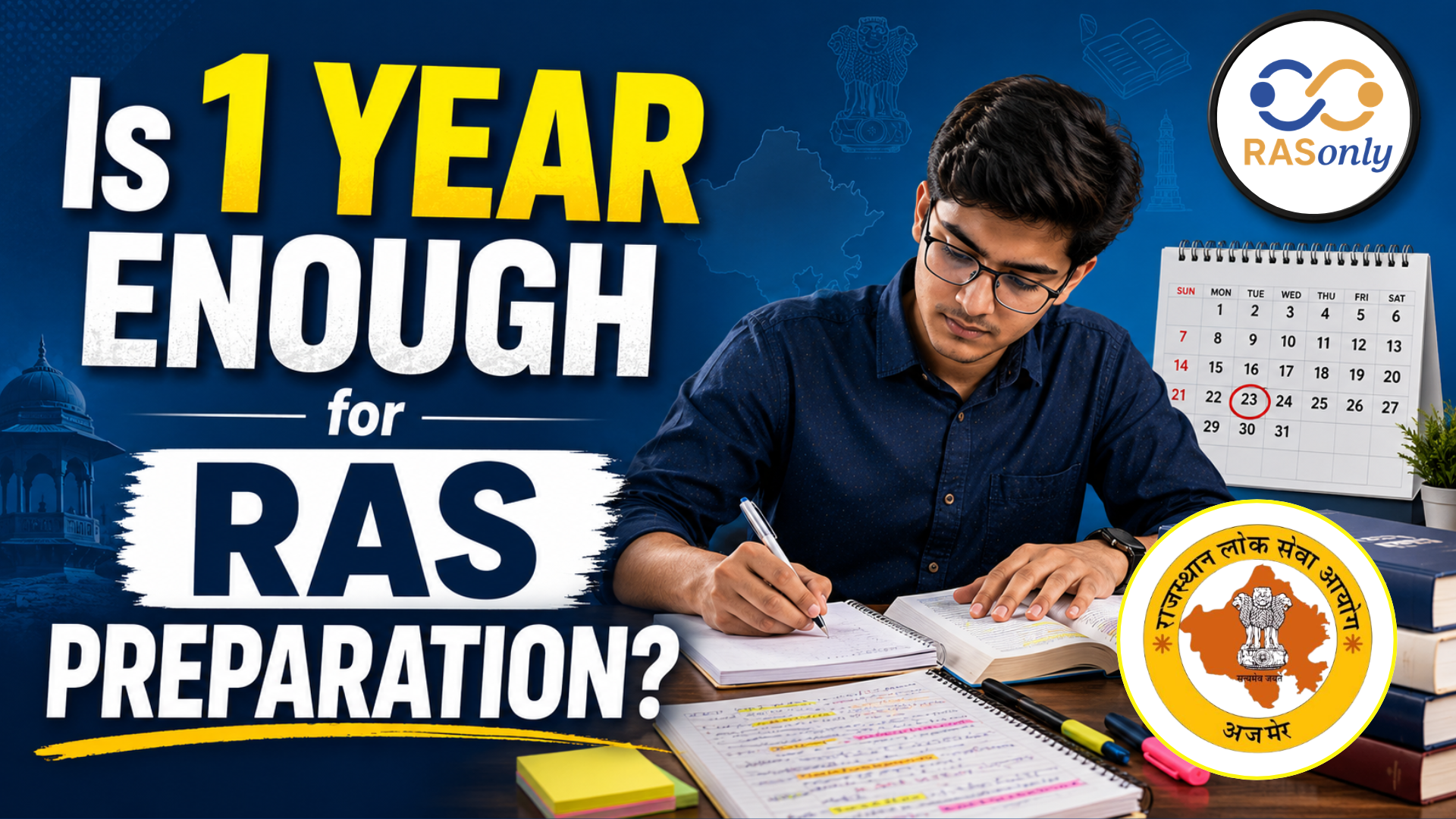
RAS preparation in 1 year is a realistic goal for beginners, college students, and working professionals, as long as the plan is structured and followed with discipline. It is not that the Rajasthan Public Service Commission (RPSC) conducts the Rajasthan Administrative Service exam to see who can study for the longest duration, but those who know the syllabus, makes modifications time and again, and practice writing answers, it is these candidates who are rewarded. There is enough time in 12 months to complete the syllabus, make multiple modifications, and take periodic exams in advance of both sections.
The key is to follow the year in three parts – laying the groundwork, finalising and fine-tuning the syllabus, and revising answer writing for the mains. History, Polity, Geography, and Rajasthan GK are topics that require continuous revision, whereas current affairs should be covered on a daily basis. This guide provides you with a month-wise plan, daily timings, a self-study plan, a working professional plan, and common errors that derail aspirants from the game.
Why One Year Can Be Enough for RAS Preparation
A year is enough when your effort is consistent, and your resources are limited and reliable. Most of the syllabus is static, which means it needs to be learned once and revised often, while only current affairs change daily. Have a set routine, and you can get through all that without sacrificing practice time.
- The syllabus is large but manageable when divided into monthly targets.
- There is no need to read the same texts over and over; revision is required for static subjects.
- Current affairs can be handled in a daily one-hour slot.
- RPSC previous year papers give plenty of practice material.
- Accuracy and speed are improved with mock tests & answer writing.
| Factor | Importance |
|---|---|
| Consistency | Very High |
| Revision | Very High |
| Time Management | Very High |
| Mock Tests | High |
| Answer Writing | High |
RPSC RAS Exam Pattern at a Glance
Before planning your year, you should know what you are preparing for. The RAS exam consists of three parts, each testing one of the skills. The details of the scheme are always updated in the official notification of RPSC, and one should always confirm the latest details.
| Stage | Type | Key Points |
|---|---|---|
| Prelims | Objective (MCQ) | Screening stage; marks are not added to final merit |
| Mains | Descriptive | 4 papers of 200 marks each (800 marks in total) |
| Interview | Personality Test | 100 marks |
The final merit is therefore based on 900 marks, made up of the mains and the interview. That's why we are so focused on strong answer writing in the second half of the year.
How Much Time Do Beginners Need to Crack RAS?
Many beginners worry that they need two or three years before they can even attempt the exam. In fact, a focused year is possible if you first get an idea of the exam pattern, the type of questions asked in previous years, and the syllabus. The goal is not to read extensively but to read each point and edit it, and then test yourself on each point.
12-Month RAS Preparation Roadmap
Months 1-3: Build Strong Fundamentals
In the first quarter, it's more about grasping concepts, not just facts and figures. Master NCERT books and some standard reference books to make the subsequent topics easier. Start from the start of the Rajasthan GK section, as it has weightage in this exam.
- Read NCERT books and basic resources.
- Start Rajasthan GK alongside the core subjects.
- Cover the basics of History, Geography, and Polity.
- Prepare short, concise notes for revision.
Months 4-6: Complete the Syllabus
In this block, the priority is to finish the remaining subjects and begin practising questions. Combine static study with reading in the daily newspaper and never have more current affairs than you can handle! Everyday MCQs allow you to gauge if the concepts have taken hold or not.
- Finish the major subjects in the syllabus.
- Start daily MCQ practice.
- Read a newspaper and current affairs regularly.
- Cover Rajasthan Economy and Geography in detail.
Months 7-9: Focus on Prelims
These months are revision time and testing time. As you answer more questions, your accuracy and speed will improve. Utilize all tests to discover weak points and correct them before proceeding.
- Join a mock test series and attempt tests regularly.
- Solve RPSC previous year papers.
- Revise your notes every week.
- Strengthen weak areas identified in tests.
Months 10-12: Focus on Mains Answer Writing
The last stage should be devoted to writing. Descriptive means that you cannot know the answer; you need to present the answer clearly in the given time. Daily practice makes your structure and handwriting faster and cleaner.
- Practise answer writing every day.
- Solve previous mains papers.
- Revise short notes regularly.
- Begin straightforward preparation for the interview stage.
RAS Preparation Strategy for Beginners
The first time a beginner studies, he should avoid going through random studies and follow a simple system. Being clear about how you'll prepare for your RAS saves time, eliminates confusion, and ensures revision is on track. Build concepts first, practise questions regularly, and stay consistent even on low-energy days.
- Understand the syllabus and exam pattern thoroughly.
- Follow a limited set of reliable study resources.
- Practise MCQs daily to improve accuracy.
- Revise important topics at fixed intervals.
- Solve previous year papers to understand question trends.
- Develop answer-writing skills early for the mains.
- Stay updated with current affairs and Rajasthan GK.
Can You Crack RAS in One Year Without Coaching?
Self-study is possible, provided that you are self-disciplined and have suitable resources. With a strict routine, regular revision, and mock tests, books, official material, and online content are sufficient. Consistency and practice are much more important than coaching, which can provide some guidance.
Self-Study Daily Plan (Full-Time Aspirant)
The plan below suits a candidate who can study around ten hours a day. Reduce the static-study block proportionally if you have fewer hours.
| Activity | Daily Time |
|---|---|
| Static Subjects | 4 Hours |
| Current Affairs | 1 Hour |
| MCQ Practice | 2 Hours |
| Revision | 2 Hours |
| Answer Writing | 1 Hour |
1-Year RAS Study Plan for Working Professionals
A job limits your study time, but it does not rule out success. Working aspirants should focus on quality sessions, strict time management, and weekend intensity. Consistent, focused hours each day with revision and tests can be sufficient to make good progress.
Monday to Friday
Short and precise lessons should be conducted on core subjects and topical issues on Weekdays. Make the routine not too demanding so that it can be done every day.
- Study for 3-4 hours daily.
- Read current affairs and a newspaper regularly.
- Practise MCQs to improve accuracy.
- Revise key topics before sleeping.
Saturday and Sunday
Weekends are the time to do deep work or consolidation. Take this time to do full-length tests and a thorough revision of the errors.
- Study for 8-10 hours.
- Attempt full-length mock tests.
- Edit weekly notes and summaries.
- Analyse mistakes and strengthen weak areas.
How Many Hours Should You Study Per Day?
There's no magic number of hours that says you'll be successful. Determine the right length of time based on your background and schedule, and productive hours count more than long hours. In the table below, you'll find a practical range for various categories of aspirants.
| Candidate Type | Suggested Study Hours |
|---|---|
| Beginner | 8-10 Hours |
| Working Professional | 4-6 Hours |
| College Student | 6-8 Hours |
| Full-Time Aspirant | 8-12 Hours |
Why Prelims and Mains Should Be Prepared Together
Taking both courses simultaneously will save time and will keep the ideas fresh through continuous revision. Those candidates who do not get to practice writing answers in the prelims may find that they have a problem building speed in the main exam. An integrated approach provides you with a solid foundation for both exams.
- Prelims focus: objective questions, current affairs, daily MCQs, and regular mock tests.
- Mains focus: descriptive answers, essay practice, analytical understanding, and clear presentation.
Importance of RPSC Previous Year Papers
Previous year papers will help you see how the commission asks you questions and what types of questions are frequently asked. Solving them will also help to develop speed and confidence for the actual exam. Treat each paper as a diagnostic test rather than just practice.
- Understand question trends and the exam pattern.
- Improve accuracy and problem-solving ability.
- Build better time management skills.
- Identify strengths and weak areas.
- Gain confidence through repeated practice.
Time Management for RPSC RAS
Effective Time Management – Break up the day into clear study blocks rather than studying everything all at once. A balanced routine is more likely to lead to a 12-month period of consistency and less risk of burnout. The sample timetable below can be adjusted to your own schedule.
| Candidate Type | Suggested Study Hours |
|---|---|
| Beginner | 8-10 Hours |
| Working Professional | 4-6 Hours |
| College Student | 6-8 Hours |
| Full-Time Aspirant | 8-12 Hours |
Common Mistakes to Avoid During RAS Preparation
The majority of learners who drop out do so due to poor planning and not inability. Avoiding the mistakes below can noticeably improve your chances in the exam.
- Following too many books and study resources.
- Skipping regular revision.
- Neglecting answer-writing practice for the mains.
- Not attempting mock tests consistently.
- Studying without a timetable or clear strategy.
- Failing to analyse mistakes and weak areas.
Also Read
| RAS Syllabus | RAS Exam Pattern |
| How to Prepare for RAS | Best Books for RAS Preparation |
| How to Write Answers in RAS Mains | RAS Previous Year Papers |
Conclusion
RAS preparation in 1 year is achievable when you combine a clear plan with steady daily effort. Spend the first quarter developing your basics, the second on completing the syllabus, the third on preparation for prelims, and the final on answering questions for mains. Whether you are a beginner, a working professional, or a self-study aspirant, the formula stays the same: limited resources, regular revision, previous year papers, and honest analysis of your mistakes. Be disciplined, monitor yourself each month, and passing the Rajasthan Administrative Service exam on the first try is now possible.
FAQs
Yes, one year is sufficient if you study both prelims and mains, tweak the content regularly and stick to a sensible plan of study. Consistency and quality of study is more significant than the length of time.
It depends on the individual, but a reasonable time is 10-12 months of concentrated effort. If you have a good start or have more time to study daily, you may require less.
Yes, there are a number of aspirants who do their preparation on their own through the standard books, official material, and mock tests. It is most effective to use self-study over a fixed time period, with the revision of material and practice with answers at regular intervals.
Newbies and dedicated novices can commit to 8-10 hours, while people who work full-time can make it to 4-6 hours of focused time. It is important to be consistent and to revise more than the exact number.
Use NCERTs to start the basics, add a few standard books for each subject, and select a good source for Rajasthan GK. Keep the list short so that you can revise every book at least twice.
BEST SELLER
🏆 PRELIMS
RAS Pass
Prelims focused Hindi & English
₹399
✓
Prelims Topic-Wise Tests
✓
Subject-Wise Tests
✓
Full-Length Prelims Tests
✓
Daily Current Affairs Tests
✓
Prelims PYQs Tests
✓
Detailed Solutions & Analysis
✓
All Rajasthan Ranking
✓
Unlimited Reattempts
✓
Mains Tests
✓
Hindi & English Tests
✓
All Rajasthan Ranking
Trusted by 5,000+ Students
Post Category
- RAS Salary
- Result
- RAS Admit Card
- RAS Job
- RAS Cutoff
- Preparation Tips
- RAS Answer Key
- RAS Exam Analysis
- RAS Syllabus
- RAS Previous Year Papers
- RPSC RAS Exam Pattern
- RAS Interview
- RAS Exam Date
- RAS Vacancy
- RAS Test Series
- RAS Best Books
- RAS Preparation Resources
- RAS Coaching Centre
- History
- Polity
- Geography
- Economics
- Science
- Art and Culture
- RPSC RAS Application Form
- RPSC RAS Notification
- RAS Eligibility Criteria
- UPSC Exam
- RPSC RAS Mains
Visit Our RASonly Offline Center
Our Expert Faculty

Bhunesh Sir
Current Affairs · 13+ Yrs

Aamir Khan Sir
RAS-2017 · IIM Ahm.

Akash Sir
Polity · 8+ Yrs
Free Resources
Official Mobile App

RASOnly App
by OTSAdda · Free
Full Video Lectures
Mock Tests & PYQs
Daily Current Affairs
AI Mock Interview
Free Download · No subscription needed to install
RAS 2024 Toppers — RASonly
Rank 2
Virendra Charan
Rank 9
Bhoopinder Singh
Rank 26
Aanchal Nagpal
Rank 33
Lokendra Singh
Rank 45
Amar Rathore
Rank 46
Manasvini Verma

Join RASonly WhatsApp Community
Get daily current affairs, exam alerts, free study material and tips from expert faculty — right on WhatsApp.
Join for Free →RASonly Interview Guidance Program

Mr. Ashok Jain
Ex-Chief Secretary Govt of Rajasthan
- IAS officer of the 1981 batch, Rajasthan cadre.
- Passionate about mentoring the next generation of RAS officers with real-world insights.
- Got retired in Dec 2017 from the post of Chief Secretary of the state of Rajasthan.

Mr. Guru Charan Rai
Ex-ASP / SP in Jaisalmer
- Guru Charan Rai, IPS (Retd), retired as Inspector General of Police (Security), Rajasthan, Jaipur in 2017.
- Served as ASP and SP in Jaisalmer, Nagaur, Sri Ganganagar, Sawai Madhopur, Dausa, Sikar, and Karauli.
- He also held key positions as DIGP and IGP in the Law and Order division.

Mr. Rakesh Verma
Ex-IAS Officer, B.Tech, MBA, and M.A. (Economics)
- IAS officer of the 1981 batch and retired in Chief Secretary Rank.
- Civil servant of high repute and vast experience.
- Has been teaching UPSC CSE subjects for the last six years.
Related Post



Daily Current Affairs for RAS Exam Preparation 2026

BRICS Sustainable Lifestyle Week 2026
November 06, 2026
STARS Programme: Objectives, States & Key Highlights 2026
November 06, 2026
RIICO to Develop Private Industrial Parks in Rajasthan
November 05, 2026