Chola Dynasty: Capital, Founder, Kings, Time Period and History
RAS Negative Marking Rules 2026 for RPSC RAS Prelims Exam (Marking Scheme & 5th Option Rule)

Get in Touch with RASonly!

The RAS Negative Marking Rules 2026 play an important role in the RPSC RAS Prelims exam pattern. Candidates preparing for the RPSC RAS exam must clearly understand the RAS marking scheme, negative marking system, and fifth option rule to avoid losing marks. A proper understanding of the RAS exam pattern and question attempt strategy helps candidates improve accuracy and score better in the RAS Prelims examination.

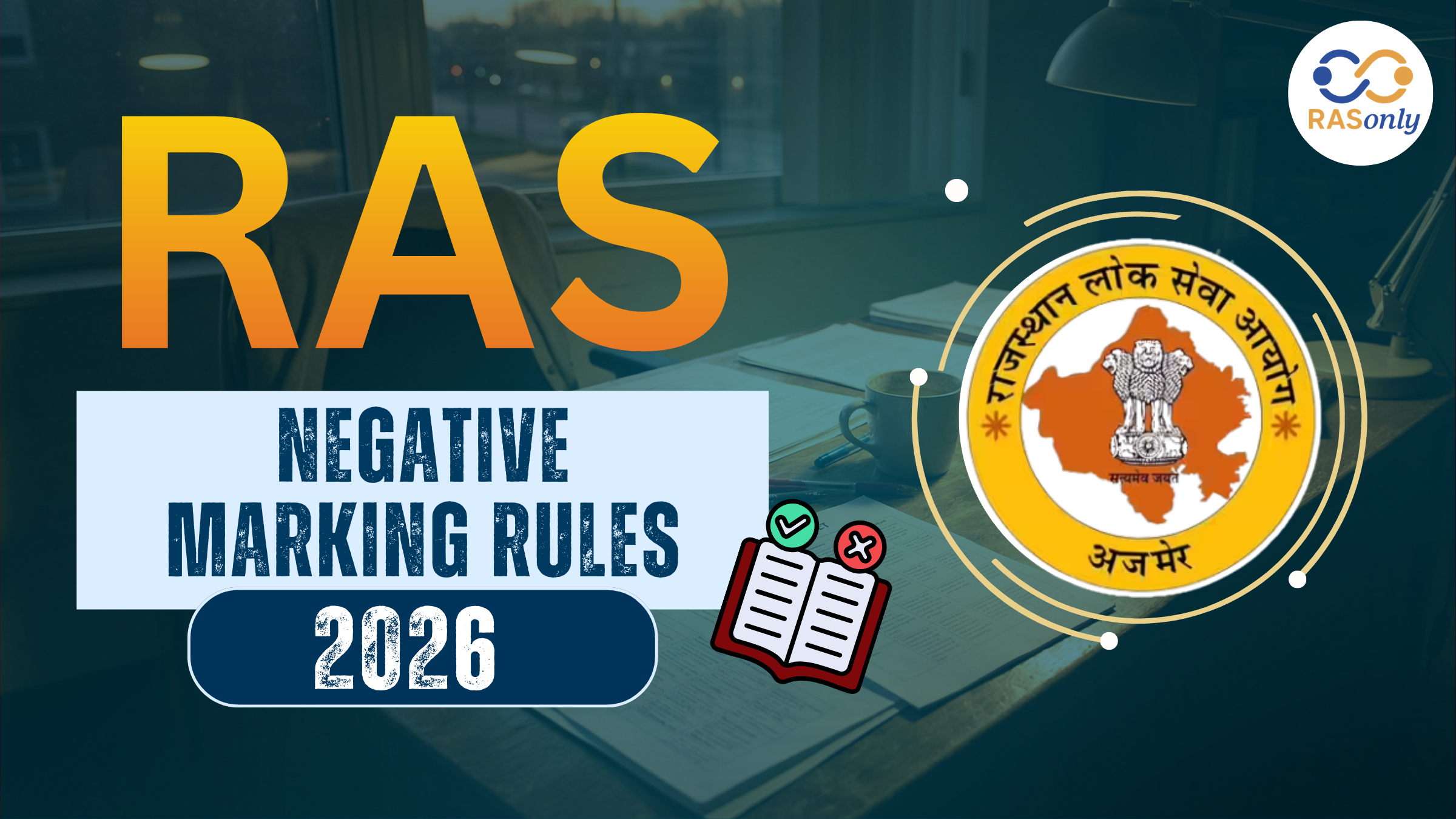
The RAS Negative Marking Rules 2026 are an important part of the RPSC RAS Exam pattern set by the Rajasthan Public Service Commission (RPSC). Candidates preparing for the RPSC RAS Prelims Exam 2026 must clearly understand the RAS marking scheme, negative marking system, and OMR sheet rules to avoid losing marks in the examination.
The RAS Prelims exam has negative marking, that is, the more marks you get wrong, the more marks are deducted. Hence, candidates should take caution when trying RAS MCQs, Rajasthan GK questions, General Science questions and current affairs questions. The RAS negative marking rules, question attempt guidelines, and answer marking guidelines are beneficial in enabling candidates to make an effective RAS exam strategy.
Understanding the RPSC RAS marking scheme properly, negative marking pattern, and the question selection strategy will enable the aspirants to maximise their mark and reduce illegal deductions of marks in the RAS Prelims examination.
RPSC RAS Exam Marking Scheme 2026
The RPSC RAS Exam Marking Scheme 2026 is designed according to the official RAS exam pattern set by the Rajasthan Public Service Commission (RPSC). The RAS selection process includes three stages, which are the RAS Prelims Exam, RAS Mains Exam, and Interview or Personality Test. The RAS Prelims exam is objective (MCQ-based) and is a screening test; the RAS Mains exam is descriptive and measures analytical skill, writing and subject knowledge.
RAS Exam Marking Scheme Overview
| Stage | Type of Exam | Number of Papers | Total Marks |
|---|---|---|---|
| RAS Prelims | Objective (MCQ) | 1 Paper | 200 Marks |
| RAS Mains | Descriptive | 4 Papers | 800 Marks |
| Interview | Personality Test | — | 100 Marks |
The first phase of the RPSC RAS selection process is the RAS Prelims examination, and only those who score above the RAS Prelims cutoff marks get the RAS Mains examination. The final merit list of the RAS exam is formed on the basis of the marks in RAS Mains exam and RAS Interview stage.
RAS Prelims Marking Scheme 2026
The RAS Prelims Marking Scheme 2026 is defined by the Rajasthan Public Service Commission (RPSC) as part of the official RAS exam pattern. The RAS Prelims exam is an objective-type test in multiple-choice question (MCQ) format of General Knowledge and General Science, and it is significant to understand the RAS marking scheme, the marks per question, and the marks per question on negative marking in order to make good RAS exam preparations.
RAS Prelims Paper Structure
| Component | Details |
|---|---|
| Number of Questions | 150 |
| Total Marks | 200 Marks |
| Marks per Question | Approximately 1.33 Marks |
| Negative Marking | 1/3 Marks Deducted |
| Exam Duration | 3 Hours |
| Exam Type | Objective (MCQ) |
The RAS Prelims exam marking system awards marks for correct answers and deducts marks for incorrect answers according to the RAS negative marking rules, which makes accuracy very important during the RPSC RAS Prelims exam.
RAS Negative Marking Rules for Prelims Exam
The RAS Negative Marking Rules for Prelims Exam are an important part of the RPSC RAS exam pattern. In the RAS Prelims examination, marks are deducted for incorrect answers according to the RPSC negative marking system, so candidates must answer questions carefully to avoid losing marks in the RAS Prelims exam.
Negative Marking Calculation
| Type of Response | Marks Awarded |
|---|---|
| Correct Answer | +1.33 Marks |
| Wrong Answer | −0.44 Marks (1/3 deduction) |
| Multiple Answers | Treated as incorrect |
| Blank Answer without marking option | Penalty may apply |
In the RAS Prelims exam, one third of the marks assigned to a question are deducted for every incorrect answer. Since each question carries about 1.33 marks, the deduction for a wrong answer is approximately 0.44 marks. Understanding the RAS negative marking rules and RPSC marking scheme helps candidates maintain accuracy and improve their score in the RAS Prelims examination.
Fifth Option Rule in RAS Exam
The Fifth Option Rule in RAS Exam is an important instruction introduced by the Rajasthan Public Service Commission (RPSC) for the RAS Prelims examination. According to this rule, candidates must mark one option for every question in the RAS OMR answer sheet, even if they do not know the correct answer.
Key Points of the Fifth Option Rule
| Rule | Explanation |
|---|---|
| Mandatory option selection | Candidates must mark one option for every question |
| Fifth option purpose | Used when the candidate does not know the answer |
| Blank questions | May attract penalty if left completely unanswered |
| OMR marking | Only one option must be selected |
If a candidate does not know the correct answer, they should select the fifth option, indicating “not attempted” instead of leaving the question blank. Following the RAS fifth option rule and RPSC exam instructions helps candidates avoid penalties in the RAS Prelims exam.
Multiple Answers and Overwriting Rules in RAS Exam
The Multiple Answers and Overwriting Rules in RAS Exam are part of the official RPSC RAS OMR sheet instructions. Candidates must carefully fill the RAS OMR answer sheet because incorrect marking, overwriting, or selecting multiple options can lead to negative marking in the RAS Prelims exam.
Important OMR Rules
| Situation | Result |
|---|---|
| More than one option marked | Answer treated as incorrect |
| Overwriting or unclear marking | May be treated as wrong answer |
| Incorrect OMR filling | Negative marking applied |
Candidates should mark answers clearly and follow the RAS OMR sheet guidelines to avoid mistakes and unnecessary negative marking in the RPSC RAS Prelims exam.
RAS Negative Marking in Mains Exam
The rule of negative marking of the RAS Mains exam is not the same as the RAS Prelims exam. RPSC RAS Mains examination has no negative marking and the candidates are graded on the basis of their writing abilities, conceptual knowledge, and analytical capability.
RAS Mains Paper Structure
| Paper | Subject | Marks |
|---|---|---|
| Paper 1 | General Studies I | 200 |
| Paper 2 | General Studies II | 200 |
| Paper 3 | General Studies III | 200 |
| Paper 4 | General Hindi and English | 200 |
Since there is no negative marking in the RAS Mains exam, candidates should attempt all questions with proper explanation and structured answers.
Minimum Qualifying Marks in RAS Exam
The minimum qualifying marks in the RAS exam are defined by the Rajasthan Public Service Commission (RPSC) for the RAS Mains examination. Candidates must achieve the required qualifying marks to be considered for the RAS Interview stage.
RAS Qualifying Criteria
| Criteria | Minimum Marks Required |
|---|---|
| Minimum marks in each paper | 10 percent |
| Minimum aggregate marks | 15 percent |
| Relaxation for SC/ST candidates | 5 percent |
The RAS Prelims exam does not have fixed qualifying marks, but candidates must score above the RAS Prelims cutoff marks to qualify for the RAS Mains exam.
Strategy to Avoid Negative Marking in RAS Prelims
The smart RAS exam strategy is necessary to reduce the negative marking in the RAS prelims exam. Those who are going to take the RPSC RAS exam should apply a balanced strategy between correct competition and the attempt of questions.
Important strategies for RAS Prelims preparation include:
- Read questions carefully before selecting an
- Avoid random guessing in difficult situations
- Use elimination techniques to find the correct
- Attempt questions where you have reasonable
- Practice RAS previous year question papers
- Solve RAS mock tests and MCQ practice questions
Following these strategies helps candidates reduce negative marking in RAS Prelims and improve their overall RAS exam score.
Importance of Understanding RAS Negative Marking Rules
The rules of RAS negative marking regarding the RPSC RAS Prelims 2026 are extremely critical to an individual taking the RAS exam. As it means that wrong answers result in losing marks, familiarity with the RAS marking scheme and the rules of the exam can make candidates more mindful in trying out the questions.
Key points to understand:
- Helps avoid unnecessary negative marking in RAS Prelims
- Improves accuracy while solving RAS MCQs and Rajasthan GK
- Helps candidates understand the RAS exam pattern and marking
- Guides candidates to attempt questions wisely instead of
- Increases chances of scoring above the RAS Prelims cutoff
- Improves overall performance in the RPSC RAS examination
A good understanding of the RAS negative marking system and OMR rules helps candidates make better decisions during the exam and increases their chances of qualifying for the RAS Mains stage.
Conclusion
The knowledge of the RAS Negative Marking Rules 2026 is crucial to candidates who are to take the RPSC RAS Prelims exam. Given that wrong responses will result in points deducted, a candidate has to pay close attention to the RAS marking scheme, instructions in the OMR sheet and the rule of fifth options when answering questions.
The proper understanding of the RAS exam pattern, negative marking system, and question selection strategy will prevent some candidates from making unnecessary mistakes and will enable them to score better in the exam. Aspirants can reduce the number of negative marks in exams by practising the previous year's question papers, practising mock tests, and MCQs to enhance accuracy and chances of making it through to the next stage of the RAS Mains, by passing the RAS Prelims.
Frequently Asked Questions (FAQs)
In the RPSC RAS Prelims exam, one-third of the marks assigned to a question are deducted for every incorrect answer. Since each question carries about 1.33 marks, the deduction for a wrong answer is approximately 0.44 marks.
No, there is no negative marking in the RAS Mains examination. The RAS Mains exam is descriptive and candidates are evaluated based on answer writing, conceptual understanding, and analytical ability.
The fifth option rule requires candidates to mark an option for every question in the RAS OMR answer sheet. If a candidate does not know the answer, they must select the fifth option, indicating “not attempted.”
The RAS Prelims exam contains 150 objective-type questions from General Knowledge and General Science, carrying a total of 200 marks.
Candidates can reduce negative marking in RAS Prelims by reading questions carefully, avoiding random guessing, using elimination techniques, and practicing RAS mock tests and previous year question papers regularly.

BEST SELLER
🏆 PRELIMS
RAS Pass
Prelims focused Hindi & English
₹399
✓
Prelims Topic-Wise Tests
✓
Subject-Wise Tests
✓
Full-Length Prelims Tests
✓
Daily Current Affairs Tests
✓
Prelims PYQs Tests
✓
Detailed Solutions & Analysis
✓
All Rajasthan Ranking
✓
Unlimited Reattempts
✓
Mains Tests
✓
Hindi & English Tests
✓
All Rajasthan Ranking
Trusted by 5,000+ Students
Post Category
- RAS Salary
- Result
- RAS Admit Card
- RAS Job
- RAS Cutoff
- Preparation Tips
- RAS Answer Key
- RAS Exam Analysis
- RAS Syllabus
- RAS Previous Year Papers
- RPSC RAS Exam Pattern
- RAS Interview
- RAS Exam Date
- RAS Vacancy
- RAS Test Series
- RAS Best Books
- RAS Preparation Resources
- RAS Coaching Centre
- History
- Polity
- Geography
- Economics
- Science
- Art and Culture
- RPSC RAS Application Form
- RPSC RAS Notification
- RAS Eligibility Criteria
- UPSC Exam
- RPSC RAS Mains
Visit Our RASonly Offline Center
Our Expert Faculty

Bhunesh Sir
Current Affairs · 13+ Yrs

Aamir Khan Sir
RAS-2017 · IIM Ahm.

Akash Sir
Polity · 8+ Yrs
Free Resources
Official Mobile App

RASOnly App
by OTSAdda · Free
Full Video Lectures
Mock Tests & PYQs
Daily Current Affairs
AI Mock Interview
Free Download · No subscription needed to install
RAS 2024 Toppers — RASonly
Rank 2
Virendra Charan
Rank 9
Bhoopinder Singh
Rank 26
Aanchal Nagpal
Rank 33
Lokendra Singh
Rank 45
Amar Rathore
Rank 46
Manasvini Verma

Join RASonly WhatsApp Community
Get daily current affairs, exam alerts, free study material and tips from expert faculty — right on WhatsApp.
Join for Free →RASonly Interview Guidance Program

Mr. Ashok Jain
Ex-Chief Secretary Govt of Rajasthan
- IAS officer of the 1981 batch, Rajasthan cadre.
- Passionate about mentoring the next generation of RAS officers with real-world insights.
- Got retired in Dec 2017 from the post of Chief Secretary of the state of Rajasthan.

Mr. Guru Charan Rai
Ex-ASP / SP in Jaisalmer
- Guru Charan Rai, IPS (Retd), retired as Inspector General of Police (Security), Rajasthan, Jaipur in 2017.
- Served as ASP and SP in Jaisalmer, Nagaur, Sri Ganganagar, Sawai Madhopur, Dausa, Sikar, and Karauli.
- He also held key positions as DIGP and IGP in the Law and Order division.

Mr. Rakesh Verma
Ex-IAS Officer, B.Tech, MBA, and M.A. (Economics)
- IAS officer of the 1981 batch and retired in Chief Secretary Rank.
- Civil servant of high repute and vast experience.
- Has been teaching UPSC CSE subjects for the last six years.
Related Post




Daily Current Affairs for RAS Exam Preparation 2026

Rajasthan’s First Sitaphal Processing Unit in Chittorgarh
October 19, 2026
Rajasthan Foundation Expansion New Chapters Announced
October 19, 2026
Continuous Biomass Torrefaction Reactor
October 17, 2026