Free Rajasthan GK One-Liner Notes for RAS
Soil Types of Rajasthan: Classification, Distribution, Characteristics & Agricultural Importance for RAS 2026

Get in Touch with RASonly!

The Soil Types of Rajasthan reflect the state’s unique geographical diversity, ranging from arid desert soils in the west to fertile alluvial plains in the east. Understanding soil classification, distribution, and characteristics is crucial for RPSC RAS 2026 preparation, especially for geography and agriculture topics. This guide provides a complete overview of Rajasthan soils with exam-focused facts, tables, and revision points.

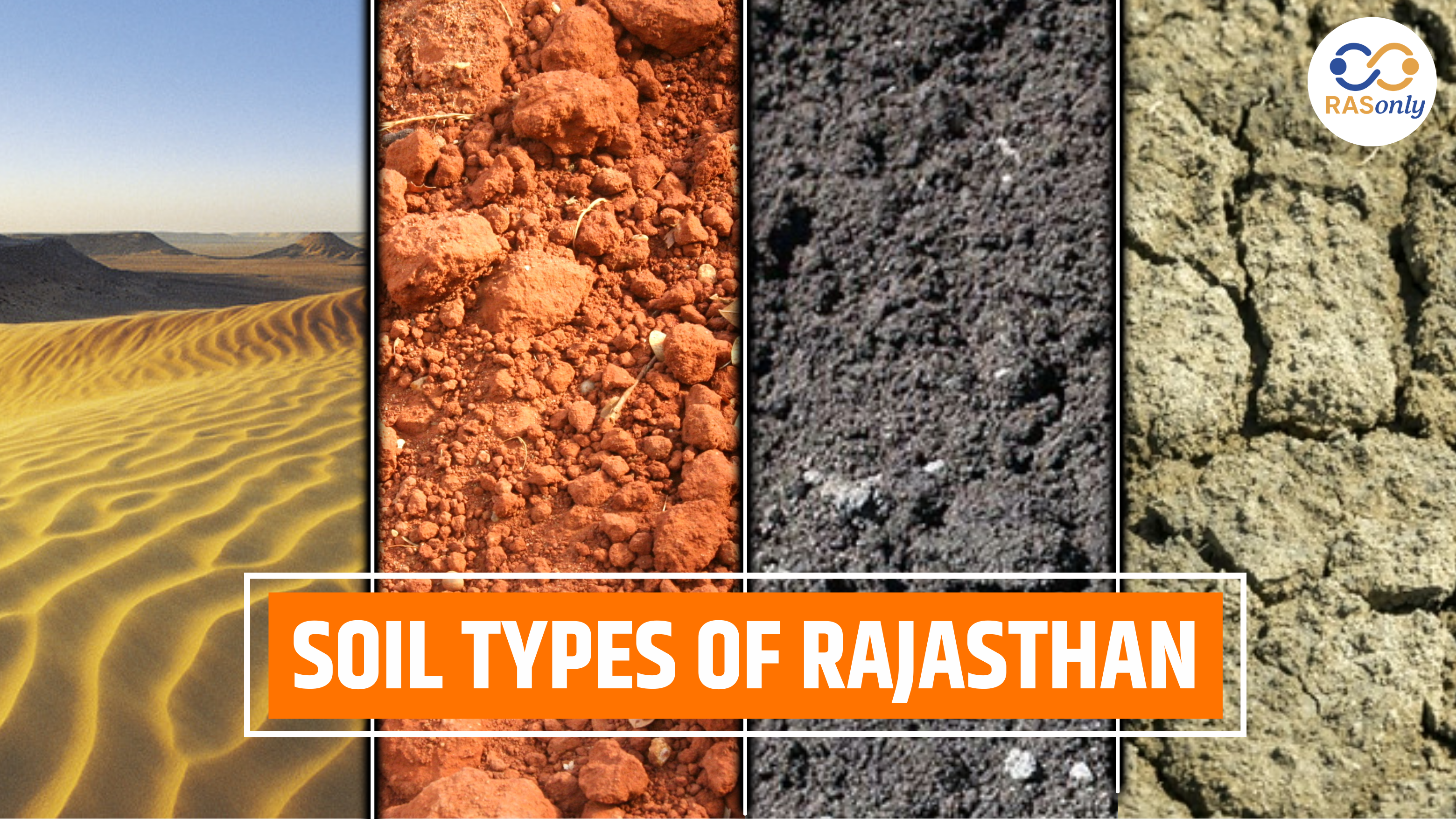
Rajasthan, the largest state of India, exhibits a highly diverse soil profile due to variations in climate, geology, and topography. The presence of the Aravalli Range divides the state into two major physical regions—arid western Rajasthan, dominated by desert soils and semi-arid to sub-humid eastern Rajasthan dominated by alluvial soils. This natural division plays a crucial role in determining the soil types of Rajasthan, agricultural patterns, and land use.
The subject Soil Types of Rajasthan is highly crucial to aspirants studying RPSC RAS 2026 under the subject of Rajasthan Geography. Prelims (soil type, distribution, crops) and Mains (soil degradation, agriculture, sustainability) are often asked questions. To score high marks, it is important to have a conceptual and analytical insight of the classification of soils, their properties and their significance to agriculture.
Soil Classification in Rajasthan
Rajasthan soils are divided into three major systems namely General Classification, Scientific Classification (USDA) and Rajasthan Agriculture Department Classification. The significance of each of the classifications in the RAS examination is different.
1. General Classification of Soil in Rajasthan
Upon general classification, it is dependent on the soil colour, texture, composition and fertility. The most critical classification of RAS Prelims is that most direct questions are posed based on this part. The soils in Rajasthan are widely classified into eight major groups with the most common one being desert soil and the most productive of all being the alluvial soil.
General Soil Types of Rajasthan
| Soil Type | Distribution | Key Characteristics | Major Crops |
|---|---|---|---|
| Desert Soil | Jaisalmer, Barmer, Bikaner, Jodhpur | Sandy, low fertility, saline | Bajra, Guar |
| Alluvial Soil | Alwar, Bharatpur, Kota, Dholpur | Highly fertile, potash-rich | Wheat, Mustard |
| Black Soil | Kota, Bundi, Jhalawar (Hadoti) | Clayey, high water retention | Cotton, Soybean |
| Red Soil | Udaipur, Banswara | Iron-rich, well-drained | Maize, Groundnut |
| Red & Yellow Soil | Ajmer, Bhilwara | Moderate fertility | Pulses, Oilseeds |
| Saline Soil | Ganganagar, Hanumangarh | High salt content | Limited crops |
| Brown Soil | Tonk, Sawai Madhopur | Sandy loam | Wheat, Barley |
| Sierozem Soil | Ajmer, Pali | Grey desert soil | Millets |
Also Check: Rajasthan Geography Notes for RAS
2. Scientific Classification of Soil (USDA System)
Scientific classification of soil is carried based on the processes of soil formation, climate and horizon development. It is critical in conceptual understanding and progressive MCQ. Rajasthan has got five key soil orders in which Entisols are the dominant soil in the desert area.
Scientific Soil Orders in Rajasthan
| Soil Order | Characteristics | Region |
|---|---|---|
| Entisols | Young, sandy soils | Western Rajasthan |
| Aridisols | Dry, calcium-rich soils | Thar Desert |
| Alfisols | Moderately fertile soils | Eastern Rajasthan |
| Inceptisols | Immature soils | Central Rajasthan |
| Vertisols | Clay-rich black soil | Hadoti Plateau |
3. Rajasthan Agriculture Department Classification
The Rajasthan Agriculture Department classifies soils into 14 sub-types, providing a more detailed understanding of regional soil variation.
Important soil sub-types include Sierozem soils, Brown sandy soils, Gypsiferous soils, and canal-irrigated alluvial soils. These classifications are useful in writing high-quality Mains answers.
Major Soil Types of Rajasthan (Detailed Explanation)
1. Desert Soil of Rajasthan (Marusthali Soil)
The most common type of soil in Rajasthan is desert soil which occupies almost 60-62 percent of the total geographical space. It is predominantly found in the western districts of Rajasthan like Jaisalmer, Barmer, Bikaner and Jodhpur located in the Thar Desert area.
This soil is described as coarse sandy in texture, it has very low organic matter and it possesses low water retention capacity. The saline and alkaline soils are common because of the temperatures and evaporation that restrict the productivity of agriculture. Nevertheless, irrigation systems such as the Indira Gandhi Canal Project have greatly enhanced the fertility of the soil in the canal command areas.
Desert soil supports drought-resistant crops, making it suitable for dryland farming systems.
Key Features of Desert Soil
| Feature | Description |
|---|---|
| Texture | Sandy and loose |
| Fertility | Low |
| Water Retention | Very low |
| Nature | Saline & alkaline |
Major Crops
Bajra, Guar, Moong, Moth
2. Alluvial Soil of Rajasthan (Kachari Soil)
Alluvial soil is found in the eastern and northern plains of Rajasthan, including Alwar, Bharatpur, Kota, and Dholpur districts. It is formed by river deposits and is widely regarded as the most fertile soil in Rajasthan.
This soil has sufficient levels of potash and lime, has a high ability to retain moisture and sustain intensive and commercial farming. It forms the backbone of the agricultural economy at Rajasthan because of its high productivity. Alluvial soil suits various patterns of crop rotation because it is fertile and has the availability of irrigation.
Key Features of Alluvial Soil
| Feature | Description |
|---|---|
| Texture | Sandy loam to clay loam |
| Fertility | High |
| Nutrients | Rich in potash & lime |
| Water Retention | Good |
Major Crops
Wheat, Mustard, Rice, Sugarcane
3. Black Soil of Rajasthan (Regur / Cotton Soil)
Black soil is mainly found in the Hadoti region, covering Kota, Bundi, and Jhalawar districts. It is also known as black cotton soil due to its suitability for cotton cultivation.
This soil is deep, clayey, and has excellent water retention capacity. A unique characteristic is its self-ploughing nature, as it develops cracks during the summer season, improving aeration. Black soil is highly suitable for cash crops and plays an important role in commercial agriculture in Rajasthan.
Key Features of Black Soil
| Feature | Description |
|---|---|
| Texture | Clayey |
| Fertility | Moderate to high |
| Water Retention | Very high |
| Special Feature | Self-ploughing cracks |
Major CropsMajor Crops
Cotton, Soybean, Wheat
4. Red and Yellow Soil of Rajasthan
Red and yellow soils are found in southern Rajasthan, particularly in Udaipur, Banswara, and Dungarpur regions. These soils are formed due to the weathering of igneous and metamorphic rocks.
Iron oxide is the cause of red colour and hydration is the cause of yellow shades. Such soils are well-drained albeit of moderate fertility, which needs fertilizers to increase productivity. They are specifically significant in tribal arable areas.
Key Features of Red & Yellow Soil
| Feature | Description |
|---|---|
| Colour | Red to yellow |
| Fertility | Moderate |
| Drainage | Good |
| Nutrients | Rich in iron, low in nitrogen |
Major Crops
Maize, Groundnut, Pulses
5. Saline and Alkaline Soil (Reh/Kallar Soil)
Saline and alkaline soils are found in northern and canal-irrigated regions, especially Ganganagar and Hanumangarh. These soils are also common in arid regions due to high evaporation.
They have a high level of soluble salts (particularly sodium), which lowers soil fertility and influences plant growth. The surface is often covered by a white crust of salt. This issue has been compounded by inappropriate irrigation and drainage, yet this issue can be managed by scientific management of soil.
Key Features of Saline Soil
| Feature | Description |
|---|---|
| Salt Content | Very high |
| Fertility | Low |
| Problem | Soil degradation |
| Appearance | White crust |
Reclamation Methods
Gypsum application, drainage improvement, proper irrigation
6. Brown and Sierozem Soil
Brown soils are found in semi-arid regions of eastern Rajasthan, while Sierozem soils occur in transitional zones between desert and alluvial regions, especially in Ajmer and Pali districts.
These are light-textured soils that are fairly fertile and are used in dry farming yet they need additional irrigation and fertilizers to achieve greater productivity. Their significance lies in examination terms since they are frequently set in higher-order RAS items.
Key Features
| Feature | Description |
|---|---|
| Texture | Sandy loam |
| Fertility | Moderate |
| Region | Semi-arid |
| Use | Cereals & oilseeds |
Major Crops
Wheat, Barley, Oilseeds
Quick Revision Table (Most Important for RAS)
| Soil Type | Region | Fertility | Key Crop |
|---|---|---|---|
| Desert Soil | Western Rajasthan | Low | Bajra |
| Alluvial Soil | Eastern Rajasthan | High | Wheat |
| Black Soil | Hadoti | High | Cotton |
| Red Soil | Southern Rajasthan | Moderate | Maize |
| Saline Soil | Northern Rajasthan | Low | Limited |
Soil Distribution in Rajasthan (Region-wise)
The soil distribution in Rajasthan follows a clear geographical pattern influenced by climate, rainfall, and relief features. The Aravalli Range acts as a dividing line, separating the arid west from the relatively fertile eastern plains.
Understanding the region-wise soil distribution of Rajasthan is extremely important for RAS 2026, especially for map-based and match-the-following questions.
Region-wise Soil Distribution in Rajasthan
| Region | Dominant Soil Type | Key Feature |
|---|---|---|
| Western Rajasthan | Desert Soil | Sandy, arid, low fertility |
| Northern Rajasthan | Saline + Alluvial | Canal irrigation, salt-affected |
| Eastern Rajasthan | Alluvial Soil | Fertile, intensive agriculture |
| Southern Rajasthan | Red & Yellow Soil | Moderate fertility, tribal farming |
| Southeastern Rajasthan | Black Soil | Cotton cultivation, high moisture |
Agricultural Importance of Soils in Rajasthan
Soil in Rajasthan plays a significant agricultural role because of the direct correlation between the type of soil and the pattern of cropping, the quantity of irrigation required and the productivity of the farm. Soil knowledge is vital in planning to undertake agriculture as various soils occur in various regions, supporting various crops.
Alluvial soils promote intensive agriculture, desert soils are suitable for dryland farming, and black soils support cash crops like cotton. Thus, soil characteristics play a key role in shaping the rural economy and agricultural development of Rajasthan.
Soil Problems in Rajasthan (RAS Mains Focus)
The climatic conditions in Rajasthan cause a number of soil-related issues, including aridity, and human activities including over-irrigation and deforestation. These problems have a direct effect on the fertility of soil and the productivity of agriculture.
Understanding these problems and their solutions is very important for RAS Mains answers, especially in geography and environmental sections.
Soil Problems and Solutions in Rajasthan
| Problem | Cause | Solution |
|---|---|---|
| Soil Erosion | Wind & water erosion | Afforestation, shelter belts |
| Salinity & Alkalinity | Irrigation, evaporation | Gypsum treatment, drainage |
| Waterlogging | Canal irrigation | Proper drainage system |
| Desertification | Overgrazing, deforestation | Soil conservation practices |
Soil Conservation Measures in Rajasthan
Soil conservation in Rajasthan is essential to maintain soil fertility, agricultural productivity, and environmental sustainability. Due to fragile desert ecosystems, conservation practices play a crucial role in preventing land degradation.
The major actions are afforestation, shelter belts, watershed management, crop rotation and organic farming. The government programs such as Soil Health Card Scheme and irrigation management programs also contribute to the sustainable use of soil.
Conclusion
The Rajasthan soils reflect a complicated combination of climate, geology, and topography that has led to the formation of several different soil types, including desert, alluvial, black, red, and salty soil. The characteristics of each type of soil, as well as its fertility and economic significance, directly affect which crops were planted by the region, and how it was developed economically.
For RAS 2026 aspirants, a thorough understanding of soil classification, region-wise distribution, and soil-related challenges is essential not only for Prelims but also for writing analytical answers in Mains. Linking soil properties with agriculture, irrigation, and sustainability can significantly improve answer quality and scoring potential.
FAQs
The major soil types of Rajasthan include desert soil, alluvial soil, black soil, red and yellow soil, saline soil, and brown soil, each with distinct characteristics and distribution.
Alluvial soil is the most fertile soil in Rajasthan due to its high nutrient content and good water retention capacity, supporting crops like wheat and mustard.
Desert soil covers the largest area (around 60–62%) of Rajasthan, mainly found in the western Thar Desert region.
Black soil is important because of its high water retention and suitability for cash crops like cotton and soybean, especially in the Hadoti region.
Major soil problems include soil erosion, salinity, waterlogging, and desertification, caused by climatic conditions and improper agricultural practices.

BEST SELLER
🏆 PRELIMS
RAS Pass
Prelims focused Hindi & English
₹399
✓
Prelims Topic-Wise Tests
✓
Subject-Wise Tests
✓
Full-Length Prelims Tests
✓
Daily Current Affairs Tests
✓
Prelims PYQs Tests
✓
Detailed Solutions & Analysis
✓
All Rajasthan Ranking
✓
Unlimited Reattempts
✓
Mains Tests
✓
Hindi & English Tests
✓
All Rajasthan Ranking
Trusted by 5,000+ Students

Post Category
- RAS Salary
- Result
- RAS Admit Card
- RAS Job
- RAS Cutoff
- Preparation Tips
- RAS Answer Key
- RAS Exam Analysis
- RAS Syllabus
- RAS Previous Year Papers
- RPSC RAS Exam Pattern
- RAS Interview
- RAS Exam Date
- RAS Vacancy
- RAS Test Series
- RAS Best Books
- RAS Preparation Resources
- RAS Coaching Centre
- History
- Polity
- Geography
- Economics
- Science
- Art and Culture
- RPSC RAS Application Form
- RPSC RAS Notification
- RAS Eligibility Criteria
- UPSC Exam
- RPSC RAS Mains
Visit Our RASonly Offline Center
Our Expert Faculty

Bhunesh Sir
Current Affairs · 13+ Yrs

Aamir Khan Sir
RAS-2017 · IIM Ahm.

Akash Sir
Polity · 8+ Yrs
Free Resources
Official Mobile App

RASOnly App
by OTSAdda · Free
Full Video Lectures
Mock Tests & PYQs
Daily Current Affairs
AI Mock Interview
Free Download · No subscription needed to install
RAS 2024 Toppers — RASonly
Rank 2
Virendra Charan
Rank 9
Bhoopinder Singh
Rank 26
Aanchal Nagpal
Rank 33
Lokendra Singh
Rank 45
Amar Rathore
Rank 46
Manasvini Verma

Join RASonly WhatsApp Community
Get daily current affairs, exam alerts, free study material and tips from expert faculty — right on WhatsApp.
Join for Free →RASonly Interview Guidance Program

Mr. Ashok Jain
Ex-Chief Secretary Govt of Rajasthan
- IAS officer of the 1981 batch, Rajasthan cadre.
- Passionate about mentoring the next generation of RAS officers with real-world insights.
- Got retired in Dec 2017 from the post of Chief Secretary of the state of Rajasthan.

Mr. Guru Charan Rai
Ex-ASP / SP in Jaisalmer
- Guru Charan Rai, IPS (Retd), retired as Inspector General of Police (Security), Rajasthan, Jaipur in 2017.
- Served as ASP and SP in Jaisalmer, Nagaur, Sri Ganganagar, Sawai Madhopur, Dausa, Sikar, and Karauli.
- He also held key positions as DIGP and IGP in the Law and Order division.

Mr. Rakesh Verma
Ex-IAS Officer, B.Tech, MBA, and M.A. (Economics)
- IAS officer of the 1981 batch and retired in Chief Secretary Rank.
- Civil servant of high repute and vast experience.
- Has been teaching UPSC CSE subjects for the last six years.




Daily Current Affairs for RAS Exam Preparation 2026

Rajasthan Universities in the QS World University Rankings 2027
September 12, 2026
Rajasthan to Host Miss Ocean World 2026
September 12, 2026
PM-SETU Scheme Bhiwadi ITI Cluster Gets Approval
September 11, 2026
