Kushan Empire: History, Rulers, Administration, Economy, Art, Decline
Indian Forest Resources Strategy for RAS 2026 Guide

Get in Touch with RASonly!

Learn Indian Forest Resources for RAS 2026 with forest types, forest cover, Rajasthan ecology, wildlife sanctuaries, conservation methods, environmental acts, climate change topics, map practice, current affairs, and effective preparation and revision strategies for Prelims and Mains.

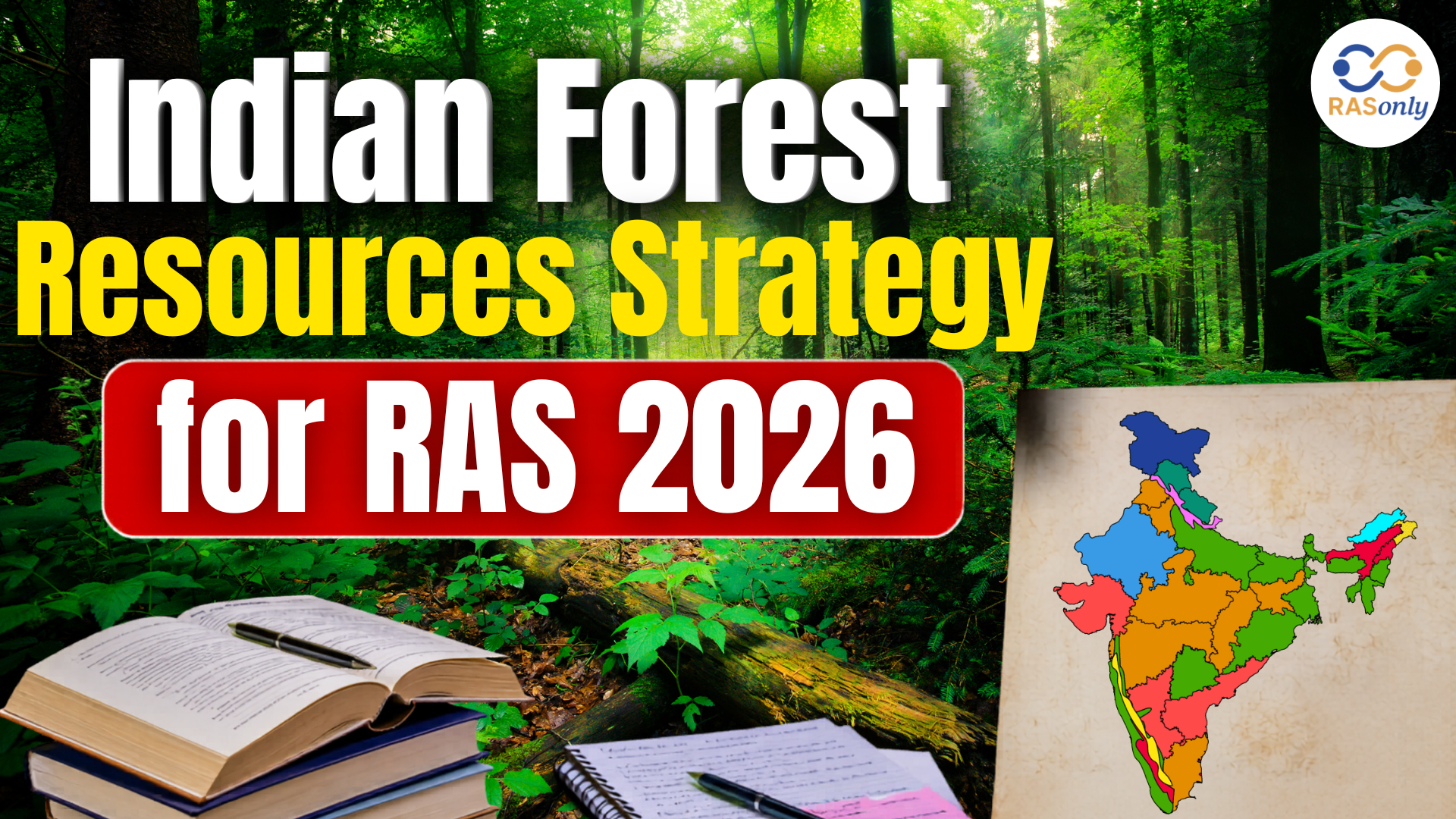
Indian Forest Resources continues to be one of the best-scoring and most frequently occurring topics in the Environment and Geography sections of the RAS, and each candidate with a structured knowledge of the topic is always doing well in the Prelims and Mains exams. This booklet is an amalgamation of forest types, biodiversity, Rajasthan-specific ecology, wildlife conservation, environmental legislation, and current affairs in one single resource so that the candidates may not have to visit various sources and find little notes here and there.
RAS 2026 is still a test that is highly focused on application and conceptual questions, and not simply on memorising facts, so the guide is designed to set out a preparation strategy rather than a list of definitions. This guide combines essential concepts with actionable study tips, tables, and bullet points in each section, enabling aspirants to end up with knowledge along with a roadmap for revision at the end of this guide (Indian Forest Resources).
Why are Indian Forest Resources Important for RAS 2026?
Indian Forest Resources are a topic that gets examined every year and are a ‘high-weightage RAS topic' as they have cross-over applications within other topics. Forests are a habitat that regulates climate, protects wildlife, controls soil erosion, and contributes to rural livelihoods; therefore, they can be a natural anchor to interdisciplinary questions.
Important areas asked in RAS include:
- Forest cover in India
- Wildlife conservation
- Biosphere reserves
- National parks
- Environmental acts
- Rajasthan ecology
What Are Forest Resources?
Forest resources include everything found in forests that is used to maintain ecological balance and ensure income for people, as well as less tangible services provided by forests such as their ability to regulate rain, protect soils, and moderate climate. This dual nature of utility and function is crucial for RAS aspirants, as it is often tested in exams.
| Category | Examples |
|---|---|
| Tangible Products | Timber, Fuelwood, Bamboo, Medicinal plants, Gum and resins, Fruits and herbs |
| Ecological Services | Wildlife habitat, Soil conservation, Rainwater regulation, Climate control |
Indian Forest Resources Strategy for RAS 2026
The decentralized and piecemeal strategy of Indian Forest Resources is not very effective for RAS, as the topic is repeatedly being asked in both Prelims and Mains. The following paragraphs will divide the topic into four parts to help develop preparation gradually rather than all at once.
1. Start with NCERT Geography
It is important to note that this entire topic is essentially linked with the concepts that you learn in Class 9 and 10 Geography and the environment chapters in Class 12. Therefore, it is one of the most common causes of problems with analytical questions at later stages of the exam.
- Class 9 Geography
- Class 10 Geography
- Class 12 Environment chapters
2. Focus on Environment Current Affairs
A high percentage of RAS environment questions are based on current developments and not just the facts from textbooks. It is important for the aspirants to follow these references throughout the year and not to leave it to the last minute of the examination.
-
India State of Forest Report (ISFR)
- Project Tiger
- COP Summits
- Green India Mission
3. Prepare Short Notes
With all the categories and facts covered in this topic, there is a difference between confident last-week revision and last-minute panic with consolidated short notes.
- Types of forests in India
- Forest conservation acts
- National parks
- Wildlife sanctuaries
- Rajasthan forest resources
4. Practice Maps Daily
In RAS Prelims, questions based on maps are always asked, and candidates without map practice lose marks on trivial things even if the question is very easy.
- National Parks in India
- Tiger reserves
- Biosphere reserves
- Forest regions
- Rajasthan wildlife sanctuaries
Types of Forests in India for RAS 2026
The forest cover in India is broadly classified in terms of climate, rainfall, and altitude and is one area which is most tested in RAS Geography and Environment. The knowledge of the characteristics of different forest types, rather than just recalling facts, helps candidates to answer both direct and comparative questions with confidence.
1. Tropical Evergreen Forests
They can be found in areas with high, humid rainfall and humidity throughout the year, are green year-round, and are home to some of the richest biodiversity in India.
| Category | Details |
|---|---|
| Main Features | Dense forests, evergreen trees, high biodiversity |
| Important Areas | Western Ghats, North-East India, Andaman & Nicobar Islands |
| Important Trees | Ebony, Rosewood, Mahogany |
2. Tropical Deciduous Forests
As India's largest forest category, tropical deciduous forests are distinguished by trees that shed their leaves seasonally to conserve water during drier months and are a must-know area for RAS 2026.
| Type/Category | Details |
|---|---|
| Moist Deciduous Forests | Found in areas receiving 100–200 cm of rainfall |
| Dry Deciduous Forests | Found in areas receiving 70–100 cm of rainfall |
| Important Trees | Teak, Sal, Bamboo, Neem |
3. Thorn Forests
Thorn forests grow in the dry and semi-arid north-western parts of India, where the climate conditions are dry and warm, which support hardy vegetation, particularly those that can withstand drought, which are also closely linked to Rajasthan's own syllabus component.
| Category | Details |
|---|---|
| Major States | Rajasthan, Gujarat, Punjab |
| Climate | Dry and semi-arid regions with low rainfall |
| Important Trees | Khejri, Babool, Cactus |
4. Mountain Forests
Mountain forests are present throughout the Himalayan belt and exhibit a definite altitudinal gradient in vegetation cover and are important in regulating watershed and soil stability.
| Category | Details |
|---|---|
| Region | Himalayan areas |
| Important Trees | Pine, Cedar, Fir, Deodar |
| Key Feature | Altitude-based vegetation |
5. Mangrove Forests
Mangrove forests are found in coastal and deltaic areas with salty water, which is where mangroves can survive thanks to their ability to withstand salt water and their extensive root system. Sundarbans are still the most referenced examples of this forest type in the questions at the RAS level.
Forest Cover in India
The classification of forest cover, which comes mostly from the India State of Forest Report (ISFR), is one of the most commonly tested factual domains in RAS Prelims, where questions are repeatedly asked about which is the leading state with respect to a particular forest cover.
| Forest Categories | States with Largest Forest Cover | States with Highest % of Forest Area |
|---|---|---|
| Very Dense Forest | Madhya Pradesh | Mizoram |
| Moderately Dense Forest | Arunachal Pradesh | Arunachal Pradesh |
| Open Forest | Chhattisgarh | Meghalaya |
Rajasthan Forest Resources for RAS 2026
The climate of the state of Rajasthan is so dry and semi-arid in nature that, as a whole, the state has very little forest cover, with thorn and dry deciduous forests being the predominant vegetation types of the state. Since ecology is an inevitable part of RAS papers, it is a good idea to pay dedicated attention to this part of the paper, especially since it is unique to the ecology of Rajasthan.
| Category | Details |
|---|---|
| Major Forest Types | Tropical Thorn Forests, Dry Deciduous Forests |
| Important Trees | Khejri, Rohida, Babool, Neem |
| Climate | Arid and semi-arid |
Important Wildlife Sanctuaries and National Parks of Rajasthan
The protected areas of Rajasthan are always evaluated on the basis of their key ecological characteristics and not their names only, so candidates should be familiar with each protected area as well as the characteristic features.
| National Park / Sanctuary | Key Feature |
|---|---|
| Ranthambore National Park | Tiger conservation |
| Sariska Tiger Reserve | Tiger reserve |
| Keoladeo National Park | UNESCO site |
| Desert National Park | Desert ecosystem |
Forest Conservation in India
Forest conservation practices are a major bridge between theory and action on the ground, and RAS often challenges candidates on the difference between practices of conservation in action.
- Social Forestry – Community involvement in tree plantation on public and wasteland areas
- Agroforestry – Growing trees along with crops to improve soil fertility and income
- Afforestation – Tree planting in unproductive or degraded lands
- Joint Forest Management (JFM) – Local communities partnering with forest departments in protection and management
Important Forest Policies and Acts
The static component of the RAS Environment paper is based on legislative knowledge and policy knowledge, and questions here are often very specific in terms of dates and objectives.
| Policy / Act | Focus Area |
|---|---|
| National Forest Policy, 1952 | Increase forest cover |
| National Forest Policy, 1988 | Ecological balance |
| Forest Conservation Act, 1980 | Protect forest land |
| Wildlife Protection Act, 1972 | Wildlife protection |
| Environment Protection Act, 1986 | Environmental protection |
Climate Change and Important Topics for RAS 2026
Climate change is invariably associated with forest-related themes because of the forests' role as natural carbon sinks, absorbing carbon dioxide and releasing oxygen, and assisting in stabilising regional and global climate patterns.
Important topics:
- Types of forests in India
- Forest cover in India
- Rajasthan forest resources
- National parks and tiger reserves
- Biodiversity hotspots
- Forest conservation methods
- Environmental acts
- Desertification in Rajasthan
Common Mistakes Students Make
Even well-prepared aspirants often lose marks in this section due to a handful of recurring, avoidable errors rather than a lack of knowledge.
| Common Mistake | Why It Matters |
|---|---|
| Ignoring Rajasthan-Specific Ecology | RAS regularly asks questions on Rajasthan environment, forests, and wildlife |
| Not Studying Current Affairs | Environment and biodiversity topics change regularly and link to current events |
| Skipping Map Practice | National parks, biosphere reserves, and forest regions are key for Prelims |
| Rote Learning Without Understanding | Conceptual clarity is needed for analytical, statement-based questions |
| Not Revising Regularly | Revision is necessary to retain facts, acts, and schemes |
Quick Revision Table for RAS 2026
A single-glance revision table is invaluable in the final days before the exam, when there is no time left to revisit full notes.
| Topic | Important Fact |
|---|---|
| Largest Forest Cover State | Madhya Pradesh |
| Mangrove Forest Example | Sundarbans |
| Thorn Forest State | Rajasthan |
| Famous Tree of Rajasthan | Khejri |
| Tiger Reserve | Ranthambore |
| Forest Conservation Act | 1980 |
| Wildlife Protection Act | 1972 |
Final Preparation Tips for RAS Aspirants
What the high scorers do differently from the rest in this section is to revise effectively and consistently, using a revision structure, and to connect static facts with current developments.
- Revise Indian Forest Resources notes regularly.
- Prepare short and easy-to-revise notes
- Solve MCQs and PYQs daily
- Focus on Rajasthan environment and ecology topics
- Read newspapers on forest and biodiversity issues
- Practice maps of national parks/biosphere reserves and forest regions
- Revise important environmental acts and government schemes
Also Read
| Indian Natural Vegetation | Forests of Rajasthan |
| Desert Ecosystem of Rajasthan | Wildlife Conservation in Rajasthan |
| National Parks & Wildlife Sanctuaries | Biodiversity in Rajasthan |
Conclusion
It is important to note that Indian Forest Resources have a significant weightage in both Environment and Geography in the RAS 2026 exams, and hence it is essential that you study it well and in an organised manner. With a clear understanding of forest types and conservation efforts, combined with keen knowledge of current affairs and key pieces of legislation related to the state of Rajasthan, aspirants have the potential to make this an easy-to-score topic.
Indian Forest Resources Strategy: FAQs
Indian Forest Resources play a vital role in the study of RAS as they link the subject of Environment and Geography with the following subjects: Forest cover, Wildlife conservation, National Parks, Environmental acts, biodiversity, and Rajasthan ecology. The topic can be helpful for Prelims as well as Mains preparation.
The major forest types covered in the guide are Tropical Evergreen, Tropical Deciduous, Thorn, Mountain, and Mangrove forests. Their distribution, characteristics, important trees, and geographical regions are important areas for RAS preparation.
Aspirants should focus on Rajasthan's major forest types, important trees, climate, national parks, wildlife sanctuaries, and ecological characteristics. Tropical Thorn and Dry Deciduous forests, along with trees such as Khejri, Rohida, Babool, and Neem, are highlighted in the guide.
Important areas include the India State of Forest Report (ISFR), Project Tiger, COP Summits, and the Green India Mission. The guide recommends following environment-related current affairs throughout the year.
The guide highlights the Forest Conservation Act, 1980; Wildlife Protection Act, 1972; Environment Protection Act, 1986; and National Forest Policies of 1952 and 1988. Their focus areas and objectives should be revised for the exam.

BEST SELLER
🏆 PRELIMS
RAS Pass
Prelims focused Hindi & English
₹399
✓
Prelims Topic-Wise Tests
✓
Subject-Wise Tests
✓
Full-Length Prelims Tests
✓
Daily Current Affairs Tests
✓
Prelims PYQs Tests
✓
Detailed Solutions & Analysis
✓
All Rajasthan Ranking
✓
Unlimited Reattempts
✓
Mains Tests
✓
Hindi & English Tests
✓
All Rajasthan Ranking
Trusted by 5,000+ Students

Post Category
- RAS Salary
- Result
- RAS Admit Card
- RAS Job
- RAS Cutoff
- Preparation Tips
- RAS Answer Key
- RAS Exam Analysis
- RAS Syllabus
- RAS Previous Year Papers
- RPSC RAS Exam Pattern
- RAS Interview
- RAS Exam Date
- RAS Vacancy
- RAS Test Series
- RAS Best Books
- RAS Preparation Resources
- RAS Coaching Centre
- History
- Polity
- Geography
- Economics
- Science
- Art and Culture
- RPSC RAS Application Form
- RPSC RAS Notification
- RAS Eligibility Criteria
- UPSC Exam
- RPSC RAS Mains
Visit Our RASonly Offline Center
Our Expert Faculty

Bhunesh Sir
Current Affairs · 13+ Yrs

Aamir Khan Sir
RAS-2017 · IIM Ahm.

Akash Sir
Polity · 8+ Yrs
Free Resources
Official Mobile App

RASOnly App
by OTSAdda · Free
Full Video Lectures
Mock Tests & PYQs
Daily Current Affairs
AI Mock Interview
Free Download · No subscription needed to install
RAS 2024 Toppers — RASonly
Rank 2
Virendra Charan
Rank 9
Bhoopinder Singh
Rank 26
Aanchal Nagpal
Rank 33
Lokendra Singh
Rank 45
Amar Rathore
Rank 46
Manasvini Verma

Join RASonly WhatsApp Community
Get daily current affairs, exam alerts, free study material and tips from expert faculty — right on WhatsApp.
Join for Free →RASonly Interview Guidance Program

Mr. Ashok Jain
Ex-Chief Secretary Govt of Rajasthan
- IAS officer of the 1981 batch, Rajasthan cadre.
- Passionate about mentoring the next generation of RAS officers with real-world insights.
- Got retired in Dec 2017 from the post of Chief Secretary of the state of Rajasthan.

Mr. Guru Charan Rai
Ex-ASP / SP in Jaisalmer
- Guru Charan Rai, IPS (Retd), retired as Inspector General of Police (Security), Rajasthan, Jaipur in 2017.
- Served as ASP and SP in Jaisalmer, Nagaur, Sri Ganganagar, Sawai Madhopur, Dausa, Sikar, and Karauli.
- He also held key positions as DIGP and IGP in the Law and Order division.

Mr. Rakesh Verma
Ex-IAS Officer, B.Tech, MBA, and M.A. (Economics)
- IAS officer of the 1981 batch and retired in Chief Secretary Rank.
- Civil servant of high repute and vast experience.
- Has been teaching UPSC CSE subjects for the last six years.



Daily Current Affairs for RAS Exam Preparation 2026

Chandra Shekhar Sain Receives Lalit Kala Akademi National Award
October 01, 2026
Jodhpur to Get India’s Third Dedicated Tropical Medicine Institute
October 01, 2026
Establishment of the Aesthetic Office
September 30, 2026