Chola Dynasty: Capital, Founder, Kings, Time Period and History
RAS Syllabus 2026 vs 2024: Key Differences & Comparison

Get in Touch with RASonly!

Compare RAS Syllabus 2026 vs 2024 to understand changes in Prelims, Mains, subjects, reasoning, current affairs, and exam structure. Know what remains unchanged, what needs extra preparation, and how old-pattern aspirants can smoothly transition to the revised RAS syllabus.

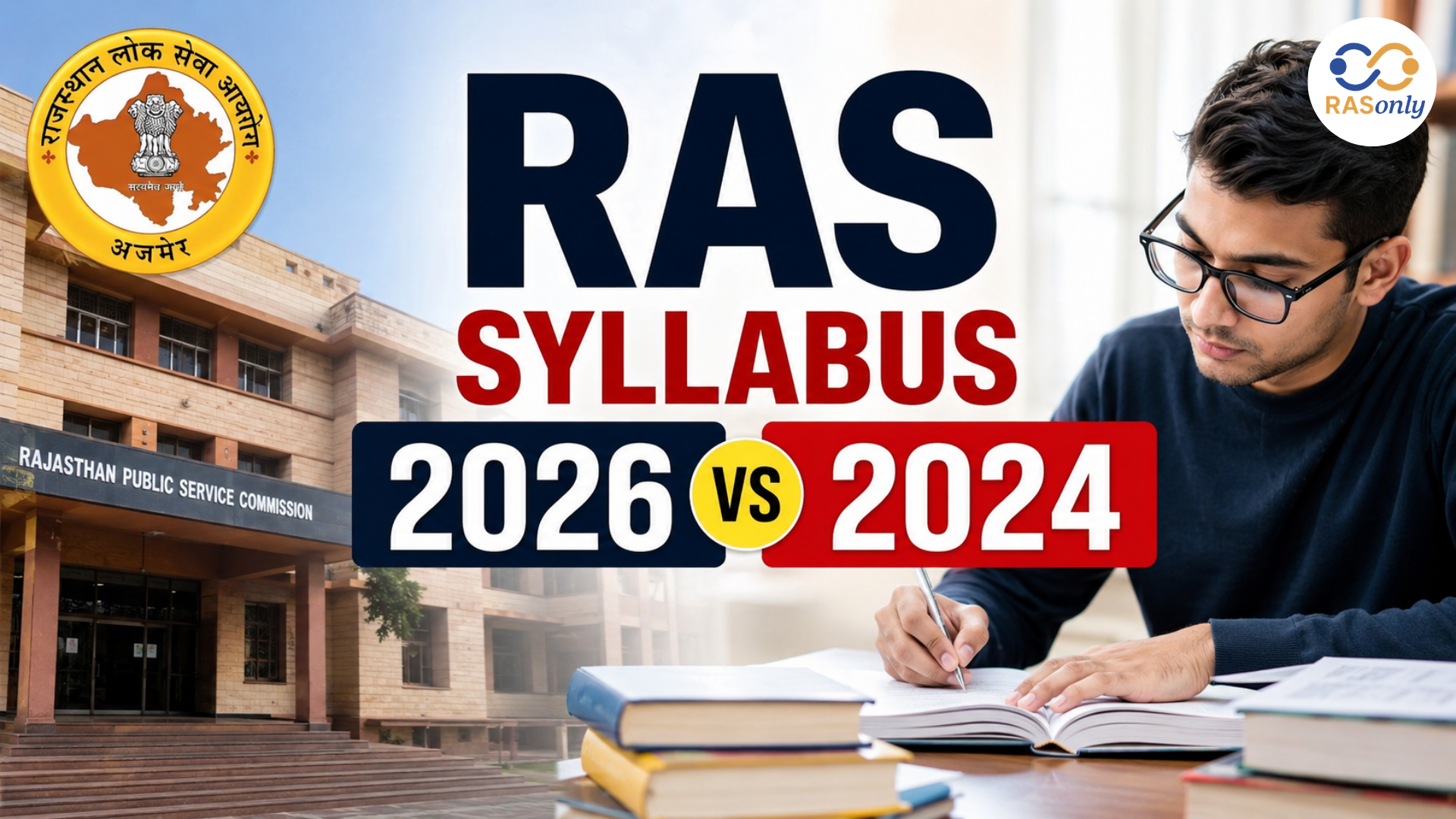
RAS Syllabus 2026 vs 2024 comparison has become one of the most searched topics among Rajasthan Administrative Service aspirants ever since RPSC released a revised syllabus on 9th January 2026. Those who had begun their preparation in the old pattern are now trying to figure out exactly what has changed, what has remained the same, and how they should adjust their study plan without giving up the work that they have done during the last twelve months.
This blog beautifully explains to you the pattern of the Exam, the topics of Prelims, the Papers of Mains, and the overall approach taken by RPSC for the Rajasthan Administrative Service Syllabus in both cycles. It was written for two types of readers: the first are new and want to know exactly what they need to start; the second are old, who are prepared for the old version but just need to know what to update. From the start to the end of your preparation, this book will help you track your preparation with the right method and follow the RAS New Syllabus 2026 without wasting time re-studying all the topics you have already studied.
Understanding the RPSC RAS Exam Structure
It is important to appreciate that the overall structure of the examinations has remained broadly similar across the cycles before making detailed comparisons with the two syllabi. RPSC Rajasthan Administrative Service recruitment takes place in three stages, which remained unchanged from 2024 to 2026. It is much easier to make a judgement on which bits of the syllabus revision actually impact your study plan, and which bits are just a change of presentation.
| Stage | Nature | Marks | Duration |
|---|---|---|---|
| Prelims | Objective, qualifying only | 200 | 3 hours |
| Mains | Descriptive, 4 papers | 800 (200 each) | 3 hours per paper |
| Interview | Personality Test | 100 | Not fixed |
- Prelims marks are not counted in the final merit list; it only shortlists candidates for Mains.
- There are no optional papers for Mains.
- Final selection is based on Mains and Interview marks.
RAS Syllabus 2024: A Quick Recap
The RAS Syllabus for the 2024 cycle was announced with the notification issued in September 2024, and in line with the RPSC exam pattern, the RAS exam has two papers – Prelims test (General Studies) and 4 Mains papers. It was used as the standard by which it is now being measured, and many of the subject areas from this cycle are still relevant for candidates completing under the new scheme.
- The prelims consisted of General Knowledge and General Science, with a focus on the state of Rajasthan in terms of history, geography and culture.
- There were General Studies questions in all three papers of Mains Papers (I-III) on History, Polity, Economy, Science and Administration.
- Paper IV assessed language skills in General Hindi and General English.
- The test was conducted in three parts – Prelims, Mains and Interview, where 1/3rd negative marking was applied in the Prelims.
RAS Syllabus 2026: What RPSC Has Introduced
RPSC officially announced the RAS Syllabus 2026 on 9th January 2026 and presented it as an updated and revamped syllabus from the previous version. As per the syllabus released alongside Prelims and Mains, the aspirants will only have to wait for one update, as they will have a clear idea of the entire selection process.
- The Prelims paper is divided into clearly labelled sections (Section A to K), covering Rajasthan history and culture, Indian history, world and Indian geography, polity and governance, economy, science & technology, reasoning, and current affairs.
- Mains consists of four compulsory descriptive papers (General Studies in Papers I-III, language skills in Paper IV).
- The weightage of current affairs has been given more explicitly, along with mentioning the recent schemes of the government and the Rajasthan Public Examination (Measures for Prevention of Unfair Means in Recruitment) Act, 2022.
- The Reasoning & Mental Ability section in Prelims has clearly defined sub-sections of logical reasoning, mental ability, and basic numeracy.
RAS Syllabus 2026 vs 2024: Side-by-Side Comparison Table
This makes it easier to see the difference between the RAS Old and New Syllabus, particularly if candidates have studied with the old syllabus and want to know exactly where their revision needs to go. The table below highlights the areas where RPSC has added more detail, and equally, the areas where the exam has stayed the same.
| Parameter | RAS Syllabus 2024 | RAS Syllabus 2026 |
|---|---|---|
| Release basis | Notification-linked syllabus, Sept 2024 | Revised syllabus notified 9 Jan 2026 |
| Prelims structure | General subject-wise listing | Sectioned format (A–K) with clearer topic grouping |
| Rajasthan-specific content | Present, integrated within GK | Expanded with dedicated sections on history, geography, and administration of Rajasthan |
| Reasoning & Numeracy | Included under General Studies | Listed as a distinct, detailed section with sub-topics |
| Current affairs | General current affairs coverage | Explicit mention of schemes, Acts, and recent developments |
| Mains papers | 4 compulsory papers (GS I–III + Language) | Same 4-paper structure retained |
| Negative marking | 1/3 mark per wrong answer | 1/3 mark per wrong answer (unchanged) |
Prelims Syllabus Comparison
The spirit of the core subjects tested in Prelims (history, geography, polity, economy and science) remains the same in both years, but the former has been rewritten to give them a greater measure of topic-level clarity in 2026. This will make it simple for the aspirants to create a list of revisions and monitor their revision for each subject separately rather than the general studies in one big chunk.
- Both years test Rajasthan History, Art & Culture as a major component.
- Indian History coverage spans ancient to modern periods in both syllabi.
- The RAS Syllabus 2026 explicitly separates World Geography and Geography of Rajasthan into distinct sections for easier preparation.
- The pattern for 2026 contains a dedicated, well-defined portion for Reasoning and Mental Ability.
Mains Syllabus Comparison
There is no need to change your approach to mains preparation, as it remains the same as it was before – 4 papers, no options. Those who have already created notes from a particular subject or taken a Mains course from the previous pattern can continue with the same, with a few adjustments.
- Paper I, II, and III continue to test General Studies at graduation level.
- At the senior secondary level, Paper IV continues to be the same as General Hindi and General English.
- Each Mains paper is descriptive, with a mix of short, medium, and long-answer questions.
- Total Mains marks remain fixed at 800 across the four papers.
Key Differences Between RAS Old and New Syllabus
In addition to the topic list, the true benefit of this comparison is to see what is actually different for a candidate's preparation for their daily practice. These are the changes that you will need to make to your weekly study plan, not merely editing the official document.
- The 2026 syllabus is more detailed and outlines the broad subjects in clearly labelled sections, instead of having a long list.
- Topics related to current affairs and governance have a more focused framing.
- Reasoning and numerical ability are not covered under General Studies, but are given as a separate focus area.
- The topics of the administrative and political system are discussed in detail for Rajasthan, which is helpful in both the prelims as well as interview preparation.
- The three main parts of the exam (marks distribution, negative marking, and the process of the exam) do not change and make past preparation redundant.
RAS Exam Pattern 2026: Marks and Structure at a Glance
If one can understand the marks distribution along with the syllabus, then it will be easy for him/her to decide how much time he/she should give to each paper in the revision time. Most serious candidates divide their effort between Prelims and the four Mains papers when there is a reasonable stability in the preparation for Prelims, and the four Mains papers are tackled with heavier weightage.
| Exam Stage | Papers | Marks per Paper | Total Marks |
|---|---|---|---|
| Prelims | 1 (Objective) | 200 | 200 |
| Mains Paper I–III | 3 (Descriptive GS) | 200 each | 600 |
| Mains Paper IV | 1 (Language) | 200 | 200 |
| Interview | — | — | 100 |
- Prelims has 150 multiple-choice questions to be attempted in 3 hours.
- Each Mains paper follows a short/medium/long answer question format.
- There is no fixed marking scheme provided for the interview stage by RPSC, but it is given 100 marks in the final merit list.
How to Prepare for RAS Syllabus 2026
The excellent news for those who have learned using the 2024 pattern is that much of what they learned remains applicable — it's more about structure and focus than content. Follow the steps below to help you not have to start preparing all over again.
- Revisit Rajasthan History, Geography, and Polity using the sectioned 2026 format to organise your notes better.
- Dedicate separate practice time to Reasoning and Basic Numeracy, since it is now a clearly defined scoring section.
- Keep track of current affairs with a special emphasis on Rajasthan government schemes, government acts of recruitment, and recent developments.
- Continue practising Mains answer-writing for Papers I–III, as the descriptive format and marking pattern have not changed.
- Compare your notes with the official RPSC-released PDF to not use outdated notes.
Also Read
| RAS Prelims Syllabus | RAS Prelims vs Mains Syllabus |
| RAS Subject List | How to Prepare for RAS Prelims |
| RAS Previous Year Papers | RAS Mains Preparation |
Conclusion
The comparison between RAS Syllabus 2026 and 2024 suggests that the RAS Syllabus has been updated with a focus on improving its clarity and structure, rather than fundamentally changing the exam itself. The three-stage selection process, the structure of the Mains paper (800 marks), and the major subject areas are unchanged, meaning that candidates who have prepared for the exams using the previous syllabus do not need to start from scratch. However, topics are now broken into more structured parts, there is a better emphasis on current affairs in the syllabus, and the exam for RPSC Assistant Sub Inspector Entrance Test 2026 has now introduced a separate reasoning section, which will require extra practice; at the same time, there are some changes in the syllabus as well, such as introducing a standalone reasoning section for the exam, which will need dedicated preparation; the smartest way is to ensure that the basic concepts of your preparation remain the same, while adopting the updated syllabus 2026 structure for your notes and revision plan; always refer to the official RPSC Assistant Sub Inspector Entrance Test 2026 notification and PDF to ensure that you're preparing for the right.
FAQs for RAS Syllabus 2026 vs 2024
The 2026 RAS syllabus provides more structured and detailed topic-wise coverage, with clearer sections for Rajasthan-specific topics, reasoning and mental ability, current affairs, governance, and other areas.
The overall three-stage selection process remains Prelims, Mains, and Interview. Mains continues to have four compulsory papers, while Prelims remains a single objective paper.
The major subjects remain similar, including History, Geography, Polity, Economy, Science and Rajasthan-specific topics. The topic grouping is clearer and more detailed, however, in the 2026 syllabus.
Yes. Reasoning and Mental Ability are clearly defined in the 2026 Prelims syllabus, including logical reasoning, mental ability, and basic numeracy.
Yes. The bulk of the content is still applicable. But candidates are advised to check their notes against the updated 2026 syllabus and also include the topics that are newly introduced and explicitly mentioned.
BEST SELLER
🏆 PRELIMS
RAS Pass
Prelims focused Hindi & English
₹399
✓
Prelims Topic-Wise Tests
✓
Subject-Wise Tests
✓
Full-Length Prelims Tests
✓
Daily Current Affairs Tests
✓
Prelims PYQs Tests
✓
Detailed Solutions & Analysis
✓
All Rajasthan Ranking
✓
Unlimited Reattempts
✓
Mains Tests
✓
Hindi & English Tests
✓
All Rajasthan Ranking
Trusted by 5,000+ Students
Post Category
- RAS Salary
- Result
- RAS Admit Card
- RAS Job
- RAS Cutoff
- Preparation Tips
- RAS Answer Key
- RAS Exam Analysis
- RAS Syllabus
- RAS Previous Year Papers
- RPSC RAS Exam Pattern
- RAS Interview
- RAS Exam Date
- RAS Vacancy
- RAS Test Series
- RAS Best Books
- RAS Preparation Resources
- RAS Coaching Centre
- History
- Polity
- Geography
- Economics
- Science
- Art and Culture
- RPSC RAS Application Form
- RPSC RAS Notification
- RAS Eligibility Criteria
- UPSC Exam
- RPSC RAS Mains
Visit Our RASonly Offline Center
Our Expert Faculty

Bhunesh Sir
Current Affairs · 13+ Yrs

Aamir Khan Sir
RAS-2017 · IIM Ahm.

Akash Sir
Polity · 8+ Yrs
Free Resources
Official Mobile App

RASOnly App
by OTSAdda · Free
Full Video Lectures
Mock Tests & PYQs
Daily Current Affairs
AI Mock Interview
Free Download · No subscription needed to install
RAS 2024 Toppers — RASonly
Rank 2
Virendra Charan
Rank 9
Bhoopinder Singh
Rank 26
Aanchal Nagpal
Rank 33
Lokendra Singh
Rank 45
Amar Rathore
Rank 46
Manasvini Verma

Join RASonly WhatsApp Community
Get daily current affairs, exam alerts, free study material and tips from expert faculty — right on WhatsApp.
Join for Free →RASonly Interview Guidance Program

Mr. Ashok Jain
Ex-Chief Secretary Govt of Rajasthan
- IAS officer of the 1981 batch, Rajasthan cadre.
- Passionate about mentoring the next generation of RAS officers with real-world insights.
- Got retired in Dec 2017 from the post of Chief Secretary of the state of Rajasthan.

Mr. Guru Charan Rai
Ex-ASP / SP in Jaisalmer
- Guru Charan Rai, IPS (Retd), retired as Inspector General of Police (Security), Rajasthan, Jaipur in 2017.
- Served as ASP and SP in Jaisalmer, Nagaur, Sri Ganganagar, Sawai Madhopur, Dausa, Sikar, and Karauli.
- He also held key positions as DIGP and IGP in the Law and Order division.

Mr. Rakesh Verma
Ex-IAS Officer, B.Tech, MBA, and M.A. (Economics)
- IAS officer of the 1981 batch and retired in Chief Secretary Rank.
- Civil servant of high repute and vast experience.
- Has been teaching UPSC CSE subjects for the last six years.
Related Post

Daily Current Affairs for RAS Exam Preparation 2026
Continuous Biomass Torrefaction Reactor
October 17, 2026
Shri Jaswant Exhibition and Cattle Fair
October 17, 2026
9th Rashtriya Poshan Maah 2026
October 16, 2026