Jainism: Founder, Symbol, Teachings, Beliefs, History & Principles
Why Do Most Students Fail in RAS? Top Reasons and Solutions for Success

Get in Touch with RASonly!

Most students fail in the RAS exam not because of a lack of intelligence or hard work but due to poor planning, inconsistent preparation, inadequate revision, and ineffective exam strategies. Understanding these common mistakes and adopting a disciplined, well-structured approach can significantly improve an aspirant's chances of clearing the RAS examination successfully.

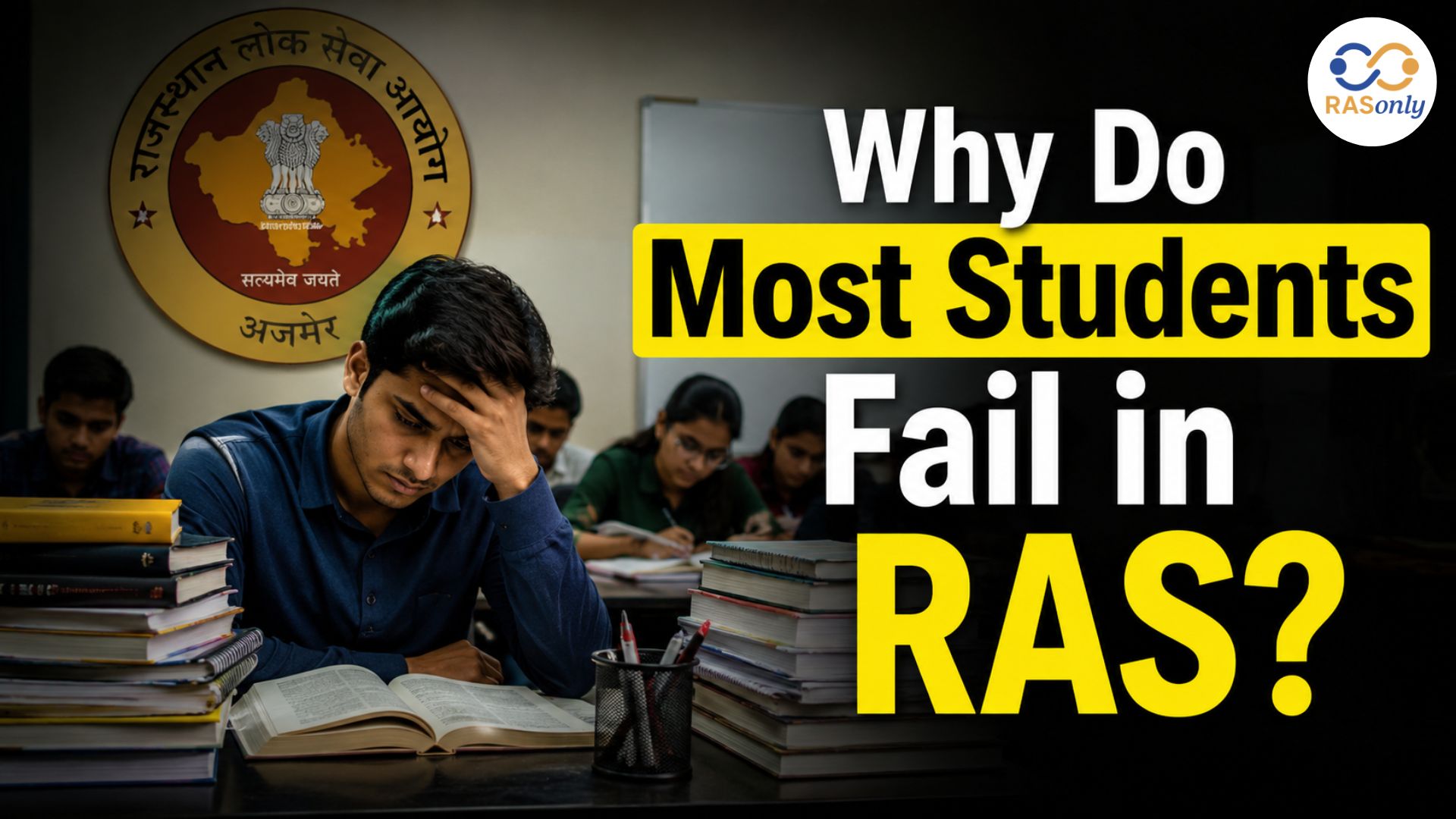
Why Do Most Students Fail in RAS? One of the most frequently asked questions by candidates appearing for the Rajasthan Administrative Service (RAS) exam by the Rajasthan Public Service Commission (RPSC). Every year, lakhs of candidates appear for the exam, but only a small percentage manage to clear all stages successfully. Despite having access to high-quality study material and guidance, many students still struggle due to common RAS preparation mistakes, poor planning, and ineffective strategies. Understanding the RAS exam failure reasons and solutions is essential for aspirants aiming to succeed.
It is not impossible to crack the RAS exam, but it requires consistency, smart preparation, and execution. Failing to manage time properly, not covering the complete syllabus, not practising answer writing and neglecting mock tests are the reasons for failure. In this article, we will explore why students fail in RAS exam, discuss the most common mistakes, and provide practical solutions along with expert RAS exam tips to help you clear the examination in your first attempt.
Understanding the RAS Examination
Before exploring the reasons behind failure, it is essential to understand the structure of the Rajasthan Administrative Service (RAS) examination conducted by the Rajasthan Public Service Commission (RPSC). The RAS selection process stages consist of three phases:
- Preliminary Examination
- Mains Examination
- Interview (Personality Test)
Consistency is the key at all three stages to be successful. Unfortunately, many aspirants focus only on one phase and ignore the overall strategy.
Why Do Students Fail in RAS Exam?
One of the most common questions among aspirants is, "Why do students fail in RAS exam?" The answer is not a lack of intelligence or hard work. The majority of failures are due to poor planning, poor preparation and avoidable errors. Understanding these reasons can help candidates develop a better strategy and improve their chances of success.
1. Lack of Understanding of the RAS Syllabus
One of the biggest RAS preparation mistakes is starting preparation without thoroughly understanding the syllabus. So many candidates spend months studying topics that are less important or completely irrelevant to the exam.
Common Mistakes
- Ignoring Rajasthan-specific topics.
- Studying too many books.
- Not following the latest RPSC notifications.
- Missing current affairs.
Solution
Download the latest syllabus and divide it subject-wise. Set monthly targets and revise regularly to ensure complete syllabus coverage.
2. Poor Study Planning
Preparation is unguided without a proper RAS study plan. Even though students learn for many hours, they don't keep up the study and cannot be productive.
Signs of Poor Planning
- No timetable.
- Frequent changes in study material.
- Lack of revision.
- No daily goals.
Solution
Make a realistic timetable comprising static topics, current affairs, MCQ practice and weekly revision. Proper time management in RAS exam preparation is crucial for success.
3. Ignoring Previous Year Papers
Aspirants will learn the exam pattern, important topics, and difficulty level from the previous year papers. But a lot of candidates ignore them and just concentrate on theory.
Why PYQs Matter
- Reveal question trends.
- Highlight repeated topics.
- Improve confidence.
- Increase accuracy.
Solution
Solve at least the previous 10 years' papers to strengthen your preparation and understand the examiner's expectations.
4. Lack of Mock Test Practice
Reading books alone is not enough to crack RAS. Many aspirants avoid mock tests because they fear getting low scores, which ultimately affects their performance in the real exam.
Benefits of Mock Tests
- Improve speed.
- Increase accuracy.
- Reduce silly mistakes.
- Enhance time management.
Solution
Regular practice with mock tests can significantly improve performance and increase the chances of qualifying for the exam.
5. Poor Current Affairs Preparation
Current affairs play an important role in both Prelims and Mains. Unfortunately, many students either don't pay attention to them or rely on monthly PDFs.
Common Mistakes
- No note-making.
- Ignoring Rajasthan current affairs.
- Following too many sources.
Solution
Read one newspaper each day, make notes and concentrate on government schemes and state developments. It's better to be consistent, rather than quantity.
6. Lack of Answer Writing Practice
One of the major reasons students fail in the Mains examination is poor answer writing. The RAS mains descriptive paper requires analytical and structured responses, which cannot be developed overnight.
Common Mistakes
- Lengthy introductions.
- Poor presentation.
- Lack of headings and diagrams.
- Incomplete answers.
Solution
Get an early head start on answering. Writing one answer daily and taking regular tests can significantly improve your performance in Mains.
7. Excessive Dependence on Coaching Institutes
Aspirants think that getting into a coaching institute automatically means they will succeed. Coaching is a tool for guidance, but it can't take the place of self-study and consistent effort.
Success Depends On
- Self-study.
- Revision.
- Practice.
- Discipline.
Solution
Coaching should be helpful, not a substitute for hard work.
8. Ignoring Rajasthan-Specific Subjects
Rajasthan GK, History, Geography, and Culture are important aspects of the RAS examination. But many candidates pay undue attention to national issues while ignoring state issues.
Important Areas
- Rajasthan GK.
- Rajasthan History.
- Geography of Rajasthan.
- Art and Culture.
Solution
Dedicate separate study hours to Rajasthan-specific topics, as they carry substantial weight in the examination.
9. Wrong Strategy for Negative Marking
Many candidates lose marks because of excessive guessing and panic during the exam. Understanding the negative marking strategy in RAS Prelims is essential.
Common Mistakes
- Attempting every question.
- Blind guessing.
- Lack of confidence.
Solution
Focus on accuracy rather than the number of attempts. Attempt only those questions in which you have reasonable confidence.
10. Lack of Revision
Revision is the key to retaining information. Some candidates keep learning new subjects and don't go back to revise the old ones.
Effective Revision Strategy
- Weekly revision.
- Monthly revision.
- Short notes.
- Mind maps.
Solution
Use a revision timetable. Concepts are reinforced and recall during assessment is enhanced through frequent revision.
11. Comparing Yourself With Others
Students are always comparing themselves with others as a result of peer pressure and social media. This will cause unneeded stress and impact confidence.
Common Comparisons
- Study hours.
- Number of books.
- Mock test scores.
Solution
Follow your own RPSC RAS strategy and focus on self-improvement rather than competing with others' routines.
12. Lack of Consistency
One of the main reasons that people win or lose for jobs is because they do not practice consistency. Many aspirants prepare seriously for a few months but gradually lose momentum.
Why Consistency Matters
- Builds strong concepts.
- Improves retention.
- Creates discipline.
- Reduces stress before the exam.
Solution
Practice regularly, don't just do it when you feel like it! Even 6–7 productive hours daily for a year can produce excellent results and help you clear the RAS examination.
Difference Between RAS Topper and Average Student Preparation
A lot of aspirants wonder what makes the toppers different from the average aspirants. The reality is that the gap between the preparations of a topper and an average student is not the hours spent on preparation but quality of preparation and consistency during the preparation process.
Key Differences Between Toppers and Average Aspirants
- Discipline.
- Revision.
- Test practice.
- Answer writing.
- Time management.
Ultimately, top performers do not necessarily study longer than others—they study smarter. They are successful not just because of motivation or hard work but because of discipline, strategic planning and constant improvement.
Also Read
| RAS Syllabus | RAS Exam Pattern |
| How to Prepare for RAS | Best Books for RAS Preparation |
| How to Write Answers in RAS Mains | RAS Previous Year Papers |
Conclusion
Most people that fail the RAS exam do not necessarily lack the skill, but rather make avoidable errors. By following a well-designed RPSC RAS strategy, regular revision, and consistent effort, aspirants can overcome these common challenges and increase their chances of success. Smart preparation, discipline, and continuous improvement are the keys to clearing the RAS exam and achieving a career in Rajasthan administration.
FAQs
Most students fail in the RAS exam due to poor planning, lack of consistency, inadequate revision, ignoring answer writing practice, and not attempting enough mock tests. These are frequently made errors that have a definite impact on overall performance.
Yes, the RAS exam is highly competitive because lakhs of candidates appear every year. But, proper study plan, regular revision and smart preparation can help to pass the exam.
There is no fixed number of study hours. Generally, a consistent and productive period of study of 6-8 hours per day, together with revision and test practice is all that is necessary to prepare effectively.
No, coaching institutes are not mandatory. They can provide guidance, but success ultimately depends on self-study, revision, practice, and discipline.
Answer writing practice is extremely important for the RAS Mains descriptive paper. It improves presentation, analytical thinking, and time management, which are crucial for scoring high marks.

BEST SELLER
🏆 PRELIMS
RAS Pass
Prelims focused Hindi & English
₹399
✓
Prelims Topic-Wise Tests
✓
Subject-Wise Tests
✓
Full-Length Prelims Tests
✓
Daily Current Affairs Tests
✓
Prelims PYQs Tests
✓
Detailed Solutions & Analysis
✓
All Rajasthan Ranking
✓
Unlimited Reattempts
✓
Mains Tests
✓
Hindi & English Tests
✓
All Rajasthan Ranking
Trusted by 5,000+ Students
Post Category
- RAS Salary
- Result
- RAS Admit Card
- RAS Job
- RAS Cutoff
- Preparation Tips
- RAS Answer Key
- RAS Exam Analysis
- RAS Syllabus
- RAS Previous Year Papers
- RPSC RAS Exam Pattern
- RAS Interview
- RAS Exam Date
- RAS Vacancy
- RAS Test Series
- RAS Best Books
- RAS Preparation Resources
- RAS Coaching Centre
- History
- Polity
- Geography
- Economics
- Science
- Art and Culture
- RPSC RAS Application Form
- RPSC RAS Notification
- RAS Eligibility Criteria
- UPSC Exam
- RPSC RAS Mains
Visit Our RASonly Offline Center
Our Expert Faculty

Bhunesh Sir
Current Affairs · 13+ Yrs

Aamir Khan Sir
RAS-2017 · IIM Ahm.

Akash Sir
Polity · 8+ Yrs
Free Resources
Official Mobile App

RASOnly App
by OTSAdda · Free
Full Video Lectures
Mock Tests & PYQs
Daily Current Affairs
AI Mock Interview
Free Download · No subscription needed to install
RAS 2024 Toppers — RASonly
Rank 2
Virendra Charan
Rank 9
Bhoopinder Singh
Rank 26
Aanchal Nagpal
Rank 33
Lokendra Singh
Rank 45
Amar Rathore
Rank 46
Manasvini Verma

Join RASonly WhatsApp Community
Get daily current affairs, exam alerts, free study material and tips from expert faculty — right on WhatsApp.
Join for Free →RASonly Interview Guidance Program

Mr. Ashok Jain
Ex-Chief Secretary Govt of Rajasthan
- IAS officer of the 1981 batch, Rajasthan cadre.
- Passionate about mentoring the next generation of RAS officers with real-world insights.
- Got retired in Dec 2017 from the post of Chief Secretary of the state of Rajasthan.

Mr. Guru Charan Rai
Ex-ASP / SP in Jaisalmer
- Guru Charan Rai, IPS (Retd), retired as Inspector General of Police (Security), Rajasthan, Jaipur in 2017.
- Served as ASP and SP in Jaisalmer, Nagaur, Sri Ganganagar, Sawai Madhopur, Dausa, Sikar, and Karauli.
- He also held key positions as DIGP and IGP in the Law and Order division.

Mr. Rakesh Verma
Ex-IAS Officer, B.Tech, MBA, and M.A. (Economics)
- IAS officer of the 1981 batch and retired in Chief Secretary Rank.
- Civil servant of high repute and vast experience.
- Has been teaching UPSC CSE subjects for the last six years.



Daily Current Affairs for RAS Exam Preparation 2026

25th SCO Foreign Trade Ministers' Meeting
September 19, 2026
India’s flag bearer at the opening ceremony of the...
September 19, 2026
PM-YASASVI Scheme Update 2026
September 18, 2026