Chola Dynasty: Capital, Founder, Kings, Time Period and History
National Commission for Women (NCW), Functions, Powers, Role

Get in Touch with RASonly!

The National Commission for Women (NCW), established on 31 January 1992 under the NCW Act, 1990, is a statutory body safeguarding women's rights in India. It reviews legal safeguards, investigates complaints, recommends policy reforms, and promotes awareness on gender equality, playing a vital role in protecting women's dignity and constitutional rights nationwide.

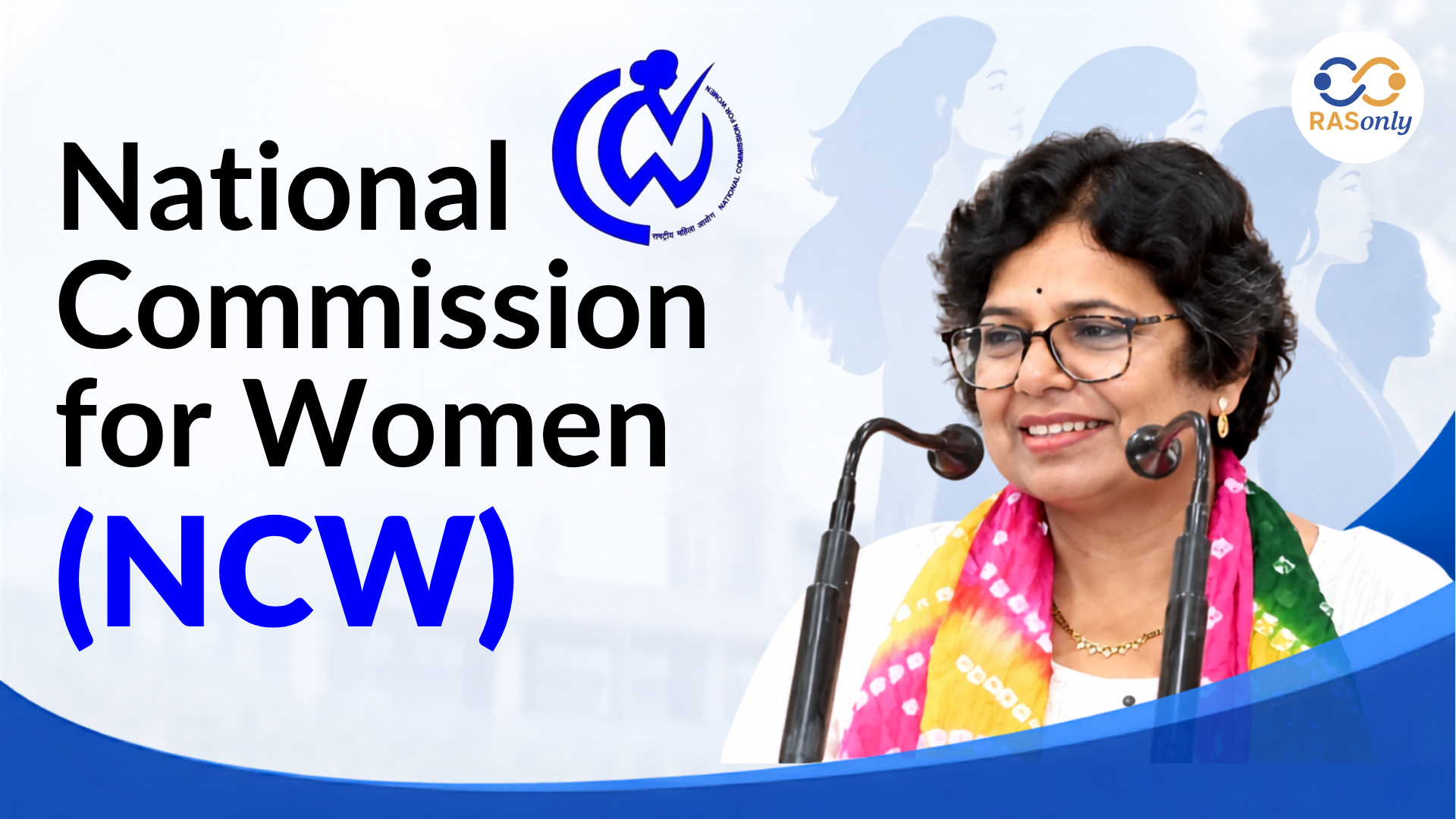
The NCW (National Commission for Women) is an Indian statutory body of the Government of India to review the constitutional and legal safeguards for women in our country. It came into existence on 31 January 1992 under the National Commission for Women Act,1990. It examines issues affecting women, reviews legal protection measures, takes up complaints regarding violations of rights and recommends policy and legislative measures to the government. It also aims to help raise awareness of women's rights and gender-based discrimination. The role of the Commission is crucial in monitoring the implementation of laws and policies, with a basis for ensuring equality, dignity and protection for women in India.
History: National Commission for Women
- The National Commission for Women (NCW) was established to serve as an institutional mechanism that would protect and promote the rights of women in India.
- Establishment of a national forum exclusively for women appeared promising due to recommendations made by several committees and growing recognition that constitutional equality must receive institutional backing.
- The Committee on the Status of Women in India (CSWI), set up in 1971, reviewed the social, economic and legal position of women and identified gaps between constitutional promises and their fulfilment.
- The CSWI’s report “Towards Equality” (1974) was a landmark document in women-centric policies in India and bolstered the demand for institutional mechanisms directed exclusively to issues concerning women.
- In the years after, calls for a permanent body vested with powers to look into matters of gender discrimination, legal protections, domestic violence and effective implementation of laws continued to grow.
- The National Commission for Women Act, 1990 was passed by Parliament, giving legal status to the Commission.
- A landmark development in the women's rights institutional framework was the formal constitution of the National Commission for Women on 31st January 1992.
- The NCW is a statutory body (as opposed to constitutional), which means that the powers and responsibilities of an entity are defined in the Act passed by Parliament.
- Over the years, its evolution bears testimony to a larger change in India from acknowledging the need for equal rights for women in law to actually observing, advocating and assessing changes through policy-making and legislation.
- Since then, the NCW has developed into an important Indian national platform for reviewing matters related to women and enhancing awareness, as well as protection mechanisms.
Composition of the National Commission for Women
The Commission consists of a Chairperson, five Members, and a Member-Secretary, forming the core structure of the NCW.
| Component | Number | Key Details |
|---|---|---|
| Chairperson | 1 | Appointed by the Central Government from among persons committed to the cause of women. |
| Members | 5 | Nominated by the Central Government from diverse fields including law, legislation, trade unionism, industry, administration, economic development, health, education and social welfare. |
| SC Representation | At least 1 Member | At least one nominated Member must belong to the Scheduled Castes. |
| ST Representation | At least 1 Member | At least one nominated Member must belong to the Scheduled Tribes. |
| Member-Secretary | 1 | Appointed by the Central Government; should have relevant expertise in management/organisational matters or specified civil-service experience. |
| Total Core Composition | 7 | 1 Chairperson + 5 Members + 1 Member-Secretary. |
| Legal Basis | — | The composition is provided under the National Commission for Women Act, 1990. |
Responsibilities of the National Commission for Women
- Safeguarding the rights of women: The NCW issues related to women and helps their legal/constitutional rights.
- Examines existing legal safeguards for women and amendments where current legal protection is deficient.
- To entertain complaints: It deals with complaints related to women's rights, discrimination, harassment and violation of legal safeguards.
- Inquiry into Violation: The NCW may inquire into any specific complaint regarding women’s rights and call for information or records.
- Study women's issues: It does or promotes research on relevant issues such as violence against women, discrimination, employment, education and social development.
- To recommend policy measures: The Commission is to advise the Central Government on programmes for women, units of the Department of Women and Child Development.
- Inspect custodial institutions: It may inspect jails, remand homes, women's institutions and other places of custody where women are lodged.
- Raising awareness: To promote awareness relating to the legal rights of women, gender equality and available.
- Intervene in court proceedings: The Commission can also appear before courts of law, wherever any proceeding is pending, involving the interest of women (as per concerned legal provisions).
- Reporting: It makes its reports and recommendations to the Central Government, specifying administrative or legislative action required.
Chairpersons of the National Commission for Women (1992–2026)
| No. | Chairperson | Tenure | Significance |
|---|---|---|---|
| 1 | Jayanti Patnaik | 3 Feb 1992 – 30 Jan 1995 | First Chairperson of the NCW; led the Commission during its formative years. |
| 2 | Dr. V. Mohini Giri | 21 Jul 1995 – 20 Jul 1998 | Strengthened institutional attention to women's rights and social welfare concerns. |
| 3 | Vibha Parthasarathi | 18 Jan 1999 – 17 Jan 2002 | Focused on women's empowerment and policy-level issues affecting women. |
| 4 | Dr. Poornima Advani | 25 Jan 2002 – 24 Jan 2005 | Continued the Commission's work on legal safeguards and women-related grievances. |
| 5 | Dr. Girija Vyas | 16 Feb 2005 – 15 Feb 2008; 9 Apr 2008 – 8 Apr 2011 | Served two terms and remained associated with major women-centric policy and rights issues. |
| 6 | Mamta Sharma | 2 Aug 2011 – 1 Aug 2014 | Led the NCW during a period of increased national focus on women's safety and violence. |
| 7 | Lalitha Kumaramangalam | 29 Sep 2014 – 28 Sep 2017 | Focused on women's safety, legal rights, social issues and institutional reforms. |
| 8 | Rekha Sharma | 29 Sep 2017 – 6 Aug 2018 (Acting); 7 Aug 2018 – 6 Aug 2024 | Served as Acting Chairperson initially and subsequently headed the Commission for a full term. |
| 9 | Vijaya K. Rahatkar | 22 Oct 2024 – Present | Current Chairperson; leads the NCW in its ongoing work on women's rights, complaints and policy advocacy. |
Powers of the National Commission for Women
- Civil court powers: The Commission has civil court powers only in limited matters while investigating cases under the NCW Act.
- Summon any Person: NCW may at any time either suo motu or on a complaint made to it, summon any person from anywhere in India to appear before the Commission for examination.
- Oath Examination: It examines witnesses and has a duty to record their statements on oath during inquiry.
- Demand Documents: The Commission can request the production of documents and records relevant to an investigation.
- Receive Evidence: NCW receives evidence in the form of affidavits and may request public records or copies of official documents.
- Issue Commissions: It may issue commissions for the examination of witnesses or documents if required during proceedings.
- Investigate Complaints: If there are complaints of deprivation of women’s rights, discrimination and non-implementation of safeguards, the Commission can investigate them.
- Observation of Institutions: NCW can inspect jails, remand homes and other institutions in which women are imprisoned at the same time, and make recommendations to authorities.
- Intervene in Court Proceedings: Also order that, if the Commission so desire, it may intervene in any proceedings before such a Court, which are not only involved but might learn something by learning more about how many women have been affected.
- Recommendation of Corrective Action: NCW, after the query, can suggest appropriate action to the govt. or concerned authority. However, its recommendations are not judicial orders.
- Report to Government: The Commission may present reports to the Central Government wherein it points out contravention or inadequacy in measures to protect the right of women.
Major Initiatives and Achievements of the National Commission for Women
- NCW Visits Across States and UTs (Gender Profiles): The NCW visited States and Union Territories to prepare gender profiles that were used to know the position of women in various areas of participation, opportunity, and empowerment on the ground.
- Grievance Redressal: Number of complaints of atrocities against women have been registered, and the Commission has taken cognisance suo motu of heinous offences
- Action Against Child Marriage: Supported NCW in its sustained advocacy against Child Marriage, including legal awareness to empower women and communities about their rights and available remedies.
- Legal Awareness Programmes: The Commission has organised awareness initiatives in order to disseminate knowledge about legal provisions related to women and encourage women to access institutional and legal aid.
- Parivarik Mahila Lok Adalats: NCW has promoted Parivarik Mahila Lok Adalat as an alternative dispute-resolution mechanism for amicable settlement of family-related disputes in a better manner.
- Women-centric Laws: The Commission has significant women-related legislation such as laws on dowry, pre-natal sex selection, marriage and criminal exemptions, and has suggested corrective measures.
- Legislative Recommendations: NCW has made suggestions for modifying laws such as the Hindu Marriage Act, 1955 and the Medical Termination of Pregnancy Act, 1971 in ways that will ensure greater protection for women as well as related provisions under the Indian Penal Code.
- Economic Empowerment: The Commission has organised workshops, seminars and expert-level consultations to enhance women’s access to income-generating participatory development opportunities.
- Gender Awareness: NCW has focused on promoting gender equality, women's dignity and awareness of legal rights through seminars and initiatives.
- Campaigns against Violence: The Commission has also supported awareness drives against violence against women and female foeticide, wherein the need for social action along with legal intervention.
- Dedicated J&K and Ladakh Cell: Keeping in mind the regional challenges in both these Union Territories, NCW set up one cell to examine cases of women-related grievances/developmental issues.
- Broader Impact: These initiatives of NCW underscore the mandate and need for NCW to go beyond addressing only complaints to include legal reform, policy advocacy, awareness, research, dispute resolution &empowerment of women.
Also Read
| Fundamental Rights | Legislature and Judiciary in India |
| Union Executive | Preamble of the Indian Constitution |
| Citizenship in India | Local Self-Government in India |
FAQs on National Commission for Women
The National Commission for Women (NCW) was formally constituted on 31 January 1992 under the National Commission for Women Act, 1990.
No. NCW is a statutory body. It derives its legal authority from the National Commission for Women Act, 1990.
The primary objective of NCW is to protect and promote the rights of women and examine issues affecting their legal, social and economic status.
The Central Government appoints the Chairperson of the National Commission for Women.
The Commission consists of one Chairperson, five Members and one Member-Secretary. The Central Government makes these appointments or nominations as provided under the NCW Act.
BEST SELLER
🏆 PRELIMS
RAS Pass
Prelims focused Hindi & English
₹399
✓
Prelims Topic-Wise Tests
✓
Subject-Wise Tests
✓
Full-Length Prelims Tests
✓
Daily Current Affairs Tests
✓
Prelims PYQs Tests
✓
Detailed Solutions & Analysis
✓
All Rajasthan Ranking
✓
Unlimited Reattempts
✓
Mains Tests
✓
Hindi & English Tests
✓
All Rajasthan Ranking
Trusted by 5,000+ Students
Post Category
- RAS Salary
- Result
- RAS Admit Card
- RAS Job
- RAS Cutoff
- Preparation Tips
- RAS Answer Key
- RAS Exam Analysis
- RAS Syllabus
- RAS Previous Year Papers
- RPSC RAS Exam Pattern
- RAS Interview
- RAS Exam Date
- RAS Vacancy
- RAS Test Series
- RAS Best Books
- RAS Preparation Resources
- RAS Coaching Centre
- History
- Polity
- Geography
- Economics
- Science
- Art and Culture
- RPSC RAS Application Form
- RPSC RAS Notification
- RAS Eligibility Criteria
- UPSC Exam
- RPSC RAS Mains
Visit Our RASonly Offline Center
Our Expert Faculty

Bhunesh Sir
Current Affairs · 13+ Yrs

Aamir Khan Sir
RAS-2017 · IIM Ahm.

Akash Sir
Polity · 8+ Yrs
Free Resources
Official Mobile App

RASOnly App
by OTSAdda · Free
Full Video Lectures
Mock Tests & PYQs
Daily Current Affairs
AI Mock Interview
Free Download · No subscription needed to install
RAS 2024 Toppers — RASonly
Rank 2
Virendra Charan
Rank 9
Bhoopinder Singh
Rank 26
Aanchal Nagpal
Rank 33
Lokendra Singh
Rank 45
Amar Rathore
Rank 46
Manasvini Verma

Join RASonly WhatsApp Community
Get daily current affairs, exam alerts, free study material and tips from expert faculty — right on WhatsApp.
Join for Free →RASonly Interview Guidance Program

Mr. Ashok Jain
Ex-Chief Secretary Govt of Rajasthan
- IAS officer of the 1981 batch, Rajasthan cadre.
- Passionate about mentoring the next generation of RAS officers with real-world insights.
- Got retired in Dec 2017 from the post of Chief Secretary of the state of Rajasthan.

Mr. Guru Charan Rai
Ex-ASP / SP in Jaisalmer
- Guru Charan Rai, IPS (Retd), retired as Inspector General of Police (Security), Rajasthan, Jaipur in 2017.
- Served as ASP and SP in Jaisalmer, Nagaur, Sri Ganganagar, Sawai Madhopur, Dausa, Sikar, and Karauli.
- He also held key positions as DIGP and IGP in the Law and Order division.

Mr. Rakesh Verma
Ex-IAS Officer, B.Tech, MBA, and M.A. (Economics)
- IAS officer of the 1981 batch and retired in Chief Secretary Rank.
- Civil servant of high repute and vast experience.
- Has been teaching UPSC CSE subjects for the last six years.
Related Post



Daily Current Affairs for RAS Exam Preparation 2026
Inauguration of 100 New Kalika Patrolling Units in Rajasthan
October 21, 2026
Jaipur International Film Festival 2027
October 21, 2026
Rajasthan’s First Sitaphal Processing Unit in Chittorgarh
October 19, 2026